2019 BMW 3 Series Reviews, Pricing & Specs



The CarGurus verdict
The ultimate computer meets BMW’s best-selling compact car.
Since 1975, the BMW 3 Series has defined what a small, sporty sedan should be. In its seventh generation, the 3 is very much in the zone it created. It’s trim and athletic, handsome yet stoic, and above all, unashamed to raise its premium name on a pedestal. Unfortunately for BMW, lots of other car companies have copied its sport sedan recipe—sometimes for the better, and often for less money. But for 2019, BMW ups its software game like none other. And it helps that the new car surrounding that software is still pretty good.
out of 10 expert review
Look & feel
Like Audi’s, BMW’s designs are evolutionary. Compared to what Mercedes-Benz, Lexus, and Acura are doing, there have been no major transformations, no love-it-or-hate-it design decisions. We’ll see BMW branch out when it releases its i-Series sub-brand of electric cars, but those will be fringe products, likely to appeal to only a relatively small section of BMW buyers. Mainstream vehicles like the 3 Series will continue carrying the BMW torch—and years on, the 2019 3 Series will have aged well, just like older ones from 10 and 20 years ago continue doing.
While the new car is a few inches longer and a tad wider, it stands on a small footprint. This is, after all, a compact car that’s easier to park and maneuver than a 5 Series. In profile, the biggest change is how BMW sliced off the rear doors’ Hoffmeister kink. That signature curve to the rear-quarter glass is now a piece of black trim on the body. When closed, it looks the same as before. It’s only when you’re up close and about to step inside that you see the hard cut line squaring off the kink. Otherwise, this is sport sedan design 101. The low hood rising to an equally low shoulder line, short overhangs, big wheels, just the right number of creases, a ground-hugging stance, and a little taper to the trunk lid—it just feels right.
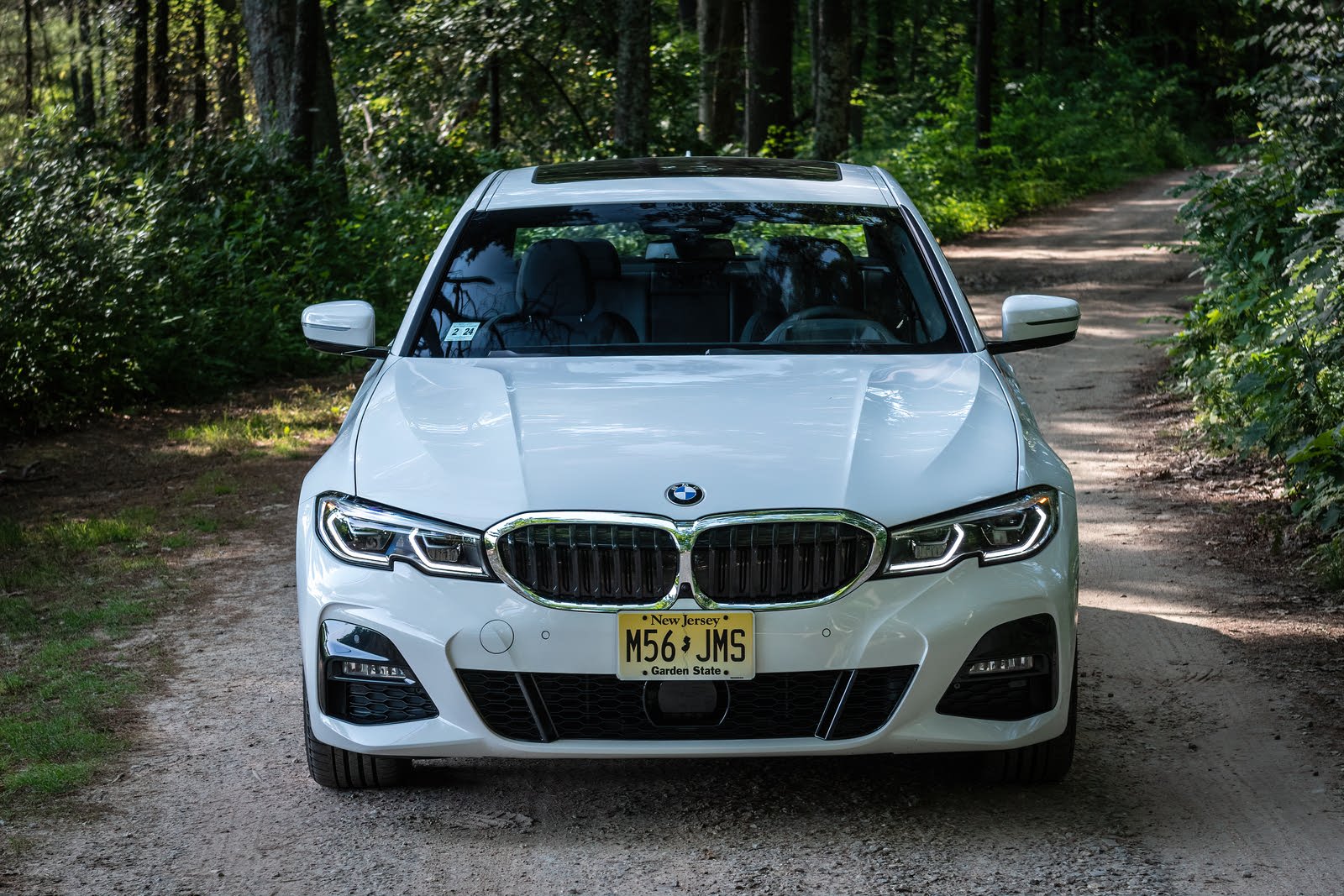
The front is instantly recognizable as a BMW. While the four round headlights haven’t been seen in years, their essence—now hard-edged half-circles—can be seen in the four LED running lamps. A small trailing edge of the bumper provides a subtle but visually strong method of separating the headlights. The kidney grilles aren’t like any kidneys I’ve seen, but the trademark design piece is still there. They've widened and stretched up onto the hood, which no longer features an awkward cut line above them. The tail showcases the most dramatic change, with LED lights that have been simplified and squashed down. There’s a lot of depth to them, just as there is with the dramatic shapes and colors inside my car’s optional laser headlights, though at times it looked to me like the new Kia Forte. I think the new Genesis G70 has a sexier rear end than the 3 Series. But all the same, it’s good and clean—that’s all anyone can ask for, right?
Inside, the 3 Series keeps the same dash structure as before: screen on top, radio and climate in the middle, cupholders down below, iDrive controller in the console. The whole setup is angled toward the driver, only now, the central cupholder is an optional wireless charging pad hidden by a large cover. The physical handbrake lever is now electric. The instrument panel is entirely digital, regardless of whether you choose Live Cockpit Pro, which includes squared-off gauges with a counter-clockwise tach. The only thing lacking in this interior is the leather, the door toppers, and dash—they’re all coarse. Compared to the previous 3 Series, those door toppers are harder and feel like sandpaper. I also don’t love whatever textured metal was on my test car, and the M Sport steering wheel is a hair too thick for my taste. The woods are very pretty and enhance the 3’s style. Otherwise, fit and finish are top class—something you won’t find in a Model 3.

Performance
My 330i xDrive is what you’ll find all over the country, with only a smattering of rear-wheel-drive (RWD) models living in warmer climes like California, Texas, and the sunbelt. BMW is an engine company, and its proficiency shows time and time again. The 2.0-liter turbocharged inline-4 that was in the previous 3 Series was already a measure of perfection: smooth, full of torque, and sweet-sounding. Now it’s been massaged to deliver more power and less noise. There’s more turbo hiss than before—and more turbo lag at low speeds—but how do 255 horsepower and 295 pound-feet of torque sound? Very good, thank you. Lots of competitors offer turbocharged 4-cylinders with similar ratings. But among luxury cars, none are as good as this BMW engine. The only thing spoiling it is the fake intake sound while driving in Sport mode. The new 3 is much quieter than before, so the industry trend is to make the car louder without stripping the insulation that makes it such a relaxing cruiser. I don’t think that makes sense at all, but some focus group convinced a group of German executives who convinced BMW's CEO that it was important.
The M340i (which is on sale now as a 2020 model) trades the four for a twin-turbo 6-cylinder of near-M3 performance: 382 hp and 369 lb-ft. Hoo boy. CarGurus hasn’t yet tested that engine, but we’re happy to report the standard 330i will leave you wanting for nothing. For those willing to upgrade, the M340i is no doubt a worthy machine, as will be the upcoming M3, which will add all-wheel drive and as much as 500 hp. The less-powerful 320i and the diesel 328d trims are gone in the U.S., as are the wagon and the no-cost option for a 6-speed manual transmission. If you’re a commuter (like most 3 Series buyers), you’ll love the 8-speed automatic’s perfect shifts and intuitive programming in every driving mode.
My test car featured the M Sport package, which bundles a lower and firmer suspension, staggered summer tires, variable-ratio steering, and a widened body kit. More goodies, like larger brakes, adaptive dampers, and a limited-slip differential, come in the Track Handling Package ($2,450). Even without them, my 330i hit the backroads of New Hampshire like it was born there. Yes, the 19-inch run-flats were stiff. BMW offers tires that will go flat as a no-cost option. But the chassis is always willing, the regular brakes are astounding, and you generally feel like a master in full control. The steering is notably improved, though purists will whine that it’s not as tingly or direct as older cars. That’s correct. But it’s gone in the right direction, and I didn’t find it offensive, as I had when BMW first came out with electric power steering.
Fuel economy is EPA-rated at 25 mpg city, 34 highway, and 28 combined for the 330i xDrive (I averaged 26 mpg over 700 miles). The RWD version is rated at 26/36/30, while the M340i (RWD or AWD) gets just 22/30/25. These don’t move the needle versus the previous-gen 3. A plug-in hybrid 330e will be sold, though estimates are not yet available.

Form & function
Backseat legroom is a little roomier than before, though the 3 hasn’t felt tight for some time. Overall, it’s a pleasant space for four, and with 17 cubic feet in the trunk, you can fit a good chunk of luggage, too. Visibility is good in all directions. The seats are on the firm side, but they’re supportive over long trips. All controls fall right to hand, and BMW’s previously confusing turn-signal and wiper stalks now have detents like normal cars.
The infotainment, head-up display (HUD), and instrument clusters are easy to operate when you're on the move, and they are very intuitive. The main screen is now a touchscreen, which supports all the usual swiping gestures plus more (such as tapping icons in the top corners to bring up menus, or swiping left to go back a menu). Shortcut buttons and a rotary controller reside on the console as before. The new climate controls, along with a third zone for the rear passengers, are a cinch. USB-C ports are on board, too.

Safety

Cost-effectiveness
Here’s where my review goes sour. At $58,220, my test car was heavily—but not fully—loaded. That’s a big ask when a Genesis G70 Sport with every option retails under $53,000—and with a V6 that would spank the 330i’s four. Spending $60K on a 3 Series is simply not the way to go. But spend, you will. While an auto-dimming rear-view mirror is now standard, the lumbar support that you’d find on an old Buick is optional. BMW lists refrigerant and a garage-door opener as standard. Gee, thanks. Even among luxury cars, the 3 Series isn’t a good value when brand new.
Spec a 330i xDrive at $50,620 to grab the Premium Package (heated front seats, heated steering wheel, HUD, connected apps, nav, Live Cockpit Pro, Apple CarPlay) and stick with the standard Sport trim instead of the M Sport. Delete the driver-assistance package and the leather, which feels nearly the same as BMW’s base SensaTec leatherette. Sure, you’ll trade some handling and nifty self-steering features, but you’ll get the rest of my car’s amazing tech for thousands less. Order the Harman Kardon stereo (superb and only $875), wireless charging ($500), and ambient lighting ($250). You’ll get three years or 36,000 miles worth of maintenance included, along with four years and unlimited miles of roadside assistance. This is a great car. How much you choose to spend making it fantastic depends on your annual salary.

What owners say
I got great value on my car. The ride is super smooth and noticeably quiet on the highway, making for a very comfortable driving experience.
February 25, 2025Great car! New body style, new features! I love it!
December 30, 2021Trims & specs
Base MSRP $45,000 | Seating 5 |
Engine 2.0L 248 hp I4 | Cargo Capacity 27.5 cu ft |
Combined MPG 28 | Drivetrain AWD |
Base MSRP $40,250 | Seating 5 |
Engine 2.0L 255 hp I4 | Cargo Capacity 13.0 cu ft |
Combined MPG 31 | Drivetrain RWD |
Base MSRP $42,250 | Seating 5 |
Engine 2.0L 255 hp I4 | Cargo Capacity 13.0 cu ft |
Combined MPG 29 | Drivetrain AWD |


Pricing trends
MSRP range
$40,250 - $45,000
Current avg. market price
$20,029
Trending down by 0.8% this month
May 2026 - November 2026


