2021 Chevrolet Blazer Reviews, Pricing & Specs






Pros & cons
What we like
Stylish design
Great handling
Easy-to-use technology
What to consider
Interior materials feel cheap
Irritating transmission
Poor value for money
The CarGurus verdict
The Camaro SUV puts exterior design and performance above all else.
In its third model year, the Chevrolet Blazer is a rarer sight on the road. That's because two other popular Chevy crossovers bookend the Blazer. The Equinox is a lot cheaper and holds just as much cargo, while the Traverse has a third row, the same powertrain, and costs the same. If you're into the Blazer, you're paying a premium for style and handling. High prices and a substandard interior keep the Blazer rare—which aren't positive traits when buying new.
out of 10 expert review
Look & feel
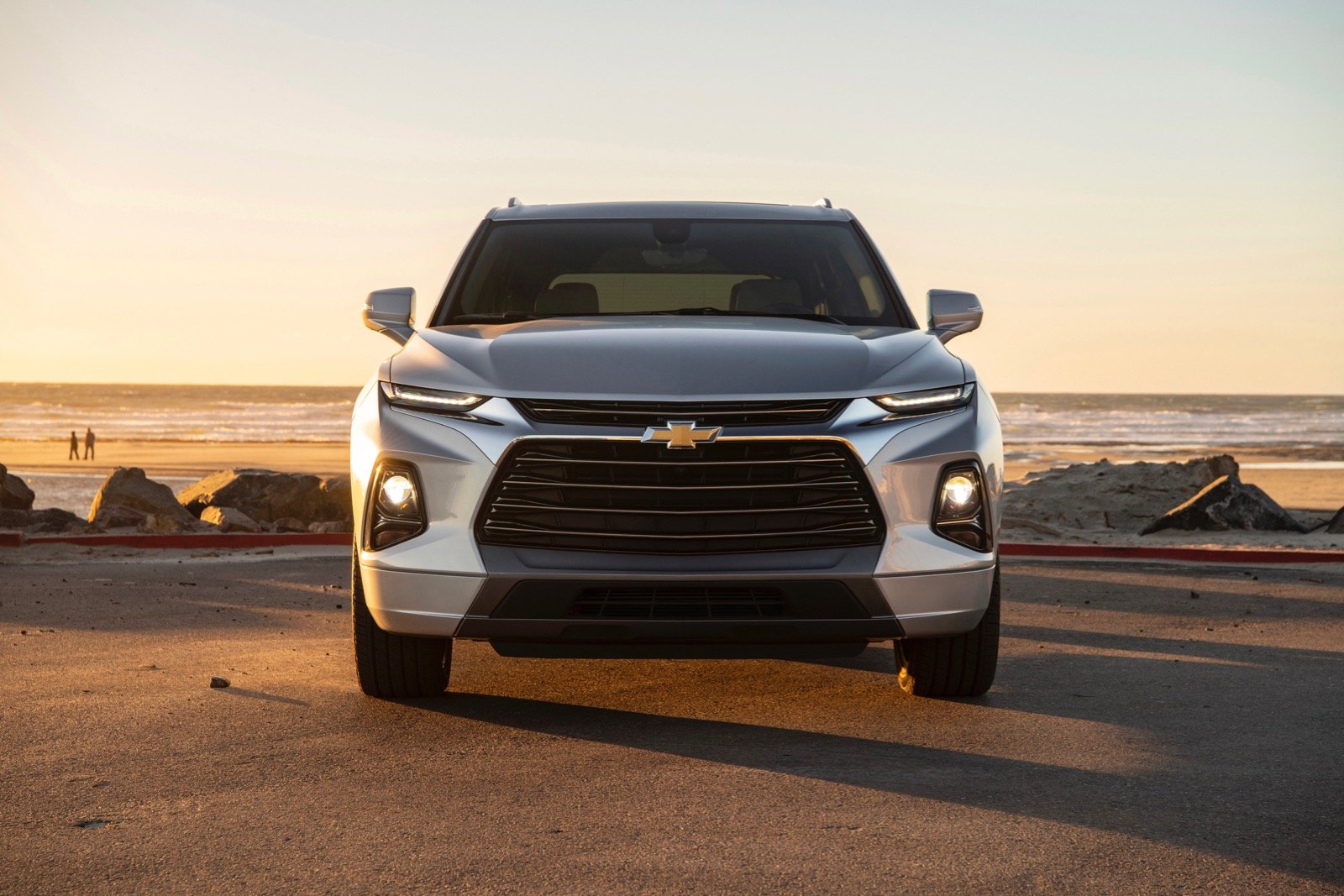
"Is that the Urus?" That was a friend's reaction to our dark blue Blazer RS pulling up to his driveway. He was looking down at the Blazer from the second floor, eyeing its wedgy profile and slim-cut windows, the sawblade 20-inch wheels, and the angry front end with the thin lights and tall, black grille with the wavy textures. A few more seconds elapsed before he noticed the Bow Tie badge. But that impression stuck. A common Chevy with the hots to evoke the Lambo supertruck? No lie. This is exterior styling done really, really well.
Chevy's normal SUVs look dowdy and utilitarian. They're like discount suits that don't fit right. With the Blazer, Chevy sampled the Camaro's excitement—its snarling face, chopped roof, muscled body and all—and added two more doors. Think of an upsized Range Rover Evoque, and you'll understand the Blazer's mission. It's here to look good, and that it does, from every angle. The taillights make a 3D effect. The Blazer's shoulder height is low, which lowers the hood. The tail is short, but not stubby. The Blazer, like the Lamborghini selling for four times as much, makes you remember it.
Chevy offers good customization. There are three grille designs to distinguish the varying trim levels (L and LT, RS, Premier), plus a fourth on the Redline package (2LT/3LT) that adds polished black wheels with red dashes painted between two of the spokes, red-outlined black badges, black door handles, black grille and Bow Tie emblems, and black mirrors with red accents. On all LT models, a Midnight/Sport edition offers some of the Redline's flair for less money. Or, if you only want a black grille, order the Black Accent package. Skip the hood and tailgate stripes, but maybe order the illuminated Bow Tie for the front. Unfortunately, two really cool colors are gone for 2021: The light pinkish-purple Oakwood and the dark yellow Sunlit Bronze. In their place are two bright shades, Cayenne Orange and Cherry Red, plus two other nondescript grays. You'll want the 20-inch wheels whenever possible. On the Premier, there's an option for 21s.
The interior is low-rent, and that dampens the Look and Feel score. It's all-black unless you order certain exterior colors that pair with a light gray on the LT trims and the Premier. The saddle tan leather is only on the Premier. Else, what you're left with is a dark and unsatisfying cabin. The seats are featureless and unsupportive. Downmarket plastic covers the doors and dash, the central screen is undersized, and most of the materials are beneath our Blazer's $48,000 as-tested price. Perhaps in the mid-30s they would be appropriate. But the RS wasn't loaded—it didn't even have a sunroof—and the Premier can top $52,000. Competitors like the Hyundai Santa Fe Calligraphy, Nissan Murano Premium, and Toyota Venza Limited use designer colors, detail, and quality at a non-luxury price point, for the same or less MSRP. Entering the Blazer is like checking into a Holiday Inn that was last renovated in 2003. Clean and functional? Sure, but living standards keep going up. Most General Motors interiors are just like the Blazer's—dated and cheap.

Performance
The Blazer offers three engines in either front-wheel drive (FWD) or all-wheel drive (AWD), all with a nine-speed automatic transmission. Stay away from the base engine, which means staying away from the base L and 1LT trims. It's the exact opposite of the Blazer persona. Underpowered and noisy, this 2.5-liter inline-four is a rental-car engine, with just 193 horsepower and 188 pound-feet of torque.
Instead, don't go lower than the 2.0-liter turbo four-cylinder engine that's standard on the 2LT, 3LT, and Premier. Its 227 hp and 258 lb-ft are acceptable. But the preferred Blazer engine is the 3.6-liter V6 on the RS, with 308 hp and 270 lb-ft. It's optional on the other trims. Here, on the RS, the Blazer feels strong and light on its admittedly heavy feet (4246 pounds before options). This trim includes a sport-tuned suspension, brakes, and steering. They all talk to each other in harmony. On the RS, there's a mechanical torque-vectoring rear axle that can vary how much power is routed to either wheel. All other AWD Blazer models have a conventional setup. However, the Blazer defaults to FWD unless you switch the driving mode selector to AWD—it won't do so automatically, so remember that before you start playing. Grip, steering with good on-center feel and turn-in, a firm brake pedal, and compliant dampers are a welcome surprise in this segment—and easily the best. It really handles. Comparisons that come to mind? BMW.
But there are several glaring errors to the transmission calibration. In Sport mode, the transmission doesn't kick down fast enough, and it won't downshift when braking or coasting down hills. There are no paddle shifters, so instead, you have to press the thumb selection button on the shifter, pull it down to L, and press a toggle switch on the shifter head. By the time you complete that movement, you're hard on the brakes or the gas—too hard, given that there's plenty of power for both stopping and going. Other cars without paddle shifters let you slide the shifter to the left and pull/push the lever without pressing additional buttons or requiring the shifter to be unlocked from D. The transmission's slow responses and convoluted manual mode are at odds with the sprightly chassis. People are buying the Blazer—especially the Blazer RS with the upgraded performance hardware—because they like driving. Chevy is promising a sporty experience, and it's not totally there. It's a few parts and a software upgrade away from completion.
EPA fuel economy is average, at 19 mpg city, 26 mpg highway, and 21 mpg combined for the AWD V6 drivetrain. The AWD turbo inline-four is 22/27/24, which beats the FWD inline-four with the larger, weaker engine. Keep that in mind in case someone tells you the base Blazer is a good choice. It's not.
Form & function
As a two-row SUV, the Blazer seats four without trouble. The low roof height on the outside is no issue inside, as the seats are mounted lower into the floor than we expected, which also makes stepping in and out of the car very easy. The only peeve, as with the Camaro, is the sightlines. They're poor from all angles, which is the cost of looking like a Lamborghini. Mercifully, GM is recognizing that large side-view mirrors can compensate for blocked rear-quarter views. The Blazer has a chunky pair that feel double the size of the tiny winglets on the last-gen Tahoe or the current-gen Cadillac CT5. With the optional rear-view mirror camera and its wide angle, visibility improves—and flicking the switch from mirror to digital display never ceases to amaze. The 360-degree cameras are also some of the clearest we've seen, and the sheer number of angles means you can't blame anyone but you for curbing a rim or scuffing a bumper.
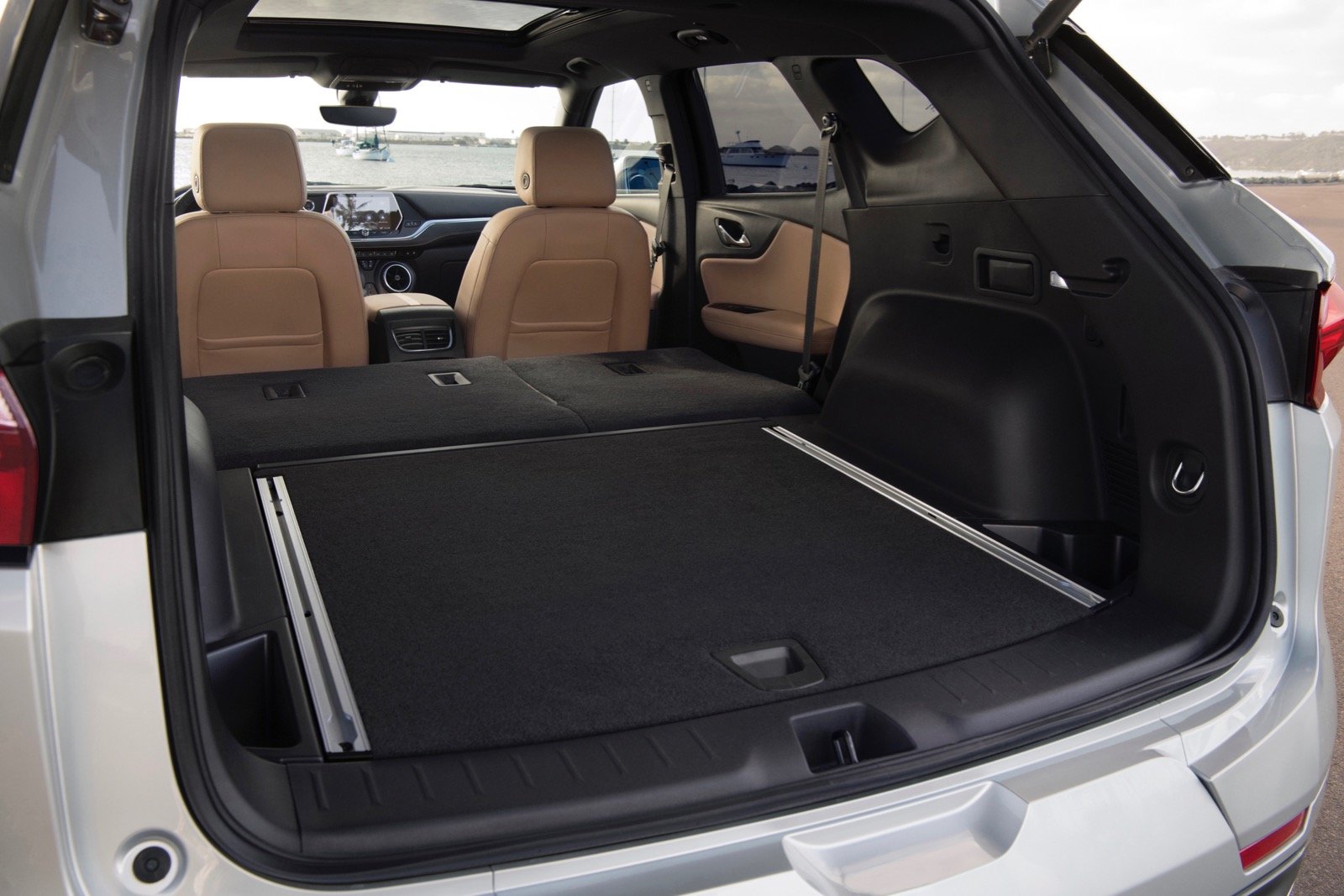
Overall, the Blazer feels more comfortable than the Equinox—which has awful, rock-hard seats—but it isn't any larger inside. Cargo space with the rear seat folded is the same 64 cubic feet. When raised, they're both 30, give or take a half cube. We moved a recumbent exercise bike like it was nothing. In the Blazer, there's enough space to really stretch out.
The Blazer stretches its legs when equipped with the trailering package, AWD, and the V6. At 4,500 pounds, it's triple what the Equinox can handle and sufficient next to other midsize-to-small SUVs. Without that configuration, the Blazer can only pull 1,500 pounds.
Controls are simple and handy, like the movable rings around the front air vents that serve as temperature dials or the Chevy logo projected on the ground at night, which indicates exactly where to place a foot to operate the hands-free power tailgate. The heated steering wheel and heated/cooled driver's seat will activate automatically depending on the exterior temperature, including during a remote start. Upper trims have the option for a power tilt/telescope steering wheel and rear heated seats. The infotainment is fast and easy, and so is the optional digital speedometer.
Technology
Every Blazer gets an 8-inch touchscreen running the latest version of Chevrolet Infotainment 3. It's one of the simplest, quickest systems on the market, and one of a growing number of systems with wireless Apple CarPlay and Android Auto as standard. Our RS with the Driver Confidence II package added wireless phone charging on the console, a washer for the rear camera, LED headlights, 360 cameras, adaptive cruise control, and the Safety Alert Seat, a GM innovation that vibrates the seat cushion to warn the driver of a potential collision or approaching object. It's subtle to passengers—no loud chimes or flashing lights—and very much awakens the driver.
A "Plus" version of the infotainment adds navigation with traffic, 4G WiFi, onboard apps, better voice recognition, and can pair two phones at once. There are some forward-thinking features unique to GM that most automakers haven't gotten around to yet. The system will upload certain infotainment and vehicle settings to a GM cloud account so the driver can transfer them into another GM vehicle. The app store looks and functions just like it does on an Apple or Android phone, with easy downloads and background updates for both apps and the infotainment software. The Marketplace app will store a credit card and offers contactless payments at gas stations and restaurants. It only works in limited places (and you'd better like Domino's or Applebee's), but the capability is there. Amazon Alexa compatibility is also included. Much appreciated are the individual privacy settings for every app in the system, so you can see (mostly) what data GM is collecting and how to disable it.
For 2021, driver assists come standard on most Blazer trims except the L and 1LT. They include forward automatic emergency braking with pedestrian detection, lane-keep assist, and automatic high beams. However, the Blazer doesn't have a semi-automated function for traffic and the steering wheel will not proactively turn when the cruise control is on.

Safety
The 2021 Blazer scored an overall five stars from the National Highway Traffic Safety Administration (NHTSA) and in all three crash tests. The front passenger scored four stars in the frontal crash and the vehicle scored four stars in the rollover test. The Insurance Institute for Highway Safety (IIHS) gave the Blazer top "Good" ratings in all crash tests, but "Marginal" and "Poor" ratings for headlights.
A driver's knee airbag is standard. GM's inboard side airbag, which inflates between the driver and passenger seat, is not offered. Neither is rear emergency braking. The "enhanced" forward emergency braking uses radar in addition to the camera, so technically it is more accurate at detecting a potential collision. It's only available on top trims with the Driver Confidence II package.

Cost-effectiveness

What owners say
"Overall, drivers are impressed with the 2021 Chevrolet Blazer, praising its sporty look, responsive power, and great features that enhance driving enjoyment. Many feel it's a good value, especially for families, but some find the interior a bit plain and the pricing somewhat high compared to competitors. The driving experience is often highlighted as a major positive."
This car is loaded and looks great. Only had it for a day so far but right now feels like a great purchase!
January 31, 2025I love this vehicle! Plenty of leg room, comfortable seating and responsive. I love the 308 hp V6. I had gotten away from Chevrolet for sometime. The value and dependability of their vehicles dropped considerably . The Blazer is the redeeming vehicle for me. The options on my Blazer are great for me and may not be suitable for other customers but at least there are plenty to choose from. If Great value for the money.
January 17, 2024Love the features. Good car for the money, it’s a dream to drive
April 12, 2021What owners say
This car is loaded and looks great. Only had it for a day so far but right now feels like a great purchase!
January 31, 2025I love this vehicle! Plenty of leg room, comfortable seating and responsive. I love the 308 hp V6. I had gotten away from Chevrolet for sometime. The value and dependability of their vehicles dropped considerably . The Blazer is the redeeming vehicle for me. The options on my Blazer are great for me and may not be suitable for other customers but at least there are plenty to choose from. If Great value for the money.
January 17, 2024Love the features. Good car for the money, it’s a dream to drive
April 12, 2021I really like the look of the Blazer, very sporty looking. I test drove the RS with the 3.6L V6 engine and it was very responsive and appeared to have plenty of power. Interior is only available in black and seemed plain, even with the red accents that come with the RS package. I did like the dash configuration and gauge cluster, reminded me of the Camaro. Over all I liked it, but compared to equally equipped Jeep Grand Cherokee or Ford Edge it is overpriced. Pricing seems to be the same as the Traverse which is a larger SUV.
June 21, 2021This car is very good value. Its almost a steal only if the interest rates right now were a lot better. Everything about this vehicle was designed very well. Especially if youre coming from a vehicle that even if you hit a minor bump or crack in the road its almost as if the whole interior is about to get rearranged but with this vehicle, completely smooth.
February 12, 2023It’s nice. It picks up speak pretty quick. I have the RS and the extra features are definitely worth the money. Don’t settle.
May 13, 2021I am short and I love that its easy to get in and out of and the driver seat adjusts adequately.
November 9, 2021Amazing car, great features, good for family and some fun when you’re driving by yourself.
March 9, 2021Trims & specs
Base MSRP $39,600 | Seating 5 |
Engine 2.0L 227 hp I4 | Cargo Capacity 30.5 cu ft |
Combined MPG 24 | Drivetrain AWD |
Base MSRP $28,800 | Seating 5 |
Engine 2.5L 193 hp I4 | Cargo Capacity 30.5 cu ft |
Combined MPG 24 | Drivetrain FWD |
Base MSRP $33,400 | Seating 5 |
Engine 2.0L 227 hp I4 | Cargo Capacity 30.5 cu ft |
Combined MPG 25 | Drivetrain FWD |
Base MSRP $32,600 | Seating 5 |
Engine 2.5L 193 hp I4 | Cargo Capacity 30.5 cu ft |
Combined MPG 24 | Drivetrain FWD |
Base MSRP $35,400 | Seating 5 |
Engine 2.0L 227 hp I4 | Cargo Capacity 30.5 cu ft |
Combined MPG 24 | Drivetrain AWD |
Base MSRP $43,000 | Seating 5 |
Engine 2.0L 227 hp I4 | Cargo Capacity 30.5 cu ft |
Combined MPG 25 | Drivetrain FWD |
Base MSRP $45,800 | Seating 5 |
Engine 2.0L 227 hp I4 | Cargo Capacity 30.5 cu ft |
Combined MPG 24 | Drivetrain AWD |
Base MSRP $41,100 | Seating 5 |
Engine 3.6L 308 hp V6 | Cargo Capacity 30.5 cu ft |
Combined MPG 23 | Drivetrain FWD |
Base MSRP $44,000 | Seating 5 |
Engine 3.6L 308 hp V6 | Cargo Capacity 30.5 cu ft |
Combined MPG 22 | Drivetrain AWD |
Base MSRP $37,600 | Seating 5 |
Engine 2.0L 227 hp I4 | Cargo Capacity 30.5 cu ft |
Combined MPG 25 | Drivetrain FWD |


Pricing trends
MSRP range
$28,800 - $45,800
Current avg. market price
$20,374
Trending down by 1.7% this month
May 2026 - November 2026


