2021 Chevrolet Bolt EV Reviews, Pricing & Specs


Pros & cons
What we like
Impressive electric range
Fuel-efficient
Spacious
What to consider
Interior materials feel cheap
Uncomfortable seats
The CarGurus verdict
The Bolt EV is almost the template for the ideal affordable EV commuter car… almost.
Spend any time reading the news, and you’ll likely read about electric vehicles. They are influencing the stock prices of major automakers, and in turn, those automakers are investing heavily into a burgeoning market of EV startups. And yet, electric cars make up an incredibly small portion of the new car market. For all the news and hype, there are only a handful of actual models on the road today. They fall into two categories: larger, luxury-minded EVs like those offered by Tesla, and smaller, minimalist offerings such as the Nissan Leaf and the 2021 Chevrolet Bolt EV.
Like the Leaf, the Bolt does things differently from Tesla. It uses a smaller battery pack and maximizes the efficiency of its nimble platform. The Bolt EV does not have the range or acceleration of the Teslas, but for many Americans, an EV like the Bolt EV is something closer to what they can afford. But is the Bolt EV right for you? Read on to learn more about this economic electric vehicle.
out of 10 expert review
Look & feel
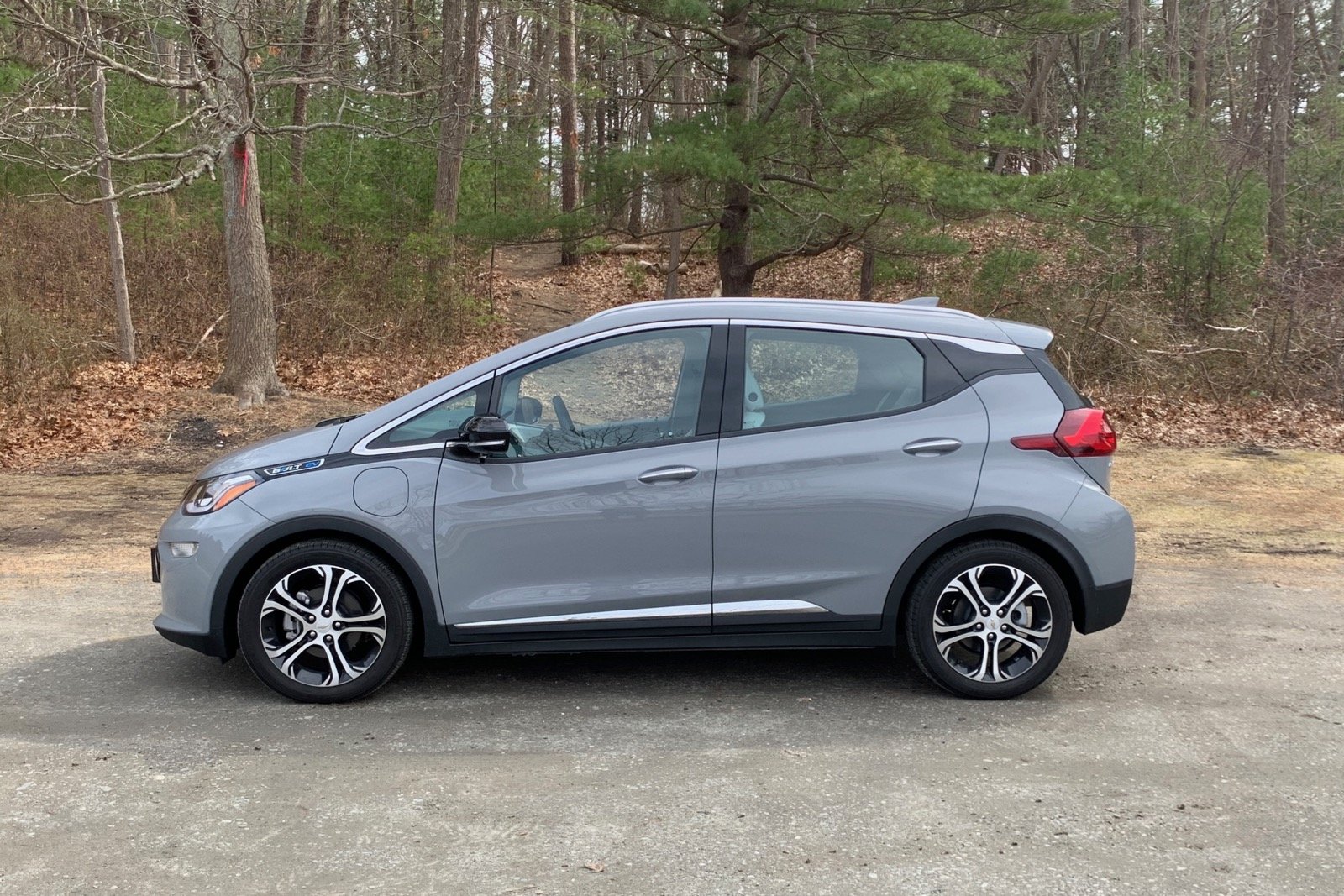
The Bolt EV’s shape is optimized for aerodynamic efficiency. That means you’ll get the same jellybean shape as the Nissan Leaf, Toyota Prius, or any other efficiency-first car. Compared to those other vehicles, the Bolt EV has a more upright layout. This provides a more commanding view of the road and terrific sightlines. The Bolt EV incorporates signature Chevrolet design cues, such as the polygon lower grille. It also features the “floating” roofline along the D-pillar between the rear side doors and the rear hatch. This helps to visually break up the Bolt EV's hatchback design. But aside from its plucky profile, the Bolt EV has a more conventional design compared to other new electric vehicles.
The Bolt EV’s cabin is far more futuristic than its exterior, with extensive use of flowing plastic panels and bright colors. The result is a cabin that shares more aesthetically with consumer electronics than most cars. It incorporates a fully digital instrument panel, a touchscreen, and streamlined center console controls. As we’ll explain a little later, the controls can be a bit confusing and the screen itself lags at times. The Bolt EV also features a conventional steering wheel design that you’d find in other Chevy vehicles. While this isn’t a big deal, General Motors took the time to rethink the entire dash area of the Bolt EV. It would have been nice to see a bit more effort put into differentiating the steering wheel as well.
There are two trims for the Bolt EV: the LT and the Premier. The LT comes standard with alloy wheels, remote start, the aforementioned 10.2-inch touchscreen with Apple CarPlay and Android Auto, and a WiFi hotspot. Other features on the Bolt EV LT include automatic climate control, dual USB ports, Bluetooth connectivity, and satellite radio.
Moving up to the Premier trim adds leather upholstery, a rear center armrest, heated front seats, heated rear seats, a heated steering wheel, and a removable cargo load floor.
There are several options and packages available for the Premier trim. The Infotainment Package ($595) adds wireless device charging, additional USB ports, and a 7-speaker Bose premium stereo system. The Driver Confidence II package adds a host of driver assistance features.

Performance
The Chevy Bolt EV features a 66-kilowatt-hour lithium-ion battery pack, providing energy to an electric motor at the front wheels. It makes 200 horsepower and 266 pound-feet of torque. That’s not a ton of power and torque, but 100% of the torque is available at zero rpm. As a result, the Bolt EV scoots off the line with terrific low-end pickup. It has plenty of power for getting around town and has a claimed zero to 60-mph time of 6.5 seconds. That might not seem very fast compared to the Teslas of the world but is surprisingly quick by compact car standards.
The placement of the battery in the floor and under the rear seats ensures a very low center of gravity. As a result, the Bolt EV’s driving experience borderlines on fun. The quick steering ratio and the powertrain's low-end torque mean the Bolt EV is surprisingly energetic around town. The downside is that you tend to feel most bumps in and cracks in the road, but is not overly harsh.
At highway speeds, the Bolt EV’s steering is more twitchy and body roll is more apparent, even when changing lanes. There is also a lot of wind noise at highway speeds and the Bolt EV is very susceptible to crosswinds at higher speeds. In all, the Bolt EV is more suited for around-town and city driving. It can do the longer trip in a pinch (it does provide 259 miles of range, per the EPA), but it won’t be as comfortable as a more conventional vehicle.

Form & function
The Bolt EV has a surprisingly spacious 56.6 cubic feet of cargo space with the 60/40 split-fold rear seats folded down. With the rear seats up, the Bolt EV has 16.9 cubic feet of rear cargo space. The Bolt EV Premier also has a removable load floor which helps organize that usable space. The Bolt EV does not offer a power or hands-free rear hatch, but a vehicle like this is going for efficiency and simplicity.
Thanks to its tall, jellybean shape, the Bolt EV provides decent cabin space for a vehicle its size. The driver and front passenger are treated to plenty of head and legroom. The second-row passengers have just as much headroom, though legroom has the potential to be lacking. If the front-row occupant is taller, then they will likely slide that seat back, cutting in on legroom. But for most occupants, there will be enough cabin space to split between the front and back rows.
The tall layout gives the driver terrific visibility of the road. Unlike most cars which have power-adjustable seats and steering columns for the top trims, no such option exists for the Bolt EV. Those are features that add weight and are a draw on power. The Bolt EV offers multiple manual adjustments to find your optimal seating position. The Bolt EV also provides deep in-door pockets and a large, low cargo tray below the center console. The center console controls can be a bit confusing, as mentioned. It minimizes the space taken up by the center console, but more conventional controls would have been appreciated. It’s also possible that using existing parts-bin buttons and dials would have further reduced costs.

Technology
The Bolt EV has a different touchscreen from other GM vehicles. Compared to the sensible, logical layout of other infotainment GM infotainment systems, this one feels like a half-baked prototype. It has a clunky layout and is laggy. Perhaps this was so the screen could focus on the various energy displays, which it does. There are plenty of ways to monitor charging and power usage. But one has to wonder if it would not have been possible to simply add energy menus to the infotainment setup found in other Chevy vehicles. Dodge has been able to pull something like this off by adding its Performance Pages within the existing Uconnect ecosystem.
What makes this setup truly confusing is the Venn-diagram-like overlap between the touch controls and hard buttons and dials. The lower bar of the touchscreen is used for the “Energy” display button as well as some of the climate controls. It’s just weird to press a touchscreen button to turn the AC on and off, but also have to use tactile buttons and dials for the fan speed and temperature. This all seems like an effort to be different without considering daily usability. The infotainment system does include Apple CarPlay and Android Auto as standard equipment, which is helpful.
The Bolt EV’s fully digital instrument panel is customizable. It allows the driver to see energy usage in different ways. One helpful element to the instrument panel is the bracketed range estimates on the left side. In addition to the actual remaining range, it provides a high and a low estimate based on your driving habits. If you drive aggressively, you’ll end up closer to the low number. If you drive more conservatively, it’s possible to hit a higher range than stated. The Bolt EV also provides a smartphone app that allows the driver to monitor the charging status and even the weather to determine if it will impact the vehicle’s range over a long journey.

Safety
There are not a ton of standard safety features on the Bolt EV outside of the typical collection of airbags, traction control, and a backup camera. The Bolt EV also comes standard with Chevy’s Teen Driver feature. It allows the driver to set speed and volume limitations for the second set of keys. All of the advanced driver assistance features are part of option packages.
The Driver Confidence I package costs $495. It adds rear parking sensors, lane-change alert, blind-spot monitoring, and rear cross-traffic alert. The Driver Confidence II package is available on the Premier. At $595, it adds automatic high beams, forward-collision warning, automatic emergency braking, pedestrian detection, a following distance indicator, lane-departure warning, and lane-keep assist.
The National Highway Traffic Safety Administration (NHTSA) gave the Bolt EV a best five-star crash test rating. The Chevrolet Bolt is also an Insurance Institute for Highway Safety (IIHS) 2019 Top Safety Pick, an accolade that carries into 2021. The IIHS also gave the Bolt EV’s optional driver assistance features a top rating of “Superior.”

Cost-effectiveness
The EPA measures electric-vehicle fuel economy in a mile-per-gallon equivalent or MPGe. According to this system, the 2021 Chevrolet Volt returns an estimated 127 MPGe city, 108 highway, 118 combined. For reference, the Nissan Leaf earns between 104 and 111 MPGe, and the Tesla Model 3 earns between 113 and 142 MPGe, depending on the model selected.
The 2021 Chevrolet Bolt has an estimated driving range of 259 miles on a full charge. There are three levels of charging, starting out with the 120-volt Level 1, wall-style charger. It adds about four miles of range per hour of charging. This option is best for overnight, at-home charging. The next step up is 240-volt Level 2 charging, which requires the installation of special equipment and adds about 25 miles of range for every hour of charging. Many of the charging stations you’ll find out on the open road are Level 2. The Bolt Premier adds DC fast-charging capability. Fast-charging stations are less common but are groining in frequency. The DC fast-charger can add up to 100 miles of range in just 30 minutes of charging.
Base MSRP for the 2021 Chevrolet Bolt is $37,495. The Bolt Premier trim starts at $42,695. The Premier with full options comes in at $44,060. The Bolt EV no longer qualifies for the $7,500 federal EV tax credit, but may qualify for state or local incentives, depending on where you live. The battery pack is protected by a generous eight-year/100,000-mile warranty.
For the 2022 model year, Chevrolet announced the Bolt EUV, a crossover "utility" vehicle. It is more of an evolution of the Bolt EV, and actually has less cargo space than the Bolt EV. But since crossovers are all the rage, Chevy will likely sell more EUVs than EVs. This does technically give Chevy multiple EV offerings, the way that Hyundai does with the Kona Electric and Ioniq Electric.
In many ways, this could be the future of around-town motoring. Large sedans like the Tesla Model S are great for long-range trips. But the Bolt EV is an ideal size and setup for a daily weekly runabout. If costs can come down and GM could fight the urge to go unorthodox with the layout of the controls, the Chevy Bolt EV would have a better chance at normalizing the EV as a daily commuter car.

What owners say
"Overall, drivers are quite impressed with the 2021 Chevrolet Bolt EV, especially praising its driving experience, spaciousness, and impressive battery range. They appreciate the low maintenance costs and value for money. However, some common dislikes include loud road noise, a subpar sound system, and cheap interior materials."
Pros: -LOVE how it drives and handles the road -Feels spacious despite being compact -Easy features to use -No more gas and limited maintenance! -Awesome battery range Cons (especially related to the LT trim level): -Road noise is still very loud even though its nothing is coming from your engine. -6-speaker sound system absolutely sucks -Missing spot or sunglasses -No USB-c -No leather seats -No all-weather mats -No electric seat adjustments -Lots of plastic on the interior -No window tinting -No automatic windshield wipers -No 3D backup camera view -Get get the stupid XM radio to stop blasting me out every time I turn on my car (Apple Car play is much quieter) The 2022 (especially the 2LT trim level) looks like it is a very nice upgrade on the interior compared to the 2021.
May 20, 2021Best value for the money anywhere really nice for driving. Really nice for maintenance and really nice. If you do have to work on it it’s very simple insurance cost are low. Initial cost to purchase is low really hard to beat. Rear seat Comfort is excellent. Front seat Comfort also excellent . handles very well. Accelerates beautiful , can pass most others in a heartbeat if you’re talking about gas cars.
February 12, 2023Insufficient range Cheap interior design Heating system quirky, slow in winter High tire wear ( front wheel drive )
January 14, 2024What owners say
Pros: -LOVE how it drives and handles the road -Feels spacious despite being compact -Easy features to use -No more gas and limited maintenance! -Awesome battery range Cons (especially related to the LT trim level): -Road noise is still very loud even though its nothing is coming from your engine. -6-speaker sound system absolutely sucks -Missing spot or sunglasses -No USB-c -No leather seats -No all-weather mats -No electric seat adjustments -Lots of plastic on the interior -No window tinting -No automatic windshield wipers -No 3D backup camera view -Get get the stupid XM radio to stop blasting me out every time I turn on my car (Apple Car play is much quieter) The 2022 (especially the 2LT trim level) looks like it is a very nice upgrade on the interior compared to the 2021.
May 20, 2021Best value for the money anywhere really nice for driving. Really nice for maintenance and really nice. If you do have to work on it it’s very simple insurance cost are low. Initial cost to purchase is low really hard to beat. Rear seat Comfort is excellent. Front seat Comfort also excellent . handles very well. Accelerates beautiful , can pass most others in a heartbeat if you’re talking about gas cars.
February 12, 2023Insufficient range Cheap interior design Heating system quirky, slow in winter High tire wear ( front wheel drive )
January 14, 2024The car had great features, but I thought it was priced too high.
June 19, 2021Actually cute in the right colors (white/red). Interior and seats of 2020-21 are not as bad as reviewers say. Quite acceptable. The slightly narrow and tall aspect of the car takes a few days to get used to. Ride is average over decent roads. Noise levels are Prius-like. You could go on a long road trip if you are young and limber. Trunk is bigger than it looks in the pictures. Acceleration is strong, but not exactly shocking. It is more substantial and attractive than it looks in pictures. Interior is just fine. Even with the coming tax credits, the 22 will be more $$ and not necessarily worth waiting for. It is the same powertrain/battery. Go and get a killer deal on a 20-21. Youll never get a E-Car with these specs for these prices again.
February 22, 2021Trims & specs
Base MSRP $36,500 | Seating 5 |
Engine 200 hp Electric | Cargo Capacity 16.9 cu ft |
Fuel Economy 127 MPG/MPGe (City), 108 MPG/MPGe (Highway) | Drivetrain FWD |
Base MSRP $41,700 | Seating 5 |
Engine 200 hp Electric | Cargo Capacity 16.9 cu ft |
Fuel Economy 127 MPG/MPGe (City), 108 MPG/MPGe (Highway) | Drivetrain FWD |


Pricing trends
MSRP range
$36,500 - $41,700
Current avg. market price
$16,523
Trending down by 2.9% this month
August 2026 - November 2026


