2021 Porsche Panamera Reviews, Pricing & Specs


Pros & cons
What we like
Multiple body styles
Fun to drive
Impressive technology
What to consider
Manual transmission not available
The CarGurus verdict
This four-door Porsche is a sedan that thinks it’s a sports car.
Sports cars like the 911 and Boxster/Cayman are the foundation of Porsche’s image, and the Macan and Cayenne SUVs are the brand’s bestsellers. That leaves the Panamera somewhere in the middle. The four-door Porsche offers more practicality than the brand’s sports cars, and thus serves a larger market, but it’s a step closer to them than the high-riding Porsche SUVs.
The current Panamera (971 in Porsche code) represents the model’s second generation. For the 2021 model year, it gets a number of updates. Highlights include, powertrain and suspension upgrades, new tires, a reshuffled model lineup, and subtle styling changes.
As before, the 2021 Porsche Panamera is offered in a number of configurations. Buyers can choose from V6, V8, and plug-in hybrid powertrains, rear-wheel drive (RWD) or all-wheel drive (AWD), and standard sedan, longer-wheelbase Executive sedan, and Sport Turismo wagon body styles. We count 24 Panamera variants for the United States market, in fact, including new-for-2021 Panamera Turbo S and Panamera 4S E-Hybrid models.
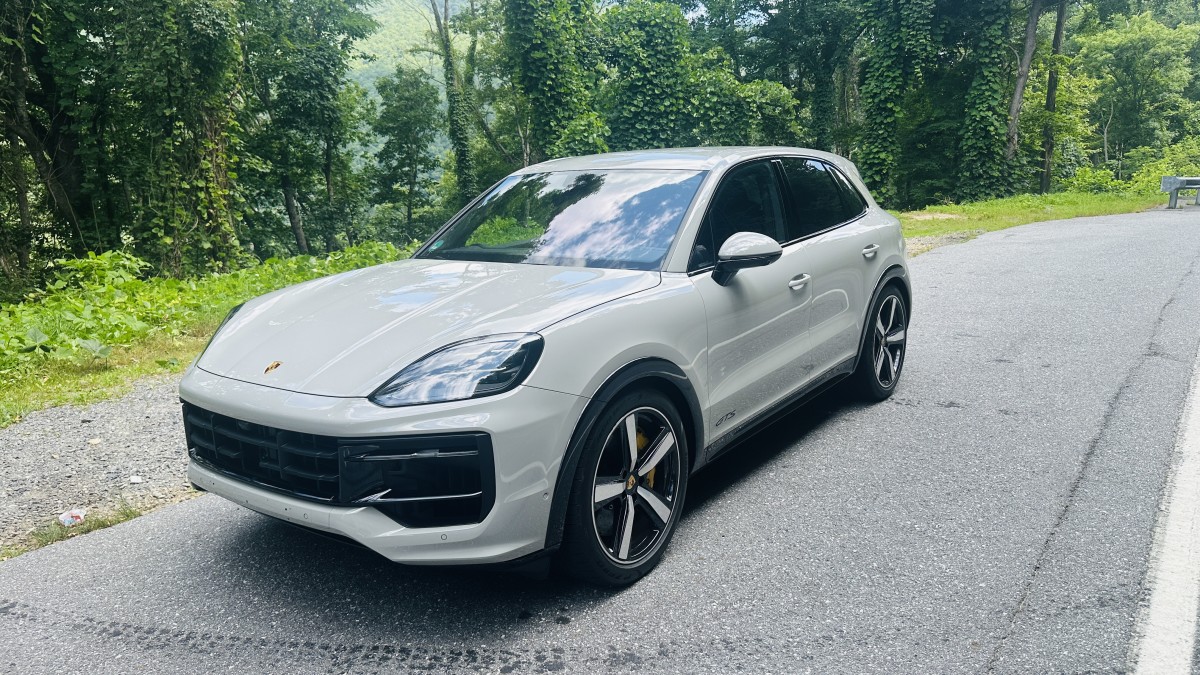
Our test car was a Panamera GTS sedan, one of the more driver-focused options positioned at the upper end of the standard (non-Executive) Panamera sedan range. We spent a week with it to determine if it was truly the Porsche of luxury sedans.
out of 10 expert review
Look & feel
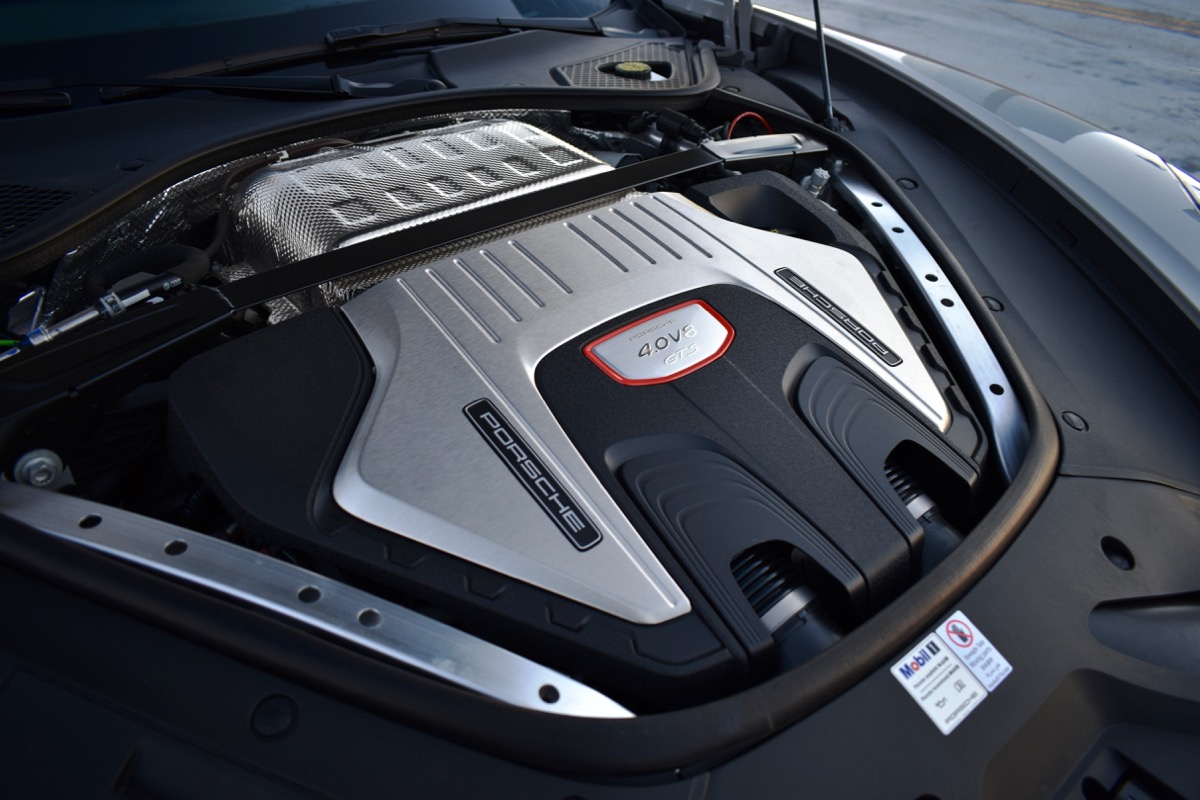
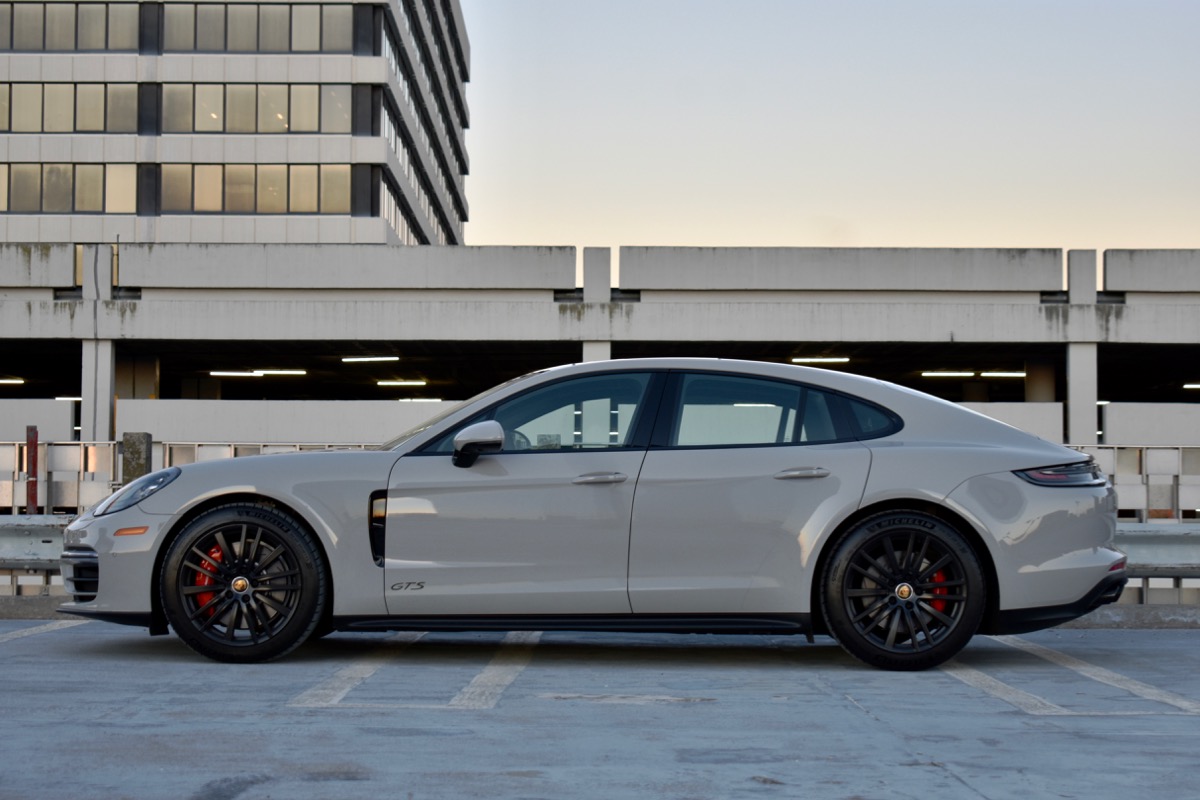
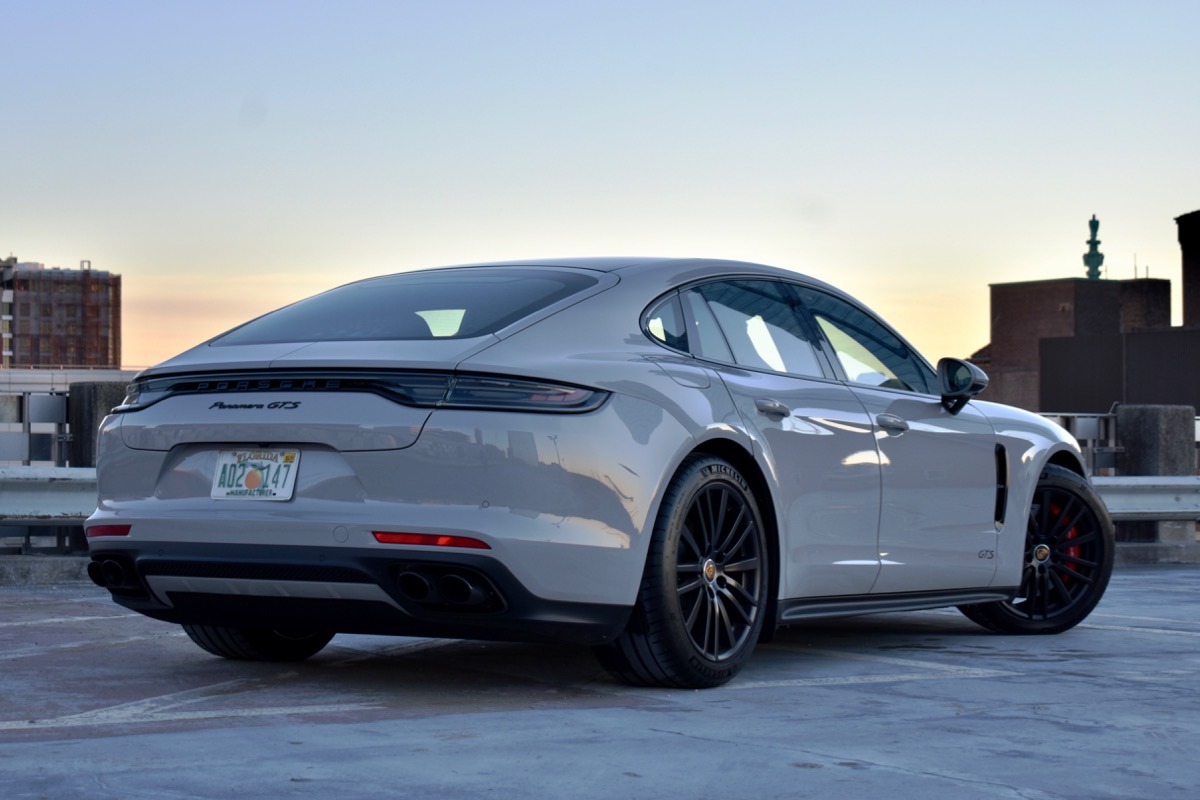
The Panamera is unmistakably a Porsche. It looks like a four-door version of the ubiquitous Porsche 911, thanks to its low roofline and fastback profile. Design features like round headlights available with four embedded LED daytime running lights closely tie the Panamera to its sports car stablemate. Except instead of being tucked behind the rear wheels, as in the 911, the engine sits under the Panamera’s long hood.
While engine placement isn’t an issue with this styling, stretching the styling of a two-door sports car over the architecture of a fairly large four-door sedan does give the Panamera somewhat odd proportions, like a 911 as seen through a funhouse mirror. Still, the Panamera is more distinctive looking than the traditionally-styled sedans from fellow German automakers Audi, BMW, and Mercedes-Benz.
For the 2021 model year, all Panamera models get the previously-optional SportDesign front fascia, plus a continuous light bar connecting the taillights that makes the Panamera look even more 911-like. A new 20-inch wheel design and two 21-inch wheel designs round out the changes. Panamera GTS, Turbo S, and Turbo S E-Hybrid models also get their own models-specific styling features.
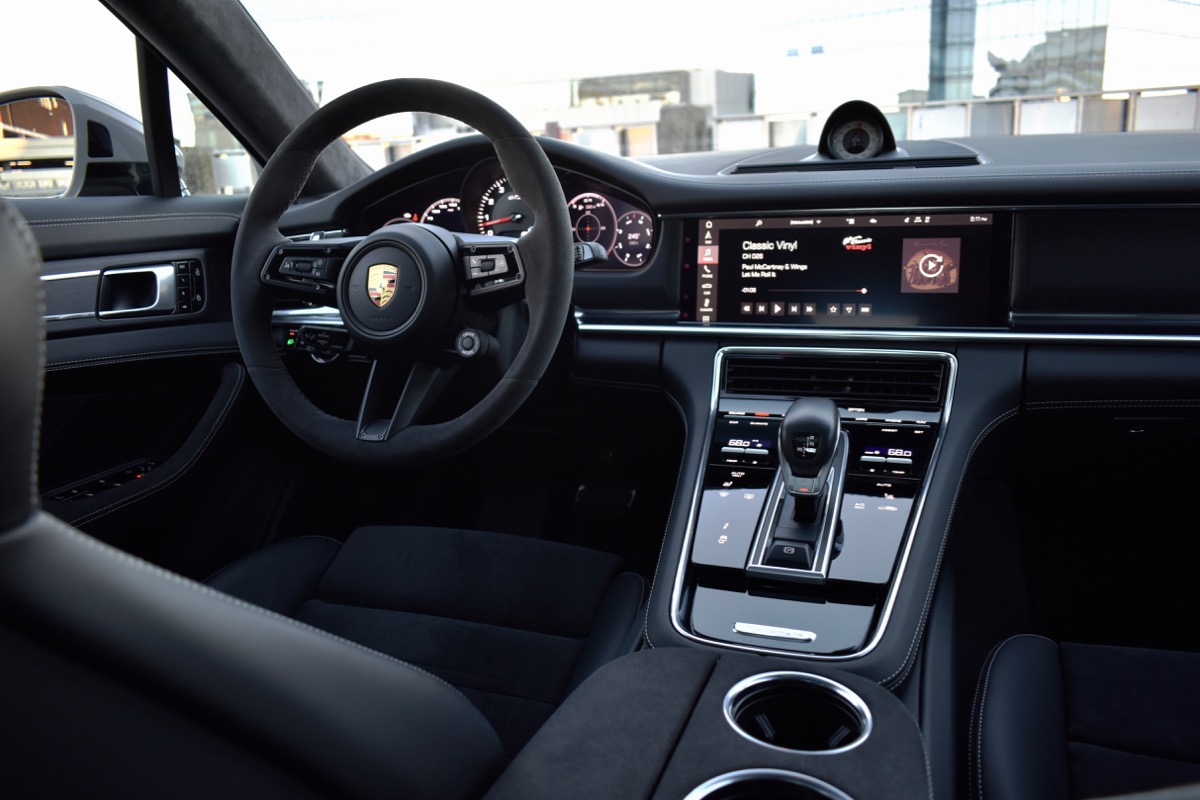
Like the exterior, the Panamera’s interior tries to create connections to the 911. The upright dashboard has the same shape, although it’s paired with a raised center console that originated on the first-generation Panamera and has since migrated to other Porsche models. You also get classic Porsche design touches like a center tachometer, and a dashboard-mounted starter switch on the left side of the steering wheel. The latter is a nod to the traditional location of the ignition on Porsches, back when you needed a key to start them.
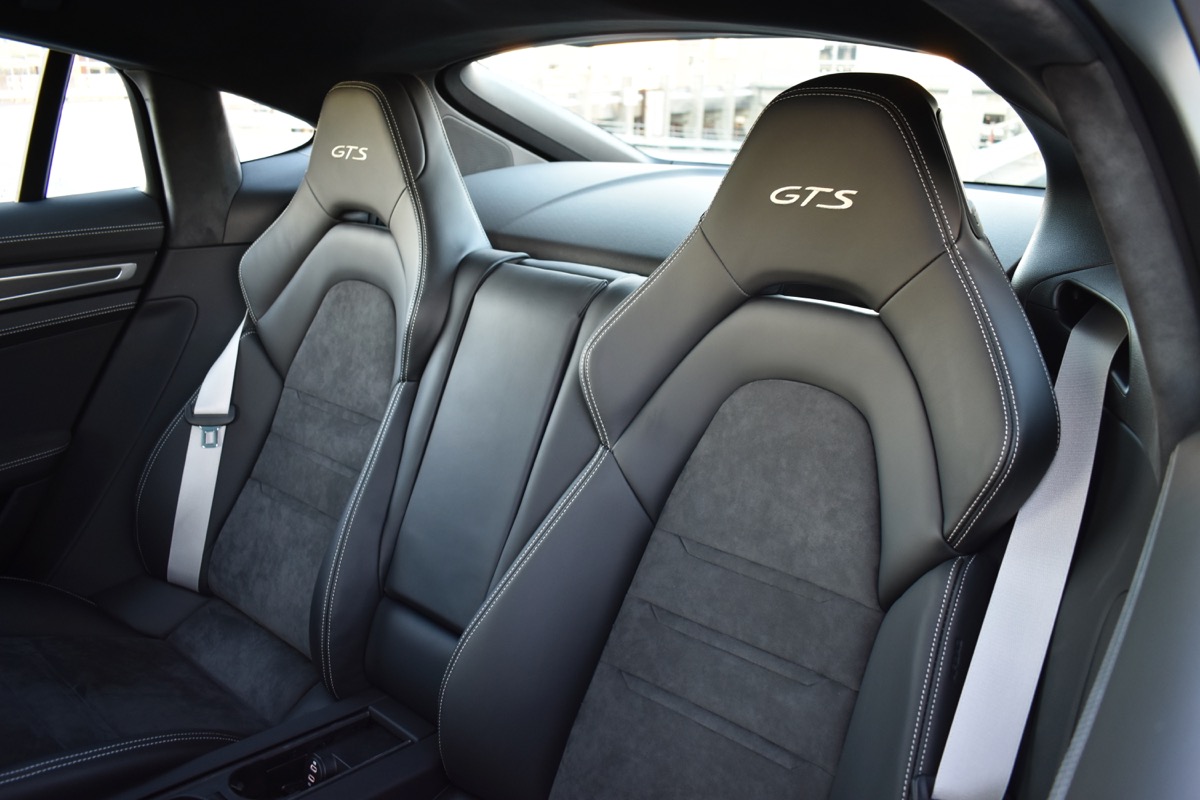
The Panamera can be luxurious or sporty, depending on your taste. Base models get eight-way power adjustable front seats with a driver memory package, while Turbo S models get standard 18-way adjustable seats with full leather upholstery. Our GTS test car had 14-way adjustable front sport seats with extra bolstering, and traded some of the leather for Alcantara. The look and feel of the heavily-bolstered seats, combined the nostalgic interior design, gave the Panamera GTS a lot more character than the average luxury sedan, in our opinion.
Performance
Porsche made several changes to the Panamera powertrain lineup for the 2021 model year, starting at the bottom. A 2.9-liter twin-turbocharged V6 replaces last year’s 3.0-liter turbo V6 engine. The new V6 makes 325 horsepower and 331 pound-feet of torque. Even this base model will do zero to 60 mph in 5.3 seconds, and reach a top speed of 168 mph, according to Porsche.
All Panamera models use the PDK eight-speed dual-clutch automatic transmission, and both RWD and AWD are available, depending on the powertrain and model.
Porsche also offers a 4.0-liter twin-turbocharged V8 that produces 473 hp (20 hp more than before) and 457 lb-ft of torque in the Panamera GTS and 620 hp and 604 lb-ft in the Porsche Panamera Turbo S (the Panamera Turbo has been eliminated for 2021). The Turbo S can do zero to 60 mph in 2.9 seconds, top out at 195 mph, and lap Germany’s Nürburgring quicker than a Chevrolet Corvette, according to Porsche.
Finally, Porsche offers the Panamera E-Hybrid, 4S E-Hybrid and Turbo S E-Hybrid plug-in hybrid models. The E-Hybrid and 4S E-Hybrid both add an electric motor to the twin-turbo V6, while the Turbo S E-Hybrid does the same with the V8 engine. That makes the Turbo S E-Hybrid the most powerful Panamera, with a total system output of 689 hp.
Our time with the Panamera GTS proved that this Porsche is more than just a muscle car for the power-crazed, though. With launch control engaged, it will do zero to 60 mph in 3.7 seconds, according to Porsche. That’s quicker than a BMW M3. You also get an excellent V8 soundtrack, with extra NASCAR-style rumble in the Sport and Sport Plus driving modes.
On twisty roads, the Panamera defied its considerable girth thanks to a combination of good chassis tuning, sticky summer tires (a no-cost option on the GTS), and Porsche’s excellent driver aids.
Rivals Audi, BMW, and Mercedes have gotten proficient at using software to defy physics, but their systems don’t feel as organic as Porsche’s. In the Panamera, you don’t notice the driver aids cutting in; everything blends together into a great driving experience. Sporty driving dynamics also don’t come at the cost of ride quality. The GTS felt decently comfortable even with adaptive air suspension in its firmer settings.
Considering that sophisticated electronics are now necessary to counteract the growing curb weights and tremendous output of modern sports sedans, this may be Porsche’s greatest asset.
Form & function
The Panamera sedan is really hatchback, with a rear decklid and glass that lift up as one piece to reveal a long, but somewhat narrow, cargo area. Still, it’s more flexible than the conventional trunks of the Audi A6, BMW 5 Series, and Mercedes-Benz E-Class sedans. Porsche quotes 17.4 cubic feet of cargo space with the rear seats in place, and 47.1 cubic feet with the rear seats folded. Plug-in hybrid models offer slightly less cargo space, however.
In non-hybrid form, the Panamera Sport Turismo wagon offers 18.3 cubic feet of cargo space with the rear seats up, and 49 cubic feet with the seats down. That’s an improvement over the Panamera sedan, but less than you get in a Mercedes-AMG E63 S wagon.
Porsche doesn’t publish complete passenger-space measurements, but notes that the Panamera Executive models get a 5.9-inch wheelbase stretch, increasing rear-seat space. We didn’t feel cramped, but the long hood hindered forward visibility somewhat, and some drivers might not like the low-slung seating position.
The Panamera’s distinctive interior design is great for tackling your favorite driving road, but not for anything else. The raised center console keeps controls within easy reach, but doesn’t leave much room for storage space. Porsche plays to old German-automaker stereotypes with undersized cupholders, and the center console storage bin is pretty small as well. You don’t even get a good place to put your phone, only a slot in the bin that’s easily overlooked.
Technology
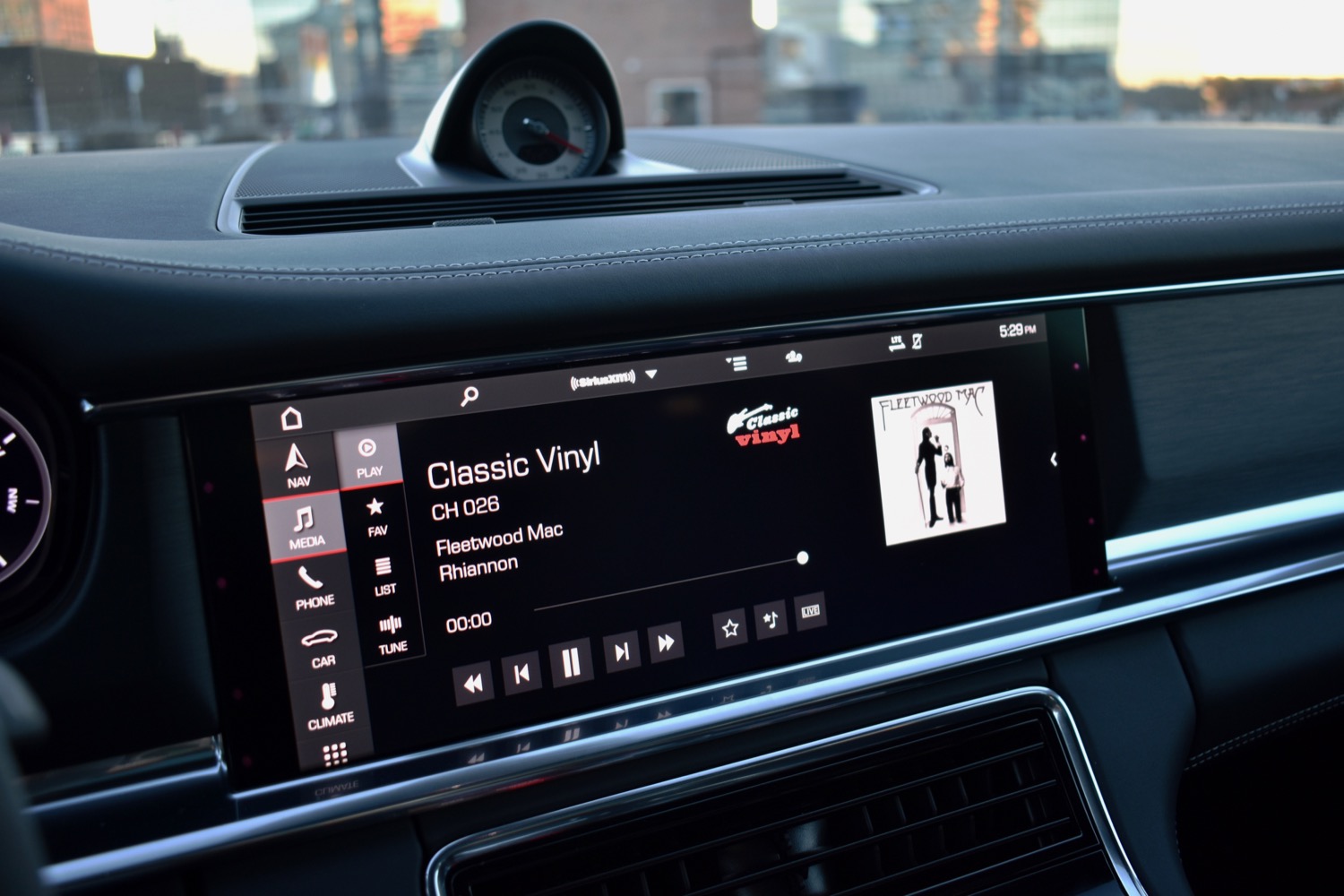
Embedded in the Panamera’s retro-looking dashboard are a 12.3-inch central touchscreen and an instrument cluster with reconfigurable digital displays (a head-up display and night vision are also available), Bluetooth, wireless Apple CarPlay and wired Android Auto.
Porsche delivers a solid infotainment system without resorting to the gimmickry of some rivals. The tech simply works, with easy-to-navigate touchscreen controls, the aforementioned center console buttons for important functions like climate control, and nice-looking graphics with a distinctive typeface.
Luxury automakers often seem pressured to pile on new features just to outdo their rivals, but Porsche’s designers and engineers seem to have remembered that the Panamera is a driver’s car, not a four-wheeled smartphone. More automakers should follow that example.
Safety
The Insurance Institute for Highway Safety (IIHS) and National Highway Traffic Safety Administration (NHTSA) haven’t published safety ratings for the 2021 Panamera. That’s not uncommon for expensive, low-volume vehicles like this.
Standard safety features include lane-keep assist, parking sensors, and traffic sign recognition, but you’ll have to pay extra for other features like blind-spot monitoring and adaptive cruise control. Porsche’s InnoDrive system offers a greater degree of automation than basic adaptive cruise control systems thanks to navigation integration, but it’s still worth noting that even mainstream brands now offer adaptive cruise control as standard equipment.
Cost-effectiveness
Panamera models with the base six-cylinder powertrain are rated at 20 mpg combined, while the optional V8 knocks a couple of mpg off those fuel-economy ratings. The most efficient model is the Panamera 4 E-Hybrid plug-in hybrid, which boasts an EPA-rated 19 miles of electric range with an efficiency rating of 52 MPGe combined. However, as with all plug-in hybrids, that’s very dependent on how often you charge. In hybrid mode, the Panamera 4 E-Hybrid is rated at 22 mpg combined—not much better than the standard Panamera.
Porsche offers a four-year, 50,000-mile new vehicle warranty, but without the free scheduled maintenance some other luxury brands include with their coverage.
Pricing for the 2021 Porsche Panamera starts at $88,550 (all prices include a mandatory $1,350 destination charge) for a base RWD sedan. Choose a higher trim level, AWD, the Executive or Sport Turismo body styles, or the V8 or plug-in hybrid powertrains, and the price quickly climbs into the six-figure range and beyond. The base price of a Panamera Turbo S E-Hybrid Executive tops $200,000 MSRP, for example.
Our Panamera GTS sedan test car had a $130,650 base price but, typically for a luxury car, it had a long list of options to tempt buyers into spending even more. Features like rear-axle steering, a surround-view camera system, lane-change assist, a Bose surround sound system, soft-close doors, and Chalk (gray) paint inflated the as-tested price to $148,800. Porsche can reasonably expect its customers to have deep pockets, but it’s hard to call a car with a pricing structure like this a good value.
That pricing structure also puts the Panamera in alignment with higher-end versions of the Audi A6, BMW 5 Series, and Mercedes-Benz E-Class. Even the base Panamera sedan is priced well above the BMW M550i xDrive, for example, let alone the base 5 Series models. Sportier Panamera models compete with the BMW M5 and Mercedes-AMG E63 or, in the case the Panamera Sport Turismo, the Audi RS 6 Avant and Mercedes E63 wagons.
Porsche thus takes an asymmetrical approach to luxury sedans. While other German sedans have to do it all, balancing luxury and practicality with sporty driving dynamics, the Porsche brand frees the Panamera to focus more on performance. So while Porsche doesn’t offer truly entry-level Panamera models as a gateway to the luxury lifestyle, it also doesn’t dilute that focus on building cars for driving enthusiasts. If a memorable driving experience is your top priority, this is the luxury sedan for you.
What owners say
The Panamera 4S is an amazing car that outperforms M5, RS7 and other similar 4door sports sedans plus it has a sleek look.
May 31, 2021Trims & specs
Base MSRP $87,200 | Seating 5 |
Engine 2.9L 325 hp V6 | Cargo Capacity 17.6 cu ft |
Combined MPG 21 | Drivetrain RWD |
Base MSRP $181,700 | Seating 4 |
Engine 4.0L 620 hp V8 | Cargo Capacity 18.3 cu ft |
Combined MPG 18 | Drivetrain AWD |
Base MSRP $91,800 | Seating 5 |
Engine 2.9L 325 hp V6 | Cargo Capacity 17.6 cu ft |
Combined MPG 21 | Drivetrain AWD |
Base MSRP $98,000 | Seating 4 |
Engine 2.9L 325 hp V6 | Cargo Capacity 18.3 cu ft |
Combined MPG 20 | Drivetrain AWD |
Base MSRP $98,500 | Seating 4 |
Engine 2.9L 325 hp V6 | Cargo Capacity 17.6 cu ft |
Combined MPG 20 | Drivetrain AWD |
Base MSRP $116,300 | Seating 4 |
Engine 2.9L 443 hp V6 | Cargo Capacity 17.6 cu ft |
Combined MPG 20 | Drivetrain AWD |
Base MSRP $105,000 | Seating 5 |
Engine 2.9L 443 hp V6 | Cargo Capacity 17.6 cu ft |
Combined MPG 21 | Drivetrain AWD |
Base MSRP $135,500 | Seating 4 |
Engine 4.0L 473 hp V8 | Cargo Capacity 18.3 cu ft |
Combined MPG 17 | Drivetrain AWD |
Base MSRP $129,300 | Seating 5 |
Engine 4.0L 473 hp V8 | Cargo Capacity 17.6 cu ft |
Combined MPG 18 | Drivetrain AWD |
Base MSRP $111,200 | Seating 4 |
Engine 2.9L 443 hp V6 | Cargo Capacity 18.3 cu ft |
Combined MPG 20 | Drivetrain AWD |
Base MSRP $177,700 | Seating 5 |
Engine 4.0L 620 hp V8 | Cargo Capacity 17.6 cu ft |
Combined MPG 18 | Drivetrain AWD |
Base MSRP $188,100 | Seating 4 |
Engine 4.0L 620 hp V8 | Cargo Capacity 17.6 cu ft |
Combined MPG 18 | Drivetrain AWD |


Pricing trends
MSRP range
$87,200 - $188,100
Current avg. market price
$66,243
Trending up by 3.4% this month
May 2026 - November 2026