2022 Toyota Sienna Reviews, Pricing & Specs


Pros & cons
What we like
Fuel-efficient
Plenty of cargo space
Great safety ratings
What to consider
Priced higher than competitors
The CarGurus verdict
Toyota’s minivan returns for its second year post-redesign, maintaining its hybrid swagger.
The 2022 Toyota Sienna hybrid minivan rolls into the second model year following a redesign for 2021. Last year’s successful makeover with a standard hybrid powertrain returns unchanged, but a new Woodland trim level is available to attract adventurous families (or those who want to look that way).
out of 10 expert review
Look & feel
Minivans occupy an odd niche in the automotive marketplace. Logic and reason seem to dictate that every growing family should drive a minivan, yet the rise of the SUV has crushed the class. Neither Ford nor General Motors have built a minivan for the United States market in a decade. Mazda, Nissan, and Volkswagen dropped their minivans years ago, and Kia now calls its minivan a “Multi-Purpose Vehicle (MPV)"—pointedly avoiding the “minivan” label.
Toyota never ran from the minivan.
Toyota’s original Van lasted from 1984 to 1989. It was replaced in 1990 by the innovative mid-engined Previa. The Sienna debuted in 1998, riding on a front-wheel-drive (FWD) platform shared with Camry, and suddenly Toyota was in the minivan mix. A second-generation Sienna came out in 2004, followed by a third generation in 2011. That version lasted a long time, as Toyota didn't launch the fourth-generation Sienna until the 2021 model year.
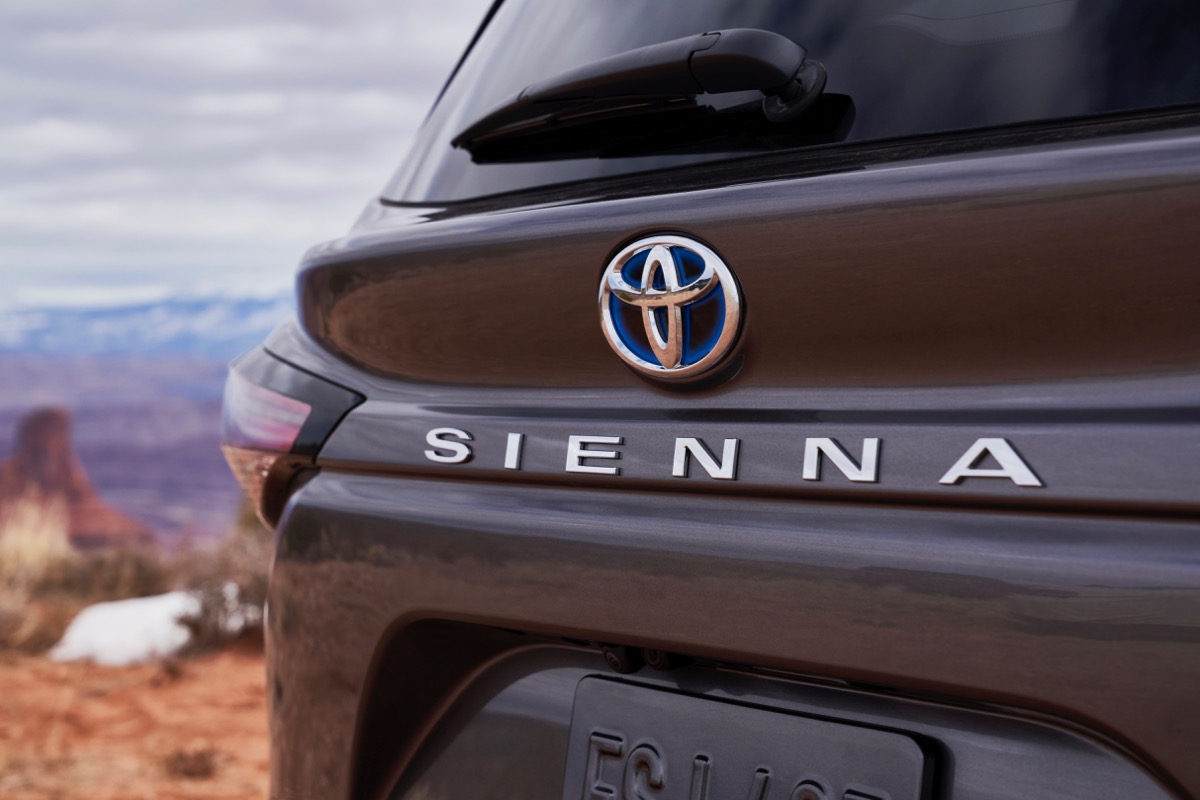
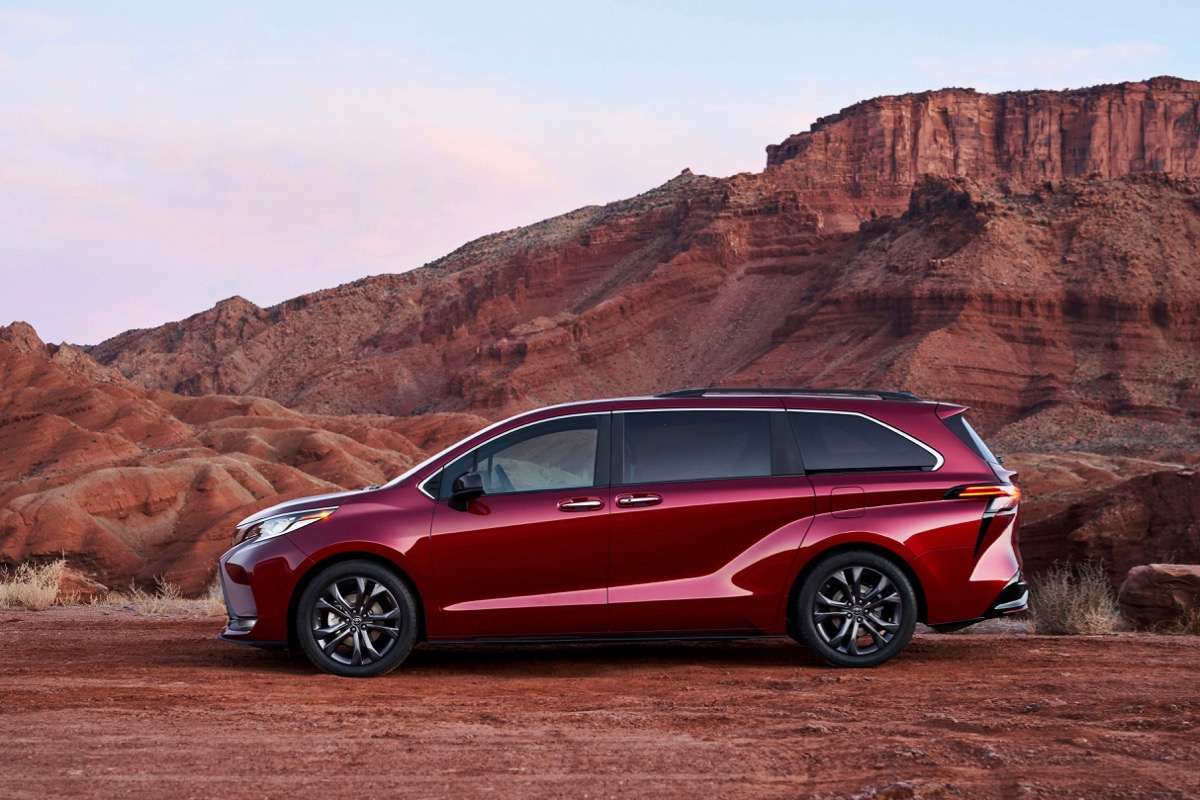
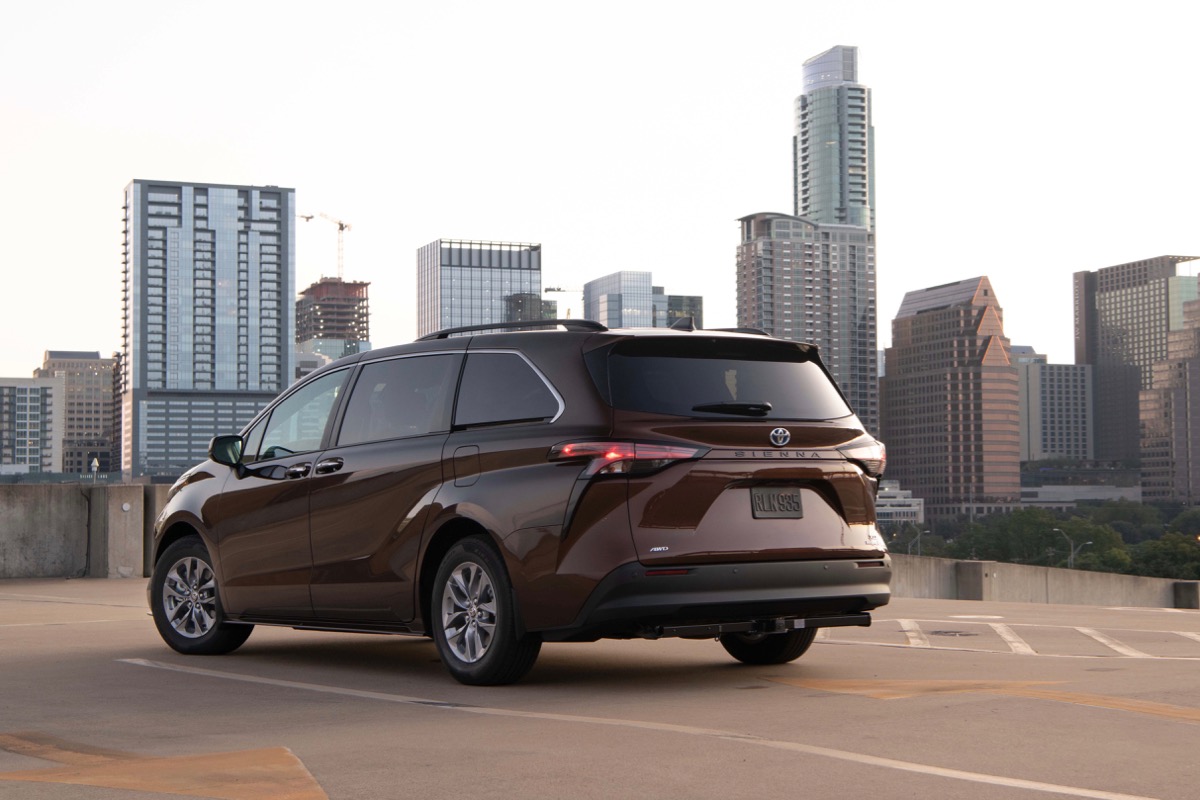
The latest Sienna does its best to present with SUV style. It doesn’t conceal the fact that it’s a minivan—that would be impossible, as the sliding side doors give it away right away. But it does have a macho front end, and Toyota re-engineered the door hinges and slides to bury the slider channel below the rear side window frame and tuck the door into the body. The rear doors have styling details integrated into the rear fender well, and the overall profile is assertive and has a nice stance. Seventeen-inch wheels are standard on base models, stepping up to 18-inch and even 20-inch wheels on upper trim levels.
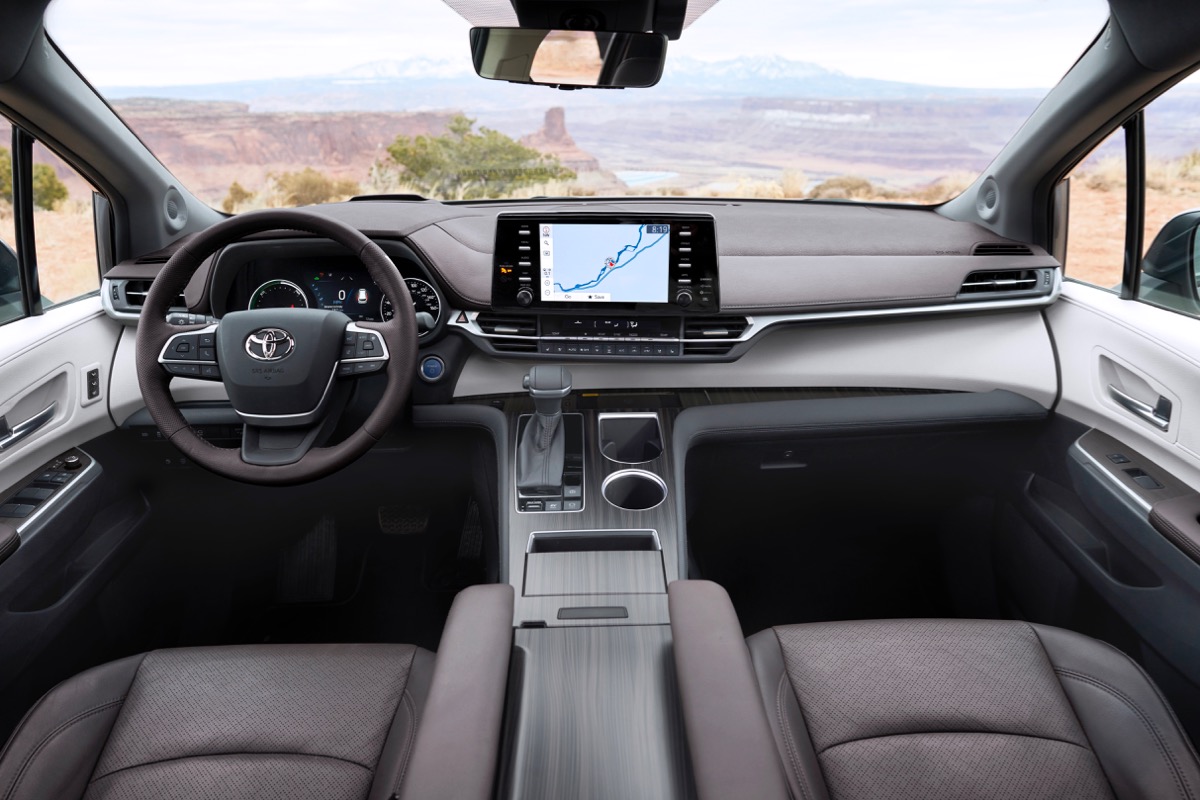
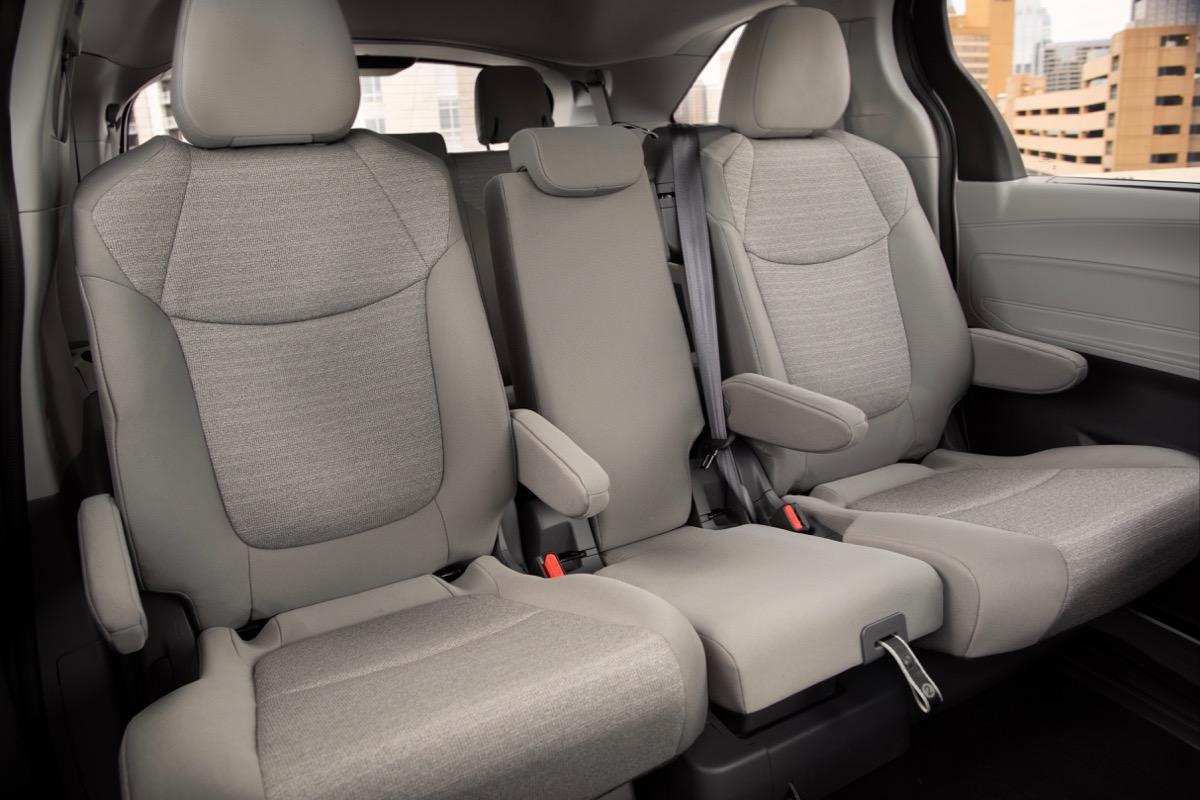
The interior avoids the minivan/school bus feel in the front cabin with an uncluttered design. Befitting a family hauler, there’s a ton of clever storage up front, in the second and third rows. Particularly handy are the under-console open storage area, big door pockets, and abundant cup holders (15 or 16, depending on whether you choose a spare tire). Second- and third-row passengers get comfortable, roomy seating, including available second-row captain’s chairs with ottomans (a bench seat is also available), and a spacious three-across bench in the third row. The third row is standard on all grades. It’s a 60/40-split bench that quickly stores away into the floor. The second-row seats slide up to 25 inches, making it super easy to get into the third row when necessary.
Performance
Carrying over from 2021, the Sienna minivan comes exclusively with a hybrid powertrain. This feature was a welcome one when it debuted last year for the first time in a Toyota minivan, especially considering Toyota’s position as a leading producer of hybrid vehicles. Toyota now makes hybrid cars (Avalon, Camry, Corolla, Prius), hybrid SUVs (Highlander, RAV4, Venza), and it's launching a Tundra hybrid pickup truck for the 2022 model year.
Like the Highlander and RAV4 hybrids, the Sienna uses a 2.5-liter four-cylinder engine and two electric motors, which combine to produce 243 horsepower. FWD is standard, but all-wheel drive (AWD) is available on all trim levels. The AWD system adds a separate electric motor driving the rear wheels with 54 hp and 89 pound-feet of torque, which eliminates much mechanical complication.
Sienna uses an electronically controlled continuously variable automatic transmission (CVT) instead of a conventional stepped gear automatic transmission. CVTs have their fans, as they can deliver power smoothly and efficiently and help maximize fuel efficiency. Drivers can engage four selectable drive modes (Normal, EV, Eco, and Sport) via a center console toggle.
Handling is better than expected for a minivan, thanks to the Toyota Next Generation Architecture (TNGA) platform’s front suspension and steering and independent rear trailing arm suspension. Body roll is minimal, and Sienna Hybrid eats up the highway with comfort and ease.
This brings us to the big news for Sienna Hybrid: EPA fuel economy numbers. The government predicts FWD Sienna Hybrid models can achieve 36 mpg city/36 mpg highway/36 mpg combined, while AWD models get 35 mpg city/36 mpg highway/35 mpg combined ratings.
Toyota tucked Sienna’s 288-volt nickel metal-hydride battery pack under the front seats in a single stack design. The pack comes with a 10-year/150,000-mile warranty.
Form & function
The Sienna is ready to be the family workhorse, capable of conveying a full 4x8 sheet of plywood inside with the tailgate closed. The sliding second row also adds flexibility for loading luggage and freight, either behind the second row through the tailgate, or in front of the second row, through the side doors. With the second row in its default position, cargo measurements are 33.5 cubic feet behind the third row, 75.2 cubic feet behind the second row, and 101 cubic feet behind the first row. The Sienna also has a 3,500-pound maximum towing capacity.
The standard 60/40-split third-row bench stores away into the floor easily. Each row has storage cubby space and cupholders, and all four side doors have bottle holders.
Both side sliding doors and the rear tailgate are power-operated, with foot-motion triggers. Approaching the Sienna with an arm full of groceries (or a toddler) and not having to free up a hand to access the passenger or cargo compartment is a welcome convenience.
Technology
The Sienna gets a ton of standard and available technology features. A 9-inch touchscreen is standard in all grades, with Apple CarPlay, Android Auto, and Amazon Alexa, SiriusXM (with a three-month trial), one USB media port, and six USB charging ports throughout the cabin.
We wish the Sienna had wireless Apple CarPlay and Android Auto capability, a feature we’re seeing in many vehicles today. Every automatic convenience a minivan driver can get is welcome, and this one is an unfortunate oversight.
The Sienna comes with a one-year trial of Safety Connect and Remote Connect telematics services (on XLE and above models), a 10-year trial of Service Connect, and a three-month trial of AT&T WiFi Connect with up to 2 gigabytes of data included. Bluetooth hands-free and audio streaming are included on all trim levels. Qi wireless phone charging is standard on Limited and Platinum models, available on all others. A 1500-watt inverter with a 120-volt AC outlet is optional on the Sienna XLE and above to power and charge devices (or a coffee maker).
Audio and multimedia systems march upwards with trim levels, from a six-speaker audio system on the LE to a 12-speaker JBL system on higher trim levels. A rear-seat entertainment system is available on XLE and above. It uses a fold-down, ceiling-mounted widescreen 11.6-inch 1080p display. The system includes a remote and two wireless headphones and can accept an HDMI input on the back of the center console.
A color multi-information display in the instrument panel center (4.2-inch on the LE, XLE, and XSE; 7-inch on LTD and Platinum) displays the odometer, fuel economy, trip information, and alert messages. In Platinum trim models, a 10-inch color head-up display shows speedometer, navigation, and hybrid system information. Having a head-up display can make driving safer and more relaxing, as the driver never has to look away from the road to get speed and speed limit information, and even navigation prompts can be displayed on the screen.
Limited and Platinum models can upgrade to a digital rearview mirror, swapping out the actual reflected view in the mirror with the rear video camera feed. When carrying a full load of passengers, or when passengers are using the rear-seat entertainment system, the digital rearview assures the driver of a clear look at the road behind. Remote keyless entry is standard with push-button start, upgraded to Smart Key System on XLE and above trim levels.
Safety
The 2021 Toyota Sienna received a Top Safety Pick+ rating from the Insurance Institute for Highway Safety (IIHS), and we expect the nearly identical 2022 model to get the same top rating. The 2022 Sienna was a five-star (out of five) vehicle according to the National Highway Traffic Safety Administration (NHTSA), following its crash-testing, just like it was in 2021.
The standard Toyota Safety Sense 2.0 suite of driver aids includes adaptive cruise control, Lane Tracing Assist lance centering, forward collision warning (with pedestrian detection), automatic emergency braking, lane departure warning, automatic high beams, and traffic sign recognition. Also standard is Toyota's Star Safety System, which includes expected safety features like stability control, traction control, anti-lock brakes, and electronic brake-force distribution.
The Sienna also gets 10 airbags and several LATCH (Lower Anchors and Tethers for Children) child-seat connectors—five locations for eight-passenger vans/four locations for seven-passenger models. A rear-seat reminder system is also standard, which might be very important for families with five child seats in their vans.
Tire-pressure monitoring and an inflator kit are standard on all models, and buyers can still opt for a spare tire. Toyota changed the spare tire location (in the wall of the cargo space) for safety and convenience. The tire was mounted underneath the vehicle in the previous generation Sienna—not ideal for roadside tire changes.
Cost-effectiveness
The 2022 Toyota Sienna is available in six trim levels. Pricing starts at $34,560 for a base eight-passenger LE FWD model ($36,635 with AWD). XLE pricing starts at $39,925 for an eight-passenger version with FWD, $40,000 for a seven-passenger FWD model, and $41,925 for the seven-passenger AWD version.
Higher-level Sienna models are only available in the seven-seat configuration, with second-row captain's chairs. The XSE starts at $42,175 with FWD ($42,935 with AWD) and the Limited starts at $46,875 ($48,675 with AWD). MSRP for a range-topping Sienna Platinum is just over $50,000 with FWD or AWD.
The new Woodland Edition trim level starts at $45,350 and comes with seven-passenger seating and AWD only.
The quoted prices do not include the mandatory $1,215 delivery, processing, and handling fee added to every vehicle. A few options and packages are available, including the $1,790-$1,915 rear-seat entertainment system (available on all but the LE) and $125 spare-tire delete (available on all models). Prices reflect a moderate $100-$175 increase over 2021.
The Sienna carries Toyota’s 36-month/36,000-mile basic warranty, 60-month/60,000-mile powertrain warranty, 60-month/no mileage limit corrosion warranty, and eight-year/100,000-mile hybrid-related component warranty.
The only other electrified minivan is the 2022 Chrysler Pacifica Hybrid (which starts at $48,255 and goes up to $56,435) but it's actually a plug-in hybrid, with the ability to drive up to 32 miles on electric power alone. Other minivans, including the Honda Odyssey (starting at $33,515) and Kia Carnival (starting at $33,275) don't offer a hybrid option. Chrysler also offers a non-hybrid Pacifica (starting at $37,095) and the Voyager (starting at $33,000), which is essentially a de-contented Pacifica.
The 2022 Toyota Sienna is not for everyone. But it doesn’t have to be. Let the other families drive their SUVs and chuckle as they struggle to load their kids, pets, and groceries onboard. Enjoy a relaxing, comfortable ride in a Sienna, confident in your decision to choose function over fashion.
What owners say
After doing some research, we decided that a Honda or Toyota mini-van would be the best option for our expanding family. We ultimately went with the Toyota Sienna due to it being a hybrid, captain seats in the middle row, full trunk that will actually fit stuff, and the drive ability.
August 8, 2025Drives great, great mileage. Im impressed with the screen options and data it tracks- even on the base LE model. Im excited to drive it every time I get in!
August 17, 2023Hybrid Sienna is great value. Compare to more expensive Hybrid Pacifica. Other brands should come online next year. Supply of Sienna Hybrid is very low. Not taking new orders. Probably will be well into 2023 model year before supply returns.
August 11, 2022What owners say
After doing some research, we decided that a Honda or Toyota mini-van would be the best option for our expanding family. We ultimately went with the Toyota Sienna due to it being a hybrid, captain seats in the middle row, full trunk that will actually fit stuff, and the drive ability.
August 8, 2025Drives great, great mileage. Im impressed with the screen options and data it tracks- even on the base LE model. Im excited to drive it every time I get in!
August 17, 2023Hybrid Sienna is great value. Compare to more expensive Hybrid Pacifica. Other brands should come online next year. Supply of Sienna Hybrid is very low. Not taking new orders. Probably will be well into 2023 model year before supply returns.
August 11, 2022Great fuel economy for this size vehicle. Little expensive, but will save on gas during ownership. Needs a little more power hp, but would be buying for the great gas mileage. Compare this Sienna to a Chrysler Pacifica hybrid, which is also expensive.
December 16, 2022Trims & specs
Base MSRP $45,500 | Seating 7 |
Engine 2.5L 245 hp I4 Hybrid | Cargo Capacity 33.5 cu ft |
Fuel Economy 35 MPG/MPGe (City), 36 MPG/MPGe (Highway) | Drivetrain AWD |
Base MSRP $49,525 | Seating 7 |
Engine 2.5L 245 hp I4 Hybrid | Cargo Capacity 33.5 cu ft |
Fuel Economy 35 MPG/MPGe (City), 36 MPG/MPGe (Highway) | Drivetrain AWD |
Base MSRP $47,525 | Seating 7 |
Engine 2.5L 245 hp I4 Hybrid | Cargo Capacity 33.5 cu ft |
Fuel Economy 36 MPG/MPGe (City), 36 MPG/MPGe (Highway) | Drivetrain FWD |
Base MSRP $51,485 | Seating 7 |
Engine 2.5L 245 hp I4 Hybrid | Cargo Capacity 33.5 cu ft |
Fuel Economy 35 MPG/MPGe (City), 36 MPG/MPGe (Highway) | Drivetrain AWD |
Base MSRP $50,725 | Seating 7 |
Engine 2.5L 245 hp I4 Hybrid | Cargo Capacity 33.5 cu ft |
Fuel Economy 36 MPG/MPGe (City), 36 MPG/MPGe (Highway) | Drivetrain FWD |
Base MSRP $42,575 | Seating 7 |
Engine 2.5L 245 hp I4 Hybrid | Cargo Capacity 33.5 cu ft |
Fuel Economy 35 MPG/MPGe (City), 36 MPG/MPGe (Highway) | Drivetrain AWD |
Base MSRP $40,575 | Seating 7 |
Engine 2.5L 245 hp I4 Hybrid | Cargo Capacity 33.5 cu ft |
Fuel Economy 36 MPG/MPGe (City), 36 MPG/MPGe (Highway) | Drivetrain FWD |
Base MSRP $40,575 | Seating 8 |
Engine 2.5L 245 hp I4 Hybrid | Cargo Capacity 33.5 cu ft |
Fuel Economy 36 MPG/MPGe (City), 36 MPG/MPGe (Highway) | Drivetrain FWD |
Base MSRP $43,585 | Seating 7 |
Engine 2.5L 245 hp I4 Hybrid | Cargo Capacity 33.5 cu ft |
Fuel Economy 35 MPG/MPGe (City), 36 MPG/MPGe (Highway) | Drivetrain AWD |
Base MSRP $42,825 | Seating 7 |
Engine 2.5L 245 hp I4 Hybrid | Cargo Capacity 33.5 cu ft |
Fuel Economy 36 MPG/MPGe (City), 36 MPG/MPGe (Highway) | Drivetrain FWD |
Base MSRP $37,285 | Seating 8 |
Engine 2.5L 245 hp I4 Hybrid | Cargo Capacity 33.5 cu ft |
Fuel Economy 35 MPG/MPGe (City), 36 MPG/MPGe (Highway) | Drivetrain AWD |
Base MSRP N/A | Seating N/A |
Engine N/A | Cargo Capacity N/A |
Fuel Economy N/A | Drivetrain N/A |
Base MSRP $35,285 | Seating 8 |
Engine 2.5L 245 hp I4 Hybrid | Cargo Capacity 33.5 cu ft |
Fuel Economy 36 MPG/MPGe (City), 36 MPG/MPGe (Highway) | Drivetrain FWD |


Pricing trends
MSRP range
$35,285 - $51,485
Current avg. market price
$35,679
Trending down by 1.3% this month
May 2026 - November 2026


