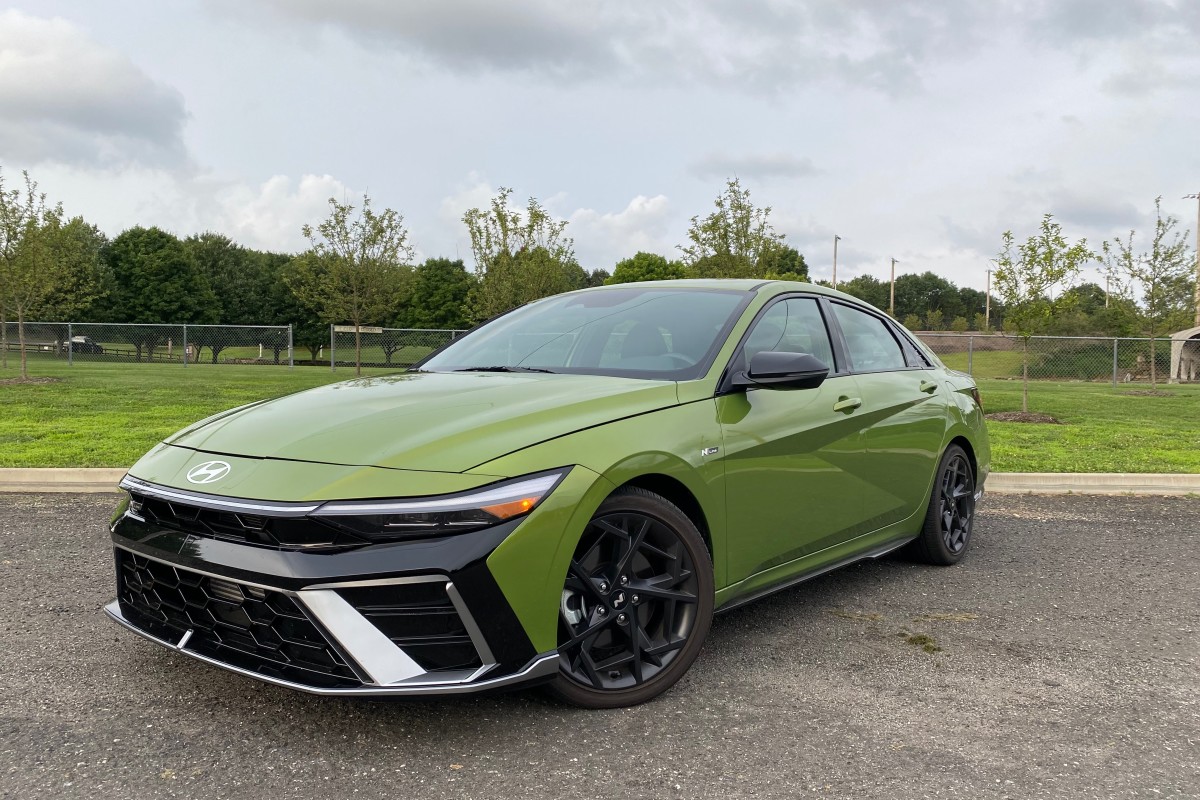
2023 Hyundai IONIQ 6 Reviews, Pricing & Specs


Pros & cons
What we like
Great handling
Impressive electric range
Comfortable
What to consider
Potentially polarizing design
Not much cargo space
Expert review
Hyundai's latest EV has a design that's impossible to ignore.
It’s said that electric cars are the future, but the 2023 Hyundai Ioniq 6 is one of the few that actually looks the part. The production version of the Hyundai Prophecy concept, this capsule-shaped sedan starkly contrasts the Hyundai Ioniq 5, its sibling in the Korean automaker’s Ioniq EV sub-brand, which takes a more retro styling direction.
The Ioniq 6 shares everything that is good about the Ioniq 5, though, including Hyundai’s E-GMP dedicated EV architecture, high-power charging, and user-friendly infotainment system. It’s just got a different wrapper, one that bucks the trend of electric crossovers for the cleaner look of a traditional sedan. Hyundai considers the Tesla Model 3 and Polestar 2 to be the Ioniq's main rivals, which makes sense, since they're the only electric sedans in its price range.
The lineup is broadly similar to the Ioniq 5 as well, with Standard Range and Long Range battery packs, single-motor rear-wheel drive (RWD) and dual-motor all-wheel drive (AWD) powertrains, and SE, SEL, and Limited trim levels. We drove a dual-motor AWD Limited model for this review.
out of 10 expert review
Look & feel
While based on the same architecture as the Ioniq 5 (as well as the Kia EV6 and Genesis GV60), the Ioniq 6 goes in the complete opposite direction when it comes to styling.
Hyundai based the Ioniq 5 on its 45 concept car, a tribute to the Hyundai Pony, the first production model the automaker developed in-house, and which started production in 1975. That meant lots of flat edges and a hatchback body style. The Ioniq 6, on the other hand, is a productionized version of the Hyundai Prophecy concept, a sleek sedan with no nostalgic ties.
The forward-looking design carries over with a few alterations. The Ioniq 6 has the same distinctive silhouette as the Prophecy, with a rounded greenhouse and short front and rear overhangs. But where the concept was as smooth as a riverbed pebble, the production Ioniq 6 looks a bit fussier. Vertical elements at the corners of the front fascia, a more complex headlight design, and a black bar (which houses sensors for the driver-assist systems) break up the otherwise-clean design.
Importantly for maximizing range, the Ioniq 6 has a drag coefficient of 0.22—the lowest ever for a Hyundai production model. The overall shape of the body, with its low nose and Saab 92-like rear end, helped achieve that, according to Hyundai, along with active air flaps, a rear spoiler, underbody tray, and "flow separation traps" on the rear bumper. Details matter too: Hyundai reduced the wheel arch gaps with small trim pieces, used aerodynamic 18-inch and 20-inch wheel designs, and even redesigned the front and rear badges.
The interior carries the design theme of the Ioniq 5 cabin forward. It still looks like a modern interpretation of a 1980s car interior, and still has a pair of display screens prominently placed on an otherwise unadorned dashboard. But the dashboard has sprouted pronounced winglets (which house screens for camera mirrors in other markets), and the door panels have elaborate carve outs that the optional dual-color ambient lighting can play off of.
Hyundai used some sustainable materials, including recycled fishing nets for the carpets. The focus on sustainability also means real leather upholstery; base SE models have cloth seats, while SEL and Limited models have H-Tex leatherette upholstery, with front heated and ventilated seats standard on the Limited.
Performance
As noted above, Hyundai offers multiple configurations of battery pack and powertrain. The base SE RWD Standard Range has a single electric motor sending 149 horsepower and 258 pound-feet of torque to its rear wheels, with a 53-kilowatt-hour battery pack.
The SE RWD Long Range model gets a 77.4-kWh battery pack and a boost to 225 hp, while torque output remains unchanged. The other RWD trim levels—SEL and Limited—also get this larger pack and higher-horsepower motor. Finally, dual-motor AWD models—the SE AWD Long Range, SEL AWD, and Limited AWD—add a second motor powering the front wheels for a combined output of 320 hp and 446 lb-ft of torque. AWD is only available with the larger battery pack.
The Ioniq 6 isn't as sporty as the Tesla Model 3 and Polestar 2, but it's a big improvement over the Ioniq 5 in both handling and comfort. It seemed more able to absorb bumps, and with less body jiggling. Superior body control also helped handling, giving the Ioniq 6 a planted feel in corners. While the steering wasn't particularly quick, and weighted up unnecessarily in Sport mode, the Ioniq 6 also felt eager to change directions, and responded smoothly to small steering corrections. Instead of attacking corners, as in a proper sports sedan, the Ioniq 6 gracefully flows through them — a very nice experience.
Hyundai also provides a few options for regenerative braking that should cover all bases. Drivers get four levels of regeneration, selectable with steering-wheel paddles, ranging from a minimal setting that allows the Ioniq 6 to coast and creep forward in traffic, to true one-pedal driving. A "smart" setting will also use the built-in radar to increase or decrease the amount of regeneration when following another car, helping maintain a consistent distance. BMW offers similar tech, but it's nice to have the ability to opt out and manually set the level of regen.
Form & function
It's unusual to see an electric sedan that isn't a Tesla, Lucid, Polestar, or the product of a German luxury brand. Most of Hyundai's rivals have opted for crossover SUV body styles, assuming that what works for gasoline-car sales will also work for EVs. The Ioniq 6 proves that a conventional sedan can be plenty practical, though.
Despite the low roof, the Ioniq 6 doesn't give up much headroom compared to the current crop of electric crossovers. If you don't get the optional sunroof, it has more headroom in both rows than a Toyota bZ4X, in fact, and more rear-seat headroom than a Kia EV6. The Hyundai also boasts more legroom in both rows than a Volkswagen ID.4, and slightly more front-seat legroom than its Ioniq 5 sibling. The Ioniq 6 also offers substantially more rear-seat legroom than the Tesla Model 3 and Polestar 2.
Cargo space is really the limiting factor. The trunk's 11.2 cubic feet of trunk space is less than even the tiny cargo area of a Chevrolet Bolt EV, and it's less than you get in the rival Model 3 and Polestar 2. The latter is also a hatchback, which makes loading and unloading cargo easier than with the Ioniq 6's fairly small trunk opening, and unlike the Ioniq 6, both offer frunks. A 60/40 split-folding rear seat is standard, but Hyundai doesn't quote a cargo-space figure with the seat folded.
The Ioniq 6 has a low floor like the Ioniq 5, but in this case Hyundai also included a traditional center console, leaving some handy storage space below. The sculpted door panels don't leave as much room for stashing water bottles as some other cars, but that also leaves more space between the doors and seats, making the interior feel less cramped. Rear-seat passengers also get climate-control vents and a pair of USB-C charging ports; Limited models add a rear power outlet.
Hyundai carried over the steering-column-mounted shifter, which takes some getting used to, as do the door-lock and window switches, which are located on the center console rather than the door panels. With its short hood and traditional sedan ride height, the Ioniq 6 also has a different driving position than most other EVs, giving you a feeling of being closer to the road.
Technology
The infotainment system includes dual 12.3-inch displays, one serving as the instrument cluster, the other as the central touchscreen, placed alongside each other to create the appearance of one continuous screen. Bluetooth and a Wi-Fi hotspot are standard, along with Apple CarPlay and Android Auto, but only wired versions are available. A head-up display isn't available due to packaging issues, but we didn't miss it.
Like other recent Hyundai infotainment systems, the Ioniq 6's interface offers pleasing graphics and a sensible layout. However, the voice-recognition system in our test car had trouble interpreting certain commands, such as changing the temperature or finding a certain genre of music on SiriusXM satellite radio.
Hyundai's Digital Key feature, which allows a smartphone or smart watch to replace the key fob, returns, but it now works for iOS as well as Android operating systems. The feature is part of Hyundai's Bluelink telematics package which, starting with the Ioniq 6, is free for as long as the 4G LTE network it runs on is active. That's much more generous than other automakers, which generally start charging for certain connectivity features after a few years.
A perk of the E-GMP platform is bidirectional charging, which Hyundai calls Vehicle-to-Load (V2L). This means the Ioniq 6 can output power at up to 1.9 kilowatts to run devices or help charge other EVs, either using an adapter for the charge port, or the in-car outlet available on Limited models.
Safety
Crash-test ratings from the National Highway Traffic Safety Administration (NHTSA) and Insurance Institute for Highway Safety (IIHS) aren't available yet, but the Ioniq 6 does get the same complement of driver aids as other Hyundai models.
Standard driver-assist tech includes forward collision warning, lane keep assist, blind-spot monitoring, and adaptive cruise control. The SEL model adds blind-spot collision avoidance assist, which intervenes instead of merely warning the driver, and Highway Driving Assist 2. Along with those features, the top Ioniq 6 Limited grade gets Remote Smart Parking Assist 2 automated parking, a surround-view camera system, and Blind-Spot View Monitor blind-spot cameras.
Previously seen on other Hyundai, Kia, and Genesis models, Highway Driving Assist 2 essentially adds automated lane centering to adaptive cruise control. For the Ioniq 6, a new sensor suite also enables automated lane changes, vehicle cut-in response, and will automatically shift the car over in its lane if another vehicle gets too close. You still have to keep your hands on the wheel at all times, though.
Automated lane changes are executed with the flick of a turn signal, but we found the system was a bit slow. It also didn't accelerate or decelerate as quickly as we would have liked when vehicles ahead sped up or braked. Like other driver-assist systems with automated lane centering, Highway Driving Assist 2 also wasn't able to hold the car dead center, especially when the road wasn't straight.
Cost-effectiveness
The Ioniq 6 offers up to 361 miles of EPA-estimated range in SE RWD Long Range form, up that drops to 316 miles of range with AWD. The base SE RWD Standard Range (with the smaller battery pack) is rated at 240 miles. SEL and Limited models fall in between, with ratings of 270 miles with AWD and 270 miles with RWD. Our AWD Limited test car also achieved impressive average efficiency of 3.9 miles per kWh over a day of driving.
Thanks to 800-volt charging hardware that's part of the E-GMP package, the Ioniq 6 can DC fast charge at up to 350 kW, allowing for a 10% to 80% charge in 18 minutes, Hyundai claims. For Level 2 AC charging, the maximum charge rate is 10.9 kW, and Hyundai says a full recharge takes seven hours and 10 minutes.
The 2023 Ioniq 6 comes with a five-year, 60,000-mile, new vehicle warranty and 10-year, 100,000-mile, powertrain warranty, as well as a 10-year, 100,000-mile, battery warranty.
Pricing starts at $42,715 for the base SE RWD Standard Range (all prices include a mandatory $1,115 destination charge). Opt for the larger battery pack and highest range rating, and the MSRP increase to $46,615. SEL and Limited models start at $48,815 and $53,715, respectively. AWD is a $3,500 Premium where available.
That pricing structure means the priciest AWD Limited model is more expensive than dual-motor versions of the Tesla Model 3 and Polestar 2, while the base SE RWD Standard Range offers less range than those rivals, making the $46,615, 361-mile SE RWD Long Range grade the sweet spot of the lineup. No matter which version you choose, however, the Ioniq 6 stands out with a daring design, a pleasant driving experience, and well-integrated tech.

What owners say
Test drive of Limited version Range close to 300m Acceleration, stability, braking = excellent Finish- superb Stylish front and retro style back - like it Technology is improving Auto park and auto lane change could be added. Smart park assist to pull out from garage and park into narrow space is cool. Interior is spacious. Trunk is spacious. Drunk is small and useless, bad idea not to have a cover. Loose items might fallout into mechanical areas. Overall Hyundai is making strides and a good competitor for Tesla and Volvo for the price.
May 29, 2023My sole complaint with electric vehicles right now is that they feel sterile. They take away what makes/made driving enjoyable. For most, this is probably a non-issue, but for some, me included, a vehicle that provides feedback is a vehicle that makes driving worthwhile and pleasurable.
May 10, 2023I like this car way more than BMW i4 - I try both and find Ioniq 6 regeneration level, caushy drive, 10 years warranty for EV battery way exceeds BMW i4 .
November 8, 2023Trims & specs
Base MSRP N/A | Seating 5 |
Engine N/A | Cargo Capacity 11.2 cu ft |
Combined MPG N/A | Drivetrain N/A |
Base MSRP N/A | Seating 5 |
Engine N/A | Cargo Capacity 11.2 cu ft |
Combined MPG N/A | Drivetrain N/A |
Base MSRP N/A | Seating 5 |
Engine N/A | Cargo Capacity 11.2 cu ft |
Combined MPG N/A | Drivetrain N/A |
Base MSRP N/A | Seating 5 |
Engine N/A | Cargo Capacity 11.2 cu ft |
Combined MPG N/A | Drivetrain N/A |
Base MSRP N/A | Seating 5 |
Engine N/A | Cargo Capacity 11.2 cu ft |
Combined MPG N/A | Drivetrain N/A |
Base MSRP N/A | Seating 5 |
Engine N/A | Cargo Capacity 11.2 cu ft |
Combined MPG N/A | Drivetrain N/A |
Base MSRP N/A | Seating 5 |
Engine N/A | Cargo Capacity 11.2 cu ft |
Combined MPG N/A | Drivetrain N/A |
Base MSRP N/A | Seating N/A |
Engine N/A | Cargo Capacity N/A |
Combined MPG N/A | Drivetrain N/A |
Base MSRP N/A | Seating N/A |
Engine N/A | Cargo Capacity N/A |
Combined MPG N/A | Drivetrain N/A |
Base MSRP N/A | Seating N/A |
Engine N/A | Cargo Capacity N/A |
Combined MPG N/A | Drivetrain N/A |


Pricing trends
MSRP range
$41,600 - $56,100
Current avg. market price
$25,309
Trending down by 0.9% this month
May 2026 - October 2026