2023 Land Rover Defender Reviews, Pricing & Specs



Pros & cons
What we like
Classic style
Customization
Lots of powertrain and body choices
What to consider
Cabin is too utilitarian
Body roll
Poor value for money
The CarGurus verdict
The newest iteration of the iconic Land Rover gets an extended-length variant, adding practicality to purpose.
People who buy a Land Rover expect their toy to come in a box. That’s the Defender, a modern recreation of the original Land Rover that served farmers, militaries, and safari guides since the end of World War II. The Defender is a high-end Jeep that treads anywhere. The difference is build quality, comfort, luxury features, and the name. Parking a new Rover on the driveway means at least some things are going very well for the people inside the home. For 2023, the extended Defender 130 joins this versatile and charming lineup of British trucks.
out of 10 expert review
Look & feel
The Defender outsells the Land Rover Discovery by more than four to one. They’re the same size and price, but one looks like a Ford and the other looks like a Land Rover. Customers wanted the boxy design of the old LR4, as the previous-generation Discovery was called in the United States, and ever since the Defender came out for 2020 they’ve ignored the Discovery.
Good industrial design uses a theme that stays consistent from corner to corner. On the Defender, it’s all about the corners. The square-jawed face, the rectangular hood and doors set parallel to the ground, and the abruptly chopped tail define a classic truck. The few body fittings that aren’t cut at 90 degrees are at very steep angles, like the windshield and the lower front bumper.
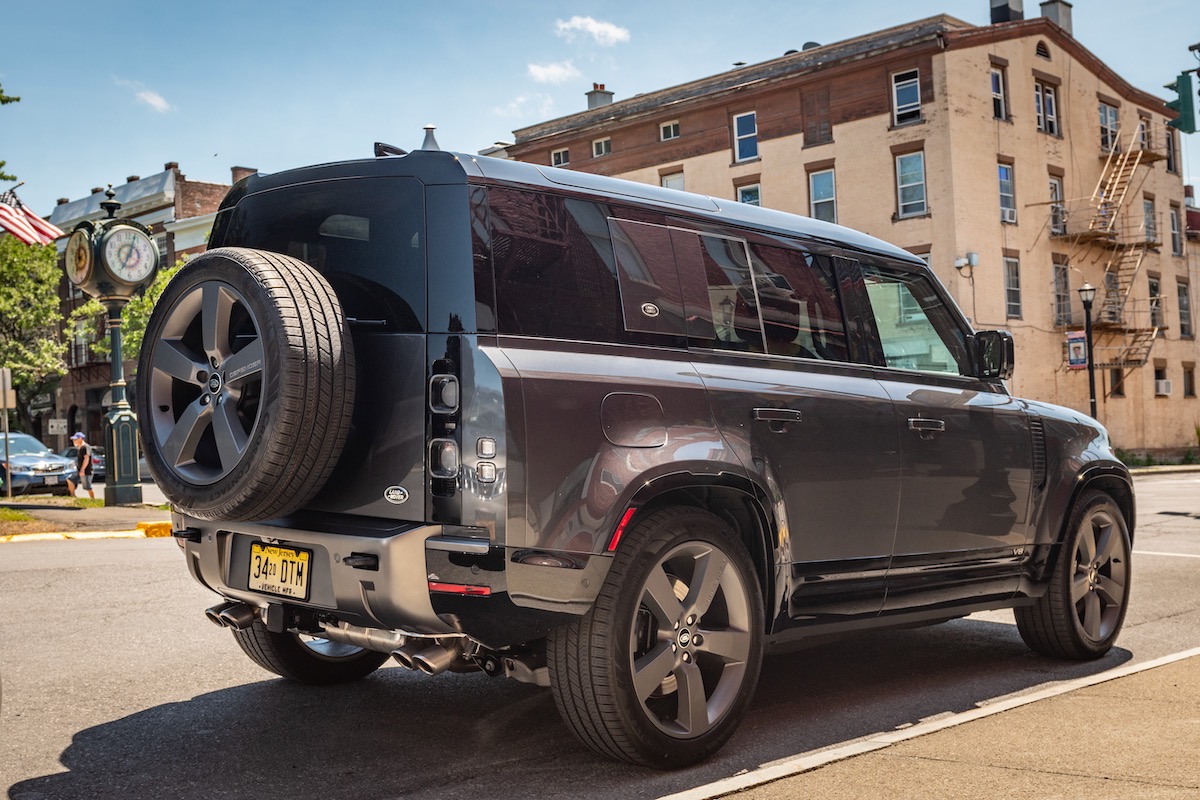
Tasteful accents are a friendly nod to the original 1980s Defender. These include the dome and the faux-metal step plates on the hood, the skylights along the sides of the roof, and the body-color square separating the side glass. While every Defender has a full-size wheel and tire mounted to the hatch—with side hinges so it opens like a huge barn door—the base model’s white steel wheels go even further back in time.
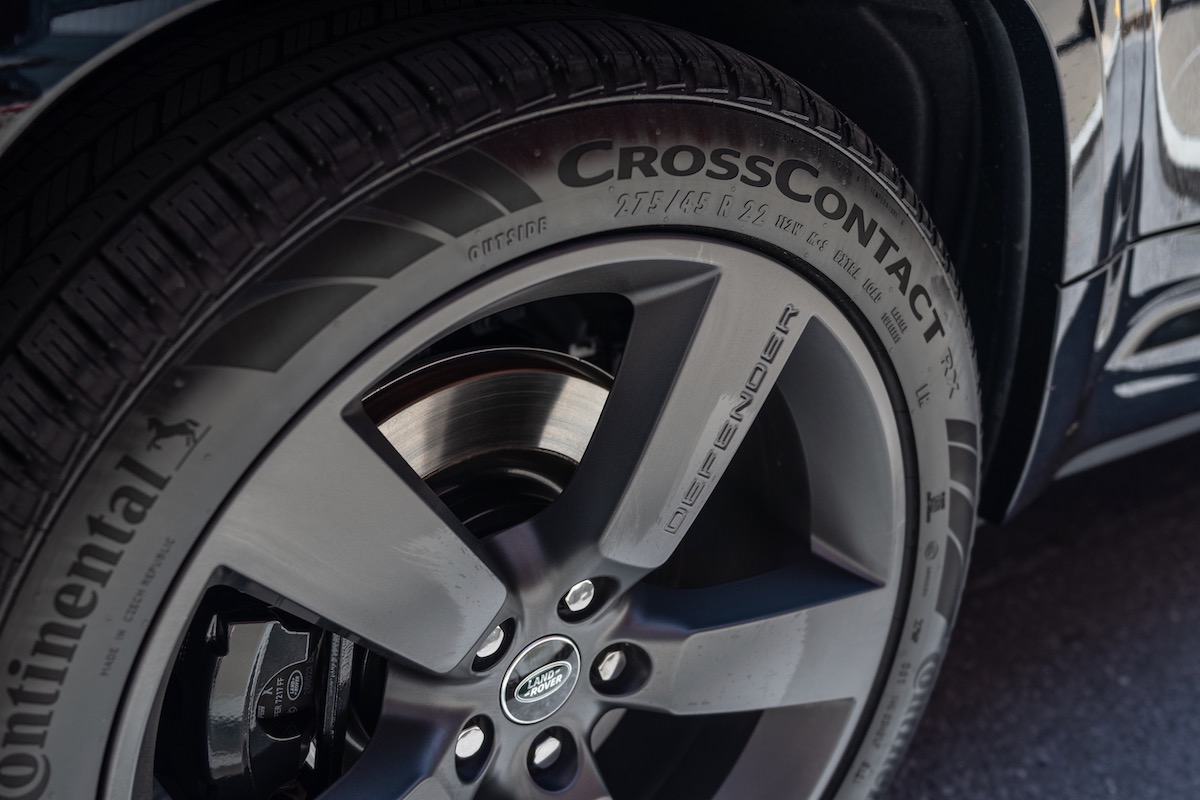
Four accessory packages dress up the Defender with a combination of ladders, roof racks, a storage box mounted on the rear window, snorkel, mud flaps, and skid plates. The X trim has a two-tone hood and front fascia, along with larger wheels and tires. The V8 rides on 22s and is entirely blacked-out head to toe. The Defender is also available in three body styles: 90 (short two-door), 110 (medium-length four-door) and 130 (extended-length four-door). The 110 and 130 have the same wheelbase length, but the 130 is stretched in the rear. For sheer choice, there’s no other SUV like a Defender.
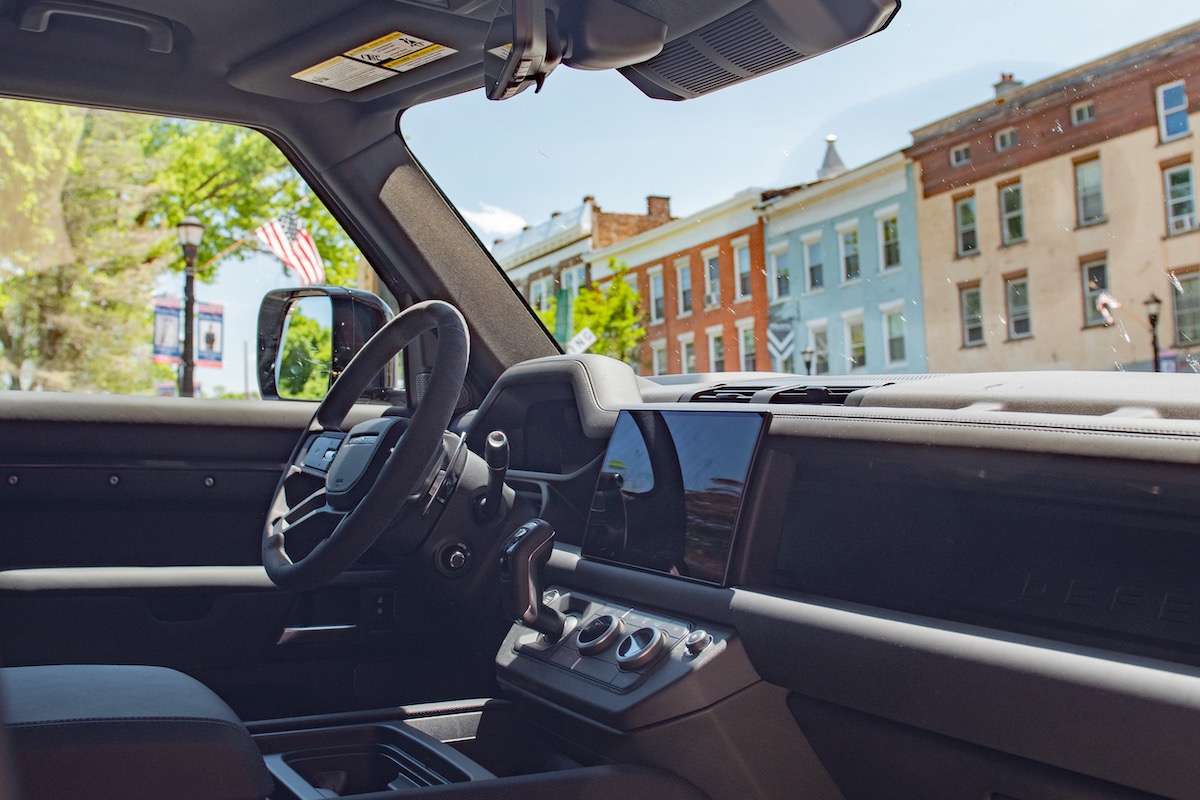
It’s the interior that strikes out. Despite the Defender’s lofty price, it sticks to a strict mission of function and durability. So even with the optional Windsor leather, most of the interior is coated in rubbers and plastics designed to wick moisture and resist stains. There’s a piece of six-inch-wide metal spanning the entire dash. There are exposed screws and plain-looking air vents. The steering wheel could be off an old Toyota. Aside from the screens, it’s basic and barren inside. In some ways, that’s refreshing since the Defender’s hardcore character is intact and still feels unique against the plusher Range Rover models. Build quality and fit are also excellent.
Yet, with a few options, a Defender costs as much as a Range Rover without feeling half as opulent. We felt the roughly $120,000 MSRP of Defender 110 V8 Carpathian Edition we tested for this review was excessive. But roughly 20,000 people a year buy a Defender (it’s the second most-popular model in Land Rover’s fleet), so it seems not everyone feels this way.
Performance
When used off-road, the Defender is an absolute animal. We tested one in 2020 on a gnarly trail and can confirm its uncanny grip, incredible wheel articulation, and generous clearance. With the air suspension raised, a Defender will climb, clear, and get through almost any path. But this is not how most Defender owners will use their vehicles. They will not be using the Terrain Response 2 system that perfectly adapts the vehicle’s powertrain and chassis to the chosen surface. They will enjoy the permanent four-wheel drive (4WD) but hardly notice if a differential is locking. Unless there’s a coastal flood, the wading depth will be of no concern.
On the road, the Defender’s Old World charms turn cumbersome. There’s so much friction in the drivetrain and drag from the body that the Defender loses speed downhill. There’s excessive body roll, even in the V8 model’s Dynamic setting that stiffens the dampers. The steering is slow and imprecise. Wind noise is apparent. When braking, the Defender dives onto its front tires, an uneasy feeling made worse by a long pedal travel. These are serious sacrifices made for serious off-road performance. But since the larger Range Rover feels more athletic on pavement and nearly as capable on a trail, the Defender is disappointing. It’s more like a Toyota 4Runner than a polished luxury car.
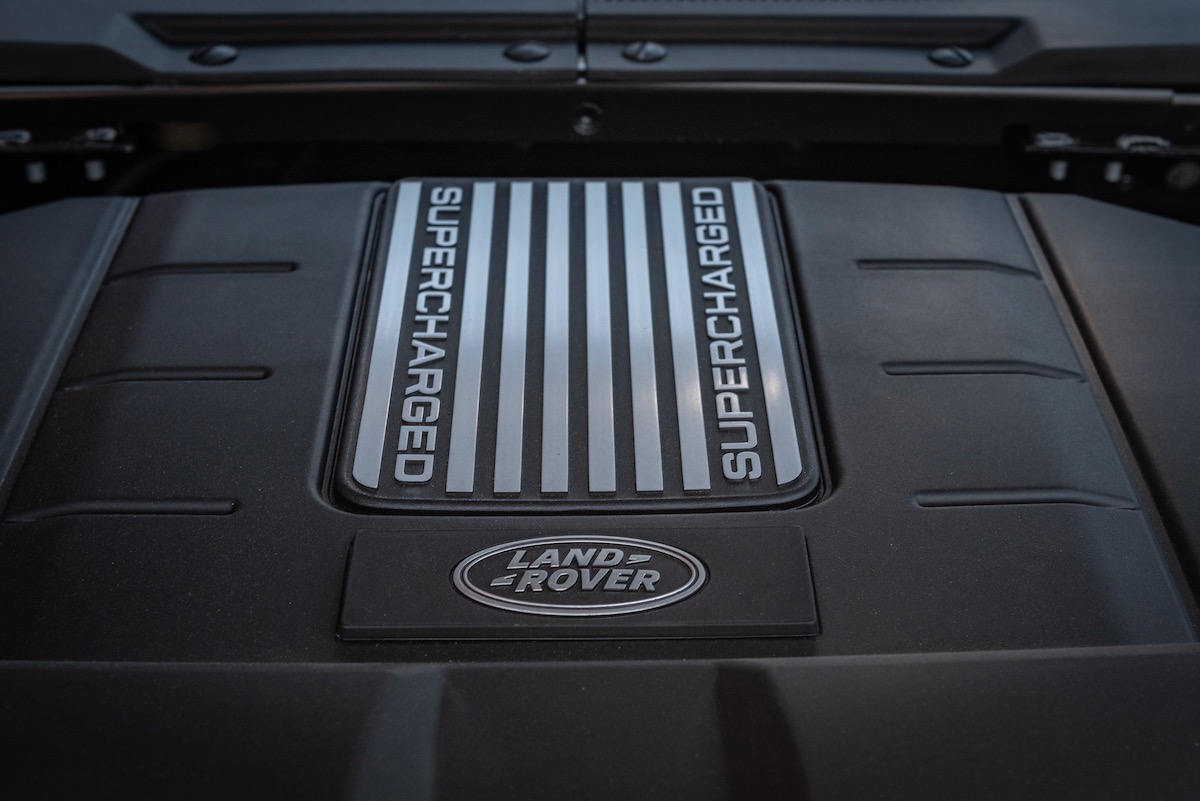
What saves the Defender are its turbocharged inline-six and supercharged V8 engines. The V8 moves the Defender with alacrity and the eight-speed automatic transmission is flawless. It’s a mildly frightening setup in a vehicle that’s so soft and top-heavy. Imagine a commercial fishing trawler with a speedboat engine. Pointed straight, the Defender V8 can easily keep up with a V8 Jaguar F-Type. That’s what happens with 518 horsepower and 461 pound-feet of torque on board. We wish it also sounded like an F-Type, but that’s an easy aftermarket fix.
The six-cylinder engine is part of a 48-volt mild hybrid powertrain, so that the engine seamlessly turns off and restarts without any shuddering. It also uses an electric supercharger for quicker response at low speeds. There’s 395 hp and 406 lb-ft, which is plenty.
We would skip the turbocharged four-cylinder engine unless you’re using a Defender for local jaunts. At 296 hp and 295 lb-ft, you’ll grow tired of straining it to highway speeds. The same goes for the non-hybrid turbo-six in the Defender 130 S, which outputs the same horsepower but more torque (347 lb-ft).
The mild-hybrid inline-six, for all its extra performance over the base engines, doesn’t penalize you at the fuel pump. In the 110, the four-cylinder is rated at 17 mpg city, 20 mpg highway, and 18 mpg combined, while the six is 18/23/20. The V8 returns very bad 14/19/16 mpg fuel economy ratings. But, regardless, we love the V8.
Form & function
In addition to exemplary off-road performance, the Defender is exceptional as an everyday SUV. The seating configurations are unmatched. What other SUV with two doors can seat six? That’s the Defender 90 with the jump seat, which allows three across in the front just like an old pickup. It’s optional on the 90 and the larger 110, the latter of which has an optional third row with two extra seats. The 130 has a standard (and wider) third row for up to eight seats. The people back there get a separate moonroof, air vents with a separate climate zone, cupholders, USB ports, and armrests. No other vehicle offers this flexibility to seat five, six, seven, or eight passengers.
Large glass, including the “alpine lights” that function like a home’s skylight windows, allow plenty of outward visibility. The 130 comes with a panoramic moonroof and the rear moonroof, while the 90 and 110 also offer a folding power fabric roof that covers the first and second rows of seats. A closed roof is standard.
With the third row and second row folded, the Defender 130 has 77 cubic feet of cargo space (but only 14 cubic feet with all rows upright). On the 90, cargo space is 16 cubic feet and 58 with the rear seats folded. On the four-door 110, it's 34 behind the second row and 79 with them folded. Three-row 110 models have 69 cubic feet of cargo space with all rows folded, 35 cubic feet behind the second row, and 11 cubic feet behind the third row.
Buyers can equip their Defenders with off-road or all-season tires on any trim. The 130’s metal roof rack can support up to 360 pounds when moving or 661 pounds when stationary—perfect for a camping tent. There is a console refrigerator, a heated windshield, a pressurized water rinse system, power-deployable side steps, a brush bar for the grille, and a winch. They’re all available. If you ask, the Defender has it.
Technology
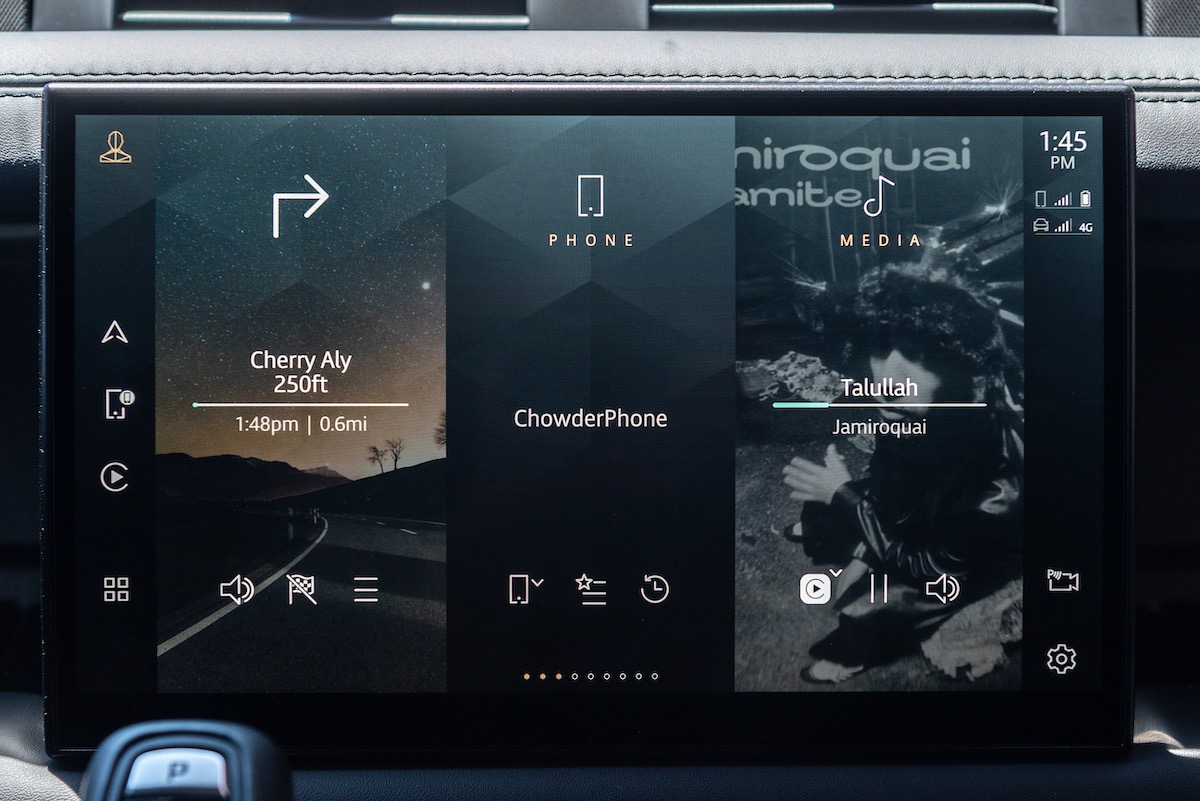
The Defender offers two touchscreen infotainment systems running Pivi Pro, Land Rover’s newest software that has yet to crash and break. So far, so good. The standard 10-inch screen is a wide format and nicely integrated in the dashboard’s metal bar. The optional 11.4-inch touchscreen is an oversize square that rests over the central dash. Either screen is quick and simple to operate, though the larger, taller screen has greater legibility. Wireless Apple CarPlay and Android Auto, a voice assistant, connected apps, and navigation come standard. So do heated front seats, a proximity key, and power-folding mirrors.
On the base Defender 110, you’ll find manual fabric seats and a no-name stereo. The Defender S starts with heated 12-way power seats with leather and a Meridian stereo. Fog lights, cute half-circle daytime running lights, surround sound, auto-dimming exterior mirrors, auto high beams, and cooled front seats grace the SE trims. The X-Dynamic SE adds silver exterior accents, black rear tow hooks, and a few interior changes such as the woven fabric that lines the outer edges of the seats (it’s called Robustec).
The X comes with air suspension, a locking rear differential, an upgraded Terrain Response 2 system, adaptive cruise control, head-up display, the larger touchscreen, and a rearview mirror with a camera display. A cabin air purifier, and configurable ambient lighting that splits the colors into three zones, are available.
Safety
The Defender has not been rated by a U.S. government agency or insurance organization. In Euro NCAP crash testing, the Defender scored five of five stars and was praised for its solid structure. Land Rover equips the Defender with six airbags, which strikes us as too low (there are no front knee airbags or rear side thorax airbags).
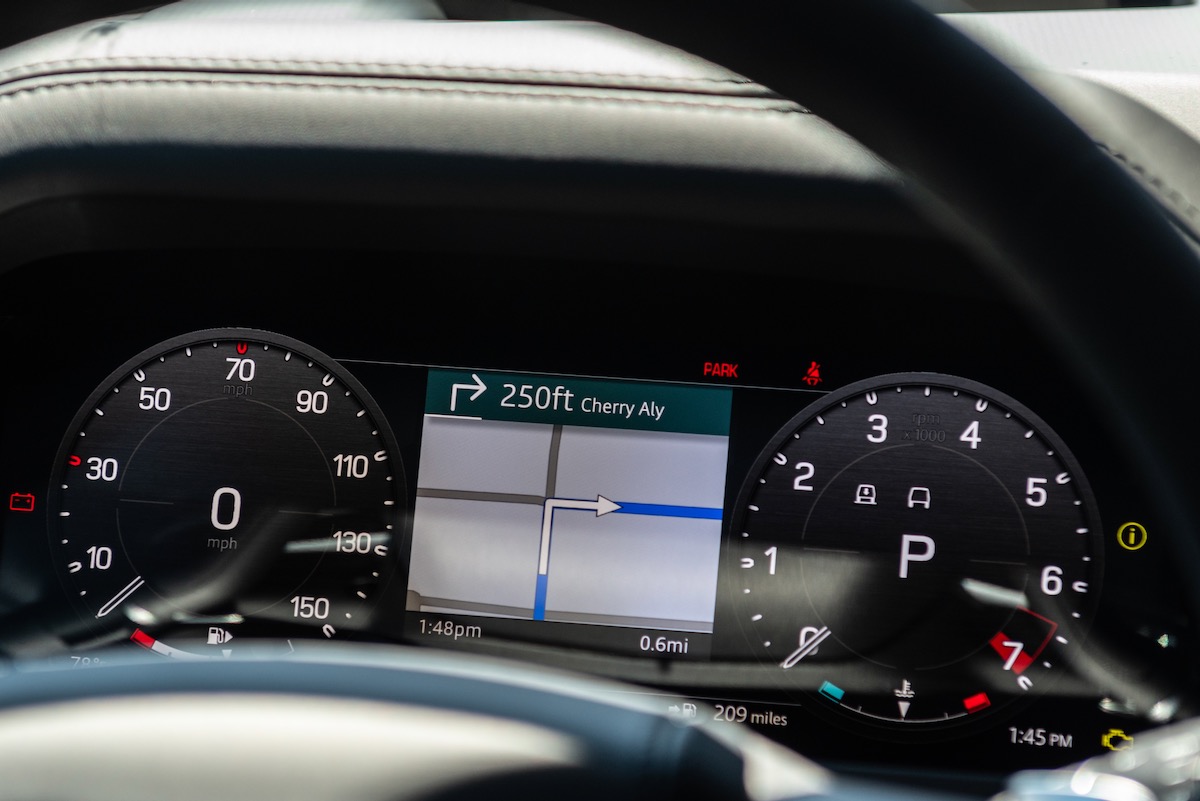
There’s no excuse to get lost or scuff a rim. An optional digital instrument panel that can show full-screen maps, a head-up display, and a 360-degree camera system that can present a “clear” view under the front wheels and show a virtual rendering while parking. Lane-keeping assist, blind-spot monitoring, and automatic emergency braking are standard. Automatic steering when reversing a trailer is also available. A self-steering highway assist, however, is not offered.
Cost-effectiveness
The 2023 Land Rover Defender starts at $53,500 for the lowest-grade four-door 110 trim level, $55,100 for the two-door 90, and $68,000 for the extended 130. While relatively affordable next to other luxury SUVs, Defender pricing climbs higher without much trying. Our Defender 110 V8 Carpathian Edition stickered for $119,875 with destination and represents the peak of the lineup.
Priced in the $60,000 range, a Defender feels worth the money given the capability and the decent list of standard equipment. Above $70,000, the Defender feels outclassed by other luxury SUVs, which are more decadent inside and feel more agile on the road. But for many Land Rover buyers, the Defender’s iconic style and comfortable straight-line cruising will likely be enough.
What owners say
It’s a good practical car, but the pricing is not customer friendly.
October 17, 2023Trims & specs
Base MSRP $93,000 | Seating 5 |
Engine 3.0L 395 hp I6 | Cargo Capacity 27.1 cu ft |
Combined MPG 20 | Drivetrain AWD |
Base MSRP $90,500 | Seating 5 |
Engine 3.0L 395 hp I6 | Cargo Capacity 10.5 cu ft |
Combined MPG 20 | Drivetrain AWD |
Base MSRP $68,000 | Seating 8 |
Engine 3.0L 296 hp I6 | Cargo Capacity 15.3 cu ft |
Combined MPG 19 | Drivetrain AWD |
Base MSRP $78,300 | Seating 8 |
Engine 3.0L 395 hp I6 | Cargo Capacity 15.3 cu ft |
Combined MPG 19 | Drivetrain AWD |
Base MSRP $55,100 | Seating 6 |
Engine 2.0L 296 hp I4 | Cargo Capacity 15.6 cu ft |
Combined MPG 19 | Drivetrain AWD |
Base MSRP $99,900 | Seating 8 |
Engine 3.0L 395 hp I6 | Cargo Capacity 15.3 cu ft |
Combined MPG 19 | Drivetrain AWD |
Base MSRP $69,100 | Seating 6 |
Engine 3.0L 395 hp I6 | Cargo Capacity 15.6 cu ft |
Combined MPG 20 | Drivetrain AWD |
Base MSRP $75,000 | Seating 5 |
Engine 2.0L 296 hp I4 | Cargo Capacity 34.0 cu ft |
Combined MPG 18 | Drivetrain AWD |
Base MSRP $72,300 | Seating 7 |
Engine 3.0L 395 hp I6 | Cargo Capacity 34.0 cu ft |
Combined MPG 20 | Drivetrain AWD |
Base MSRP $84,700 | Seating 8 |
Engine 3.0L 395 hp I6 | Cargo Capacity 15.3 cu ft |
Combined MPG 19 | Drivetrain AWD |
Base MSRP $69,300 | Seating 7 |
Engine 3.0L 395 hp I6 | Cargo Capacity 34.0 cu ft |
Combined MPG 20 | Drivetrain AWD |
Base MSRP $81,400 | Seating 8 |
Engine 3.0L 395 hp I6 | Cargo Capacity 15.3 cu ft |
Combined MPG 19 | Drivetrain AWD |
Base MSRP $88,400 | Seating 6 |
Engine 3.0L 395 hp I6 | Cargo Capacity 15.6 cu ft |
Combined MPG 20 | Drivetrain AWD |
Base MSRP $53,500 | Seating 7 |
Engine 2.0L 296 hp I4 | Cargo Capacity 34.0 cu ft |
Combined MPG 18 | Drivetrain AWD |
Base MSRP $111,300 | Seating 5 |
Engine 5.0L 518 hp V8 | Cargo Capacity 34.0 cu ft |
Combined MPG 16 | Drivetrain AWD |
Base MSRP $66,100 | Seating 6 |
Engine 3.0L 395 hp I6 | Cargo Capacity 15.6 cu ft |
Combined MPG 20 | Drivetrain AWD |
Base MSRP $90,900 | Seating 7 |
Engine 3.0L 395 hp I6 | Cargo Capacity 34.0 cu ft |
Combined MPG 20 | Drivetrain AWD |
Base MSRP $115,000 | Seating 5 |
Engine 5.0L 518 hp V8 | Cargo Capacity 15.6 cu ft |
Combined MPG 17 | Drivetrain AWD |
Base MSRP $107,900 | Seating 5 |
Engine 5.0L 518 hp V8 | Cargo Capacity 15.6 cu ft |
Combined MPG 17 | Drivetrain AWD |
Base MSRP $58,300 | Seating 7 |
Engine 2.0L 296 hp I4 | Cargo Capacity 34.0 cu ft |
Combined MPG 18 | Drivetrain AWD |
Base MSRP $118,400 | Seating 5 |
Engine 5.0L 518 hp V8 | Cargo Capacity 34.0 cu ft |
Combined MPG 16 | Drivetrain AWD |


Pricing trends
MSRP range
$53,500 - $118,400
Current avg. market price
$50,952
Trending down by 1.5% this month
May 2026 - November 2026


