2023 Toyota Camry Hybrid Reviews, Pricing & Specs


Pros & cons
What we like
Fuel-efficient
Easy-to-use technology
Great safety ratings
What to consider
Potentially polarizing design
Interior materials feel cheap
Not much cargo space
Expert review
Since 1983, the Toyota Camry has been a favorite of Americans seeking a reliable family sedan.
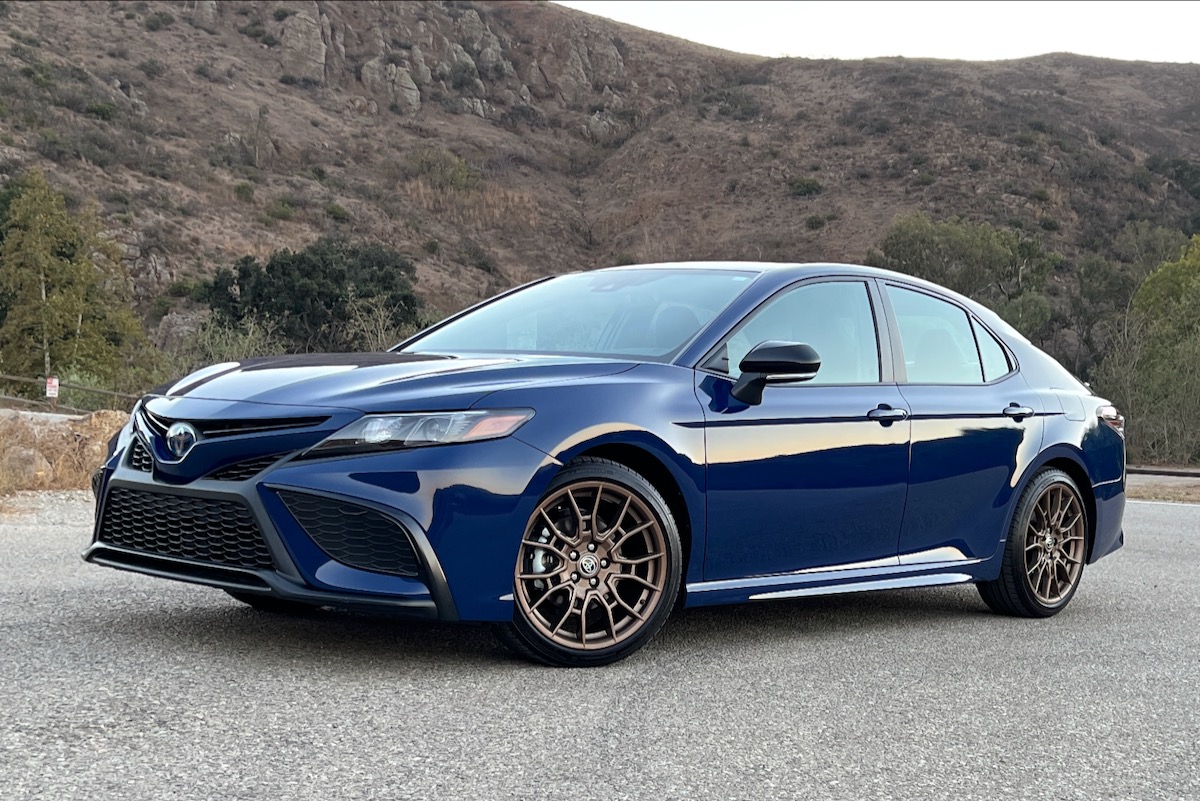
You’d think that Toyota would celebrate the Camry’s 40th anniversary in the United States market with a special edition commemorating the milestone. Maybe that’s still to come. But for now, you’ll need to settle for a 2023 Toyota Camry Nightshade Edition sporting spiffy bronze wheels and a beautiful new paint color called Reservoir Blue. The Nightshade Edition is offered with SE trim and your choice between a standard or a hybrid powertrain. There aren’t any other changes to the 2023 Camry, for now.
out of 10 expert review
Look & feel
Six years after the eighth-generation Camry went on sale for the 2018 model year, we’re finally getting used to the styling. Either that, or we’re smitten enough with the 2023 Toyota Camry lineup’s new Reservoir Blue paint and the Nightshade Edition’s matte-bronze 19-inch wheels to overlook that styling.
The 2023 Camry Nightshade Edition is available only with SE trim. You can get it with the standard 2.5-liter four-cylinder engine or in hybrid specification, and with front-wheel drive (FWD) or, non non-hybrid models, all-wheel drive (AWD). It features black-trimmed headlights and taillights, a TRD (Toyota Racing Development) mesh grille, black side mirror caps, a black rear spoiler, and black badges. In addition to Reservoir Blue color, you can also choose Ice Cap or Midnight Black. Any of the three look terrific.
Open the driver’s door, and you’ll find the same SE-spec interior that Toyota has offered for more than half a decade. Toyota claims the Camry Hybrid offers “impeccable fit and finish,” but that’s not really the case. However, considering the car’s base price, you can live with the cheap-looking plastic.
Unfortunately, when you shut the trunk, the license plate rattles. Similarly, when you close the doors, they sound tinny and unsubstantial. The Camry also allows plenty of road noise into the cabin. When you add these sounds to the car’s preponderance of inexpensive-looking interior plastics, the Camry comes across as shoddy instead of substantial.
New Camry Hybrid prices start at just over $29,000 with destination. Buy the top-level trim and check all the option boxes, and you’ll spend closer to $35,000 (non-hybrid models push closer to $40,000 fully loaded). And that’s before selecting from the long list of dealer-installed accessories.
Our Camry SE Hybrid Nightshade Edition cost considerably less than that. It came with an optional blind-spot monitoring system, rear cross-traffic alert, an auto-dimming rearview mirror, a universal garage door opener, and all-weather floor liners. These upgrades, and the $1,095 destination charge, brought the manufacturer’s suggested retail price (MSRP) of the test car to $32,983.
Performance
When you buy a new 2023 Camry, Toyota gives you three powertrains from which to choose. The most popular one is the 2.5-liter four-cylinder engine, making between 202 horsepower or 206 hp, depending on the trim level and whether the car has FWD or AWD.
If you want more power than that, a 301-hp 3.5-liter V6 is available with the XLE, XSE, and performance-tuned TRD trim levels. However, the V6 comes only with FWD. All non-hybrid 2023 Camry models include an eight-speed automatic transmission.
Our test vehicle had the hybrid powertrain, even though it didn’t say “Hybrid” anywhere on the exterior (which is fine by us). The Camry Hybrid uses a 2.5-liter Atkinson-cycle four-cylinder engine, an electric motor, and a lithium-ion battery pack tucked underneath the car’s back seat. Net power output is 208 horsepower, and the hybrid system simulates a continuously variable transmission (CVT) to send power to the front wheels.
Toyota says the Camry Hybrid comes with six programmed ratios to make it sound and feel more like it has a traditional automatic transmission. Additionally, the sporty Hybrid SE and Hybrid XSE have paddle shifters. Drivers can also choose between Normal, Eco, EV, and Sport driving modes, and when the Camry Hybrid is in Eco model, something called Auto Glide Control allows the car to coast for longer distances, saving gas.
Since fuel economy is the point of the Camry Hybrid, we can only report disappointment on that front. The EPA fuel economy rating for a Camry Hybrid is 46 mpg in combined driving, but the test car averaged no better than 33.4 mpg. That’s not even in the same region as the EPA rating, let alone the same neighborhood.
So, what happened? We drove the car in Normal and Sport modes, and did not spend much time creeping in traffic in EV mode or Auto Gliding down mountainsides in Eco mode. Also, we drove “normally” on our mountainous Southern California testing loop, meaning we didn’t hypermile the car in any way, shape, or form. So you can consider our result to be a worst-case scenario.
Considering the hybrid version of the SE Nightshade costs $2,130 more than the standard powertrain, it will take some time to recoup that initial investment in gas savings unless you drive differently than we did. Still, there’s no other downside to choosing a Camry Hybrid.
For example, the electric assist motor’s torque helps to make the car feel quick when accelerating from a stop, and the drivetrain is well isolated from the cabin. We didn’t notice much in the way of CVT moaning and groaning either. And while Toyota uses a regenerative braking system to keep the battery pack charged, brake pedal feel and modulation proved better than expected.
Any Camry wearing SE or XSE badges features sport suspension tuning. We found the ride to be a little soft because Toyota dials in enough compliance to ensure a livable ride quality. Still, the Hybrid SE Nightshade gets around corners well enough, consistently taking a set in curves and delivering predictable, trustworthy handling. Grip impresses, despite the all-season rubber, and the steering offers good weighting without an artificially boosted feel.
However, we noticed that the Camry Hybrid SE Nightshade’s stability control was a little sensitive, especially when threading S-curves. When weight shifted from one side of the car to the other, unloading either the left or right front tires, it would momentarily engage just to be on the safe side.
Overall, we still prefer how the Honda Accord drives, but if you’re a Camry fan, the Hybrid SE Nightshade is entertaining enough. Just make sure to drive it with more care if you want to maximize your gas mileage.
Form & function
We love the simplicity of the Toyota Camry. It is crafted of durable materials, it takes a no-nonsense approach to the controls and layout, and you don’t need to crack open the owner’s manual in order to understand how to use and drive it.
Nearly every version of the Camry has a dual-zone automatic climate control system, and depending on which version you choose, you can get heated and ventilated front seats. A heated steering wheel is also available.
Our test car’s front seats had eight-way power-adjustment for the driver and manual adjustment for the passenger, but people riding shotgun can use a manual height adjuster to get more comfortable. The driver’s seat proved comfortable during longer drives, and the steering wheel is a delight to hold.
The Camry sits relatively low to the ground, but the height-adjustable front seats make it easier to get into and out of the car. Toyota uses its SofTex artificial leather in the Camry Hybrid SE, but unlike in some of the automaker’s other models, it isn’t very soft. The SE’s fabric seat inserts have stripes on them and feel durable.
The back seats are adequately comfortable, but there isn’t much room to stretch out. The Camry’s rear passenger accommodations aren’t nearly as roomy as what you’ll find in a Honda Accord. Also, the test car lacked rear air conditioning vents, which made a couple of teenagers grumpy.
Within the cabin, the Camry provides good storage space, but most areas are unlined, so items placed there will potentially rattle during the drive. Trunk space measures 15.1 cubic feet, which is small for the midsize sedan class and substantially less than an Accord. But you can carry full-size suitcases on their sides, which helps to maximize the space. There is no handle to use to close the lid, so if the trunk’s paint is dirty, so will be your fingertips.
Technology
Toyota offers the Camry with a 7-inch or a 9-inch touchscreen infotainment display. Both of them have smartphone connectivity including Bluetooth, Apple CarPlay, and Android Auto compatibility. Choose the larger 9-inch system, and you can get a connected navigation system and a 9-speaker JBL premium sound system.
Additionally, both systems are Amazon Alexa compatible. Toyota also includes SiriusXM satellite radio and several connected service plans that come with complimentary trial subscriptions. Examples include Safety Connect with automatic collision notification, Remote Connect with remote engine starting and a find-my-car function, and WiFi Connect with access to a Wi-Fi hotspot.
The test car had the 7-inch touchscreen, so it was basic. Using the voice recognition system, we told the Camry we wanted to listen to reggae music, but it could not comply with that request. Asking it to tune to the Bob Marley station on SiriusXM proved successful.
As far as the infotainment system’s controls are concerned, we like the physical knobs and buttons surrounding the screen. However, it would be nice if the knobs stuck out a little bit more to make them easier to grasp and twist.
Additional tech includes an available 7-inch driver information center between the gauges and a 10-inch head-up display. The test car had neither of these features.
Safety
Standard safety features include 10 airbags, a rear-seat reminder system, and Toyota Safety Sense 2.5 (TSS 2.5), which encompasses forward-collision warning with pedestrian detection, automatic emergency braking, lane-departure warning, lane-keeping assist, lane-centering assist, and adaptive cruise control. It also has automatic high-beam headlights and Intersection Support, which can detect pedestrians and traffic when turning and attempt to prevent collisions. Blind-spot monitoring and rear cross-traffic alert are optional.
During the evaluation, TSS 2.5 did not demonstrate the smoothness and refinement that you’ll find in modern examples of the technology. On northbound Pacific Coast Highway up the coast from Malibu, California, the adaptive cruise control braked too dramatically in some of the tighter curves in the road. Worse, the lane-departure warning, lane-keeping assist, and lane-centering assist systems had trouble with travel lanes that widened or narrowed, and struggled to keep their cool when passing by exit ramps on the freeway. In addition, the lane-centering assist system is too obvious about what it’s doing, and that irritates the driver.
Generally speaking, TSS 2.5 is not as subtle as it should be, and we preferred driving the Camry Hybrid without using many of its features.
When it comes to crash-test ratings, the 2023 Camry is aging gracefully. It gets five-star ratings in every assessment conducted by the National Highway Traffic Safety Administration (NHTSA), including for rollover resistance.
The Camry Hybrid also earns a Top Safety Pick+ rating from the Insurance Institute for Highway Safety (IIHS), although that rating applies to 2022 models for calendar year 2022. The Camry also receives a Poor rating in the updated IIHS side-impact crash test, which means it could lose its top rating for the 2023 model year and/or calendar year.
Cost-effectiveness
A Toyota Camry Hybrid SE Nightshade Edition like our test car is a cost-effective choice. It carries four people in comfort, can hold their luggage in its trunk, gets good gas mileage, and is safe. Plus, it costs less than $33,000—and that’s if you pay the sticker price. Lastly, it comes with two years or 25,000 miles of free scheduled maintenance.
However, for about the same money, you can choose the Honda Accord, which offers a hybrid powertrain and has more interior room and cargo space. The Hyundai Sonata is also available as a hybrid, and at the same price as the tested Toyota it offers far more equipment and superior ownership perks including a longer period of complimentary scheduled maintenance and a more generous free subscription to connected services.
For 2023, those are the three midsize hybrid family sedans available. Any of them would make an excellent choice. But the Honda and the Hyundai cannot match the updated Camry Hybrid SE Nightshade Edition for sheer visual attitude.

What owners say
So far I am delighted with the 2023 Toyota Camry Hybrid SE. It is sporty, smooth,and fun to drive. It is a good value and I have no buyers remorse!
March 27, 2023This.Camry feels like an expensive sports car at a great price.!! Highly recommend trying one. Amazing car.
June 17, 2023Trims & specs
Base MSRP $33,545 | Seating 5 |
Engine 2.5L 208 hp I4 Hybrid | Cargo Capacity 15.1 cu ft |
Combined MPG 45 | Drivetrain FWD |
Base MSRP $34,095 | Seating 5 |
Engine 2.5L 208 hp I4 Hybrid | Cargo Capacity 15.1 cu ft |
Combined MPG 45 | Drivetrain FWD |
Base MSRP $31,190 | Seating 5 |
Engine 2.5L 208 hp I4 Hybrid | Cargo Capacity 15.1 cu ft |
Combined MPG 45 | Drivetrain FWD |
Base MSRP $28,655 | Seating 5 |
Engine 2.5L 208 hp I4 Hybrid | Cargo Capacity 15.1 cu ft |
Combined MPG 52 | Drivetrain FWD |
Base MSRP $30,190 | Seating 5 |
Engine 2.5L 208 hp I4 Hybrid | Cargo Capacity 15.1 cu ft |
Combined MPG 45 | Drivetrain FWD |


Pricing trends
MSRP range
$28,655 - $34,095
Current avg. market price
$25,472
Trending down by 2.0% this month
May 2026 - October 2026


