2023 Toyota Tacoma Reviews, Pricing & Specs
Write a reviewPros
Stylish design
Great off-road capability
Excellent reputation for reliability
Cons
Poor fuel economy
Cramped back seat
Outdated technology
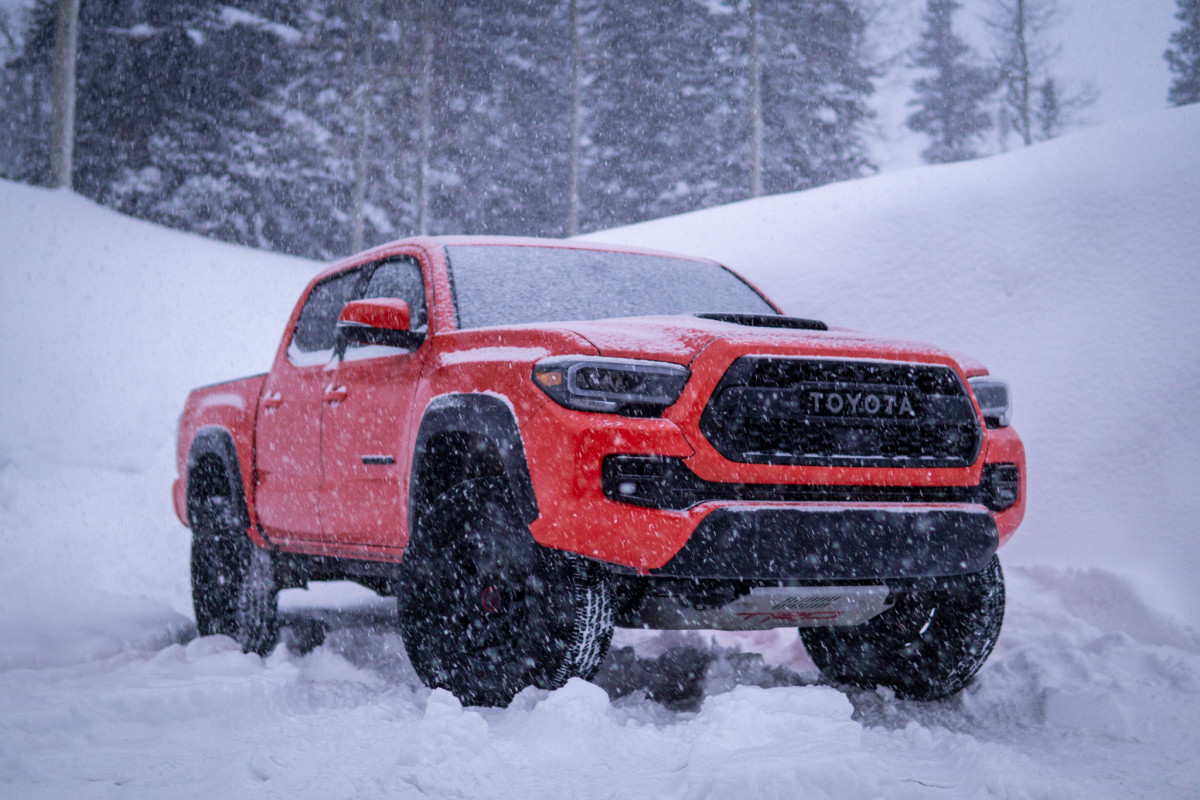
Toyota’s tough little truck looks ready for a refresh.
The Toyota Tacoma has reached “Legend” status: it’s the default choice for many shoppers, and for good reason. The Tacoma enjoys a hard-earned reputation for bullet-proof reliability. It’s the ideal size for many situations. It looks cool and, in TRD Pro trim, it can back up those looks with genuine off-road brilliance.
But heavy is the head that wears the crown, and the current Tacoma may be starting to buckle under the weight. With more powerful and more efficient options emerging in the compact and midsize truck space, Toyota is no longer the one-stop shop for shoppers. Luckily, a new Tacoma may be just over the horizon.

When a Ford F-150, Chevy Silverado, Ram 1500, or Toyota Tundra is just too big, look to the midsize truck segment. While the length of a full-size pickup truck like the Tundra can stretch more than 250 inches, the longest Tacomas come in nearly two feet shorter. Rather than looking stubby, however, the Tacoma carries an assertive stance. Its upright grille and tall bed make it look substantial without appearing huge.
Toyota sells the 2023 Tacoma in an array of trim levels, ranging from the base SR trim and rising through SR5, TRD Sport, TRD Off-Road, and TRD Pro. Shoppers can also opt for the Trail Special Edition trim level, and while a Nightshade Edition will reportedly be available, it was not included in Toyota’s shopping materials at the time of this review. With multiple powertrain options, two available bed lengths, and a choice between the clamshell-doored access cab and a full four-door double cab, Toyota sells the Tacoma in a whopping 34 combinations.
New this year is the SR5 SX package, previously offered only on the lowest-level Tacoma SR trim. The SX Package adds black overfenders, black wheels, and blacked-out trim and badging. Conversely, a new Chrome Package opts for—you guessed it—chrome trim and badging, rather than black or body color. Door handles, exhaust tip, and a “TACOMA” tailgate insert get finished in chrome, and the standard 16-inch wheels get traded for 18-inch chrome-finished alloys. If the SR5 SX is trying to be stealthy, the Chrome Package is trying for just the opposite.
We tested a TRD Pro trim level—in bright Solar Octane paint—during a snowy week outside Salt Lake City, Utah. Against the near-constant whiteout backdrop, our bright orange truck looked truly awesome (even the drive-through attendant at Taco Bell complimented the paint job).
The 2023 Toyota Tacoma TRD Pro is about more than just paint, though. Toyota fits this range-topping, off-road-oriented trim with underbody skid pads, a TRD-tuned suspension, a TRD sport exhaust, and a unique grille with “TOYOTA” spelled out in large letters. Tack on the hood scoop and blacked-out badging, and the TRD Pro is an undeniably cool pickup truck.
Inside, the Tacoma ranges from a spartan, fabric-and-plastic affair in SR trim to a nicely appointed pickup complete with leather upholstery and soft-touch materials in Limited trim. Our TRD Pro was equipped with Softex leather-trimmed upholstery, heated front seats, and a full set of all-weather floor mats. We appreciated the physical knobs for climate control, and the physical buttons flanking the infotainment system were also very easy to operate—even while wearing gloves.

Toyota equips lower-level Tacomas with a standard 2.7-liter four-cylinder engine. Making 159 horsepower and 180 pound-feet of torque, and managed by a standard six-speed automatic transmission, this engine fails to impress most shoppers, particularly as its uninspired specs don’t provide much of a fuel-efficiency bump over the optional V6.
And that’s why the majority of Tacoma buyers are going to want the bigger engine. With 278 horsepower and 265 pound-feet of torque, the 3.5-liter V6 engine is more satisfying and more capable. It also comes with a six-speed automatic transmission, but shoppers can opt for a six-speed manual.
Toyota sells the Tacoma with rear-wheel drive (RWD) and four-wheel drive (4WD). Being a TRD Pro, our test truck employed the V6 with the automatic transmission and 4WD.
Despite the significant power advantage of the V6, the Tacoma isn’t a quick truck. It roars mightily when you depress the accelerator past its halfway point, which you’ll need to do every time you try to get up to highway speeds. Once you’re moving along with highway traffic, the wind and engine noise remains ever-present. Because our truck had all-terrain tires, we also dealt with more road noise than would be typical in a Tacoma Limited.
In city driving, the V6 Tacoma is enjoyable to drive, relative to other pickups, offering decent acceleration from a stop. And, because our TRD Pro’s suspension was designed for driving off-road, it handled crumbling city streets without any problems. One seemingly unavoidable to our truck’s off-road orientation was its tendency to wander on paved roads. The steering, in particular, felt vague and demonstrated plenty of play off-center when driving around town.
Fuel economy leaves a bit to be desired, but that’s somewhat expected in the midsize pickup truck segment. The EPA estimates that the Tacoma will return 20 mpg city, 23 highway, and 21 combined when equipped with the four-cylinder engine and RWD and 19/22/20 with 4WD. Swap in the V6, and those numbers drop to 19/24/21. Add 4WD, and they dip further to 18/22/20. The Manual transmission hurts fuel economy in this truck—those models get 17/21/18. Our TRD Pro with an automatic transmission delivered a disappointing 16.3 mpg, although we did drive it at elevation and in winter conditions.
Not too long ago, Toyota competed against the old Nissan Frontier… and that was about it. Then, the Chevy Colorado and GMC Canyon arrived. Shortly thereafter, an updated Honda Ridgeline joined the party, followed quickly by the reintroduced Ford Ranger. Now, a new class of compact pickup trucks has emerged with the Hyundai Santa Cruz and the Ford Maverick, and many of the Tacoma’s competitors have also enjoyed generational redesigns. Considering the increased competition, the Tacoma is starting to look a bit old-school.
Toyota equipped our TRD Pro model with Goodyear Wrangler AT tires. Although they’re certainly more capable than a summer or dedicated on-road tire, it’s worth noting that these are not dedicated snow tires, nor do they come with the preferred “three-peak” winter designation. Still, we had no problem driving from Salt Lake City up Big Cottonwood Canyon, and we even maintained impressive traction on the last stretch of our journey, which took us completely off the paved road and onto a hard-packed snow surface.
We suspect the Tacoma TRD Pro would have felt even more at home on dirt trails, rather than snow-covered ones. With Multi-Terrain Select and Crawl control, our Tacoma was designed to operate off-road and at low speed.

As intimated earlier, shoppers have plenty of configuration choices with the Toyota Tacoma. The access-cab body style features clamshell-style doors and comes with a six-foot-one-inch bed. Choose the double cab, and you’ll also get a choice between a long bed and a shorter, five-foot bed.
No two-door regular cab is offered, but if you’re looking for a compact interior, the access cab with fit the bill. Although it technically offers seating for four, the rear seats are very tight, not very comfortable, and are extremely short on legroom. If you have plans to put anything more than a toolbox or a duffel bag in the back seat, we recommend the double cab.
With four genuine doors, the double cab offers easier entry and egress, although the truck’s height may make it a chore for shorter drivers and passengers. Legroom is still tight in the backseat of the Tacoma double cab, but the quality of the seats is a huge improvement.
The front seats are a massive improvement over the rears, but they’re not without fault. We were pleased with the amount of cubby space up front, and we didn’t run short on legroom or headroom. However, the steering wheel doesn’t extend very far in the Tacoma, making it challenging for tall drivers to get comfortable. Similarly, the positioning of the front seat and the pedals had us feeling a bit like we were driving a park bench.
Outside, even the five-foot bed was large enough to carry all of our gear for four days of skiing—multiple bags, a load of groceries, four pairs of skis (measuring between 170 and 190 centimeters), and a responsible amount of cheap beer.

The Tacoma is not a class-leading pickup truck when it comes to technology, but it nonetheless offers an intuitive and easy-to-use interface. Anchored by a 7-inch touchscreen in base SR trims and an 8-inch touchscreen in higher trims, all Tacomas benefit from Bluetooth connectivity, Apple CarPlay, Android Auto, and SiriusXM satellite radio (assuming you pay for a subscription to the latter service). The interface is simple, but it’s also a bit outdated. Toyota has begun to roll out its newer infotainment software in other cars, but the Tacoma looks a bit behind the times.
Our test truck was equipped with a premium, six-speaker JBL audio system, and two USB-A ports. Ultimately, while the Tacoma offers all the tech you’ll likely need, it doesn’t necessarily provide all the tech you’ll likely want. For that, you can look to competing trucks like the Chevrolet Colorado, Honda Ridgeline, and Nissan Frontier.

Advanced safety technology has become a point of pride for Toyota. The 2023 Tacoma comes equipped with Toyota Safety Sense (TSS), the company’s suite of features. This includes automatic emergency braking with pedestrian detection, adaptive cruise control, lane-departure alert, and automatic high beams.
Our TRD Pro also included blind-spot monitoring, rear- and side parking distance sensors, and a surround-view camera. However, other Toyotas benefit from a much more robust version of TSS. You won’t find lane-keeping assist or rear automatic emergency braking. As other vehicles on the market begin to offer more level 2 autonomous driving aids, the Tacoma does not.
As such, the 2023 Toyota Tacoma was not awarded a Top Safety Pick award from the Insurance Institute for Highway Safety (IIHS). In crash-test evaluations from the National Highway Traffic Safety Administration (NHTSA), the Tacoma scored four out of a possible five stars, overall. While it managed five starts in side-impact tests, it missed top marks in the frontal crash test and rollover tests.

The midsize pickup truck market has become incredibly competitive, and the segment’s pricing reflects that. With a starting price of $27,750 before its $1,335 destination fee, the Tacoma lines up directly with the Ford Ranger, but the top-level TRD Pro trim carries a much higher price than the less-capable Ranger Tremor.
Our TRD Pro test truck costs north of $51,000, which feels like a lot and, in fact, sits above the top MSRPs of the Ranger, Chevy Colorado, and Honda Ridgeline. However, it’s less expensive than a Jeep Gladiator Rubicon, and it’s likely more capable off-road than the Ranger, and certainly more capable than the Honda Ridgeline Black Edition.
When it comes to value, our eyes shift to the Nissan Frontier. While that truck starts at $29,370, its PRO-4X off-roading trim comes in at nearly $10,000 less than a Tacoma TRD Pro’s price. We’ve yet to test the 2023 Chevy Colorado ZR2, but that truck also looks like a worthy alternative, given that it boasts top-tier performance and carries a price tag in the high $40,000 range.
The Tacoma has earned its popularity, thanks to a reputation for reliability, great styling, and a trim lineup that encompasses everything from a run-of-the-mill work truck to a conquer-everything adventure vehicle. One look at the market shows that its competitive set has made major strides, and we look forward to seeing how Toyota innovates its legendary pickup for the 2024 model year.


