2024 BMW X5 Reviews, Pricing & Specs



Pros & cons
What we like
Fun to drive
Comfortable
Premium interior materials
What to consider
Poor voice recognition technology
Advanced safety features are not standard
Poor value for money
The CarGurus verdict
With a 2024 BMW X5 plug-in hybrid, you get power, performance, and practicality in a luxurious, efficient package.
Our test vehicle for this review was the X5 xDrive50e, the plug-in hybrid electric vehicle (PHEV) version of the X5 midsize SUV, but it’s just one of several X5 models you can buy. Those with 40i in their name feature a satisfying turbocharged six-cylinder engine (with electric assist in the plug-in hybrid), while the M60i features a turbocharged V8 engine. Maximum performance is available in the comically fun X5 M Competition. Drive any of them, though, and it’s easy to understand why the X5 is BMW’s best-selling model.
Verdict: Newer BMWs are losing what has always made this automaker’s cars and SUVs appealing to people who like to drive. Fortunately, the 2024 BMW X5 hasn’t succumbed to the trend. In xDrive50e specification, it remains a delight to drive while supplying about 40 miles of electric-only range before its gasoline-fueled turbo six turns on.
out of 10 expert review
Look & feel
Last redesigned in 2019, the BMW X5’s styling has aged well, though we’re not fans of the M Sport treatment. It makes the X5 look more like a station wagon wearing a black mask than an SUV. Our test vehicle had the optional 21-inch “741M” wheel design with staggered-width summer tires, and we think they’re well worth the upgrade if you don’t mind the eventual cost of replacing the rubber.
As noted above, the X5 is available with a turbocharged inline six-cylinder engine (sDrive40i and xDrive40i), a turbo-six PHEV powertrain (xDrive50e), a turbocharged V8 engine (M60i), and as a high-performance variant with an even more powerful turbo V8 (X5 M Competition). The six-cylinder and PHEV models offer a choice between Sport and M Sport trim packages, and buyers can upgrade features by adding equipment packages and standalone options.
Our test vehicle arrived in xDrive50e M Sport specification. It wore extra-cost Brooklyn Grey paint, had the optional 21-inch wheels, and every available equipment package. The manufacturer’s suggested retail price (MSRP) was $88,075, including the $1,175 destination charge.
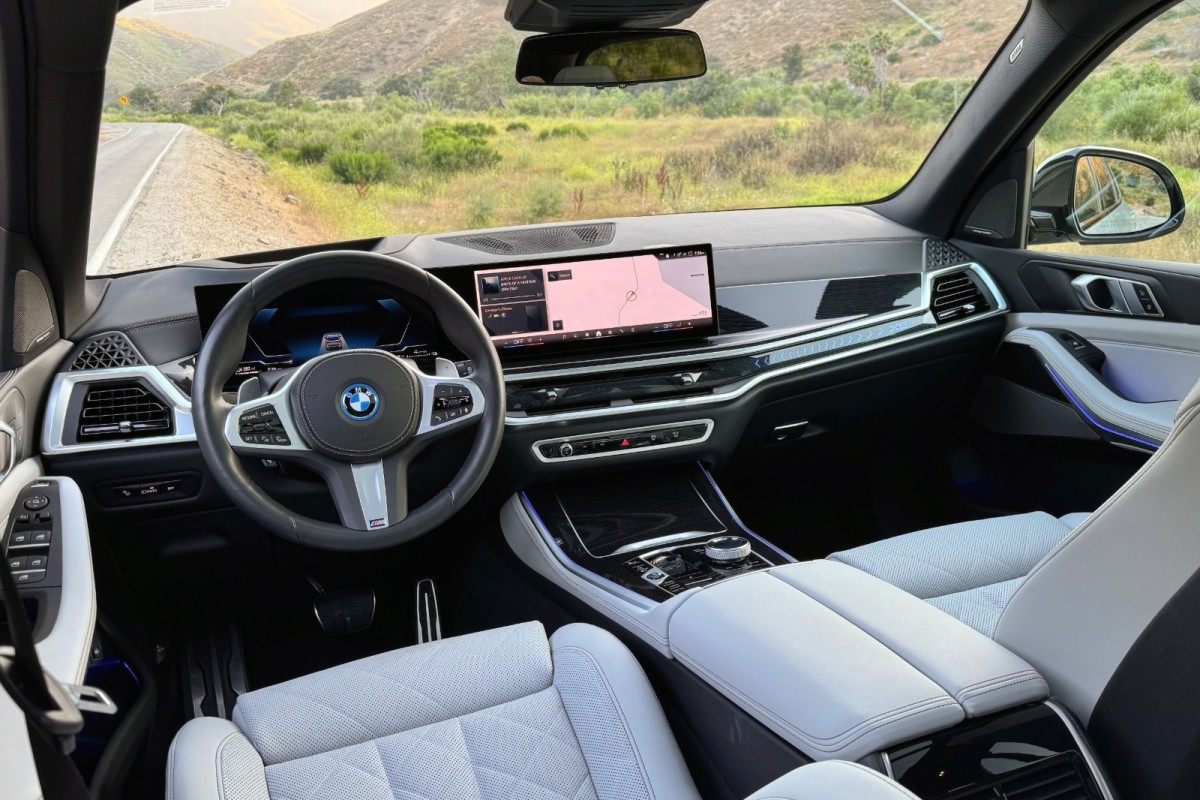
In addition to a light styling refresh to better align the X5 with BMW’s other models, the automaker adds its BMW Curved Display instrumentation and infotainment screen to the cabin for 2024. This modernizes the interior, as does a reduction in physical switchgear and BMW’s new transmission controls. But enough old-school BMW thinking remains to tie the X5 to the past, especially regarding the quality of the materials and their construction.
Performance
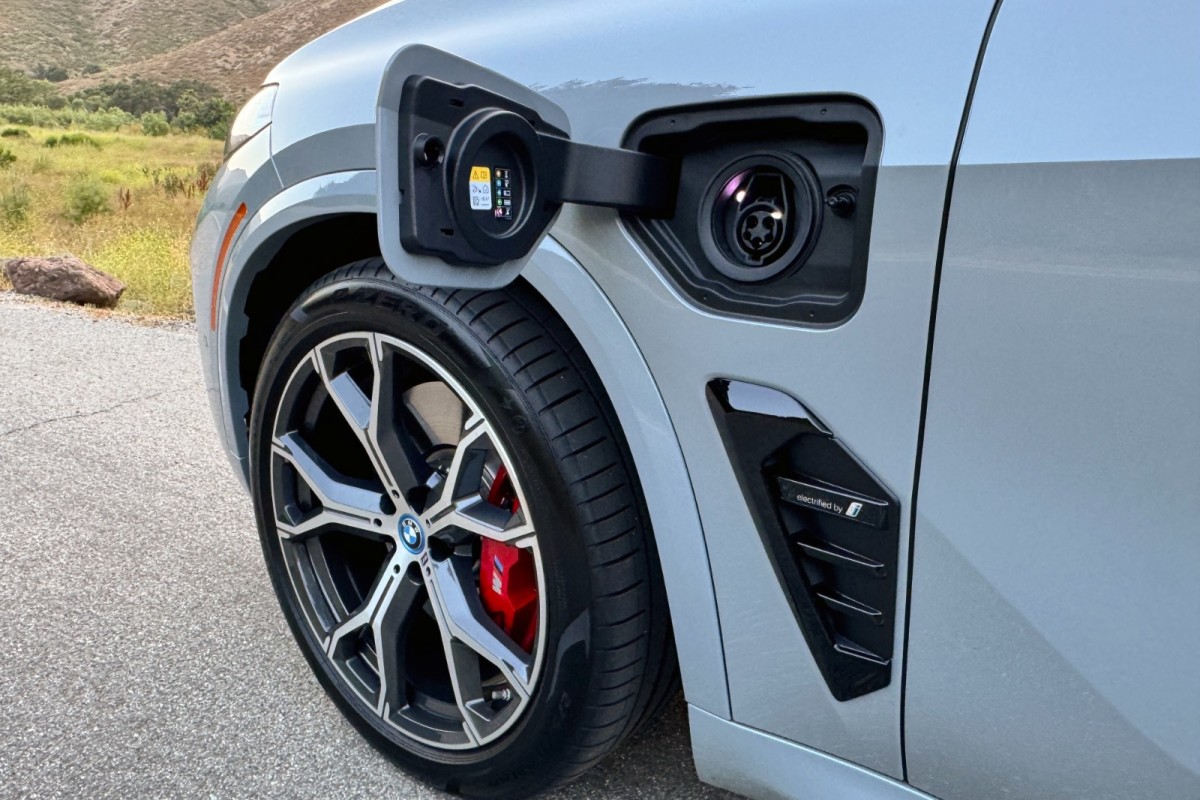
Other changes include new mild-hybrid six-cylinder and V8 engines, and a substantial upgrade to the X5 xDrive50e PHEV’s electric range and overall power output. It features a new, more powerful electric motor integrated into the eight-speed automatic transmission and a more energy-dense lithium-ion battery pack, now with a capacity of 19.2 kilowatt-hours. BMW also doubled the battery’s maximum AC charging rate to 7.4 kilowatts.
According to BMW, the 2024 X5 xDrive50e supplies 38 miles of electric-only driving before the gasoline-fed turbocharged six-cylinder fires up after which it should get 22 mpg in combined driving. However, since the PHEV continually recuperates energy as you drive and then uses that energy to help propel the X5, it is likely to perform better than that when driving in hybrid mode.
The xDrive50e makes 483 horsepower and 516 pound-feet of torque, and BMW claims it can accelerate to 60 mph in 4.6 seconds. That’s not even half a second slower than the X5 M60i with its turbo V8, which costs almost $17,000 more. (The PHEV costs just over $5,000 more than the base xDrive40i.)
The X5 with the plug-in hybrid system is our favorite version of this SUV. However, if you want to maximize electric driving, we recommend getting a Level 2 home charging station. When plugged into a standard household electrical outlet, our test vehicle was adding less than two miles of range with each hour of charging. It took 24 hours to fully recharge the SUV’s battery.
Nevertheless, you need not fully recharge the BMW X5 xDrive50e in order to reap its benefits. For example, we drove from the Los Angeles suburbs to West L.A., departing home with a family of four aboard and 26 miles of indicated electric range. We wound up traveling 26.8 miles solely on electricity, at an efficiency rate of 2.4 miles per kWh. Upon our return home, the X5 PHEV had averaged 33.7 mpg during our journey.
On evaluation day, we departed with a full battery and 42 miles of indicated range. We traveled 46.5 miles on electricity, on a route including city streets, winding country roads, straight and narrow farm roads, freeway driving, and the curving Pacific Coast Highway. On this all-electric drive, the BMW delivered 2.7 miles per kWh. However, it is important to note the route included an approximate 1,000-foot descent to sea level, undoubtedly adding to the electric-only range. The electric motor also produces only 194 hp and 331 lb-ft of torque, and you must drive with a light foot on the accelerator pedal to prevent the gasoline engine from switching on in electric mode.
Equipped with an adaptive damping air suspension, the PHEV successfully hides its considerable weight. Also, aside from added road noise, the huge 21-inch wheels and tires aren’t a liability when it comes to ride quality. Sure, you can feel the road, but this is a BMW, so that’s a natural characteristic. Outward visibility is excellent, and the quick steering makes the X5 a delight when parking or navigating narrow paths. Speed humps and bumps reveal a robust underlying architecture and the suspension’s ability to isolate occupants from the road surface.
Naturally, we took the X5 xDrive50e M Sport for a rousing run down Southern California’s fabled Mulholland Highway. In Sport mode, of course. It proved brilliant, delivering excellent acceleration, phenomenal grip, perfect steering effort and response, and expertly damped vertical and lateral body motions resulting in little of the head toss common with tall vehicles like this SUV. The brakes withstood repeated hard use, too, and while the pedal felt a little stiff in this type of driving, the fade-free performance more than made up for that.
Not only was the X5 PHEV great to drive hard and fast, but it also picked up six miles of battery charge as we sliced canyons from high in the Santa Monica Mountains down to the beach. Ultimately, during the evaluation drive, we traveled 95.5 miles and achieved an average fuel economy of 38.8 mpg. There is just one conclusion to draw from our drive: the xDrive50e is the X5 to get unless you can’t live without the X5 M.
Form & function
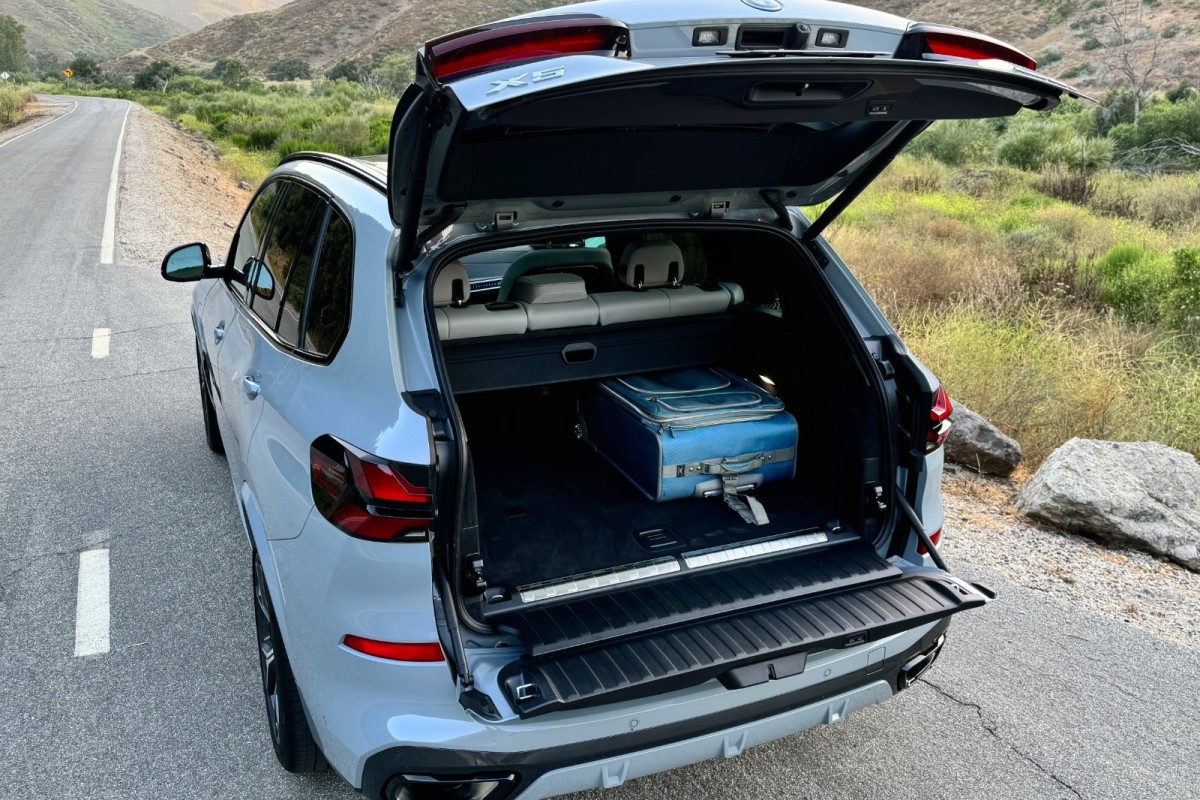
In addition to its enjoyable driving character and impressive efficiency, the X5 xDrive50e works well as a midsize luxury SUV. There is room for five people in two rows of seats, and the 33.1 cubic-foot cargo area expands to 71.2 cubic feet of cargo space when you fold down the 40/20/40-split back seat. However, the X5 uses a split liftgate design. So, while it provides a nice place to sit while enjoying the sunset, it also forces you to stretch to reach items deep in the cargo hold.
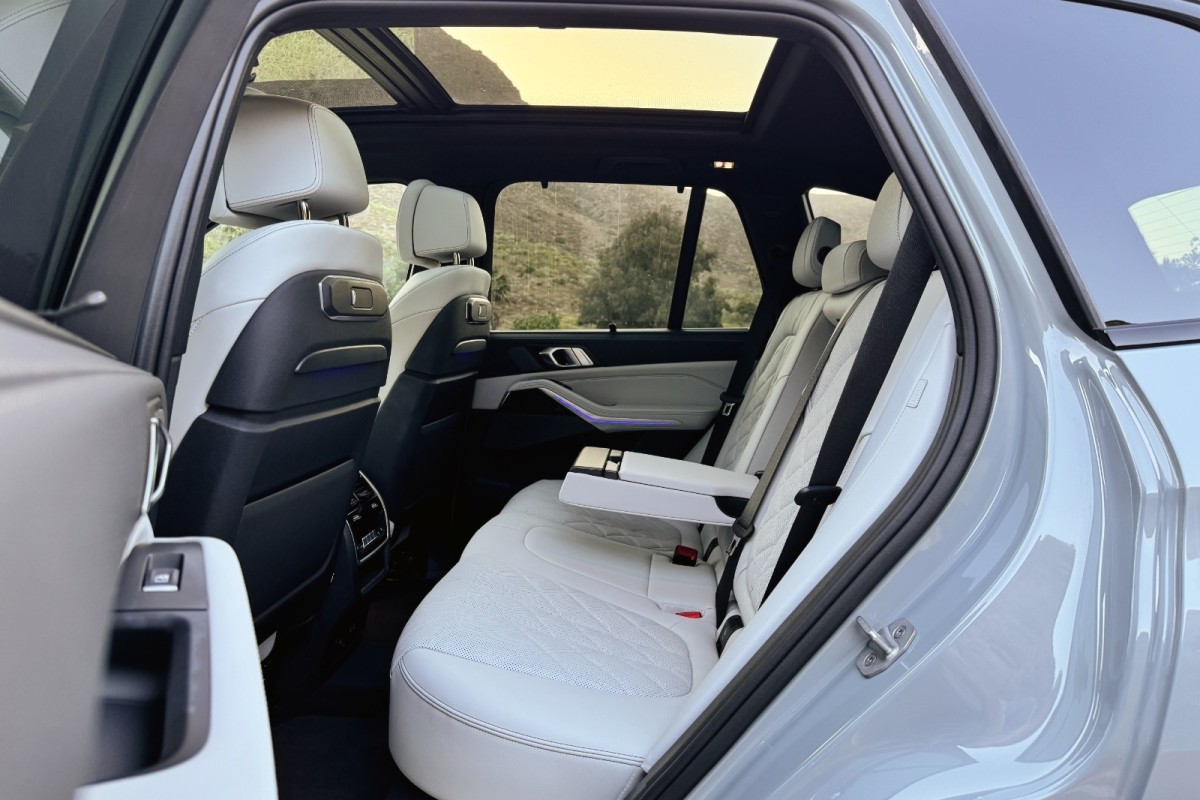
While our test vehicle had nearly all of the available options, genuine leather upholstery wasn’t among them. We didn’t miss it, though, because BMW’s Sensafin artificial leather is standard. You’d never guess it isn’t the real thing.
Sport seats are also standard, and when you choose the Climate Comfort Package, you get exceptionally comfortable 20-way power-adjustable multi-contour front seats with heating and ventilation. (Massage is available as a separate upgrade.) That option package also installs four-zone automatic climate control, a heated steering wheel, heated armrests, and heated rear seats.
Rear-seat passengers will be comfortable on supportive cushions, especially with the Climate Comfort Package’s upgrades. The available panoramic sunroof extends over the back seat, providing a great view out, and features a full shade when desirable. In addition, side window sunshades help to keep the sun out of an infant’s eyes when using the X5 as family transport.
In the past, BMW has offered an optional third-row seat in the X5, but that’s no longer the case. For that feature, you’ll need to step up to the BMW X7.
Technology
BMW’s configurable BMW Curved Display to the X5 marries a 12.3-inch digital instrumentation panel with a 14.9-inch touchscreen infotainment system housed under a single curved piece of glass.
The infotainment system runs BMW Operating System 8.5 (iDrive 8.5). Highlights include wireless Apple CarPlay and Android Auto connectivity, SiriusXM 360L satellite radio, connected services, and over-the-air software update capability. Embedded into the long list of connected services are a cloud-based navigation system and an Intelligent Personal Assistant that you can rouse by saying “Hey BMW.”
We had no trouble pairing an iPhone 15 to the BMW, and it’s easy to switch back and forth between Apple CarPlay and the native infotainment system environment. The interface is reasonably intuitive, and there are numerous apps available, including the ability to take Zoom calls, eliminating an excuse to skip meetings. The test vehicle also had the optional Harman Kardon sound system, which is terrific.
What’s not terrific is the Intelligent Personal Assistant. In the past, BMW, along with Mercedes-Benz, has led on this front, adding conversational voice recognition to perform a variety of tasks. But lately, things are literally getting lost in translation.
For example, while driving in a suburb of L.A., within 10 miles of several large hospitals, the Intelligent Personal Assistant instead offered directions to two hospitals located in Mexico before listing nearby ones in SoCal. The prompt was: “I need to go to a hospital.” Naturally, you would expect directions to the closest ones, not a medical facility over 1,000 miles away in a different country.
Also, we requested directions to the White House by saying: “Give me directions to Sixteen Hundred Pennsylvania Avenue in Washington D.C.” On the X5’s available head-up display, we could see the assistant correctly understood what we said. However, on the infotainment system, the technology showed 1600 Pigeon Hollow in Farmington, Idaho.
During our week with the X5, we had trouble finding a popular restaurant in West L.A. by using the eatery’s name combined with Century City Mall. After requesting directions to home, the assistant suggested: “Please continue using manual controls.” While listening to SiriusXM, it could not find reggae music or respond to a request to tune to Bob Marley’s Tuff Gong Radio, but when we told it to tune to Alt Nation, no problem.
This performance is disappointing. BMW’s voice recognition technology used to be industry-leading, but now, apparently, it isn’t, making the company’s decision to reduce physical controls in the X5’s cabin less wise.
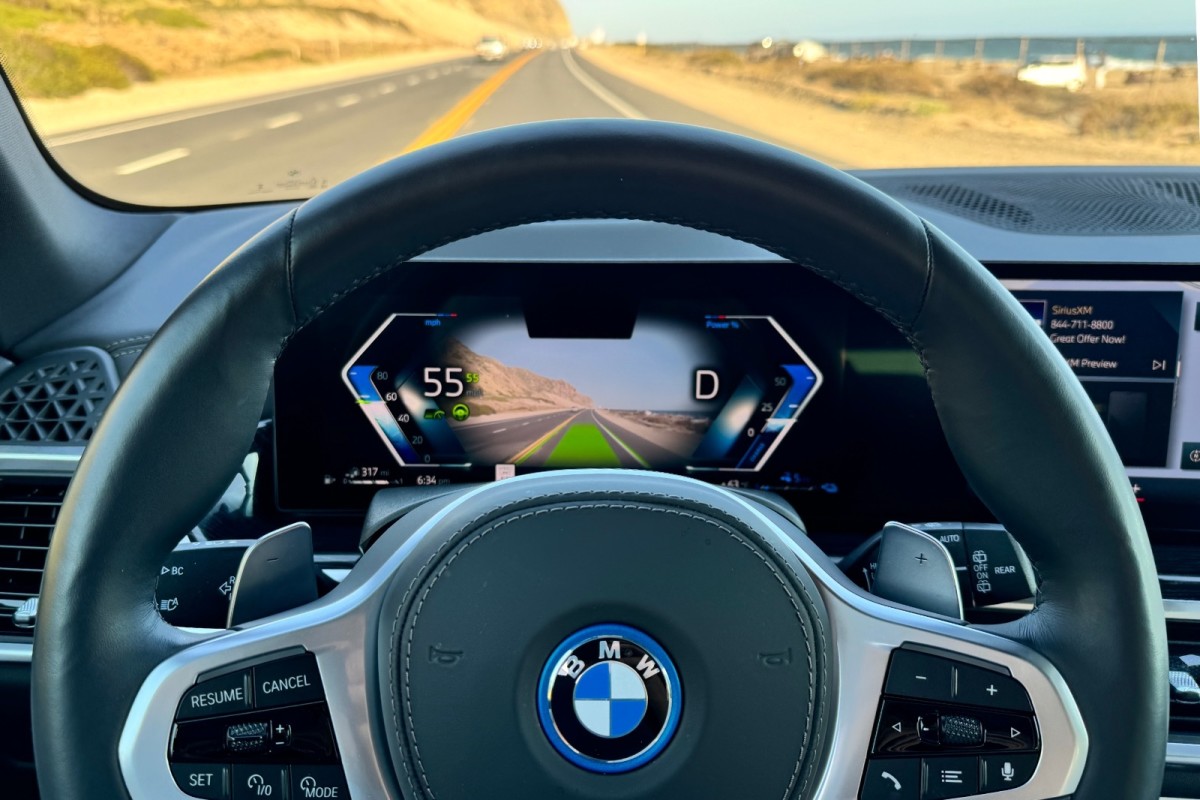
However, there is good news on the technology front. The available head-up display does a great job of conveying data to the driver, including the current status of advanced driving assistance systems. An augmented video function for the navigation system also shows a forward-facing camera view in the middle of the digital display. Of course, the trick to using it is getting the Intelligent Personal Assistant to provide accurate directions to a destination, which might take some luck.
Safety
For 2024, BMW adds its Highway Assistant hands-free driving assistance system to the X5. You must be deliberate about turning this function on within the safety features menu on the infotainment screen. You must also choose the Assisted Driving Plus cruise control mode using the steering wheel controls. You’ll know when the system is ready to take control through indicators on the digital instrumentation or the head-up display, and when you let go of the steering wheel, green indicator lights illuminate on the wheel’s spokes.
Like similar technologies from other automakers, Highway Assistant is best when used in dense, slow-moving traffic or at higher speeds in light traffic. Under these conditions, it works well and is remarkably effective when driving into the late afternoon sun, a situation that can flummox similar technologies.
However, in an area like L.A., where traffic across multi-lane freeways is typically moderate with plenty of motorists lane-shopping for the quickest path to their destination, Highway Assistant can behave in ways a human driver does not, causing some irritation and frustration. In addition, in heavy traffic, the technology suddenly and sharply engaged the brakes for a brief moment without any apparent cause.
When using the hands-on adaptive cruise control and lane-centering assistance on the Pacific Coast Highway, the technology did a great job navigating the curves and keeping the SUV in the middle of the lane. However, on one of the bends in the road there was a truck parked on the shoulder. The X5 saw it as an obstacle and briefly engaged hard braking. Fortunately, there wasn’t anyone traveling behind the BMW at the time.
Aside from the errant braking episodes we experienced, our favorite thing about the X5’s driver aids is that they operate in the background. You’re barely aware these features are on and working their magic because they operates in a subtle and sophisticated manner most of the time. In turn, that means you’re more likely to use the technology instead of turning it off.
As for crash-test ratings, the Insurance Institute for Highway Safety (IIHS) gave the 2024 X5 high ratings, although lower headlight ratings prevented the BMW from earning an IIHS safety award for this model year. The National Highway Traffic Safety Administration (NHTSA) gives the 2024 X5 an overall crash-test rating of four stars, one below the maximum five-star rating.
Cost-effectiveness
As great as the 2024 BMW X5 is, you’ll pay for the privilege of driving it. Pricing starts at around $65,000—and that’s for a rear-wheel-drive (RWD) model without a single upgrade. You’ll have to pay extra for BMW’s xDrive all-wheel drive (AWD) system. Sure, BMW provides complimentary scheduled maintenance for three years or 36,000 miles and four years of free roadside assistance, but those perks don’t justify the X5’s price premium.
What does make you feel better about spending more to seemingly get less are the X5’s traditional Germanic driving characteristics, its high-quality interior, and the sense that the people working in BMW’s Spartanburg, South Carolina, assembly plant have screwed this SUV together with the utmost precision. Also, the xDrive50e offers enough electric-only driving range that you’ll save plenty of money at the pump.
Unlike some recent BMW models we’ve reviewed, the 2025 X5 still clearly traces the automaker’s past. We like it a lot, especially in the BMW X5 xDrive50e PHEV spec.

What owners say
"Overall, owners appreciate the 2024 BMW X5 for its impressive technology, smooth hybrid performance, and comfort. Features like hands-free driving and electric range are highlighted as favorites. However, some drivers feel that it doesn't differ much from the previous model and are not entirely pleased with the color options available."
The SUV exceeds our expectations. From comfort to safety to style this BMW hit all points! My wife loves the sensors around the vehicle making her aware of any obstacles before incident. Overall this was our number one choice and happy with it. We also looked at the XC90, Grand Cherokee, GV80.
January 11, 2025BMW X5 this is a very good premium crossover, I think this car loses a lot of value in the first year and then the price stays the same, it's a very decent car!
August 14, 2025Great car with so many features. Some of the features I liked the most are Hands free driving ( Driver Assistant plus), record the parking route and replay it later for auto parking, using my phone and apple watch as a key so no need to carry physical key, live view of the car from your smartphone and so on. 46 miles of electric range and 3 different driving modes - sports, hybrid and electric makes this car one of the best cars I drove.
September 3, 2023What owners say
The SUV exceeds our expectations. From comfort to safety to style this BMW hit all points! My wife loves the sensors around the vehicle making her aware of any obstacles before incident. Overall this was our number one choice and happy with it. We also looked at the XC90, Grand Cherokee, GV80.
January 11, 2025BMW X5 this is a very good premium crossover, I think this car loses a lot of value in the first year and then the price stays the same, it's a very decent car!
August 14, 2025Great car with so many features. Some of the features I liked the most are Hands free driving ( Driver Assistant plus), record the parking route and replay it later for auto parking, using my phone and apple watch as a key so no need to carry physical key, live view of the car from your smartphone and so on. 46 miles of electric range and 3 different driving modes - sports, hybrid and electric makes this car one of the best cars I drove.
September 3, 2023Great car with ample electric range for most local driving
January 2, 2024Amazing plug in Hybrid! Smooth transitions and plenty of power!
December 26, 2023The car is fine and as advertised. It just seemed too similar to my current 2017 X5. Plus I wasn’t thrilled by the color.
June 24, 2024Trims & specs
Base MSRP $89,300 | Seating 5 |
Engine N/A | Cargo Capacity 33.9 cu ft |
Combined MPG N/A | Drivetrain N/A |
Base MSRP $65,200 | Seating 5 |
Engine N/A | Cargo Capacity 33.9 cu ft |
Combined MPG N/A | Drivetrain N/A |
Base MSRP $67,500 | Seating 5 |
Engine N/A | Cargo Capacity 33.9 cu ft |
Combined MPG N/A | Drivetrain N/A |
Base MSRP $72,500 | Seating 5 |
Engine N/A | Cargo Capacity 33.1 cu ft |
Combined MPG N/A | Drivetrain N/A |


Pricing trends
MSRP range
$65,200 - $89,300
Current avg. market price
$50,229
Trending down by 1.3% this month
May 2026 - November 2026


