2025 BMW 3 Series Reviews, Pricing & Specs


Pros & cons
What we like
Fun to drive
Easy-to-use technology
Great safety ratings
What to consider
Snug interior
Front seat comfort on longer trips, hot days
Confusing, inconsistent names for technology
The CarGurus verdict
Long the benchmark of luxury sports sedans, the 2025 BMW 3 Series is still a thrill.
To enjoy driving a new 3 Series, you don’t need to upgrade to the M340i or the M3, though we certainly wouldn’t discourage you if those models are within your budget. Instead, try the standard 330i with the M Sport Package. It’s surprisingly satisfying. Plus, minor updates and refinements make the 2025 3 Series better than ever. However, the plug-in hybrid powertrain is gone, so for that, you’ll need to find a leftover 2024.
Verdict: The 2025 BMW 3 Series isn’t perfect, but it’s perfectly enjoyable to drive. Also, for a car nearing the end of its current generation, it offers remarkably advanced technology. A redesign is coming soon, but the current version remains one of our favorites.
out of 10 expert review
Look & feel
BMW has a reputation for daring to be different with design, but the company has always hedged its bets with the 3 Series. At one point in the automaker’s history, the 3 Series was BMW’s most important vehicle, so risking profit with a bold-and-brave look was ill-advised.
So it is with the 2025 3 Series, a relatively conservative design compared to the more expressive 2 Series, 5 Series, and 7 Series. This year, minor changes freshen the aging 3 Series, including a couple of new paint colors, intricate new wheel designs, restyled steering wheels, and minor dashboard revisions related to a technology upgrade.
BMW offers the 3 Series as the 330i, 330i xDrive, M340i xDrive, and M3, with increasing levels of power and performance. The xDrive designation refers to BMW’s all-wheel-drive (AWD) system. Our rear-wheel drive (RWD) 330i test vehicle featured an upgrade from standard Sport trim to M Sport. That brought minor styling changes, different wheels, a sport-tuned suspension, and variable sport steering.
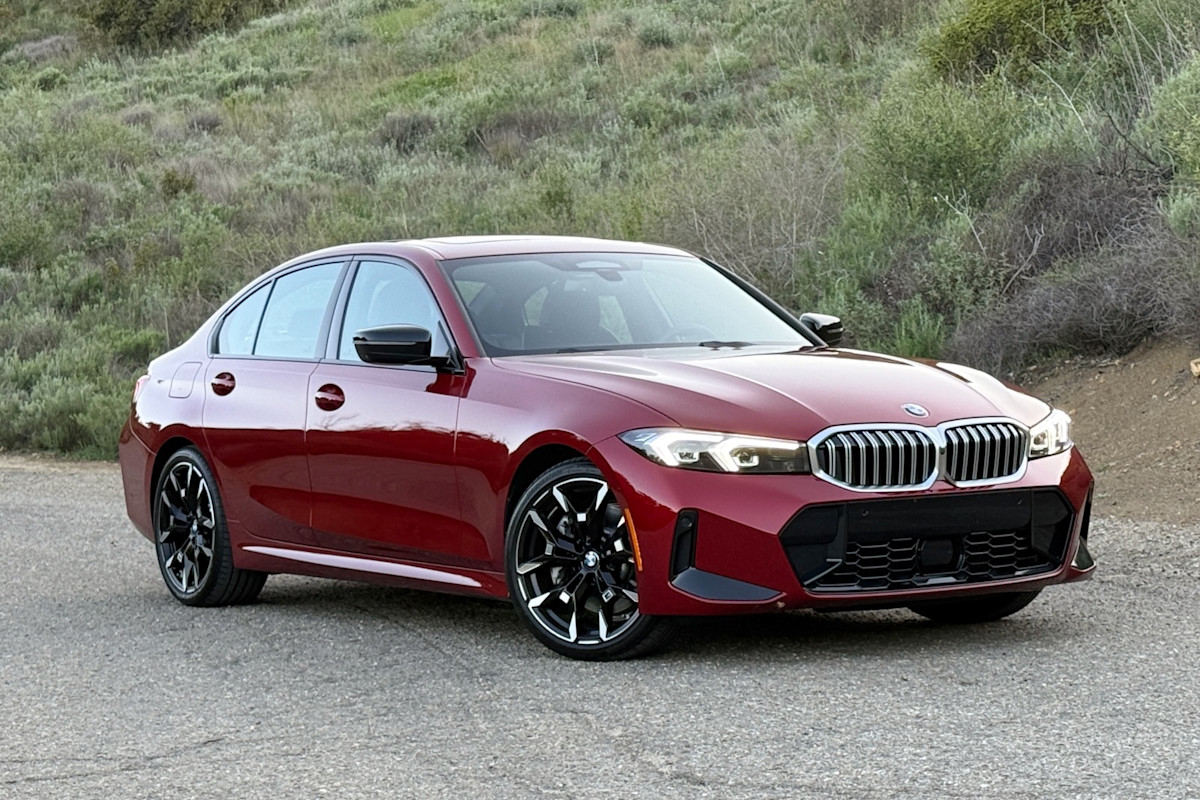
That Vegas Red paint color you see in the photos is new for 2025; the other fresh hue is Arctic Race Blue. In addition to the extra-cost paint, the test vehicle had leather upholstery, a Harman Kardon surround-sound system, and the Parking Assistance, Driving Assistance Professional, and Premium Packages. It wore a manufacturer’s suggested retail price (MSRP) of $57,200, including the $1,175 destination charge.
The test car’s dark, businesslike interior featured brushed aluminum trim and metallic detailing to add contrast to the cabin. Everything inside the 3 Series exudes quality, and that sense of robust materials and construction starts with the decisive thunk the door makes when you close it. If you prefer a brighter or more luxurious interior, BMW offers several upholstery and trim choices to help you make that happen.
Our test vehicle did not have the optional Shadowline Package or the extended Shadowline upgrade. They include a black version of the car’s iconic twin-kidney grille, creating a gaping maw between the headlights that makes it look like BMW forgot to install something at the San Luis Potosi, Mexico, factory.

Performance
Depending on the version of the BMW 3 Series you choose, you’ll get swift, speedy, or stunning performance. They’re all sporty, though. Our 330i was the swift version, accelerating to 60 mph in a claimed 5.6 seconds. Had BMW equipped it with the available xDrive AWD system, that acceleration time would have dropped to 5.4 seconds.
The BMW 330i employs a turbocharged 2.0-liter four-cylinder engine with 48-volt mild-hybrid system, while M340i xDrive and M3 models have inline-six engines. Output is 255 horsepower between 4,700 rpm to 6,500 rpm and 295 pound-feet of torque from 1,600 rpm to 4,500 rpm. As you can see from those peak power and torque spreads, you get one or the other from shortly after launch all the way to near the engine’s redline.
This is a delightful engine. It revs smoothly, sounds good, and offers plenty of power in most driving situations. An eight-speed automatic transmission with a Sport mode, paddle shifters for manual control, and a launch control system powers the car’s rear wheels unless you get xDrive. Drivers can choose between Eco, Comfort, and Sport driving modes, and our 330i M Sport test vehicle also had a Sport+ mode.
Ventilated front and rear disc brakes are standard, and the M Sport Package adds a sport suspension and variable sport steering. Our test car rode on 19-inch wheels wrapped in staggered-width Bridgestone Turanza tires sized P225/40R19 in front and P255/35R19 in back. You can further enhance the 330i M Sport with a Dynamic Handling Package containing performance tires, more powerful brakes, and M-tuned adaptive dampers.
Our test vehicle didn’t have that upgrade, and it showed in the curves and corners of Mulholland Highway near Malibu, California. The Turanzas howled a little and allowed the 330i’s nose to push wide in tighter turns. Quick acceleration out of corners made the car’s rear end feel a little greasy, too.
Otherwise, you don’t need the Dynamic Handling Package’s M Sport brakes unless you’re planning a track-day outing. The standard stoppers withstood abuse when driving the 330i with enthusiasm. But, with that stout stopping capability comes extra sensitivity and stickiness when driving in the city and in traffic. And that makes it hard to drive smoothly.
It’s hard to say if the optional adaptive dampers would have improved the ride. We can report that if you don’t want awareness of every nuance in the pavement surface, you should skip the M Sport Package. Driving enthusiasts will welcome that level of communication, but luxury car buyers won’t. Also, the 3 Series isn’t as isolated from road, wind, and ambient noise as expected.
We like the 330i M Sport’s steering. The new steering wheel design is a perfect shape and thickness, and the response to input is quick and crisp. Even in Sport mode, the effort level is a touch light, but that’s alright. When driving on public roads, it’s terrific.
In addition to offering plenty of performance, the 330i is remarkably fuel-efficient. The official EPA fuel economy rating is 31 mpg in combined driving. We didn’t hit that number on the evaluation loop, logging 28.1 mpg driving the car mostly in Comfort mode but using the Sport and Sport+ modes in the mountains. However, on a day trip traveled almost exclusively on Southern California freeways, the 330i averaged 37 mpg despite getting stuck in afternoon rush-hour traffic in Los Angeles. Based on that, we expect most 330i owners to achieve or even beat the official EPA combined-driving estimate.

Form & function
In the U.S. market, the 3 Series is a compact luxury sedan (a wagon is available in other markets), and it feels that way when you’re sitting inside the cabin. It offers a snug, tailored fit appropriate for four adults of no more than typical height.
The 330i has power-adjustable heated sport seats wrapped in SensaTec artificial leather or, at extra cost, the real thing. Manually adjustable thigh supports are also standard. Yet we struggled to find the right mix of seat height and leg support we prefer, resulting in soreness on longer drives. Furthermore, BMW does not offer ventilated front seats as an option—an unexpected omission on what is supposed to be a luxury car.
Getting into the back seat is a deliberate exercise, but once you’re settled in, the seat cushion and backrest angles provide excellent support. Robust outboard bolsters help to hold you in place when the driver takes corners with gusto, but they can make a graceful exit elusive. The hard plastic front seatback panels intrude on legroom if the front-seat occupants recline them too much.
Interior storage is quite good, and most of it is covered to keep things stashed out of sight. The trunk measures 16.9 cubic feet, is deep enough to accommodate full-size suitcases stored on their sides, and has enclosed lid hinges to help you maximize loading. The 40/20/40-split folding rear seat allows you to carry long items and two passengers simultaneously.

Technology
For the 2025 model year, the 3 Series receives an upgraded infotainment system running BMW Operating System 8.5 (iDrive 8.5). It features a new Home page with three primary information panels and QuickSelect access to the features and functions contained within the infotainment system. To operate it, you can use the 14.9-inch infotainment touchscreen, the iDrive controls on the center console, or the BMW Intelligent Assistant voice recognition system.
As always, we evaluated the BMW Intelligent Assistant using a standard set of commands ranging from simple to complex. And as always, the BMW Intelligent Assistant responded quickly and accurately to most of them. In a new and unexpected twist, after we said, “Hey BMW, I need to go to a hospital,” the first two choices were not medical facilities located in Mexico, which is typically what happens with iDrive 8.5. However, this time, the tech mixed in some doctor offices with local hospitals. So, still not the desired result, but an improvement of sorts.
Our test vehicle had the optional Harman Kardon surround-sound system with stylish front speaker grilles—and it’s impressive. We had no trouble programming navigation destinations, pairing an iPhone 16, running the wireless Apple CarPlay integration (Wireless Android Auto is also standard), or streaming music. The car’s wireless smartphone charger also worked well.
Thanks to the optional Parking Assistance Package, we easily tucked the 3 Series into tight spaces. That upgrade includes front and rear parking sensors with automatic braking and front, 3D panoramic, and surround-view camera angles. Guidance lines help you to carefully maneuver to avoid obstacles, curbs, and the like.

Safety
It’s hard to determine what safety features are standard on a BMW 3 Series, partly because the automaker groups things into packages with names like Active Protection System, Active Guard, and Active Driving Assistant. Moreover, BMW appears to list some standard items within optional equipment packages, adding to the confusion.
The Active Protection System is a collection of features that prepare the 3 Series and its occupants for an imminent collision. For example, it tightens the seatbelts to snug people into the seats. After a crash, a post-collision braking system brings the car to a stop as soon as possible to avoid secondary collisions.
BMW says the standard Active Guard feature includes forward collision warning and automatic emergency braking at city speeds, but then lists those features as part of the Active Driving Assistant, which also has pedestrian detection and a lane departure warning system. Active Driving Assistant is standard, yet is also a line item in the optional Convenience and Premium option packages.
Presumably, since our test vehicle had it, blind-spot monitoring with rear cross-traffic alert is also standard. Unfortunately, BMW doesn’t list it anywhere, but we cannot imagine that a modern luxury sedan would make those features optional instead of standard.
From there, it’s easier to sort out the standard and optional equipment. A Driving Assistance Package equips the car with adaptive cruise control. The Driving Assistance Professional Package adds Active Driving Assistant Pro, which includes Steering Assistant (lane-keeping and lane-centering assist), Lane Change Assistant (semi-autonomous lane-change assist), and Evasion Assistant (evasive steering assist). Extended Traffic Jam Assistant is also a part of the Driving Assistance Professional Package. It provides hands-free driving at speeds under 40 mph and works only on limited-access highways.
Furthermore, the in-car displays refer to the adaptive cruise control and lane-centering assist operation as Assisted Driving, and the Extended Traffic Jam Assistant as Assisted Driving Plus. Separately, you can use Steering Assistant without the adaptive cruise control, but it wrecks the driving experience.
We know that’s all super confusing. But here’s the upshot: the hands-on Assisted Driving technology works well on freeways, and not as well on winding highways like coastal California’s Pacific Coast Highway. Also, if you’re impatient, it can take some effort to override the Lane Change Assistant if you’re not willing to wait for the tech to nudge the car over a lane.
The Assisted Driving Plus system will automatically present an opportunity to use it when Assisted Driving is active on an approved highway and your speed drops below 40 mph for an extended time. Activate it, let go of the steering wheel, and the green indicator lights on the wheel spokes will confirm it is active. It isn’t quite as intuitive as newer BMW models, but it works well. Like all hands-free driving systems used in situations when the surrounding vehicles are human-driven, its behavior can cause some irritation in other motorists.
If you cannot avoid a collision, know that the 2025 BMW 3 Series earns the highest possible crash-test ratings from the National Highway Traffic Safety Administration (NHTSA). Across the board, in every evaluation, including rollover resistance, it gets a top five-star rating.
Similarly the 3 Series earns top marks in at least some Insurance Institute for Highway Safety (IIHS) crash tests. However, the IIHS hadn’t subjected the 2025 3 Series to its newest crash tests at the time of publication, making the Bimmer ineligible for a Top Safety Pick award.

Cost-effectiveness
CarGurus reported that the average price of a new vehicle sold in the first quarter of 2025 was approximately $49,500. You can buy a brand-new BMW 3 Series for less than that.
Granted, you could save almost $10,000 by instead choosing something like a Mazda 3 Turbo sedan that has about the same power, standard AWD, similar levels of refinement and sophistication, and more standard equipment. But no matter how fun a Mazda is to drive, it’s not a BMW. Besides, the turbocharged Mazda 3 sedan is significantly less fuel-efficient.
What about rivals in the compact luxury car class? The ones hailing from Germany include the more affordable Audi A4, which is a capable if bland alternative that won’t be available after the 2025 model year, as it’s being replaced by the redesigned Audi A5.
The Mercedes-Benz C Class is a compelling car, but even in the base C 300 specification, it is a little more expensive and less efficient than the BMW. Plus, BMW includes three years of complimentary scheduled maintenance, sweetening the value proposition compared to the Benz.
The Lexus IS is a proper rival to the 3 Series, but it’s also an older design, rapidly falling behind in technological sophistication. It is the least expensive of the three alternatives we’ve named here, but it is also the least efficient. However, the IS is known to deliver outstanding long-term reliability.
The Genesis G70 is another path to luxury sports sedan ownership, and it has a fantastic warranty and a nice price. But the rear seat and trunk are so small as to be nearly unusable.
Ultimately, in this segment, we prefer the BMW 3 Series. It isn’t the most affordable, elegant, luxurious, or attractive compact luxury sports sedan, but it delivers impressive power, efficiency, driving dynamics, technology, and safety in a car that’s easy to live with. And when you spec one like our test car, it is still a real thrill to drive.

What owners say
Trims & specs
Base MSRP $47,950 | Seating 5 |
Engine 2.0L 255 hp I4 | Cargo Capacity 16.9 cu ft |
Combined MPG 30 | Drivetrain AWD |
Base MSRP $45,950 | Seating 5 |
Engine 2.0L 255 hp I4 | Cargo Capacity 16.9 cu ft |
Combined MPG 31 | Drivetrain RWD |
Base MSRP $60,200 | Seating 5 |
Engine 3.0L 386 hp I6 | Cargo Capacity 16.9 cu ft |
Combined MPG 30 | Drivetrain RWD |
Base MSRP $62,200 | Seating 5 |
Engine 3.0L 386 hp I6 | Cargo Capacity 16.9 cu ft |
Combined MPG 29 | Drivetrain AWD |


Pricing trends
MSRP range
$45,950 - $62,200
Current avg. market price
$39,917
Trending down by 1.3% this month
May 2026 - November 2026