2025 Cadillac Escalade IQ Reviews, Pricing & Specs
Write a review--
Original MSRP
5.7
of 10
expert review
avg user rating
(0 reviews)
Pros
Hard-to-ignore exterior
Posh interior
Standard advanced safety features
Cons
Drives as big as it looks
Tech is a case of quantity over quality
High-power charging is mandatory for road trips
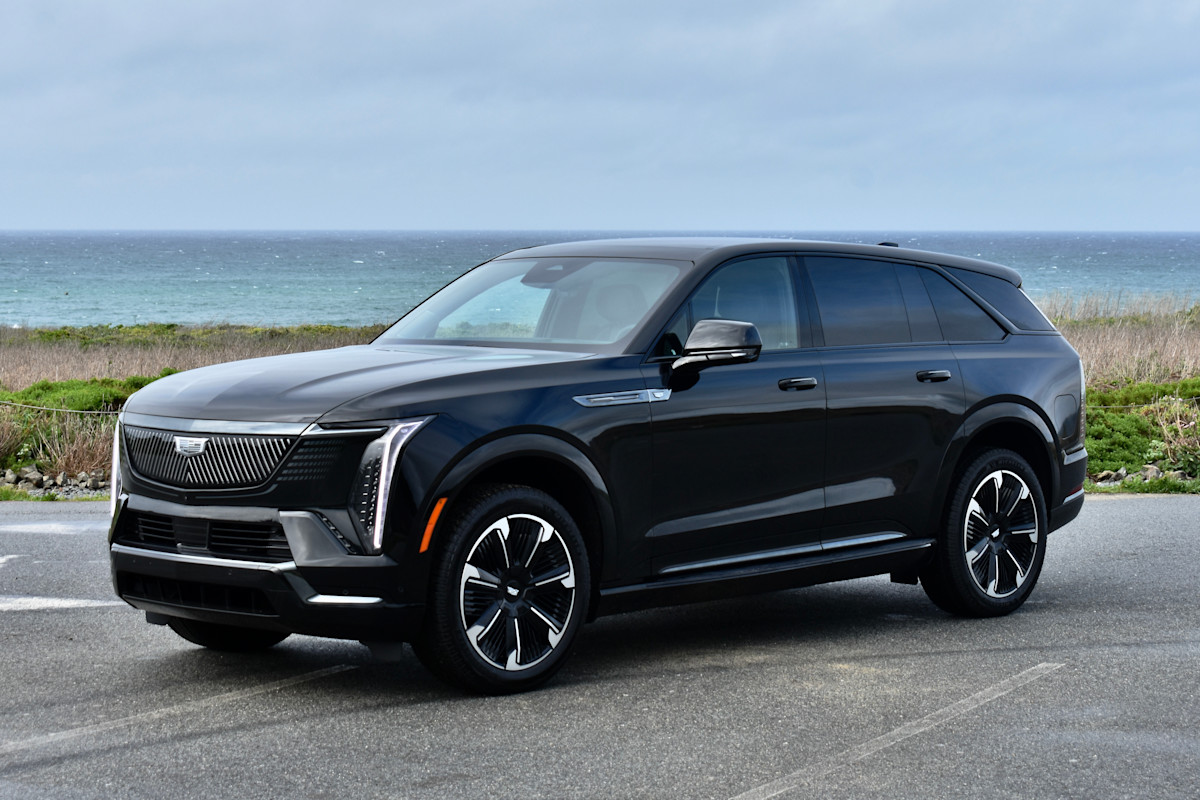
Cadillac applies the Escalade name to a new all-electric full-size SUV, sitting above the Cadillac Optiq EV.
Cadillac’s biggest electric vehicle yet arrives with little direction competition. The new 2025 Cadillac Escalade IQ is unrelated to the internal-combustion Escalade full-size SUV, instead sharing underpinnings with the GMC Hummer EV and General Motors’ electric full-size pickup trucks. That leaves an electric luxury SUV unrivaled in size, for now.
Verdict: The Escalade IQ does things no other full-size SUV can, but it’s still hard to justify.
The Escalade IQ follows the template established with other GM brands of applying a familiar model name to a clean-sheet EV design. Instead of the standard Escalade’s body-on-frame construction, the Escalade IQ features unibody construction, with the entire body shell designed around the battery pack’s dimensions. This is a common approach for all of GM’s current EVs, but the Escalade IQ is the first electric Cadillac to carry over the name from a combustion model.
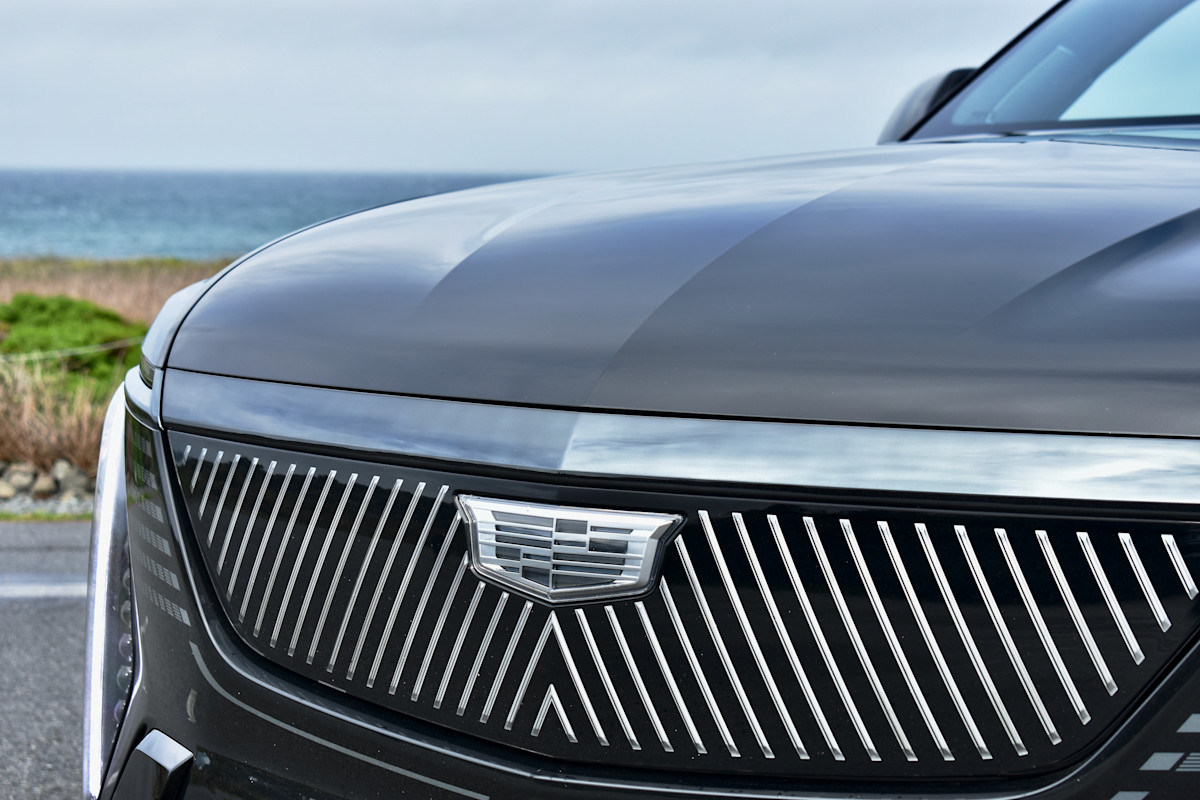
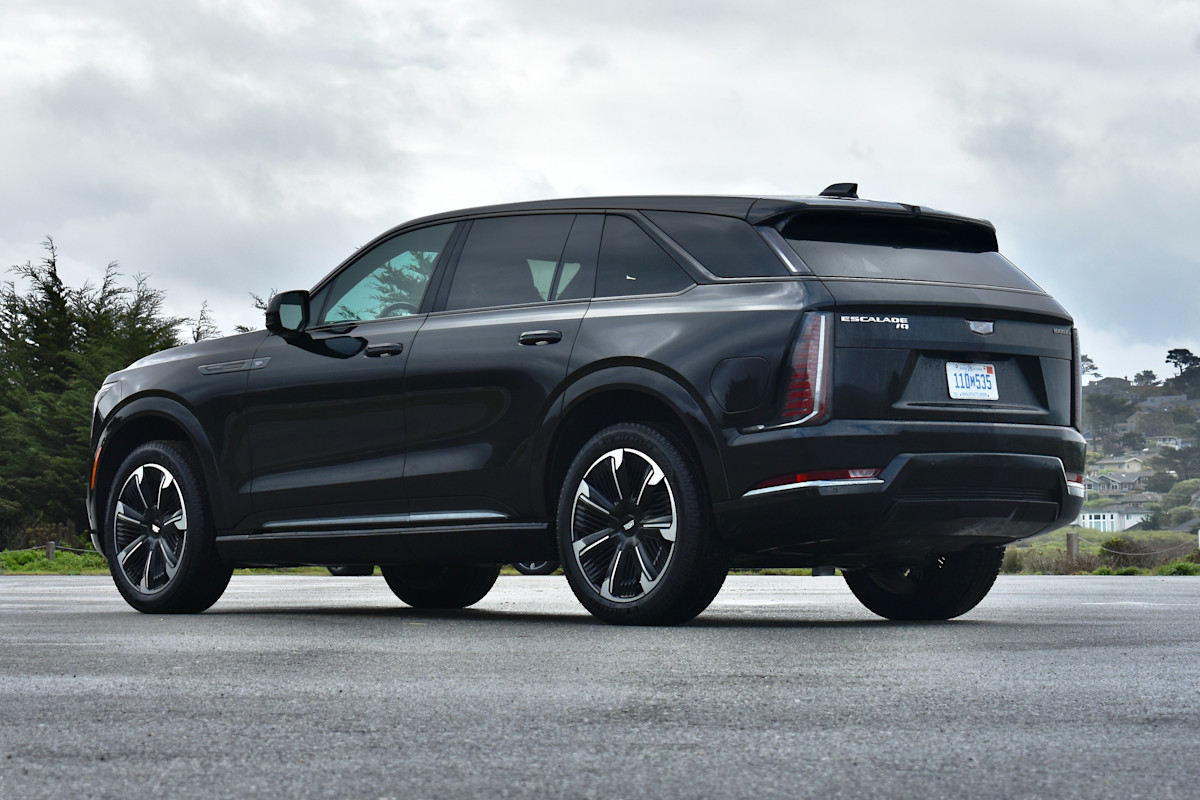
Styling is also much closer to the Escalade IQ’s namesake, especially since the latter’s most recent facelift. Both Escalade models now share high-mounted headlights, a broad front end like a cliff face, and available 24-inch wheels. But IQ features the blanked-off grille and split taillights of Cadillac’s other electric SUVs—the Optiq, Lyriq, and Vistiq—to remind you that it’s electric. The IQ also has a much faster roofline than the standard Escalade—you could almost call it an Escalade coupe—although the extra-space Escalade IQL model arriving for 2026 has a more conventional profile.
Those EV-specific styling cues don’t really disguise the Escalade IQ’s bulk. At 224.3 inches long, it’s a just over a foot longer than a standard-wheelbase Escalade, and just 2.7 inches shorter than the stretched Escalade ESV. It’s still about as wide as a standard Escalade, while sitting 0.6 inch lower thanks to its sleeker roofline. Like other Cadillac models, the Escalade IQ is available in Luxury and Sport design themes, but in this case both come standard with 24-inch wheels.
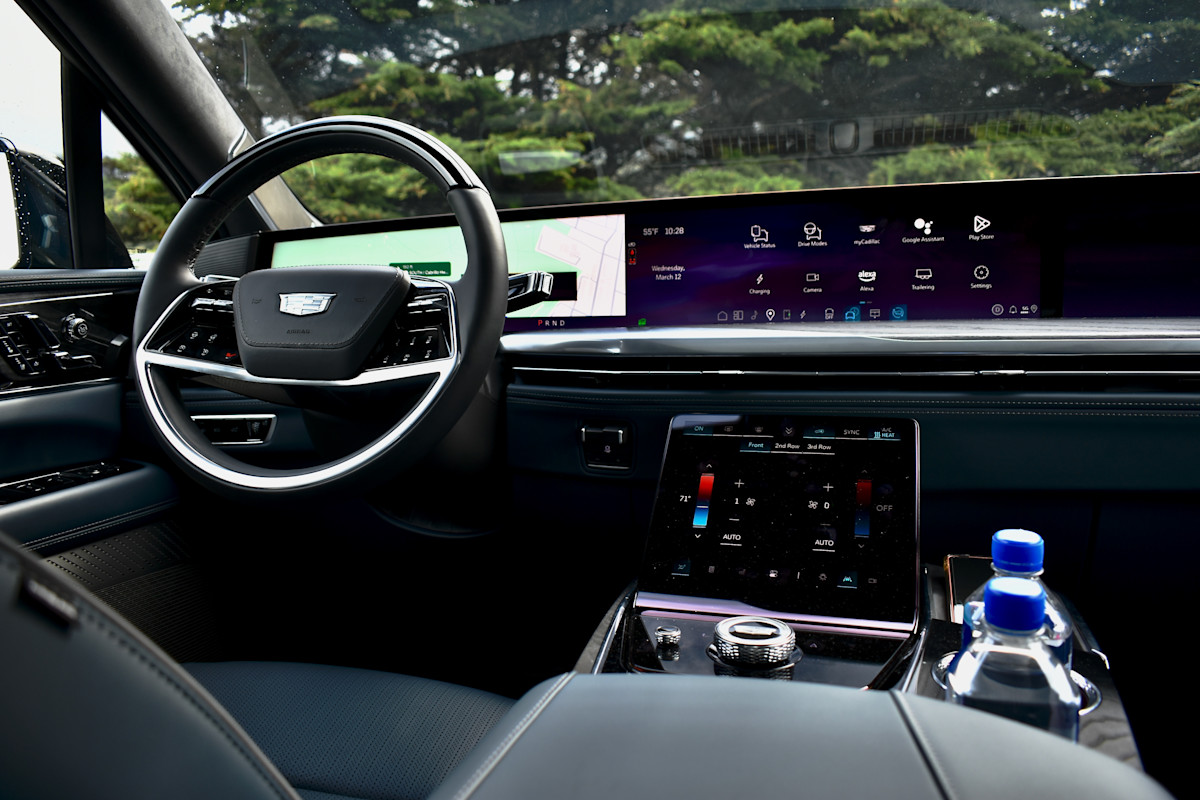
Inside, the Escalade IQ feels like a true luxury vehicle, with interesting and varied interior materials, attention to detail in areas like intricate speaker grilles, and well-integrated screens. However, for such a large vehicle, the front seats felt cozier than expected thanks to some of these design features. The dramatic door-to-door screen requires a high-and-deep dashboard, while the door speakers and wide center console ate into thigh room.
The Escalade IQ’s standard dual-motor all-wheel drive (AWD) powertrain generates up to 750 horsepower and 785 lb-ft of torque when using the driver-selectable Velocity Max mode. This is Cadillac’s name for the Watts to Freedom (WTF) and Wide Open Watts (WOW) launch modes from GMC and Chevy electric trucks, respectively, and it performs the same function here.
Unlocking the powertrain’s full potential, Velocity Max gets the Escalade IQ from zero to 60 mph in 4.7 seconds, according to Cadillac. That’s in the same ballpark as the gasoline Escalade-V, which gets to 60 mph in 4.4 seconds courtesy of a 682hp supercharged 6.2-liter V8. And that’s an impressive feat considering the Escalade IQ weighs a lot more.
That extra weight is due to the Escalade IQ’s plus-sized battery pack. It uses the same double-layer pack as the longest-range versions of the GMC Hummer EV, GMC Sierra EV, and Chevy Silverado EV, with 24 modules and an estimated 200 kilowatt-hours of total capacity. That provides a Cadillac-estimated 460-miles range, while its 800-volt electrical system allows for 350 kW charging, which, according to Cadillac, gets you 100 miles of range in 10 minutes.
That range will dip significantly if you decide to make use of the Escalade IQ’s estimated 8,000-pound towing capacity. That’s comparable to the 8,200-pound maximum for the standard Escalade, but no matter how the vehicle is propelled, towing takes more energy. And while GM is partnering with EVgo on gas-station-style pull-through charging stations, right now many public chargers can’t accommodate vehicles with trailers.
The Escalade IQ also uses the four-wheel steering system that debuted in the GMC Hummer EV, allowing a tight turning circle of just 39.4 feet and the ability to drive diagonally at parking lot speeds. GMC calls that feature CrabWalk, but Cadillac gives it the classier name of Arrival Mode.
Gimmicks like Velocity Max and Arrival Mode are fun, but they don’t compensate for the problems inherent with such a big, heavy vehicle. Like its platform-mates, the Caddy weighs over 9,000 pounds, which puts it into the range of heavy-duty vehicles rather than passenger cars. Air suspension and magnetic dampers aim to manage that girth—and only partially succeed.
Riding on 24-inch wheels with fairly low-profile tires, the Escalade IQ was marginally better to drive than the similarly-shod GMC Sierra EV Denali, but that’s not much of a complement given how sketchy that truck’s handling is. Like the Sierra EV, the Escalade IQ still felt like a truck, albeit one with 750hp. And while it was a bit more comfortable than its GMC pickup cousin, we still felt lots of impacts and shimmying when driving over bumps and other road imperfections.
While there are a handful of three-row electric luxury SUVs on sale right now, the Escalade IQ stands apart because of its sheer size. It’s two feet longer than a Volvo EX90, for example, and 10.9 inches wider. But do the packaging efficiencies of an electric powertrain give it an advantage over the also-enormous internal-combustion Escalade?
Not exactly. Despite a wheelbase that’s 2.1 inches longer than even that of the long-wheelbase Escalade ESV, the seven-seat Escalade IQ only offers fractionally more legroom in its first and second rows. The benefit mainly goes to third-row occupants, who get an extra 2.6 inches compared to a standard-wheelbase, non-electric Escalade.
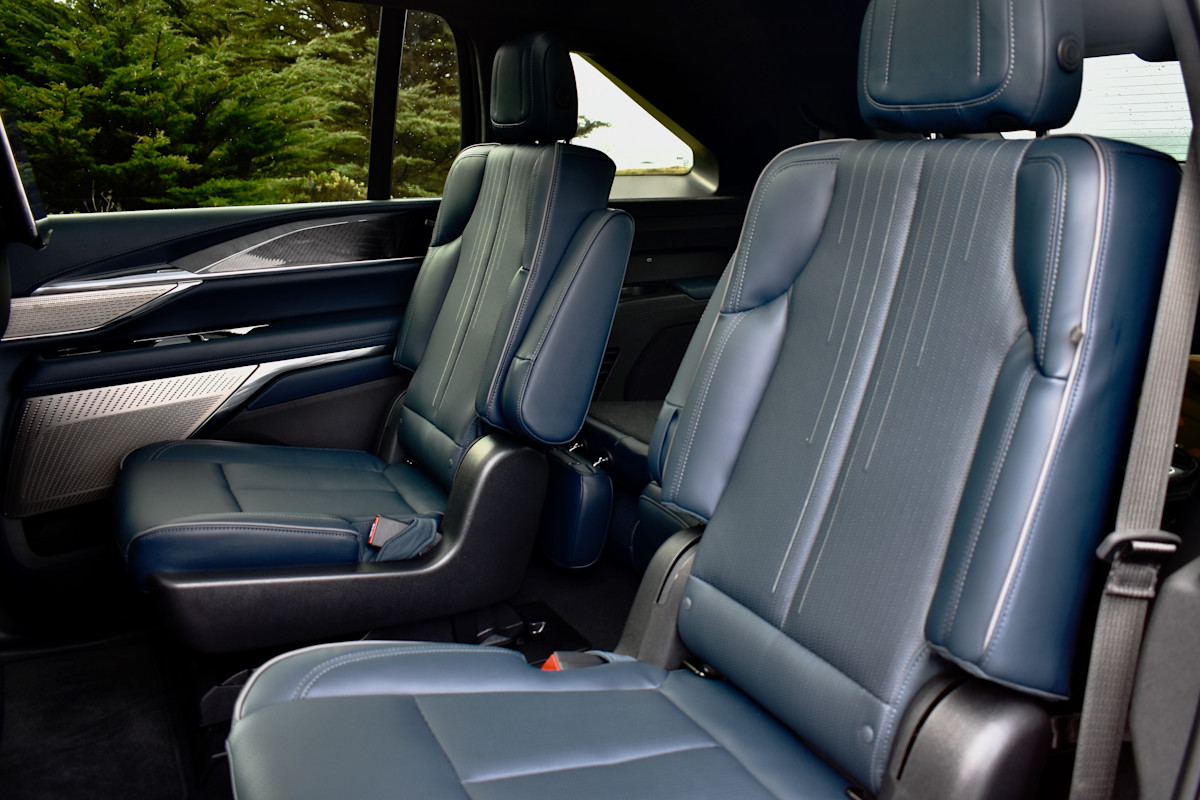
However, Cadillac also offers an Executive Second Row seating option for the new Escalade IQ, with 16-way power-adjustable captain’s chairs that feature heating, ventilation, and lumbar massage, aircraft-style tray tables, and more space. Legroom grows to 45 inches, and the Cadillac-estimated 39.7 inches of headroom is also slightly more than you’d get in the second row of a conventional Escalade.
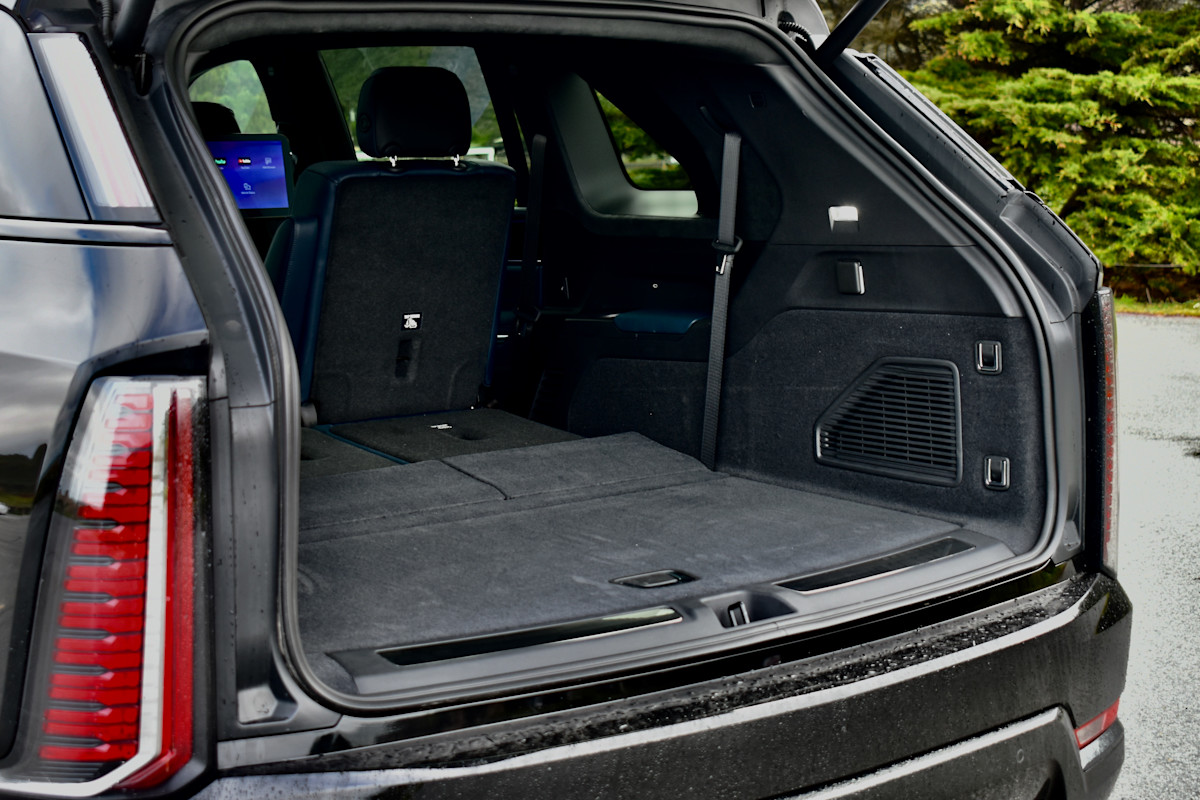
When it comes to cargo space, the Escalade IQ trails its fossil-fuel counterpart across all three rows. However, with 23.6 cubic feet behind the rear seats, 69.1 cubic feet behind the middle seats, and 119.1 cubic feet with both the second and third rows folded, there’s still plenty of space back there. The Escalade IQ also boasts a 12.2-cubic-foot frunk, and an IQL model is coming for 2026 with a more upright roofline that increases cargo space.
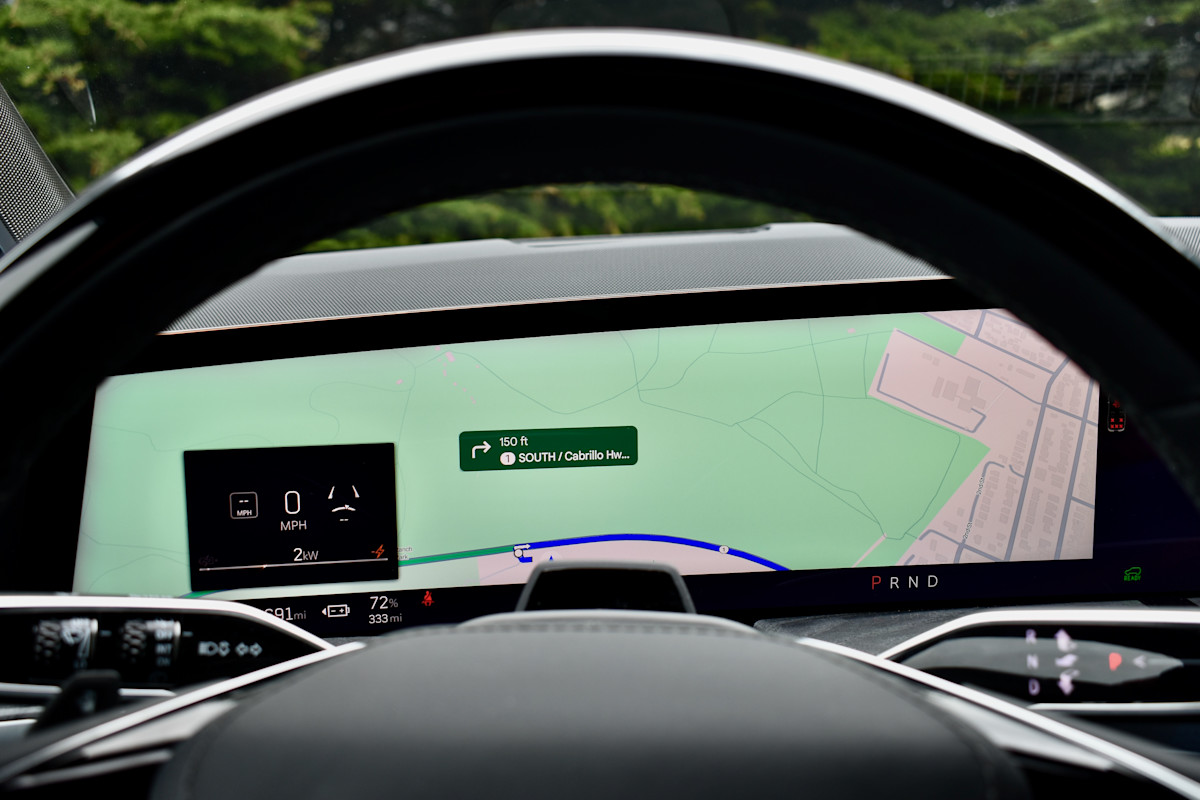
As noted above, the Escalade IQ features a dashboard-spanning display incorporating a digital instrument cluster for the driver, a central infotainment touchscreen, and a second touchscreen for the front passenger. A head-up display is standard as well, while night vision is optional.
The same 55-inch display was added to the standard Escalade for its 2025-model-year refresh, but unlike in that model, you can’t get Apple CarPlay and Android Auto. The Escalade IQ uses the same Google-based infotainment system as other recent GM EVs, and the automaker is sticking to its policy of not offering those smartphone mirroring features on electric models.
The lack of Apple CarPlay and Android Auto wasn’t the only area where the Escalade IQ’s dashboard display felt like a step backward. Other Cadillac models like the Lyriq and Optiq have a panel to the left of the instrument cluster that, among other things, lets the driver change the cluster’s format. That function is now in a more obscure location, so we spent a good part of the driver with redundant maps on both the cluster and main touchscreen.
A smaller screen leans against the dashboard and handles functions like climate control and some vehicle settings. But other vehicle-related functions, like the headlight controls, live on the main touchscreen. And the air suspension’s ride height is controlled by a hard button on the left side of the dashboard. So familiarization is key before setting out.
We didn’t have any issues with the infotainment system’s core functions, or with streaming video (built-in apps include Hulu and YouTube) on the front passenger screen. And the Escalade IQ cabin is studded with speakers so that tunes can be easily heard across all three rows. A 21-speaker AKG audio system is standard, with 38-speaker and 42-speaker versions optional. Sound-enhancing Dolby Atmos software is coming for the 2026 model year.
The elation that Cadillac had finally added a blind-spot camera system turned to disappointment when we saw its low resolution. The camera view also takes over the central screen whenever a turn signal is activated.
Cadillac includes its full array of driver assist features, such as automatic emergency braking (front and rear) blind spot monitoring, rear cross traffic alert, lane keep assist, lane departure warning (with a vibrating driver’s seat to communicate said warning), adaptive cruise control, 360-degree camera system, and automated parking assist. Because this is a GM vehicle, the Escalade IQ also features a teen-driver monitoring system.
GM’s Super Cruise hands-free driving system is also standard. That steering-wheel-free capability is only available on pre-mapped highways, but drivers can now tell the car’s built-in navigation system to look for them. We remain impressed by Super Cruise’s ability to control such a big vehicle, even though the Escalade IQ’s width left it with little room to maneuver on parts of the test route. Automatic lane-change functionality is included as well, but in past experiences we’ve found it to be a bit overzealous.
Safety ratings from the Insurance Institute for Highway Safety (IIHS) and National Highway Traffic Safety Administration (NHTSA) weren’t available at press time, as the Escalade IQ is a brand-new model. Such ratings may never be published, either, as the Escalade IQ’s weight exceeds the limits for passenger cars, exempting it from mandatory crash testing.
The Escalade IQ achieves its impressive 460-mile range not through efficiency, but through an enormous battery pack. When it’s time to recharge that pack, Cadillac says the Escalade IQ can recover 36.5 miles of range per hour of charging from a 240-volt Level 2 AC source, but only with the optional 19.2-kilowatt onboard charger (an 11.5-kW charger is standard).
DC fast charging at up to 350 kW allows the Escalade IQ to recover 100 miles in 10 minutes, according to Cadillac. But that’s assuming you can find a 350-kW charging station; lower power stations take a lot longer to add miles. So while the Escalade IQ should be more than adequate for daily driving—especially if you can charge at home or at work—road trips could be more challenging.
Cadillac does at least give customers ways to get more out of that big battery pack. The Escalade IQ is equipped for bidirectional charging, and with available hardware from GM’s home-energy division it can power your house during blackouts. The total cost for this hardware—including a special charger, inverter, grid disconnect switch, and a small battery to keep the system awake during outages—was $7,299 at the time of publication, but with it a fully-charged Escalade IQ could easily power a home for several days.
The Escalade IQ itself has a starting MSRP of $129,990 (including a $2,290 destination charge) in base Luxury 1 trim. The Sport 1 trim level, with some different design elements but similar feature content, costs $132,780 with destination. Higher-content Luxury 2 and Sport 2 grades cost $152,280 and $152,780 with destination, respectively.
Where it’s range, features, or interior volume, the Escalade IQ offers more of everything. In that sense, it helps justify its six-figure price. The Mercedes-Benz G 580 with EQ Technology—the all-electric version of the iconic G-Class off-roader—has an equally big personality and price tag, but not as much space or range. And the Escalade IQ is better to drive and more pleasant to be in than its SUV platform-mate, the also off-road-focused GMC Hummer EV.
But for those who simply want a spacious electric SUV with a premium feel, the Volvo EX90, the BMW iX, and the Rivian R1S are much less expensive and should be easier to live with thanks to their more manageable size and battery packs. The same will also be true of the 2026 Cadillac Vistiq—a smaller three-row electric SUV the GM luxury brand plans to launch for the following model year.


