2025 Hyundai Ioniq 5 Reviews, Pricing & Specs
Write a review$42,600 to $58,200
Original MSRP
8.7
of 10
expert review
avg user rating
(0 reviews)
Pros
Broad public charging network
Standard advanced safety features
Stylish design
Cons
Competitors have more storage space
Real leather not available
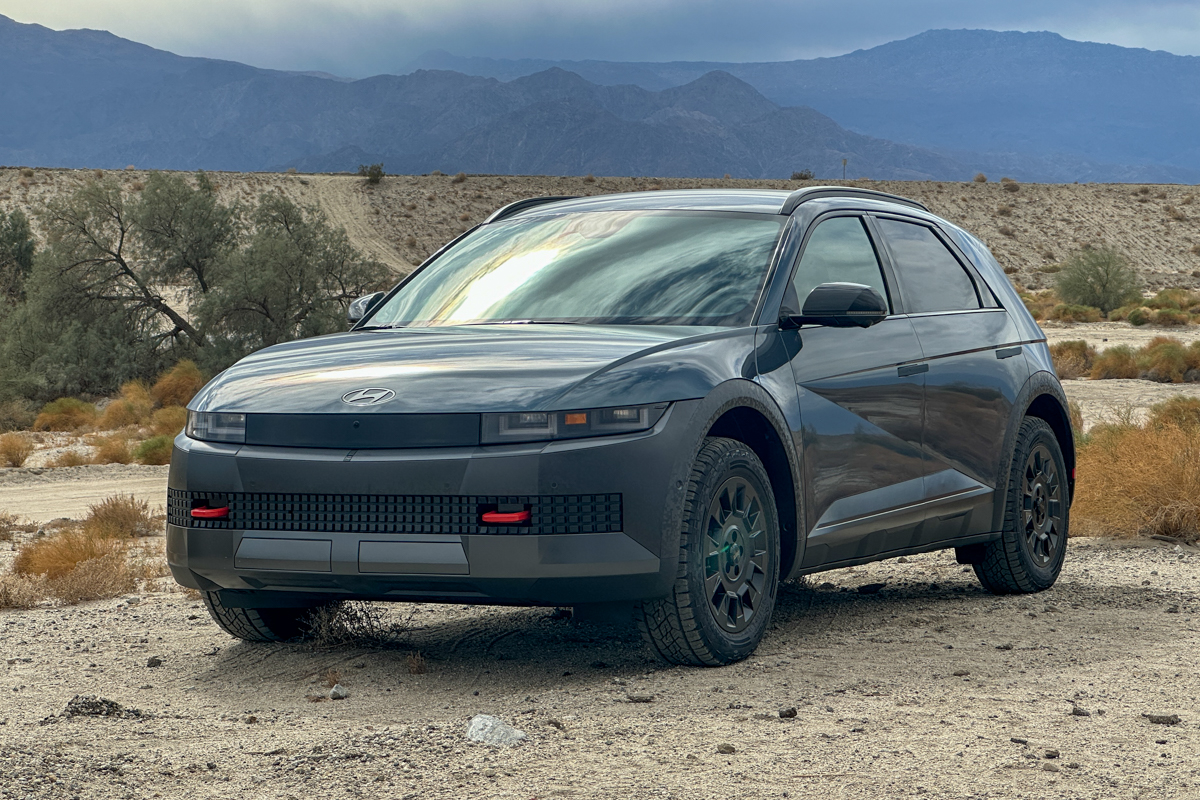
In the 2025 Hyundai Ioniq 5, the automaker refines an already-good EV and aims to broaden its appeal with a new adventure-ready trim.
It would appear to be the calendar, not the competition, that has the Ioniq 5 due for a mid-cycle refresh. We liked it when it burst onto the scene as an angular oddball in a sea of soft-lined sameness, and it has only improved over the last few years.
Verdict: Hyundai makes minor but welcome changes and avoids tweaking the many things that were working well, successfully making a good thing better.

The Ioniq 5 has always been distinctive in appearance. It’s drawn retro comparisons to the 1986-1991 Lancia Delta (which works particularly well with the high-performance Ioniq 5 N variant), but it looks like little else on the road today, and Hyundai has kept the styling largely the same through this mid-cycle refresh. The lower front fascia gets mild revisions, with the same general shapes proportioned slightly differently, but it still has the “Parametric Pixel” headlights and taillights, the perfectly round wheel arches, the stark diagonal crease making triangles of the side, and the high rear spoiler that definitely seems to be hot-hatchback-inspired.
You don’t have to have a great eye for ground clearance to spot the new XRT trim: It easily stands out from the rest of the lineup with its red tow hooks and the black plastic bumper cladding that seems to be obligatory for any off-road package these days. The Ioniq 5 XRT’s plastic does up the aesthetic ante a little with a neat “digital camouflage” pattern. It’s not so obvious as to be eye-watering from afar, but it does add interest up close. The XRT also gets two exclusive colors, Ultimate Red and Cosmic Blue Pearl, but the color palette for other trims has also expanded for 2025 with the addition of Atlas White Matte and Ecotronic Gray Matte.
The new model year brings new wheel designs. 19-inch wheels still come standard on the SE and SEL trims and 20-inchers on the Limited, but the styling is blessedly less busy, though still aggressive. We strongly prefer the 18-inch wheels exclusive to the XRT: They look a bit like steelies, but they also look like real wheels, and their design makes clear references to rally style, which is just plain cool.
Like its exterior, the Ioniq 5’s interior also saw only minor changes with this refresh, and we don’t fault Hyundai for that; we had few criticisms before. The cabin remains an open and uncluttered space, with the minimalistic and modern feel typical both of EVs in general and of Hyundai electric vehicles in particular—see the Ioniq 6 sedan for details. The center console has been revised for functionality–more on that later–but the overall feel is much the same. The new XRT trim does lean a tad more rough-and-ready with its dark interior, all-weather floor mats, and the XRT logo debossed in the seats.

Etched rather than glued-on badging, extra cladding, and a solid front fascia all seem designed to minimize vulnerability, but that’s where the XRT’s special protection ends. There are no skid plates or armor here–clearly, Hyundai does not expect anyone to take this thing rock crawling, as evidenced by the available drive modes.
The Ioniq 5 XRT adds a Terrain Mode button on the steering wheel. Pressing it accesses and cycles through a menu of three options: Snow, Mud, and Sand. All three adjust the throttle mapping, wheel slip, power distribution front to rear (locked at 50/50 in these modes), and the regenerative braking. We kept it in Sand mode for our desert adventure, but we did take note of the ease of access to these varying drive modes. There’s no need to reach or fumble for a rarely used dial; it’s front and center, impossible to lose track of, and couldn’t be easier to operate.
We unfortunately did not get to experience the Ioniq 5 XRT on pavement, where it will no doubt spend most of its time with most buyers. Given the relatively subtle modifications, we can imagine that on-road driving experience will likely be quite similar to that of the Limited trim we did drive, though possibly with a bit more road noise from the standard all-terrain tires.
The XRT handled the loose sand surface on our off-road course admirably, allowing just the right amount of slippage to optimize the mix of confidence and glee. Many off-roaders employ a version of hill-descent control that can take over braking, maintaining a safe speed and allowing the driver to focus on wheel placement. The Ioniq 5 doesn’t need it. Regen meant we barely had to touch the brakes; we could just modulate the throttle. We enjoyed the same while navigating the twisty mountain roads above Palm Springs in the Limited trim and rarely had to move our foot from left to right.
The XRT is naturally offered only in all-wheel drive (AWD) form, while the base SE Standard Range is offered only in rear-wheel drive (RWD). SE, SEL, and Limited trims are RWD by default but can be upgraded to AWD for a fee. The Ioniq 5 gets slightly higher battery capacity from both its standard and long-range batteries for 2025, which in turn translates to longer distances on a single charge: Most trims can travel 318 miles in their single-motor, RWD configuration before recharging, though the base trim has an EPA-rated 245-mile range. Opting for AWD reduces SE and SEL range to 290 miles, the larger-wheeled Limited to 269, and the slightly lifted, AWD-only XRT to 259 miles of range.
Power output also varies with the powertrain choice, of course. RWD models produce a total of 168 horsepower and 258 pound-feet of torque when the single electric motor is paired with the standard-range battery, or 225hp and 258 lb-ft with the long-range alternative. AWD models, meanwhile, feature dual motors and total 320hp and 446 lb-ft of torque. These are not staggering numbers for a vehicle with a curb weight well north of 4,000 pounds, but with the benefit of electric vehicle instant torque, you can still have plenty of fun behind the wheel of an Ioniq 5.

One of the few common complaints levied at the original Ioniq 5 was its lack of a rear windshield wiper. Hyundai has remedied that with the refresh; the rear wiper is new and standard. Inside, the movable center console now features fore-and-aft rather than two-across cupholders. The wireless charging pad, if equipped, lies alongside the cupholders, and buttons to control seat and steering wheel heating as well as parking cameras are conveniently located here as well.
Heated front seats are standard, and the heated steering wheel comes into play at the SEL trim level. Only the Limited trim gets front seat ventilation and driver’s seat memory as well, and heated rear seats are not available at all. The driver’s seat is power-adjustable in every trim, though, which is a nice touch.
Interior dimensions have not changed with this refresh. Head room measures 39.1-39.8 inches front and 37.5-38.7 rear–the smaller numbers only apply to the Limited trim, as it’s the only one that offers a sunroof. Leg room is a generous and fairly equitable 41.7 inches up front or 39.4 inches in the back seat. Cargo space measures 26.3 cubic feet with the rear seats up or 58.5 with them folded down, and the “frunk” adds another .85 cubic feet to the total.
The Ioniq 5’s head room is roughly on par with that of the Ford Mustang Mach-E. The latter has more front but less rear legroom and offers more cargo space across the board, plus a comparatively massive frunk that can accommodate 4.7 cubic feet of gear. The Ioniq 5 does do better on cargo space when compared to its more luxurious corporate cousin, the Genesis GV60. It’s worth noting that that platform-sharer favors the front-row occupants at the cost of any back-seat passengers when it comes to leg room.
Perhaps the most functional change to the Ioniq 5, though, is its transition to the North American Charging System (NACS). This is the same charging standard used by Tesla, meaning 2025 Ioniq 5 owners will be able to make use of the Tesla Supercharger network. Hyundai is also including a Combined Charging System (CCS) adapter with every new Ioniq 5 purchase, cracking open the world of public and fast charging for those buyers.

Screen size is often the de facto measure of tech advancements in a car. The Ioniq 5’s touchscreen infotainment system and digital instrument cluster have not changed in size or appearance for the new model year–we still see a pair of 12.3-inch screens attractively presented in a single slick glass display–but Hyundai promises improved functionality with faster processing speeds thanks to behind-the-scenes software updates. GPS accuracy is also reportedly improved. Wireless Apple CarPlay and Android Auto are new and standard–the 2024 model did have smartphone connectivity, but only in wired form.
Availability of the Bose Premium Audio system was previously limited to the Limited trim, but the new Ioniq 5 XRT also benefits from that more advanced stereo. The SE and SEL trim levels get a generic six-speaker sound system, but all enjoy standard navigation, dynamic voice recognition, bluetooth connectivity that can support two devices at once, and five total USB-C ports–three up front and two in the back. We love that the Ioniq 5 comes with Hyundai’s clever USB feature which lets you choose the functionality for the central USB-C port: It can be set for either charging only or charging and data transmitting, depending on your needs in the moment. Further tech features include a head-up display, which comes only on the Limited trim, and the aforementioned wireless charging pad, which starts at the SEL trim level.

We gave the 2022 Ioniq 5 our highest possible safety rating when the model was new. So did the Insurance Institute for Highway Safety (IIHS): The Ioniq 5 has earned a Top Safety Pick+ award every year since its debut, and the 2025 model looks to be on track for that highest honor as well. It has already secured five stars out of five from the National Highway Traffic Safety Administration (NHTSA). Some competitors have caught up on the safety tech in the years since 2022, rendering Hyundai’s suite of offerings perhaps a tad less impressive, but it is still comprehensive, and it’s grown for 2025. New standard safety and driver-assistance features include an enhanced driver attention system, which now incorporates haptic steering wheel feedback and hands-on detection as well as forward attention warning. Hyundai has also added reverse and forward parking-distance warning. The Ioniq 5 XRT gets the surround-view monitor and blind-spot view monitor also included on the Limited trim. It looks as though blind-spot collision-avoidance assist has been removed from the base trim for this latest model year, though–the Ioniq 5 SE now appears to only offer blind-spot collision warning, without the interventional capability.
As was true last year, both Highway Driving Assist 1 and Highway Driving Assist 2 are available on the Ioniq 5 lineup. HDA 1, equipped on the base trim, combines the standard adaptive cruise control and lane-keep assist functions into a system that can stop and go, maintain a safe distance from the vehicle ahead, and keep you within the lines that define a lane. HDA 2, an upgrade that comes with the SEL, XRT, and Limited trims, adds lane-changing capability and features machine learning, so it should be able to better approximate your own driving style with time.

Like many EV manufacturers, Hyundai provides early-journey charging support with the purchase of each new Ioniq 5. Buyers can choose between at-home or public charging with either a complimentary ChargePoint charger installation or $400 in charging credit. This is an especially sweet deal if the 2025 Ioniq 5 will be your second or third electric vehicle, you already have a charge port at home, and you can take advantage of longer but cheaper overnight charge times.
The RWD-only SE SR trim has a starting MSRP of $43,975 after the mandatory $1,475 destination fee. The range tops out at $59,575 for the Limited AWD, and the new Ioniq 5 XRT clocks in at $56,875. AWD adds $3,500 to the price of an Ioniq 5 SE or SEL, while the Limited commands $3,900 to make the change. It’s also worth factoring in Hyundai’s excellent five-year/60,000-mile new-car warranty.
The Ioniq 5 shares a platform with the Kia EV6 and the Genesis GV60, both of which have equally distinct looks and personalities. The 2025 EV6 starts at a near-identical $42,900, although it is eligible for the Federal Tax Credit, which can reduce the price to $35,400. The Genesis, meanwhile, starts at $53,800 and can easily cross the $70k mark, reflecting its position as a luxury brand. The Mustang Mach-E undercuts them all, starting at $38,490, though it must be said that its stiff ride is not for everyone. Other potential electric SUV contenders include the Audi Q4 e-tron ($49,800), the Subaru Solterra ($38,495), the Tesla Model Y ($37,490 after the Federal Tax Credit), the Toyota BZ4X ($37,070), and the Volkswagen ID.4 ($45,095).
For those to whom the Ioniq 5’s strong styling appeals (or those whom it doesn’t offend), this well-equipped crossover represents a sweet spot in the market. It’s no wonder Hyundai opted for a light touch refreshing a vehicle that does so much so well.

User reviews for 2025 Hyundai Ioniq 5
Write a review2025 Hyundai Ioniq 5 Pricing
Trims & specs
Air Conditioning
Automatic climate control front air conditioning · Dual front air conditioning zones
Airbags
Dual front airbags · Passenger airbag deactivation: occupant sensing deactivation · Rear side airbags · Rear side curtain airbags
Audio System
Antenna Type: mast · Voice recognition audio system · Auxiliary audio input: jack · HD radio · Satellite Radio: SiriusXM · Total Number of Speakers: 6
Brakes
ABS: 4-wheel · Braking assist: hill start assist · Electronic parking brake: auto off · Front brake diameter: 12.8 · Front brake width: 1.18 · Front brakes: ventilated disc · Rear brake diameter: 12.8 · Rear brake width: 0.47 · Rear brakes: disc
Comfort Features
Armrests: rear center with cupholders · Floor Material: carpet · Steering wheel trim: leatherette
Convenience Features
Adaptive stop and go cruise control: semi-automatic · Assist handle: front · Autonomous lane guidance: lane centering · Cargo area power outlet: 12V · Center console: front console with armrest and storage · Cruise control: adaptive · Cupholders: front · Multi-function remote: trunk release · One-touch windows: 1 · Power outlet(s): 12V front · Power steering: speed-proportional · Power windows: lockout button · Reading lights: front · Steering wheel: tilt and telescopic · Steering wheel mounted controls: paddle shifter · Storage: door pockets · Vanity mirrors: dual illuminating
Driver Seat
Adjustable lumbar support: power · Power adjustments: 8
Drivetrain
Axle ratio: 4.71
Engine
EV on-board charger rating: 10.9 kW · Electric Charge Cord: 120 volt · Electric Motor Battery Type: lithium polymer · Electric Motor HP: 168 · Electric Motor Power Output (Kilowatts): 125 · Electric Motor Torque: 258 · Electric motor charger: DC fast charging · Electric motor charger connector: Tesla (SAE J3400) · Electric motor charging time (120V): 54 hours · Electric motor charging time (240V): 5.7 hours · Electric motor miles per charge: 245
Exterior Features
Door handle color: body-color · Fender lip moldings: black · Front bumper color: body-color · Grille color: black · Mirror color: body-color · Rear bumper color: black · Rear spoiler: roofline spoiler · Rear spoiler color: body-color · Rear trunk/liftgate: liftgate · Rocker panel color: black · Window trim: black
Headrests
Front headrests: adjustable · Number of front headrests: 2 · Number of rear headrests: 3
Hybrid
EV battery capacity: 63 kWh
In Car Entertainment
Connected in-car apps: Google POIs · Infotainment: Blue Link · Infotainment screen size: 12.3 in. · Smartphone integration: wireless Android Auto
Instrumentation
Instrument cluster screen size: 12.3 in. · Warnings and reminders: low washer fluid
Lights
Daytime running lights: LED · Exterior entry lights: security approach lamps · Headlights: automatic high beam dimmer · Tail and brake lights: LED
Mirrors
Exterior mirrors: power · Inside rearview mirror: manual day/night
Passenger Seat
Manual Adjustments: 6
Rear Seats
Type: 60-40 split bench
Safety
Automatic emergency braking: intersection/junction turn · Camera system: rearview · Child seat anchors: LATCH system · Cross Traffic Alert: rear · Crumple zones: front · Parking sensors: rear · Pre-Collision Warning System: audible warning · Pre-collision warning system: pedestrian detection · Programmable safety key: MyKey · Rearview monitor: in dash · Traffic sign recognition: adaptive speed limiting
Seatbelts
Emergency locking retractors: front and rear · Front seatbelts: 3-point · Seatbelt force limiters: front and rear · Seatbelt pretensioners: front · Seatbelt warning sensor: driver and passenger · Second row seatbelts: 3-point
Seats
Driver seat power adjustments: height · Front seat type: bucket · Passenger seat manual adjustments: reclining · Rear seat folding: split · Rear seat manual adjustments: reclining · Upholstery: cloth
Security
Power door locks: anti-lockout
Spare Tire
Kit: tire sealant
Steering
Steering ratio: 14.3 · Turns lock-to-lock: 2.7
Suspension
Front Arm Type: lower control arms · Front Shock Type: gas shock absorbers · Front Spring Type: coil springs · Front Suspension Classification: independent · Front Suspension Type: MacPherson struts · Rear Shock Type: gas shock absorbers · Rear Spring Type: coil springs · Rear Suspension Classification: independent · Rear Suspension Type: multi-link · Stabilizer bar(s): rear
Telematics
Driver assistance app: roadside assistance · Electronic messaging assistance: with voice recognition · Navigation system: hard drive navigation system · Phone: voice activated · Phone wireless data link: Bluetooth · Smart device app compatibility: MyHyundai with Blue Link · Smart device app function: security event/collision alert · Wifi: hotspot
Tires
Type: all season
Tires and Rims
Wheel type: aluminum alloy
Windows
Front wipers: variable intermittent · Laminated glass: acoustic · Liftgate window: fixed · Power windows: with safety reverse · Rear wiper: with washer · Solar-tinted glass: front
Air Conditioning
Automatic climate control front air conditioning · Dual front air conditioning zones
Airbags
Dual front airbags · Passenger airbag deactivation: occupant sensing deactivation · Rear side airbags · Rear side curtain airbags
Audio System
Antenna Type: diversity · Voice recognition audio system · Auxiliary audio input: jack · HD radio · Satellite Radio: SiriusXM · Total Number of Speakers: 6
Brakes
ABS: 4-wheel · Braking assist: hill start assist · Electronic parking brake: auto off · Front brake diameter: 12.8 · Front brake width: 1.18 · Front brakes: ventilated disc · Rear brake diameter: 12.8 · Rear brake width: 0.47 · Rear brakes: disc
Comfort Features
Armrests: rear center with cupholders · Floor Material: carpet · Steering wheel trim: leatherette
Convenience Features
Adaptive stop and go cruise control: semi-automatic · Assist handle: rear · Autonomous lane guidance: lane centering · Cargo area power outlet: 12V · Center console: front console with armrest and storage · Cruise control: adaptive · Cupholders: front · Multi-function remote: proximity entry system · One-touch windows: 1 · Power outlet(s): USB-C rear · Power steering: speed-proportional · Power windows: lockout button · Reading lights: front · Steering wheel: tilt and telescopic · Steering wheel mounted controls: paddle shifter · Storage: accessory hook · Vanity mirrors: dual illuminating
Driver Seat
Adjustable lumbar support: power · Power adjustments: 8
Drivetrain
Axle ratio: 4.71
Engine
EV battery capacity: 84 kWh · EV on-board charger rating: 10.9 kW · Electric Charge Cord: 120 volt · Electric Motor Battery Type: lithium polymer · Electric Motor HP: 225 · Electric Motor Power Output (Kilowatts): 168 · Electric Motor Torque: 258 · Electric motor charger: DC fast charging · Electric motor charger connector: SAE Combo CCS · Electric motor charging time (120V): 72 hours · Electric motor charging time (240V): 7.3 hours · Electric motor miles per charge: 318
Exterior Features
Door handle color: body-color · Fender lip moldings: black · Front bumper color: body-color · Grille color: black · Mirror color: body-color · Rear bumper color: black · Rear spoiler: roofline spoiler · Rear spoiler color: body-color · Rear trunk/liftgate: liftgate · Rocker panel color: black · Window trim: black
Headrests
Front headrests: adjustable · Number of front headrests: 2 · Number of rear headrests: 3
In Car Entertainment
Connected in-car apps: Google search · Infotainment: Blue Link · Infotainment screen size: 12.3 in. · Smartphone integration: wireless Apple CarPlay
Instrumentation
Instrument cluster screen size: 12.3 in. · Warnings and reminders: low battery
Lights
Daytime running lights: LED · Exterior entry lights: security approach lamps · Headlights: automatic high beam dimmer · Tail and brake lights: LED
Mirrors
Exterior mirrors: power · Inside rearview mirror: manual day/night
Passenger Seat
Manual Adjustments: 6
Rear Seats
Type: 60-40 split bench
Safety
Automatic emergency braking: intersection/junction turn · Camera system: rearview · Child seat anchors: LATCH system · Cross Traffic Alert: rear · Crumple zones: front · Parking sensors: front · Pre-Collision Warning System: visual warning · Pre-collision warning system: pedestrian detection · Programmable safety key: MyKey · Rearview monitor: in dash · Traffic sign recognition: adaptive speed limiting
Seatbelts
Emergency locking retractors: front · Front seatbelts: 3-point · Seatbelt force limiters: front and rear · Seatbelt pretensioners: front · Seatbelt warning sensor: driver and passenger · Second row seatbelts: 3-point
Seats
Driver seat power adjustments: reclining · Front seat type: bucket · Passenger seat manual adjustments: reclining · Rear seat folding: split · Rear seat manual adjustments: reclining · Upholstery: cloth
Security
Power door locks: anti-lockout
Spare Tire
Kit: tire sealant
Stability and Traction
Traction control: with trailer stability control
Steering
Steering ratio: 14.3 · Turns lock-to-lock: 2.7
Suspension
Front Arm Type: lower control arms · Front Shock Type: gas shock absorbers · Front Spring Type: coil springs · Front Suspension Classification: independent · Front Suspension Type: MacPherson struts · Rear Shock Type: gas shock absorbers · Rear Spring Type: coil springs · Rear Suspension Classification: independent · Rear Suspension Type: multi-link · Stabilizer bar(s): rear
Telematics
Driver assistance app: roadside assistance · Electronic messaging assistance: with voice recognition · Navigation system: with voice recognition · Phone: voice activated · Phone wireless data link: Bluetooth · Smart device app compatibility: MyHyundai with Blue Link · Smart device app function: maintenance status · Wifi: hotspot
Tires
Type: all season
Tires and Rims
Wheel type: aluminum alloy
Towing and Hauling
Trailer wiring: 4-pin
Windows
Front wipers: variable intermittent · Laminated glass: acoustic · Liftgate window: fixed · Power windows: with safety reverse · Rear wiper: with washer · Solar-tinted glass: front
Air Conditioning
Automatic climate control front air conditioning · Dual front air conditioning zones
Airbags
Dual front airbags · Passenger airbag deactivation: occupant sensing deactivation · Rear side airbags · Rear side curtain airbags
Audio System
Antenna Type: diversity · Voice recognition audio system · USB auxiliary audio input · HD radio · Satellite Radio: SiriusXM · Total Number of Speakers: 6
Brakes
ABS: 4-wheel · Braking assist: hill start assist · Electronic parking brake: auto off · Front brake diameter: 12.8 · Front brake width: 1.18 · Front brakes: ventilated disc · Rear brake diameter: 12.8 · Rear brake width: 0.47 · Rear brakes: disc
Comfort Features
Armrests: rear center with cupholders · Floor Material: carpet · Steering wheel trim: leatherette
Convenience Features
Adaptive stop and go cruise control: semi-automatic · Ambient lighting: color-adjustable · Assist handle: rear · Autonomous lane guidance: lane changing · Cargo area power outlet: 12V · Center console: front console with armrest and storage · Cruise control: adaptive · Cupholders: rear · Dimming rearview mirror: auto-dimming · Footwell lights: color-adjustable · Multi-function remote: proximity entry system · One-touch windows: 2 · Power outlet(s): USB rear · Power steering: speed-proportional · Power windows: lockout button · Reading lights: front · Steering wheel: tilt and telescopic · Steering wheel mounted controls: paddle shifter · Storage: sunglasses holder · Universal garage door opener: Homelink · Vanity mirrors: dual illuminating
Driver Seat
Adjustable lumbar support: power · Power adjustments: 8
Drivetrain
Axle ratio: 4.71
Engine
EV battery capacity: 84 kWh · EV on-board charger rating: 10.9 kW · Electric Charge Cord: 120 volt · Electric Motor Battery Type: lithium polymer · Electric Motor HP: 225 · Electric Motor Power Output (Kilowatts): 168 · Electric Motor Torque: 258 · Electric motor charger: DC fast charging · Electric motor charger connector: SAE Combo CCS · Electric motor charging time (120V): 72 hours · Electric motor charging time (240V): 7.3 hours · Electric motor miles per charge: 318
Exterior Features
Door handle color: body-color · Fender lip moldings: black · Front bumper color: body-color · Grille color: black · Mirror color: body-color · Rear bumper color: black · Rear spoiler: roofline spoiler · Rear spoiler color: body-color · Rear trunk/liftgate: sensor-activated · Rocker panel color: black · Window trim: black
Headrests
Front headrests: adjustable · Number of front headrests: 2 · Number of rear headrests: 3
In Car Entertainment
Connected in-car apps: Google search · Infotainment: Blue Link · Infotainment screen size: 12.3 in. · Smartphone integration: wireless Android Auto
Instrumentation
Instrument cluster screen size: 12.3 in. · Warnings and reminders: low washer fluid
Lights
Daytime running lights: LED · Exterior entry lights: security approach lamps · Headlights: Auto on/off · Tail and brake lights: LED
Mirrors
Exterior mirrors: integrated turn signals
Passenger Seat
Manual Adjustments: 6
Rear Seats
Type: 60-40 split bench
Roof
Roof rails: black
Safety
Automatic emergency braking: front pedestrian · Camera system: rearview · Child seat anchors: LATCH system · Cross Traffic Alert: rear · Crumple zones: front · Evasive steering assist: head-on collision avoidance · Parking sensors: rear · Pre-Collision Warning System: visual warning · Pre-collision warning system: pedestrian detection · Programmable safety key: MyKey · Rearview monitor: in dash · Traffic sign recognition: adaptive speed limiting
Seatbelts
Emergency locking retractors: front · Front seatbelts: 3-point · Seatbelt force limiters: front · Seatbelt pretensioners: front and rear · Seatbelt warning sensor: driver and passenger · Second row seatbelts: 3-point
Seats
Driver seat power adjustments: height · Front seat type: bucket · Passenger seat manual adjustments: height · Rear seat folding: split · Rear seat manual adjustments: reclining · Upholstery: leatherette
Security
Power door locks: anti-lockout
Spare Tire
Kit: inflator kit
Stability and Traction
Traction control: with trailer stability control
Steering
Steering ratio: 14.3 · Turns lock-to-lock: 2.7
Suspension
Front Arm Type: lower control arms · Front Shock Type: gas shock absorbers · Front Spring Type: coil springs · Front Suspension Classification: independent · Front Suspension Type: MacPherson struts · Rear Shock Type: gas shock absorbers · Rear Spring Type: coil springs · Rear Suspension Classification: independent · Rear Suspension Type: multi-link · Stabilizer bar(s): rear
Telematics
Driver assistance app: roadside assistance · Electronic messaging assistance: with read function · Navigation system: with voice recognition · Phone: voice activated · Phone wireless data link: Bluetooth · Smart device app compatibility: MyHyundai with Blue Link · Smart device app function: maintenance status · Wifi: hotspot
Tires
Type: all season
Tires and Rims
Wheel type: aluminum alloy
Towing and Hauling
Trailer wiring: 4-pin
Windows
Front wipers: variable intermittent · Laminated glass: acoustic · Liftgate window: fixed · Power windows: with safety reverse · Rear wiper: with washer · Solar-tinted glass: front
Air Conditioning
Automatic climate control front air conditioning · Dual front air conditioning zones
Airbags
Dual front airbags · Passenger airbag deactivation: occupant sensing deactivation · Front side airbags · Rear side curtain airbags
Audio System
Antenna Type: mast · Voice recognition audio system · USB auxiliary audio input · HD radio · Satellite Radio: SiriusXM · Total Number of Speakers: 6
Brakes
ABS: 4-wheel · Braking assist: hill start assist · Electronic parking brake: auto off · Front brake diameter: 12.8 · Front brake width: 1.18 · Front brakes: ventilated disc · Rear brake diameter: 12.8 · Rear brake width: 0.47 · Rear brakes: disc
Comfort Features
Armrests: rear center with cupholders · Floor Material: carpet · Steering wheel trim: leatherette
Convenience Features
Adaptive stop and go cruise control: semi-automatic · Assist handle: rear · Autonomous lane guidance: lane centering · Cargo area power outlet: 12V · Center console: front console with armrest and storage · Cruise control: adaptive · Cupholders: rear · Multi-function remote: trunk release · One-touch windows: 1 · Power outlet(s): USB-C front · Power steering: speed-proportional · Power windows: lockout button · Reading lights: front · Steering wheel: tilt and telescopic · Steering wheel mounted controls: audio · Storage: sunglasses holder · Vanity mirrors: dual illuminating
Driver Seat
Adjustable lumbar support: power · Power adjustments: 8
Drivetrain
4WD Type: full time · Axle ratio: 4.71
Engine
EV battery capacity: 84 kWh · EV on-board charger rating: 10.9 kW · Electric Charge Cord: 120 volt · Electric Motor Battery Type: lithium polymer · Electric Motor HP: 320 · Electric Motor Power Output (Kilowatts): 239 · Electric Motor Torque: 446 · Electric motor charger: DC fast charging · Electric motor charger connector: SAE Combo CCS · Electric motor charging time (120V): 72 hours · Electric motor charging time (240V): 7.3 hours · Electric motor miles per charge: 290
Exterior Features
Door handle color: body-color · Fender lip moldings: black · Front bumper color: body-color · Grille color: black · Mirror color: body-color · Rear bumper color: black · Rear spoiler: roofline spoiler · Rear spoiler color: body-color · Rear trunk/liftgate: liftgate · Rocker panel color: black · Window trim: black
Headrests
Front headrests: adjustable · Number of front headrests: 2 · Number of rear headrests: 3
In Car Entertainment
Connected in-car apps: Google search · Infotainment: Blue Link · Infotainment screen size: 12.3 in. · Smartphone integration: wireless Android Auto
Instrumentation
Instrument cluster screen size: 12.3 in. · Warnings and reminders: low battery
Lights
Daytime running lights: LED · Exterior entry lights: security approach lamps · Headlights: auto delay off · Tail and brake lights: LED
Mirrors
Exterior mirrors: manual folding · Inside rearview mirror: manual day/night
Passenger Seat
Manual Adjustments: 6
Rear Seats
Type: 60-40 split bench
Safety
Automatic emergency braking: intersection/junction turn · Camera system: rearview · Child seat anchors: LATCH system · Cross Traffic Alert: rear · Crumple zones: front · Parking sensors: front · Pre-Collision Warning System: visual warning · Pre-collision warning system: pedestrian detection · Programmable safety key: MyKey · Rearview monitor: in dash · Traffic sign recognition: adaptive speed limiting
Seatbelts
Emergency locking retractors: front · Front seatbelts: 3-point · Seatbelt force limiters: front · Seatbelt pretensioners: front · Seatbelt warning sensor: driver and passenger · Second row seatbelts: 3-point
Seats
Driver seat power adjustments: reclining · Front seat type: bucket · Passenger seat manual adjustments: reclining · Rear seat folding: split · Rear seat manual adjustments: reclining · Upholstery: cloth
Security
Power door locks: anti-lockout
Spare Tire
Kit: tire sealant
Stability and Traction
Traction control: with trailer stability control
Steering
Steering ratio: 14.3 · Turns lock-to-lock: 2.7
Suspension
Front Arm Type: lower control arms · Front Shock Type: gas shock absorbers · Front Spring Type: coil springs · Front Suspension Classification: independent · Front Suspension Type: MacPherson struts · Rear Shock Type: gas shock absorbers · Rear Spring Type: coil springs · Rear Suspension Classification: independent · Rear Suspension Type: multi-link · Stabilizer bar(s): front
Telematics
Driver assistance app: roadside assistance · Electronic messaging assistance: with voice recognition · Navigation system: over-the-air map updates (OTA) · Phone: voice activated · Phone wireless data link: Bluetooth · Smart device app compatibility: MyHyundai with Blue Link · Smart device app function: send destination to vehicle · Wifi: hotspot
Tires
Type: all season
Tires and Rims
Wheel type: aluminum alloy
Towing and Hauling
Trailer wiring: 4-pin
Windows
Front wipers: variable intermittent · Laminated glass: acoustic · Liftgate window: fixed · Power windows: with safety reverse · Rear wiper: with washer · Solar-tinted glass: front
Air Conditioning
Automatic climate control front air conditioning · Dual front air conditioning zones
Airbags
Dual front airbags · Passenger airbag deactivation: occupant sensing deactivation · Front side airbags · Front side curtain airbags
Audio System
Antenna Type: diversity · Voice recognition audio system · USB auxiliary audio input · Touch screen display radio · Satellite Radio: SiriusXM · Total Number of Speakers: 6
Brakes
ABS: 4-wheel · Braking assist: hill start assist · Electronic parking brake: auto off · Front brake diameter: 12.8 · Front brake width: 1.18 · Front brakes: ventilated disc · Rear brake diameter: 12.8 · Rear brake width: 0.47 · Rear brakes: disc
Comfort Features
Armrests: rear center with cupholders · Floor Material: carpet · Steering wheel trim: leatherette
Convenience Features
Adaptive stop and go cruise control: semi-automatic · Ambient lighting: color-adjustable · Assist handle: rear · Autonomous lane guidance: lane changing · Cargo area power outlet: 12V · Center console: front console with armrest and storage · Cruise control: adaptive · Cupholders: front · Dimming rearview mirror: auto-dimming · Footwell lights: color-adjustable · Multi-function remote: keyless entry with panic alarm · One-touch windows: 2 · Power outlet(s): 12V front · Power steering: electric · Power windows: lockout button · Reading lights: front · Steering wheel: tilt and telescopic · Steering wheel mounted controls: cruise controls · Storage: sunglasses holder · Universal garage door opener: Homelink · Vanity mirrors: dual illuminating
Driver Seat
Adjustable lumbar support: power · Power adjustments: 8
Drivetrain
4WD Type: full time · Axle ratio: 4.71
Engine
EV battery capacity: 84 kWh · EV on-board charger rating: 10.9 kW · Electric Charge Cord: 120 volt · Electric Motor Battery Type: lithium polymer · Electric Motor HP: 320 · Electric Motor Power Output (Kilowatts): 239 · Electric Motor Torque: 446 · Electric motor charger: DC fast charging · Electric motor charger connector: Tesla (SAE J3400) · Electric motor charging time (120V): 72 hours · Electric motor charging time (240V): 7.3 hours · Electric motor miles per charge: 290
Exterior Features
Door handle color: body-color · Fender lip moldings: black · Front bumper color: body-color · Grille color: black · Mirror color: body-color · Rear bumper color: black · Rear spoiler: roofline spoiler · Rear spoiler color: body-color · Rear trunk/liftgate: sensor-activated · Rocker panel color: black · Window trim: black
Headrests
Front headrests: adjustable · Number of front headrests: 2 · Number of rear headrests: 3
In Car Entertainment
Connected in-car apps: Google POIs · Infotainment: Blue Link · Infotainment screen size: 12.3 in. · Smartphone integration: wireless Android Auto
Instrumentation
Instrument cluster screen size: 12.3 in. · Warnings and reminders: low battery
Lights
Daytime running lights: LED · Exterior entry lights: security approach lamps · Headlights: LED · Tail and brake lights: LED
Mirrors
Exterior mirrors: power folding
Passenger Seat
Manual Adjustments: 6
Rear Seats
Type: 60-40 split bench
Roof
Roof rails: black
Safety
Automatic emergency braking: front · Camera system: rearview · Child seat anchors: LATCH system · Cross Traffic Alert: rear · Crumple zones: front · Evasive steering assist: head-on collision avoidance · Parking sensors: front · Pre-Collision Warning System: vibrating steering wheel · Pre-collision warning system: pedestrian detection · Programmable safety key: MyKey · Rearview monitor: in dash · Traffic sign recognition: adaptive speed limiting
Seatbelts
Emergency locking retractors: front · Front seatbelts: 3-point · Seatbelt force limiters: front and rear · Seatbelt pretensioners: front and rear · Seatbelt warning sensor: driver and passenger · Second row seatbelts: 3-point
Seats
Driver seat power adjustments: height · Front seat type: bucket · Passenger seat manual adjustments: height · Rear seat folding: split · Rear seat manual adjustments: reclining · Upholstery: leatherette
Security
Power door locks: anti-lockout
Spare Tire
Kit: tire sealant
Stability and Traction
Traction control: with trailer stability control
Steering
Steering ratio: 14.3 · Turns lock-to-lock: 2.7
Suspension
Front Arm Type: lower control arms · Front Shock Type: gas shock absorbers · Front Spring Type: coil springs · Front Suspension Classification: independent · Front Suspension Type: MacPherson struts · Rear Shock Type: gas shock absorbers · Rear Spring Type: coil springs · Rear Suspension Classification: independent · Rear Suspension Type: multi-link · Stabilizer bar(s): rear
Telematics
Driver assistance app: roadside assistance · Electronic messaging assistance: with voice recognition · Navigation system: over-the-air map updates (OTA) · Phone: voice activated · Phone wireless data link: Bluetooth · Smart device app compatibility: MyHyundai with Blue Link · Smart device app function: window operation · Wifi: hotspot
Tires
Type: all season
Tires and Rims
Wheel type: aluminum alloy
Towing and Hauling
Trailer wiring: 4-pin
Windows
Front wipers: variable intermittent · Laminated glass: acoustic · Liftgate window: fixed · Power windows: with safety reverse · Rear wiper: with washer · Solar-tinted glass: front
Air Conditioning
Automatic climate control front air conditioning · Dual front air conditioning zones
Airbags
Dual front airbags · Passenger airbag deactivation: occupant sensing deactivation · Front side airbags · Rear side curtain airbags
Audio System
Antenna Type: mast · Voice recognition audio system · USB auxiliary audio input · Premium Brand: Bose · AM/FM radio · Satellite Radio: SiriusXM · 1 subwoofer · Total Number of Speakers: 7
Brakes
ABS: 4-wheel · Braking assist: hill start assist · Electronic parking brake: auto off · Front brake diameter: 12.8 · Front brake width: 1.18 · Front brakes: ventilated disc · Rear brake diameter: 12.8 · Rear brake width: 0.47 · Rear brakes: disc
Comfort Features
Armrests: rear center with cupholders · Door sill trim: scuff plate · Floor Material: carpet · Steering wheel trim: leatherette
Convenience Features
Active parking system: driver controlled brake, gas and gear selection · Adaptive stop and go cruise control: semi-automatic · Ambient lighting: color-adjustable · Assist handle: front · Autonomous lane guidance: lane changing · Cargo area power outlet: 12V · Cargo cover: retractable · Center console: front console with armrest and storage · Cruise control: adaptive · Cupholders: rear · Dimming rearview mirror: auto-dimming · Footwell lights: color-adjustable · Memorized settings: 2 driver · Multi-function remote: proximity entry system · One-touch windows: 4 · Power outlet(s): 12V front · Power steering: electric · Power windows: lockout button · Reading lights: front · Remote parking assist: key fob operated · Steering wheel: tilt and telescopic · Steering wheel mounted controls: multi-function screen controls · Storage: cargo tie-down anchors and hooks · Sunshade: side window · Universal garage door opener: Homelink · Vanity mirrors: dual illuminating
Driver Seat
Adjustable lumbar support: power · Power adjustments: 8
Drivetrain
Axle ratio: 4.71
Engine
EV battery capacity: 84 kWh · EV on-board charger rating: 10.9 kW · Electric Charge Cord: 120 volt · Electric Motor Battery Type: lithium polymer · Electric Motor HP: 225 · Electric Motor Power Output (Kilowatts): 168 · Electric Motor Torque: 258 · Electric motor charger: dual on-board · Electric motor charger connector: Tesla (SAE J3400) · Electric motor charging time (120V): 72 hours · Electric motor charging time (240V): 7.3 hours · Electric motor miles per charge: 318
Exterior Features
Door handle color: body-color · Fender lip moldings: gray · Front bumper color: body-color · Grille color: black · Mirror color: body-color · Rear bumper color: gray · Rear spoiler: roofline spoiler · Rear spoiler color: body-color · Rear trunk/liftgate: liftgate · Rocker panel color: silver · Window trim: black
Headrests
Front headrests: adjustable · Number of front headrests: 2 · Number of rear headrests: 3
In Car Entertainment
Connected in-car apps: Google POIs · Infotainment: Blue Link · Infotainment screen size: 12.3 in. · Smartphone integration: wireless Android Auto
Instrumentation
Instrument cluster screen size: 12.3 in. · Warnings and reminders: low washer fluid
Lights
Daytime running lights: LED · Exterior entry lights: security approach lamps · Headlights: Auto on/off · Tail and brake lights: LED
Mirrors
Exterior mirrors: integrated turn signals
Passenger Seat
Adjustable lumbar support: power · Power adjustments: 8
Rear Seats
Type: 60-40 split bench
Roof
Moonroof / Sunroof: power sunshade · Sunroof: panoramic
Safety
Automatic emergency braking: front pedestrian · Blind spot safety: passenger side camera · Camera system: surround view · Child seat anchors: LATCH system · Cross Traffic Alert: rear · Crumple zones: front · Evasive steering assist: head-on collision avoidance · Parking sensors: rear · Pre-Collision Warning System: visual warning · Pre-collision warning system: pedestrian detection · Programmable safety key: MyKey · Rearview monitor: in dash · Traffic sign recognition: adaptive speed limiting
Seatbelts
Emergency locking retractors: front · Front seatbelts: 3-point · Seatbelt force limiters: front and rear · Seatbelt pretensioners: front and rear · Seatbelt warning sensor: driver and passenger · Second row seatbelts: 3-point
Seats
Driver seat power adjustments: reclining · Front seat type: bucket · Passenger seat power adjustments: reclining · Rear headrests: adjustable · Rear seat folding: split · Rear seat manual adjustments: reclining · Upholstery: leatherette
Security
Power door locks: anti-lockout
Spare Tire
Kit: inflator kit
Stability and Traction
Traction control: with trailer stability control
Steering
Steering ratio: 14.3 · Turns lock-to-lock: 2.7
Suspension
Front Arm Type: lower control arms · Front Shock Type: gas shock absorbers · Front Spring Type: coil springs · Front Suspension Classification: independent · Front Suspension Type: MacPherson struts · Rear Shock Type: gas shock absorbers · Rear Spring Type: coil springs · Rear Suspension Classification: independent · Rear Suspension Type: multi-link · Stabilizer bar(s): front
Telematics
Driver assistance app: roadside assistance · Electronic messaging assistance: with voice recognition · Navigation system: over-the-air map updates (OTA) · Phone: voice activated · Phone wireless data link: Bluetooth · Smart device app compatibility: MyHyundai with Blue Link · Smart device app function: window operation · Wifi: hotspot
Tires
Type: all season
Tires and Rims
Wheel type: aluminum alloy
Towing and Hauling
Trailer wiring: 4-pin
Windows
Front wipers: rain sensing · Laminated glass: acoustic · Liftgate window: fixed · Power windows: with safety reverse · Rear wiper: with washer · Solar-tinted glass: front
Air Conditioning
Automatic climate control front air conditioning · Dual front air conditioning zones
Airbags
Dual front airbags · Passenger airbag deactivation: occupant sensing deactivation · Front side airbags · Rear side curtain airbags
Audio System
Antenna Type: diversity · Voice recognition audio system · Bluetooth auxiliary audio input · Premium Brand: Bose · HD radio · Satellite Radio: SiriusXM · 1 subwoofer · Total Number of Speakers: 7
Brakes
ABS: 4-wheel · Braking assist: hill start assist · Electronic parking brake: auto off · Front brake diameter: 12.8 · Front brake width: 1.18 · Front brakes: ventilated disc · Rear brake diameter: 12.8 · Rear brake width: 0.47 · Rear brakes: disc
Comfort Features
Armrests: rear center with cupholders · Floor Material: carpet · Steering wheel trim: leatherette
Convenience Features
Active parking system: driver controlled brake, gas and gear selection · Adaptive stop and go cruise control: semi-automatic · Assist handle: front · Autonomous lane guidance: lane changing · Cargo area power outlet: 12V · Center console: front console with armrest and storage · Cruise control: adaptive · Cupholders: front · Dimming rearview mirror: auto-dimming · Multi-function remote: proximity entry system · One-touch windows: 2 · Power outlet(s): USB rear · Power steering: electric · Power windows: lockout button · Reading lights: front · Remote parking assist: perpendicular · Steering wheel: tilt and telescopic · Steering wheel mounted controls: multi-function screen controls · Storage: sunglasses holder · Universal garage door opener: Homelink · Vanity mirrors: dual illuminating
Driver Seat
Adjustable lumbar support: power · Power adjustments: 8
Drivetrain
4WD Type: full time · Axle ratio: 4.71
Engine
EV battery capacity: 84 kWh · EV on-board charger rating: 10.9 kW · Electric Charge Cord: 120 volt · Electric Motor Battery Type: lithium polymer · Electric Motor HP: 320 · Electric Motor Power Output (Kilowatts): 239 · Electric Motor Torque: 446 · Electric motor charger: dual on-board · Electric motor charger connector: Tesla (SAE J3400) · Electric motor charging time (120V): 72 hours · Electric motor charging time (240V): 7.3 hours · Electric motor miles per charge: 259
Exterior Features
Door handle color: body-color · Fender lip moldings: black · Front bumper color: black · Grille color: black · Mirror color: black · Rear bumper color: black · Rear spoiler: roofline spoiler · Rear spoiler color: black · Rear trunk/liftgate: liftgate · Rocker panel color: black · Window trim: black
Headrests
Front headrests: adjustable · Number of front headrests: 2 · Number of rear headrests: 3
In Car Entertainment
Connected in-car apps: Google search · Infotainment: Blue Link · Infotainment screen size: 12.3 in. · Smartphone integration: wireless Apple CarPlay
Instrumentation
Instrument cluster screen size: 12.3 in. · Warnings and reminders: turn off headlights
Lights
Daytime running lights: LED · Exterior entry lights: security approach lamps · Headlights: LED · Tail and brake lights: LED
Mirrors
Exterior mirrors: power
Passenger Seat
Manual Adjustments: 6
Rear Seats
Type: 60-40 split bench
Safety
Automatic emergency braking: rear · Blind spot safety: passenger side camera · Camera system: surround view · Child seat anchors: LATCH system · Cross Traffic Alert: rear · Crumple zones: front · Evasive steering assist: head-on collision avoidance · Parking sensors: rear · Pre-Collision Warning System: visual warning · Pre-collision warning system: pedestrian detection · Programmable safety key: MyKey · Rearview monitor: in dash · Traffic sign recognition: adaptive speed limiting
Seatbelts
Emergency locking retractors: front · Front seatbelts: 3-point · Seatbelt force limiters: front · Seatbelt pretensioners: front and rear · Seatbelt warning sensor: driver and passenger · Second row seatbelts: 3-point
Seats
Driver seat power adjustments: height · Front seat type: bucket · Passenger seat manual adjustments: height · Rear headrests: adjustable · Rear seat folding: split · Rear seat manual adjustments: reclining · Upholstery: leatherette
Security
Power door locks: anti-lockout
Spare Tire
Kit: tire sealant
Stability and Traction
Traction control: with trailer stability control
Steering
Steering ratio: 14.3 · Turns lock-to-lock: 2.7
Suspension
Front Arm Type: lower control arms · Front Shock Type: gas shock absorbers · Front Spring Type: coil springs · Front Suspension Classification: independent · Front Suspension Type: MacPherson struts · Rear Shock Type: gas shock absorbers · Rear Spring Type: coil springs · Rear Suspension Classification: independent · Rear Suspension Type: multi-link · Stabilizer bar(s): front
Telematics
Driver assistance app: roadside assistance · Electronic messaging assistance: with read function · Navigation system: over-the-air map updates (OTA) · Phone: voice activated · Phone wireless data link: Bluetooth · Smart device app compatibility: MyHyundai with Blue Link · Smart device app function: horn/light operation · Wifi: hotspot
Tires
Type: all terrain
Tires and Rims
Wheel type: aluminum alloy
Towing and Hauling
Tow hooks: front · Trailer wiring: 4-pin
Windows
Front wipers: variable intermittent · Laminated glass: acoustic · Liftgate window: fixed · Power windows: with safety reverse · Rear wiper: with washer · Solar-tinted glass: front
Air Conditioning
Automatic climate control front air conditioning · Dual front air conditioning zones
Airbags
Dual front airbags · Passenger airbag deactivation: occupant sensing deactivation · Front side airbags · Front side curtain airbags
Audio System
Antenna Type: mast · Voice recognition audio system · Auxiliary audio input: jack · Premium Brand: Bose · HD radio · Satellite Radio: SiriusXM · 1 subwoofer · Total Number of Speakers: 7
Brakes
ABS: 4-wheel · Braking assist: hill start assist · Electronic parking brake: auto off · Front brake diameter: 12.8 · Front brake width: 1.18 · Front brakes: ventilated disc · Rear brake diameter: 12.8 · Rear brake width: 0.47 · Rear brakes: disc
Comfort Features
Armrests: rear center with cupholders · Door sill trim: scuff plate · Floor Material: carpet · Steering wheel trim: leatherette
Convenience Features
Active parking system: driver controlled brake, gas and gear selection · Adaptive stop and go cruise control: semi-automatic · Ambient lighting: color-adjustable · Assist handle: rear · Autonomous lane guidance: lane changing · Cargo area power outlet: 12V · Cargo cover: retractable · Center console: front console with armrest and storage · Cruise control: adaptive · Cupholders: front · Dimming rearview mirror: auto-dimming · Footwell lights: color-adjustable · Memorized settings: driver seat · Multi-function remote: proximity entry system · One-touch windows: 4 · Power outlet(s): 12V front · Power steering: electric · Power windows: lockout button · Reading lights: front · Remote parking assist: perpendicular · Steering wheel: tilt and telescopic · Steering wheel mounted controls: cruise controls · Storage: sunglasses holder · Sunshade: side window · Universal garage door opener: Homelink · Vanity mirrors: dual illuminating
Driver Seat
Adjustable lumbar support: power · Power adjustments: 8
Drivetrain
4WD Type: full time · Axle ratio: 4.71
Engine
EV battery capacity: 84 kWh · EV on-board charger rating: 10.9 kW · Electric Charge Cord: 120 volt · Electric Motor Battery Type: lithium polymer · Electric Motor HP: 320 · Electric Motor Power Output (Kilowatts): 239 · Electric Motor Torque: 446 · Electric motor charger: dual on-board · Electric motor charger connector: vehicle-to-load capable (V2L) · Electric motor charging time (120V): 72 hours · Electric motor charging time (240V): 7.3 hours · Electric motor miles per charge: 269
Exterior Features
Door handle color: body-color · Fender lip moldings: gray · Front bumper color: body-color · Grille color: black · Mirror color: body-color · Rear bumper color: gray · Rear spoiler: roofline spoiler · Rear spoiler color: body-color · Rear trunk/liftgate: liftgate · Rocker panel color: silver · Window trim: black
Headrests
Front headrests: adjustable · Number of front headrests: 2 · Number of rear headrests: 3
In Car Entertainment
Connected in-car apps: Google POIs · Infotainment: Blue Link · Infotainment screen size: 12.3 in. · Smartphone integration: wireless Apple CarPlay
Instrumentation
Instrument cluster screen size: 12.3 in. · Warnings and reminders: low battery
Lights
Daytime running lights: LED · Exterior entry lights: security approach lamps · Headlights: LED · Tail and brake lights: LED
Mirrors
Exterior mirrors: power folding
Passenger Seat
Adjustable lumbar support: power · Power adjustments: 8
Rear Seats
Type: 60-40 split bench
Roof
Moonroof / Sunroof: power sunshade · Sunroof: panoramic
Safety
Automatic emergency braking: rear · Blind spot safety: passenger side camera · Camera system: surround view · Child seat anchors: LATCH system · Cross Traffic Alert: rear · Crumple zones: front · Evasive steering assist: head-on collision avoidance · Parking sensors: rear · Pre-Collision Warning System: vibrating steering wheel · Pre-collision warning system: pedestrian detection · Programmable safety key: MyKey · Rearview monitor: in dash · Traffic sign recognition: adaptive speed limiting
Seatbelts
Emergency locking retractors: front · Front seatbelts: 3-point · Seatbelt force limiters: front · Seatbelt pretensioners: front and rear · Seatbelt warning sensor: driver and passenger · Second row seatbelts: 3-point
Seats
Driver seat power adjustments: reclining · Front seat type: bucket · Passenger seat power adjustments: reclining · Rear headrests: adjustable · Rear seat folding: split · Rear seat manual adjustments: reclining · Upholstery: leatherette
Security
Power door locks: anti-lockout
Spare Tire
Kit: tire sealant
Stability and Traction
Traction control: with trailer stability control
Steering
Steering ratio: 14.3 · Turns lock-to-lock: 2.7
Suspension
Front Arm Type: lower control arms · Front Shock Type: gas shock absorbers · Front Spring Type: coil springs · Front Suspension Classification: independent · Front Suspension Type: MacPherson struts · Rear Shock Type: gas shock absorbers · Rear Spring Type: coil springs · Rear Suspension Classification: independent · Rear Suspension Type: multi-link · Stabilizer bar(s): front
Telematics
Driver assistance app: roadside assistance · Electronic messaging assistance: with read function · Navigation system: over-the-air map updates (OTA) · Phone: voice activated · Phone wireless data link: Bluetooth · Smart device app compatibility: MyHyundai with Blue Link · Smart device app function: lock operation · Wifi: hotspot
Tires
Type: all season
Tires and Rims
Wheel type: aluminum alloy
Towing and Hauling
Trailer wiring: 4-pin
Windows
Front wipers: rain sensing · Laminated glass: acoustic · Liftgate window: fixed · Power windows: with safety reverse · Rear wiper: with washer · Solar-tinted glass: front
Airbags
Dual front airbags · Passenger airbag deactivation: occupant sensing deactivation · Front side airbags · Rear side curtain airbags
Brakes
ABS: 4-wheel · Front brake diameter: 12.8 · Front brake width: 1.18 · Rear brake diameter: 12.8 · Rear brake width: 0.47
Drivetrain
Axle ratio: 2.26
Engine
EV battery capacity: 77.4 kWh · Electric Motor Battery Type: lithium polymer · Electric Motor HP: 225 · Electric Motor Power Output (Kilowatts): 168 · Electric Motor Torque: 258 · Electric motor charger: DC fast charging · Electric motor charger connector: vehicle-to-load capable (V2L) · Electric motor charging time: 7 hours · Electric motor miles per charge: 303
Exterior Features
Door handle color: body-color · Rear spoiler: roofline spoiler · Rear spoiler color: body-color · Rear trunk/liftgate: liftgate
Headrests
Number of rear headrests: 3
Instrumentation
Warnings and reminders: maintenance reminder
Lights
Daytime running lights: LED · Headlights: LED · Tail and brake lights: LED
Seatbelts
Front seatbelts: 3-point · Seatbelt warning sensor: driver and passenger · Second row seatbelts: 3-point
Steering
Steering ratio: 14.3 · Turns lock-to-lock: 2.7
Tires
Type: all season
Tires and Rims
Wheel type: aluminum alloy
Windows
Liftgate window: fixed

