2025 Mazda CX-70 Reviews, Pricing & Specs


Pros & cons
What we like
Stylish design
Fun to drive
Impressive technology
What to consider
Firm ride quality
Limited paint, wheel, and interior choices
Noisy
The CarGurus verdict
Following a recipe created by one of the most popular luxury SUVs, the 2025 Mazda CX-70 courts American empty-nesters.
The CX-70 midsize SUV mimics the Lexus RX by offering two rows of seats, seating for five people, distinctive styling, an upscale interior, and gas or plug-in hybrid (PHEV) powertrains. If this new Mazda model looks familiar, you’re not mistaken. The 2025 CX-70 is the same as the CX-90, but without a third-row seat. Subtle styling changes help it to stand apart from its family-friendly sibling in the Mazda SUV lineup.
Verdict: Mazda envisions itself as a premium brand and makes the necessary investments in its products to ensure credibility in that respect. However, its vehicles also cost less than luxury-badged alternatives, adding value to the equation. That value makes it easier to forgive the 2025 Mazda CX-70’s few shortcomings.
out of 10 expert review
Look & feel
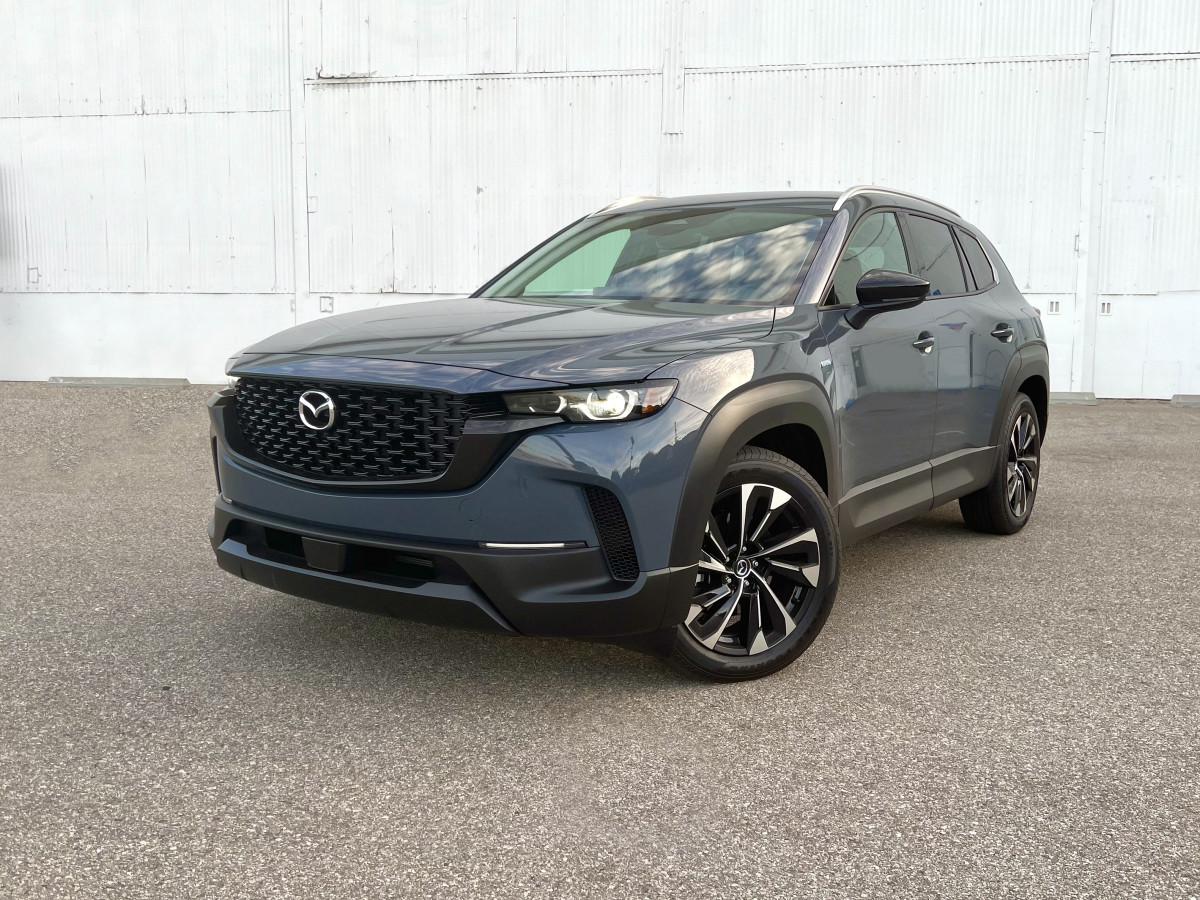
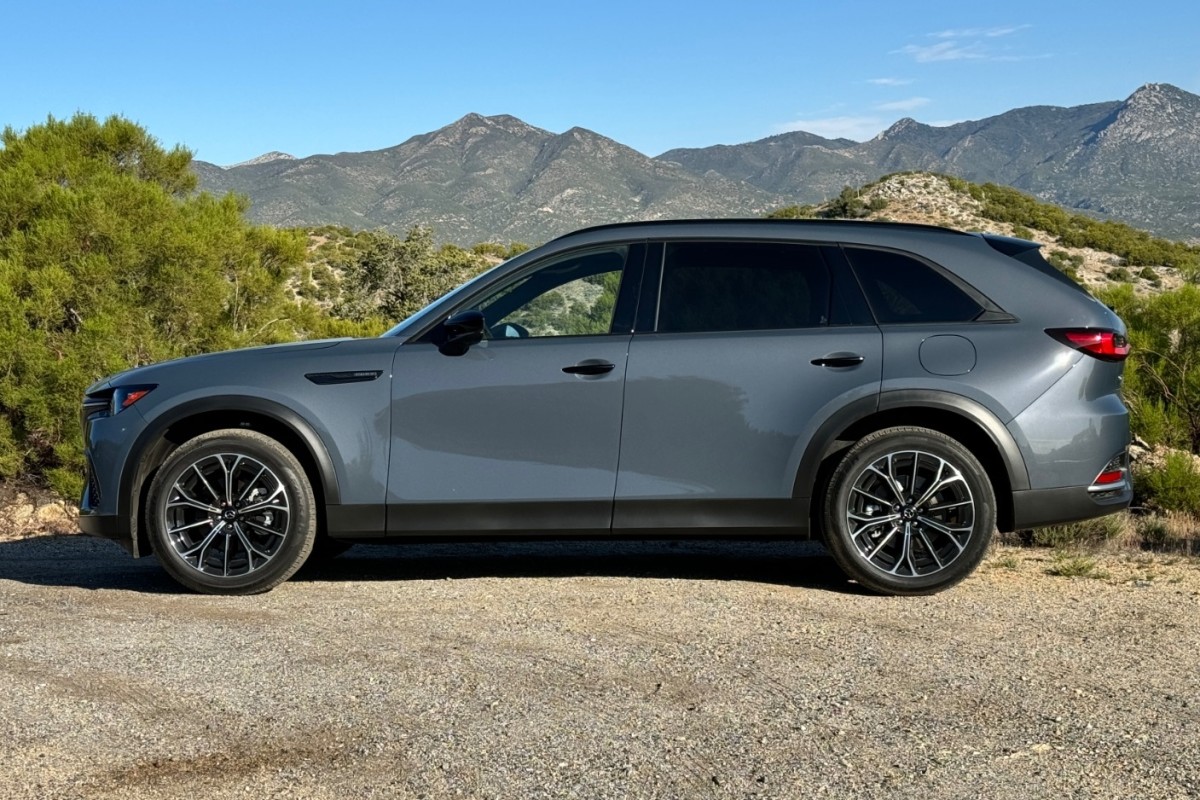
If the Mazda CX-90 came with a sport appearance package, it would look something like the new 2025 Mazda CX-70. Redesigned front and rear fasciae, a different grille insert, new wheels, and dark accents differentiate the two SUVs. The result of those changes is an appealing, sporty-looking SUV that performs an optical illusion; the CX-70 looks slightly smaller than the CX-90 on which Mazda bases it.
Inside, the differences are less distinct. Similar to how Mazda offers several exclusive paint colors for the CX-70, the interior is available in a red leather treatment you won’t find in the CX-90 (and the CX-90’s white leather is not available in the CX-70). Otherwise, the two SUVs are nearly identical, aside from the CX-70’s missing third-row seat.
Generally speaking, and especially in the higher trim levels, the new CX-70 features quality materials with appealing textures and surfaces. However, Mazda might consider adding soft-touch lower dashboard panels to the most expensive variants to drive the affordable luxury concept home with customers.
Overall, the new Mazda CX-70 looks and feels more upscale than an SUV from a mainstream brand, but it doesn’t match the sophistication and refinement of luxury models. Still, considering the prices, it wouldn’t be fair to expect otherwise.
Mazda sells the CX-70 in three configurations: 3.3 Turbo, 3.3 Turbo S, and PHEV. Depending on that selection, you can choose from Preferred (3.3 Turbo only), Premium, and Premium Plus trim levels. Prices range from $41,910 to $58,905, including the $1,445 destination charge.
For this review, we drove two CX-70s. The first was a 3.3 Turbo S Premium Plus with extra-cost Soul Red paint, and the second was a PHEV Premium Plus with optional Polymetal Gray paint. The Turbo S had a manufacturer’s suggested retail price (MSRP) of $58,000, while the PHEV’s MSRP amounted to $59,355, both prices including destination charges.

Performance
Open the hood of a CX-70 3.3 Turbo or Turbo S, and you’ll find a turbocharged 3.3-liter inline six-cylinder engine stashed there. In the Turbo models, it makes 280 horsepower at 5,000 rpm and 332 pound-feet of torque at 2,000 rpm. The Turbo S model is more powerful, at 340 hp and 369 lb-ft, but it also requires premium fuel to achieve those outputs. Mazda estimates the Turbo and Turbo S will get 25 mpg in combined driving, assisted by the standard 48-volt mild-hybrid technology.
The CX-70 PHEV employs a 2.5-liter four-cylinder engine and a 68-kilowatt electric motor juiced by a 17.8-kilowatt-hour battery. Together, they produce 323 hp at 6,000 rpm and 369 lb-ft at 4,000 rpm, and the four-cylinder gas engine prefers premium gas. Mazda says the PHEV provides 26 miles of electric-only range before reverting to gas-electric hybrid operation and returning 25 mpg. It recharges overnight (in 11 hours) using a standard household power outlet.
All CX-70 models have an eight-speed automatic transmission and a standard all-wheel-drive (AWD) system that biases power delivery to the rear wheels. Normal, Sport, Off-Road, and Towing drive modes are available, and the PHEV adds an EV mode. The Turbo and Turbo S provide 5,000 pounds of towing capacity, while the PHEV can tackle 3,500 lbs. Maximum ground clearance is 8.1 inches, enough to support light off-roading excursions.
The CX-70 3.3 Turbo S supplies good power, and the inline-six has a distinctive growling note. However, the powertrain doesn’t sound or feel as refined as expected. There is a grittiness to it. Also, though the power is robust, the delivery is subtle. It doesn’t push you deeper into your seat as you push harder on the accelerator pedal, like many turbocharged engines will.
Thanks to its EV mode, the CX-70 PHEV is quieter and smoother in operation. But once the four-cylinder engine starts up, it adds an unpleasant amount of racket to the drive. Thankfully, Mazda uses a traditional automatic transmission instead of a continuously variable transmission (CVT), so the grumbling from under the hood doesn’t turn into a steady drone when accelerating from a stop.
Equipped with a double-wishbone front and multi-link rear suspension design, the hefty CX-70 delivers athletic handling and a communicative ride, in keeping with traditional Mazda character. However, an adaptive damping suspension would benefit this SUV. On imperfect pavement, the ride can be downright brittle.
Still, we’ll accept that in exchange for the CX-70’s buttoned-down handling. Mazda expertly controls unwanted body motions, and most versions of the SUV have large 21-inch wheels with P275/45R21 tires, so the CX-70 can tackle a winding road with enthusiasm. Sizable brakes, responsive steering, and Mazda’s Kinematic Posture Control technology all play a role in making the CX-70 fun to drive.
We briefly ventured off road in the CX-70. The SUV requires extra care when traversing bumps, dips, and ruts, so take them slow. On smoother surfaces, like a gravel road or a well-worn dirt trail, the AWD system’s rear-axle power delivery bias can put a grin on your face when rounding bends. We assume the same will be true on snow.
We averaged 23.5 mpg in the 3.3 Turbo S, falling short of the 25-mpg estimate in combined driving. But we did use the Sport mode while driving a lonely desert highway seemingly built to resemble a roller coaster ride, so your results may prove better.
The PHEV provided 32 miles of electric-only driving, but that included a 1,000-foot descent in elevation, which undoubtedly boosted the range. Including the full battery charge at the start of the drive, the PHEV averaged 30.8 mpg.

Form & function
Step into the Mazda CX-70, and you’ll find plenty of room for up to five people. Heated front seats and a triple-zone automatic climate control system are standard, and every version of the SUV has leather upholstery. Choose a CX-70 with Premium Plus trim, and you get heated and ventilated front seats, heated rear seats, and a heated steering wheel.
Though the CX-70 doesn’t have soft seats that you sink into, the firmly cushioned front chairs offer good support. However, because the SUV capably carves corners, they could use adjustable side bolsters to better hold a driver in place behind the steering wheel. Also, we think the target buyers will expect front seat massagers with the Premium Plus trim.
Small-item storage space is confined to lower door panel bins and the center console cupholders, though a wireless smartphone charging shelf is available just forward of the fussy electronic transmission shifter. If Mazda would go ahead and make the infotainment screen touch-sensing for all functions, it could free up space and add a place to stash house keys, gum, and other items that you’d rather not bury within the bin under the center armrest or in the glove compartment.
Cargo space is generous, and because the CX-70 doesn’t have the CX-90’s third-row seat, it offers a sizable storage area underneath the load floor. To make it even more practical, Mazda sells an accessory organizer to compartmentalize items you put there. Behind the back seat, the CX-70 has 39.6 cubic feet of cargo space. Fold the rear seat down, and you’ve got 75.3 cu-ft to use.
In addition to the organizer, Mazda offers numerous cargo-enhancing accessories. You can also get roof-rail crossbars and a rooftop awning to add shade to outdoor activities.

Technology
Mazda equips most versions of the CX-70 with a 12.3-inch digital instrumentation panel, and all of them get a 12.3-inch infotainment screen.
Called Mazda Connect, the infotainment system lives in a screen which offers touch-sensing capability only when you’re using the wireless Apple CarPlay and Android Auto systems. Otherwise, it is a static display. A large control knob surrounded by primary function buttons lives on the center console, where you’ll also find a volume knob that toggles to change radio stations or music tracks.
Mazda Connect is a graphically pleasing and logically laid-out infotainment system, and, with time, the center console controls become second-nature. Historically, Mazda’s voice-recognition system has proven annoyingly obtuse, to the point of uselessness, but the CX-70 has Alexa Built-in, a conversational digital voice assistant that makes it less problematic that the display screen isn’t touch-sensing.
We quickly and easily paired an iPhone 15 to the system, and we ran Apple CarPlay without any trouble. The touchscreen functionality for the smartphone mirroring platforms is undeniably helpful and reduces distraction while driving.
In addition, the Alexa Built-in technology works beautifully. Using our standardized list of commands, the digital assistant responded quickly and accurately. It represents a quantum leap over the previous voice-recognition system.
Most CX-70 models have a 12-speaker Bose Centerpoint surround-sound system. While listening to music contained on a USB thumb drive, it delivered excellent clarity and resonant bass. When streaming music from a phone via Pandora, sound quality degraded but remained commendable.
Mazda also offers an Active Driving Display in the CX-70, a head-up display showing a comprehensive amount of information. A camera-based digital rearview mirror is available for this SUV as an accessory, and trim levels equipped with the surround-view camera include a Hitch View angle that helps when attaching a trailer to the CX-70.

Safety
Safety comes standard in the 2025 Mazda CX-70. Grouped into an i-ActiveSense collection of advanced driving-assistance systems (ADAS), the list of safety features includes the technology you expect to find in a modern SUV, and then some.
Take one step up the trim level ladder to Premium, and the CX-70 adds several semi-autonomous steering-assistance features. They include an active blind-spot assist system, emergency lane-keeping assist, road-keeping assist, and head-on traffic-avoidance assist. On a two-lane desert highway, when we allowed the CX-70 to drift too close to the edge of the pavement, we experienced the road-keeping assist system. It is effective.
In addition, starting with the Premium trim, the CX-70 has a Cruising & Traffic Support system with Unresponsive Driver Support. This technology combines the standard adaptive cruise control with lane-centering assist, creating a hands-on semi-autonomous driving-assistance system. We used it on two-lane highways and on multi-lane freeways, and it works with impressive accuracy and refinement.
The Unresponsive Driver Support system is active when using Cruising & Traffic Support. In the event the CX-70’s driver becomes unresponsive to warnings to hold the steering wheel, the vehicle will initiate a safe, automated stop to prevent a potential collision. This technology addresses situations when a driver falls asleep or suffers a medical emergency while driving, but it only works when Cruising & Traffic Support is active.
The National Highway Traffic Safety Administration (NHTSA) awarded the 2025 Mazda CX-70 five stars overall in its crash testing, and the Insurance Institute for Highway Safety (IIHS) named it a Top Safety Pick+.

Cost-effectiveness
In addition to the Lexus RX, Mazda cites the BMW X5 as a potential CX-70 rival. That makes the CX-70 an incredible value by comparison, but there are compromises.
First, the Mazda is not as refined as the BMW or the Lexus. Some of the CX-70’s driving dynamics and interior materials can’t measure up to the BMW’s silky-smooth drivetrain or the Lexus’s whisper-quiet interior. The BMW and Lexus also offer more supple and composed rides.
Second, Mazda limits buyer choice to a surprising degree. Simply put, you cannot tailor this SUV’s appearance and equipment outside of the narrow lanes painted by Mazda, and both BMW and Lexus buyers will expect a wider ability to mix and match paint, interior, and wheel choices.
Still, given the style, comfort, features, technology, and practicality for the price, the Mazda CX-70 strikes us as a good deal. Also, as of this writing, Mazda is offering a $7,500 leasing incentive to make CX-70 PHEV payments significantly more affordable than the Turbo models. So, if you lease, you’ll pay less each month to drive the plug-in hybrid, and you'll also save money on gas if you recharge the battery each night.
From a cost-effectiveness standpoint, that’s what we call a win-win situation.

What owners say
Comfort and handling is smooth and predictable. Plenty of power using EV mode for shorter commutes with no gas used. When the full hybrid mode is used I get even more power The red color is the best I have seen.
April 19, 2026Trims & specs
Base MSRP $49,570 | Seating 5 |
Engine 3.3L 280 hp I6 | Cargo Capacity 39.6 cu ft |
Combined MPG 26 | Drivetrain AWD |
Base MSRP $56,870 | Seating 5 |
Engine 3.3L 340 hp I6 | Cargo Capacity 39.6 cu ft |
Combined MPG 25 | Drivetrain AWD |
Base MSRP $46,780 | Seating 5 |
Engine 3.3L 280 hp I6 | Cargo Capacity 39.6 cu ft |
Combined MPG 26 | Drivetrain AWD |
Base MSRP $57,450 | Seating 5 |
Engine 2.5L 323 hp I4 Hybrid | Cargo Capacity 39.6 cu ft |
Combined MPG 57 | Drivetrain AWD |
Base MSRP N/A | Seating N/A |
Engine N/A | Cargo Capacity N/A |
Combined MPG N/A | Drivetrain N/A |
Base MSRP N/A | Seating N/A |
Engine N/A | Cargo Capacity N/A |
Combined MPG N/A | Drivetrain N/A |
Base MSRP $54,400 | Seating 5 |
Engine 2.5L 323 hp I4 Hybrid | Cargo Capacity 39.6 cu ft |
Combined MPG 57 | Drivetrain AWD |
Base MSRP N/A | Seating N/A |
Engine N/A | Cargo Capacity N/A |
Combined MPG N/A | Drivetrain N/A |
Base MSRP $53,440 | Seating 5 |
Engine 3.3L 340 hp I6 | Cargo Capacity 39.6 cu ft |
Combined MPG 25 | Drivetrain AWD |
Base MSRP $42,750 | Seating 5 |
Engine 3.3L 280 hp I6 | Cargo Capacity 39.6 cu ft |
Combined MPG 26 | Drivetrain AWD |
Base MSRP N/A | Seating N/A |
Engine N/A | Cargo Capacity N/A |
Combined MPG N/A | Drivetrain N/A |
Base MSRP N/A | Seating N/A |
Engine N/A | Cargo Capacity N/A |
Combined MPG N/A | Drivetrain N/A |
Base MSRP N/A | Seating N/A |
Engine N/A | Cargo Capacity N/A |
Combined MPG N/A | Drivetrain N/A |


Pricing trends
MSRP range
$40,445 - $57,450
Current avg. market price
$34,065
Trending down by 3.6% this month
May 2026 - November 2026