2025 Mazda MAZDA3 Reviews, Pricing & Specs


Pros & cons
What we like
Stylish design
Fun to drive
Great safety ratings
What to consider
Cramped back seat
Outdated technology
Poor rear visibility
The CarGurus verdict
You need not suffer when driving a small, affordable, efficient car. The 2025 Mazda 3 proves it.
Last redesigned for the 2019 model year, the Mazda 3 is getting old, yet aging gracefully. It still looks, feels, and drives better than some of its rivals. For 2025, Mazda adds value to the lineup, introducing a new base version of the 2.5 S. Moving one rung up the trim level ladder, the 2.5 S Select Sport gets Amazon Alexa Built-in for 2025, while the Premium and Premium Plus gain a cloud-based navigation system.
Verdict: Available in four-door sedan and five-door hatchback body styles, there is a Mazda 3 to suit nearly anyone. Basic or upscale, turbocharged or not, and with front-wheel drive (FWD) or all-wheel drive (AWD), the common threads across all Mazda 3s are quality, refinement, sophistication, safety, and enjoyable driving dynamics. This is a terrific compact car.
out of 10 expert review
Look & feel
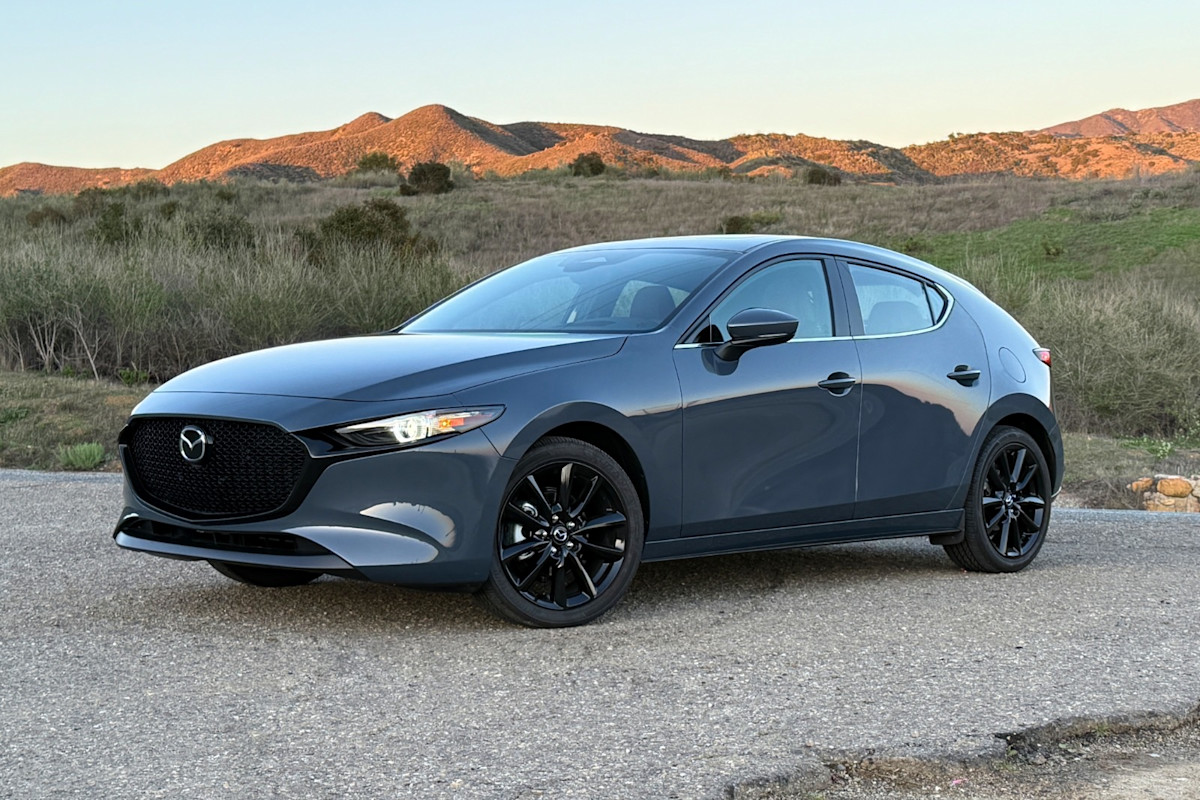
Organically shaped, the Mazda 3 Hatchback has a long hood, tapered greenhouse, and stubby butt. Sheetmetal swells create S-shaped reflections on the car’s flanks, signalling its suitability for tackling mountain switchback roads. Depending on the light and viewing angle, it can look odd and out of proportion, but that’s true of many hatches.
Our test car had Polymetal Gray paint over red leather, and it looked terrific. The interior is oriented toward the driver, with clean design and soft, flowing forms creating a calming atmosphere. Materials quality for this segment is top-notch, but the gloss black plastic trim on the center console easily shows wear. Our well-equipped test vehicle had classy metal speaker grilles, analog climate controls, and gauges that were a model of clarity.
The Mazda 3 Hatchback comes in 2.5 S and 2.5 Turbo model series. The S lineup includes base, Select Sport, Preferred, Carbon Edition, and Premium trim levels. Turbocharged variants include the Carbon Turbo and Premium Plus. Prices range from $25,150 to $37,150, not including the $1,185 destination charge.
For this Mazda 3 review, we evaluated a 2.5 S Premium hatch—the only version still available with a manual transmission. Besides the stick, the test car had extra-cost paint, a rear bumper scratch guard, and a rear hatch spoiler. Those upgrades brought the manufacturer’s suggested retail price (MSRP) to $33,045 with destination.

Performance
Mazda equips the 2.5 S models with a 2.5-liter four-cylinder engine from its Skyactiv family, making 191 horsepower at 6,000 rpm and 186 pound-feet of torque at 4,000 rpm. Choose one of the Mazda 3 Turbo models, and you get a turbocharged version of that engine generating 250 hp at 5,000 rpm and 320 lb-ft at 2,500 rpm. However, to extract that power, you must feed it premium gas. Run it on regular, and the turbo four delivers 227 hp at 5,000 rpm and 310 lb-ft at 2,000 rpm.
You don’t need the turbo to achieve satisfaction with a Mazda 3. It’s calibrated more for pleasure than performance, providing a subtle and sweet boost over the standard engine that, like that extra-large slice of chocolate cake following a delectable meal, you can easily live without. Besides, the standard engine provides plenty of power and is so smooth, quiet, and refined across its entire rev range that it’s a delight in its own right.
Most Mazda 3s have a six-speed automatic transmission featuring a Sport mode and manual shift control. With Premium trim, Mazda gives loyal driving enthusiasts a treat: a sweet-shifting six-speed manual gearbox. But it’s not available with the optional AWD system.
The official EPA fuel economy rating says the manual should get 30 mpg in combined driving. Despite our best efforts to fall well short of that by driving the car like we stole it, we averaged 29.1 mpg on our mountainous Southern California evaluation loop.
It took a few drives to acclimate to the Mazda 3’s clutch, but shifting gears proved effortless from the start. The stick fluidly glides from gear to gear and is a delight to row. Mazda engines provide good power across a broad rev range, and the 2.5-liter is so silky and silent that its easy to mistakenly leave the 3 in fourth or fifth gear on the highway.
Mazda’s G-Vectoring Control Plus technology is standard. It uses the braking system to enhance the handling and stability. At higher speeds on imperfect pavement, we wished for a firmer response from the suspension, but despite the compliant ride, the car is nothing but communicative, predictable, trustworthy, and tossable.
Regardless of how fast you’re traveling, the torsion-beam rear suspension magnifies sharper bumps, cracks, and divots in the road, momentarily unsettling the car. When driving enthusiastically during a mountain descent, braking response softened, though we experienced no fade, brake rumble, or pedal vibration. The steering response and effort level are perfect, but the steering-wheel rim is on the thin and delicate side. The Mazda 3 also suffers from elevated road noise at highway speeds.
If it seems like we’re nitpicking, we are. Overall, the Mazda 3 makes every drive a joy, and we’re not saying that because the test car had a manual transmission. Last fall, we rented a Mazda 3 Select Sport during a long weekend in New Hampshire, and that automatic-equipped car was delightful on the two-lane roads meandering across the state.

Form & function
The Mazda 3 feels small even compared to other small cars. Every seating location feels like a snug, tailored fit, and stretch-out room simply does not exist. Fortunately, the seats are comfortable, and the test car’s eight-way power-adjustable driver’s seat allowed us to find a perfect driving position. In addition, the evaluation vehicle’s red leather upholstery was soft and supple, and the heated front seats easily warded off the early spring morning chill.
From behind the wheel, forward visibility is excellent, and large heated exterior mirrors maximize side visibility as well. The Mazda’s long and low nose is hard to judge, though, and its design compromises visibility to the rear. Unfortunately, the reversing camera doesn’t offer guidance lines to show the vehicle’s path when backing up, and Mazda reserves a surround-view camera system for the most expensive trim level.
Rear-seat legroom is tight, and passengers complained about the lack of air vents, USB ports, and storage space. In front, the Mazda 3 offers a sizable center console storage bin with USB ports, topped with a padded sliding center armrest, though.
Cargo space isn’t generous, but it is shaped in a practical way. Within the 20.1 cubic feet behind the back seat, you can stash two full-size suitcases lengthwise on their sides, and then stack a carry-on or two next to them. The folding rear seat expands the amount of room, but Mazda does not provide a maximum cargo space measurement with the car so configured.

Technology
While every other car company has embraced touchscreen operation and functionality, Mazda sticks to its guns with its Mazda Connect infotainment system. Depending on which version of the Mazda 3 you get, the largely static display measures 8.8 inches or 10.25 inches across. Either way it’s elegantly integrated into the dashboard but out of easy reach.
Last year, Mazda relented a little regarding touchscreen operation, making it possible to use Apple CarPlay and Android Auto with a fingertip on the screen. Otherwise, you must still fiddle with the physical controls on the center console, the buttons on the steering wheel, or the sketchy voice recognition technology.
Alexa Built-in should resolve that last issue, but in the test car, we got a Network Error message saying Alexa needed internet access to work, and we would need to sign in to our account. Which we don’t have. Switching to the native voice-recognition system, we discovered that for the best results, you’ll want to follow the onscreen prompts. Even then, it had some trouble understanding queries and commands.
Therefore, to side-step Mazda Connect’s faults and frustrations, we recommend using Apple CarPlay or Android Auto. But have a USB-C cable handy, because only a few versions of the Mazda 3 offer wireless connectivity to these popular platforms. Regardless, we found the Mazda 3 far more satisfying with Apple CarPlay running, and the test car’s 12-speaker Bose Centerpoint premium audio system sounded great for the small car segment.
Other infotainment features include Wi-Fi hotspot access, mobile 911 automatic emergency notification, and a complimentary one-year subscription to Mazda Connected Services. The test car appeared to have a wireless charging pad, but when we placed a phone on it, a message popped up on the infotainment display telling us wireless charging was unavailable.

Safety
Safety is another Mazda 3 selling point. In addition to offering plenty of standard driving assistance systems, it boasts safety ratings few vehicles can match. It earns a “Top Safety Pick+” rating from the Insurance Institute for Highway Safety (IIHS)—the highest possible rating—and the maximum five stars in all National Highway Traffic Safety Administration (NHTSA) crash tests, including rollover resistance.
Standard equipment includes: forward collision warning, automatic emergency braking, lane departure warning, lane-keeping assist, blind-spot monitoring, and rear cross-traffic alert. Our test car also had adaptive cruise control, but because of the manual transmission, it did not include stop-and-go capability. Lane centering assist is also unavailable.
While testing the safety features, the lane departure warning system issued inaccurate alerts when two travel lanes narrowed to one, buzzing a vibration through the car’s steering wheel. Also, in the sharper curves of the Pacific Coast Highway, it reduced speed too much and too quickly, creating aggravation in other drivers following behind.
Notably, in traffic, when other motorists cut into the gap ahead, the adaptive cruise control system reacted in a smooth, calm, and composed way. We also like how the test car’s head-up display showed blind spot warnings, and the impressive automatic high-beam headlights and adaptive front lighting system make driving in dark areas much safer.

Cost-effectiveness
Few compact hatchbacks remain available to people who prefer their size, price, efficiency, and utility over entry-level crossover SUVs. Among those still on sale, the Subaru Impreza and Toyota Corolla Hatchback offer impressive value. More expensive alternatives to the Mazda include the Honda Civic Hatchback and Volkswagen Golf GTI. Kia is planning a hatchback version of the new K4, but prices were unavailable as of this writing.
The Mazda 3 lands smack in the middle of them regarding its base price, and when loaded up in 2.5 Turbo form, it’s still a better deal than a comparable VW GTI. If you’re shopping purely on price, the Toyota is probably your best bet. But it lacks the Mazda’s refinement, driving experience, and timeless sense of style, and you can’t get AWD unless you upgrade to the performance-tuned GR Corolla.
Where the Mazda comes up short is in comparison to the Honda Civic Hatchback Hybrid. With similar levels of overall sophistication and driving enjoyment, paired with an impressive hybrid powertrain supplying up to 49 mpg in combined driving, the Civic Hybrid is impossible to ignore.

What owners say
Exceptional driving experience. The most balanced, precision crafted steering wheel system of any cars I have ever owned (25 of them). Drives better than most acclaimed German machines out there.Mazda cars are very enjoyable to drive, yet these models are ones of the most underrated and undervalued vehicles yet. Amazing Mazda vehicles. They're excellent values, but folks have to give Mazda cars chances. Drive one. The issues I have with the current models are: 1). There's no 6 Speed Manual with the 2.5 Turbo AWD Premium Plus trim models. 2). Please, bring CD ( Compact Disc) entertainment back in all Mazdas. 3). Add colors to the interior design. It's too bland, monotonous, monochromatic, and boring. The only comparisons out there to the superb driving of Mazda vehicles are Nissan Altima SR, Audi S3 and BMW M340.
January 17, 2026Excellent value. You only have to move up one trim level from the base to get leatherette seats. All the safety features. I was comparing against a Honda Civic and a Toyota Corolla. This was clearly the better deal.
September 13, 2025Trims & specs
Base MSRP $24,890 | Seating 5 |
Engine 2.5L 191 hp I4 | Cargo Capacity 13.2 cu ft |
Combined MPG 32 | Drivetrain FWD |
Base MSRP $30,760 | Seating 5 |
Engine 2.5L 191 hp I4 | Cargo Capacity 20.1 cu ft |
Combined MPG 29 | Drivetrain AWD |
Base MSRP $24,150 | Seating 5 |
Engine 2.5L 191 hp I4 | Cargo Capacity 13.2 cu ft |
Combined MPG 32 | Drivetrain FWD |
Base MSRP $29,610 | Seating 5 |
Engine 2.5L 191 hp I4 | Cargo Capacity 13.2 cu ft |
Combined MPG 30 | Drivetrain AWD |
Base MSRP $32,300 | Seating 5 |
Engine 2.5L 250 hp I4 | Cargo Capacity 13.2 cu ft |
Combined MPG 27 | Drivetrain AWD |
Base MSRP $37,150 | Seating 5 |
Engine 2.5L 250 hp I4 | Cargo Capacity 20.1 cu ft |
Combined MPG 27 | Drivetrain AWD |
Base MSRP $27,890 | Seating 5 |
Engine 2.5L 191 hp I4 | Cargo Capacity 20.1 cu ft |
Combined MPG 31 | Drivetrain FWD |
Base MSRP $30,850 | Seating 5 |
Engine 2.5L 191 hp I4 | Cargo Capacity 20.1 cu ft |
Combined MPG 31 | Drivetrain FWD |
Base MSRP $36,000 | Seating 5 |
Engine 2.5L 250 hp I4 | Cargo Capacity 13.2 cu ft |
Combined MPG 27 | Drivetrain AWD |
Base MSRP N/A | Seating N/A |
Engine N/A | Cargo Capacity N/A |
Combined MPG N/A | Drivetrain N/A |
Base MSRP $25,150 | Seating 5 |
Engine 2.5L 191 hp I4 | Cargo Capacity 20.1 cu ft |
Combined MPG 31 | Drivetrain FWD |
Base MSRP N/A | Seating N/A |
Engine N/A | Cargo Capacity N/A |
Combined MPG N/A | Drivetrain N/A |
Base MSRP N/A | Seating N/A |
Engine N/A | Cargo Capacity N/A |
Combined MPG N/A | Drivetrain N/A |
Base MSRP $26,540 | Seating 5 |
Engine 2.5L 191 hp I4 | Cargo Capacity 13.2 cu ft |
Combined MPG 32 | Drivetrain FWD |
Base MSRP N/A | Seating N/A |
Engine N/A | Cargo Capacity N/A |
Combined MPG N/A | Drivetrain N/A |
Base MSRP N/A | Seating N/A |
Engine N/A | Cargo Capacity N/A |
Combined MPG N/A | Drivetrain N/A |
Base MSRP N/A | Seating N/A |
Engine N/A | Cargo Capacity N/A |
Combined MPG N/A | Drivetrain N/A |
Base MSRP $26,190 | Seating 5 |
Engine 2.5L 191 hp I4 | Cargo Capacity 20.1 cu ft |
Combined MPG 31 | Drivetrain FWD |
Base MSRP $33,450 | Seating 5 |
Engine 2.5L 250 hp I4 | Cargo Capacity 20.1 cu ft |
Combined MPG 27 | Drivetrain AWD |


Pricing trends
MSRP range
$24,150 - $37,150
Current avg. market price
$22,370
Trending down by 1.3% this month
May 2026 - November 2026