2025 Porsche Macan Electric Reviews, Pricing & Specs



Pros & cons
What we like
Fun to drive
Great handling
Impressive acceleration
What to consider
Limited rear-seat space
Distracting infotainment interface
Expert review
The Porsche Macan Electric proves that the preceding Taycan was no fluke.
Porsche's second foray into EVs, the Macan Electric is a rousing success. With the company's trademark handling and power, it's a compact athlete that is sure to bring joy to your daily commute and excitement to your favorite roads.
Verdict: With few rivals, the Macan Electric an easily recommendable choice for performance-minded drivers looking for an electric car.
out of 10 expert review
Look & feel
The Macan is Porsche's compact SUV offering, supporting the midsize Cayenne since it debuted in 2015. It's been one of the company's best-sellers thanks to continuous updates throughout its production run, and with the introduction of an all-electric variant for the 2024 model year, it's not only Porsche's second SUV, but also Porsche's second electric vehicle, alongside the Taycan.
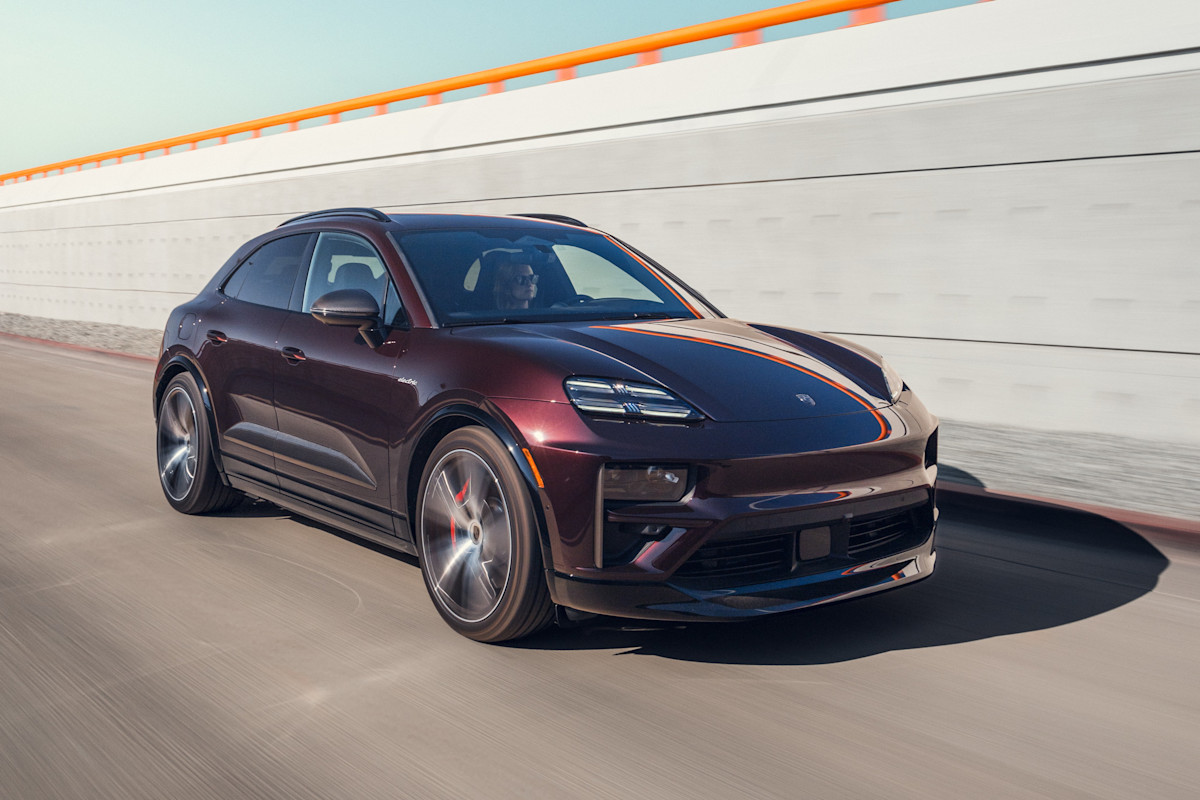
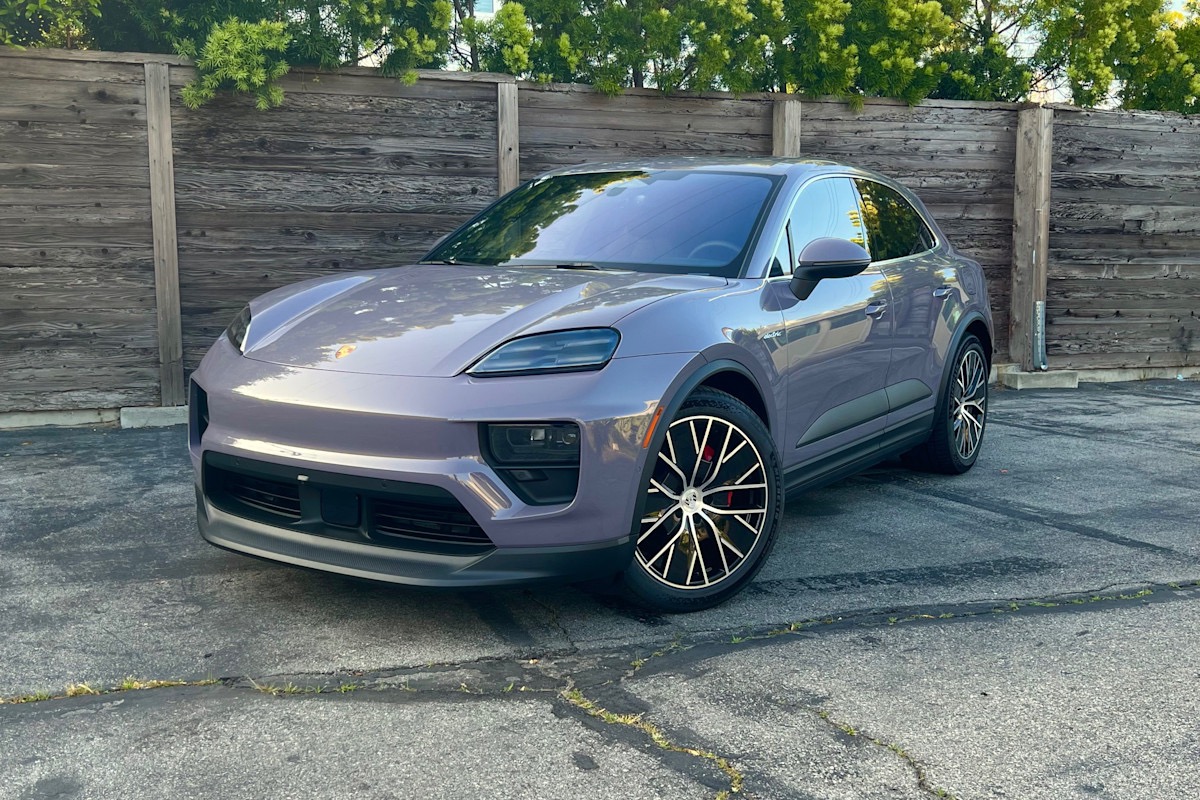
The Electric has plenty of similarities to the gas-powered Macan, but also some key differences. They're essentially the same size, with the Electric version measuring about two inches longer than the standard Macan. Up front, the clamshell hood makes way for a more conventional bonnet, with a small frunk underneath. The top headlight area is narrower and only houses the LED accent lights, with the actual headlights mounted below in a blacked-out section that looks like an air intake from a distance. As an electric car with minimal powertrain cooling needs, this Macan can get away with a smaller grille that's mounted under what we'd traditionally consider the front bumper.
The result is a more modern and sleek appearance. While the standard Macan was already appropriately sporty looking, the Electric pushes that athleticism even further. It's helped by a protruding front air dam that gives the Macan Electric a more hunkered-down attitude, as if it's ready to ravenously inhale the pavement laid in front of it.
From the side, the Macan Electric is more streamlined, with a rear roofline that tapers gracefully to a more rounded rear end. The regular Macan's rooftop spoiler is also absent, further accentuating the cleaner and more aerodynamic styling. The taillights are set into a light bar that spans the hatch and curves around the corners.
Aside from the lack of tailpipes, there's really not much to signal that this Macan is an EV. As both an EV and an SUV, some Porsche purists might have previously complained that the Macan Electric isn't a "real" Porsche but, we can assure you, it most certainly is. There's enough of the carmaker's storied history still present in its exterior design, as well as on the inside, and we haven't even gotten around to how it drives.
The front seats retain the familiar shape that originated with the Porsche 911 sports car, while the digital instruments have hints of the traditional three-gauge layout from that model. More importantly, the Macan is built to the same standard, with premium materials adorning almost every surface, over a construction that feels as though it was carved from a solid chunk of steel. The only thing we'd change is the piano black center console, which is a magnet for fingerprints and dust, and is also prone to annoying reflections in the midday sun.
Performance
The standard Macan is offered in four trim levels, ranging from 261 horsepower to 434 hp, as is the Macan Electric, in this case starting at 335 hp and peaking at 576 hp. Porsche sent us the Macan 4S Electric for this review, which has a 95-kWh lithium-ion battery pack mounted in the floor. Its dual-motor all-wheel-drive (AWD) powertrain delivers 442 hp and an EPA-rated 288 miles on a full charge, but lower trim levels offer more range. The Macan 4 Electric is rated at 308 miles and the entry-level single-motor rear-wheel drive (RWD) base model is the mileage leader at 315 miles.
Porsche’s specs claim the Macan 4S Electric will reach 60 mph in 3.9 seconds, but we think it's much quicker. As with most EVs—especially performance-minded models—acceleration is instantaneous and very satisfying. Launching up a highway on-ramp from a traffic light likely left a lavender purple blur in its wake, and by the time we got up to speed to check our mirrors, the rest of the vehicles that were at the signal with us were barely making their way onto the ramp. Even with this explosive acceleration, the Macan Electric remains drama-free. It tracks dead-straight and feels as though it can still handle more power and performance.
Braking is also confidence-inspiring. In many ways, the Macan Electric brakes like the standard Macan, with a firm pedal that is easy to modulate. You won't feel any transition between regenerative braking (where the electric motors are used to decelerate while recovering energy to charge the battery) or when the actual pads touch the rotors. It's as seamless as it should be, but there was something missing.
One-pedal driving is popular among EV owners, as the vehicle can slow to a stop without having to touch the brakes. It can help to reduce some fatigue, especially in dense traffic, and gives drivers a unique experience in otherwise uninspired driving conditions. Porsche claims it wants to deliver more familiar driving manners and that one-pedal driving isn't as efficient, but we're not convinced of the latter. At the very least, we'd like to have the option to activate one-pedal driving. Instead, there's a regeneration setting that increases the amount of charge and deceleration, but the experience is still very similar to an internal-combustion vehicle.
Then there's the handling. With much of the battery weight located under the floor, the Macan's center of gravity is very low, and in some instances, it feels better balanced than a 911. Sacrilege, we know, but the compact SUV is able to dart through traffic like a tiny hatchback, and we never managed to even make the tires squeal in some of our more aggressive cornering maneuvers. It's thoroughly entertaining, and you'd never guess it weighs almost 5,300 pounds (about 1,000 pounds more than the standard Macan and a few hundred pounds heavier than a Ford F-150).
The adaptive air suspension's ride quality is firmer than in other electric SUVs we’ve driven, but not overly so. We felt every seam in the concrete highway, but it never got intrusive or harsh. Switching to the Sport Plus drive mode did make the ride unreasonably choppy on one of the notorious stretches of the 405 freeway in L.A., but drivers can tailor the setup to match their preferences. The Sport modes also add some synthetic "engine" noises, which are appropriately futuristic. If that's not your thing, they can also be deactivated if you prefer the crypt-like silence of a typical EV. Overall, the Macan 4S Electric is so good that the driving experience encouraged us to volunteer to take the wheel at every opportunity.
Form & function
Our Macan Electric came with optional seats with 14-way adjustability, which have an excellent blend of comfort and lateral support. They're easy to live with on longer drives, yet hold you in place when you're railing through the curves. Adaptive sport seats with 18-way adjustability are also available for those who desire even more aggressive side bolstering.
From the driver's seat, the primary controls are within easy reach, though the gear selector's positioning next to the windshield wiper stalk was responsible for a few inadvertent wiper swipes. The steering wheel controls are logically arranged and even though the Porsche's cruise control stalk may not be as intuitive as the more prevalent buttons, we got acclimated to it fairly quickly.
The climate controls on the center console are sometimes difficult to read because of the reflection coming off the glossy black surface, but we typically only needed to adjust the temperature, which was a no-look affair thanks to the physical lever. Unfortunately, activating the heated and ventilated seats required our full attention, as the capacitive-touch "button" requires a precise and definite push.
There should be adequate storage for your personal items up front, with medium-sized cupholders, a rubberized wireless phone charger tray, and some additional pockets and bins in the center console and doors. It's not what we'd consider generous when compared to conventional SUVs, but it is for a Porsche.
The rear seats aren't nearly as accommodating as the first row, but average-sized passengers should have ample space. You definitely wouldn't want to put six-footers back there and accessing those seats is complicated by the low sloping roof and narrow doorway.
Further back, the cargo area can hold up to 19.1 cubic feet. That's slightly larger than the standard Macan's 17.2 cubic-foot capacity, but gasoline compact SUVs from other luxury brands can generally hold 22 to 32 cubic feet of cargo. The Macan Electric’s cargo area should easily accommodate the typical shopping haul, but the fastback hatch limits its ability to carry bulkier items. Helping matters is a standard power liftgate and a height-adjustable load floor, plus there's a front trunk (frunk) that's just big enough for your charge cable.
Technology
Standard tech features include a 10.9-inch infotainment touchscreen and a 12.6-inch digital instrument panel. While these give the cockpit a modern slant, they're integrated in a way that keeps them in the Porsche family. The instruments are configurable but allow for the traditional three-gauge layout that is synonymous with Porsche. A second 10.9-inch touchscreen is available for the front passenger, allowing them to help with navigation and DJ duties. They can also enjoy streaming video and games without distracting the driver, thanks to a privacy filter that keeps them from seeing what's on the screen.
The infotainment touchscreen is on the small side, especially for an EV, and requires more attention to use. Apple CarPlay and Android Auto are included; they pair well with the wireless charging pad that can easily hold Max-sized iPhones and also features a signal booster. Also available, but not present in our Macan, is a head-up display with augmented reality overlays. It's especially helpful when you're navigating unfamiliar streets, as it projects an animated line that precisely shows where you should be turning.
Our Macan came with the optional Bose surround sound audio system for $990, but we're more inclined to recommend spending a ton more for the $5,690 Burmester upgrade, especially for audiophiles. The Bose system has potent bass, but the highs can get a little muddy with the volume cranked up. Our experiences with the Burmester system in other Porsche vehicles left us awestruck by contrast, and the silent cabin only enhances the experience.
Speaking of impressive power, the Macan Electric is capable of DC fast charging at rates as high as 270 kW. At that rate, using a 350-kW charger, you could replenish the battery from 10 to 80 percent in only 21 minutes, or add 155 miles of range in only 10 minutes, according to Porsche. On the more common 150 kW chargers, it should take 33 minutes to get from 10 to 80 percent.
Safety
Crash test results from the National Highway Traffic Safety Administration (NHTSA) or the Insurance Institute for Highway Safety (IIHS) weren’t available at the time of publication. As expensive, low-volume vehicles, Porsches typically aren’t a priority for testing by those organizations. That said, Porsche vehicles typically have a strong reputation for crash survivability.
All 2025 Macans come standard with forward collision warning, automatic emergency braking, adaptive cruise control, lane departure warning, lane keep assist, and parking proximity sensors. The electric Macans also include blind-spot monitoring with rear cross-traffic alert and evasive steering assist, while the Macan 4S Electric also adds a surround-view camera system.
In our brief time with the Macan Electric, all of these systems functioned just as they should. We never encountered any false alarms or glitches, and the adaptive cruise control expertly and smoothly maintained a consistent distance between us and the car in front. In heavy traffic, the adaptive cruise control, when paired with the lane departure warning system, also greatly reduced the demands on the driver and likewise reduced long-distance fatigue.
It's worth noting that most EVs offer a lot more in terms of advanced safety features and driver assists. There's no talk of automated driving systems in this setting, as Porsche remains a "driver's car" that aims to engage and excite the driver rather than take them out of the equation. With this in mind, the Macan Electric has just enough tech to help you skip over the boring parts of commuting.
Cost-effectiveness
The base RWD Macan Electric has a manufacturer’s suggested retail price (MSRP) of $77,295 (including the $1,995 destination fee). Our Macan 4S Electric starts at $86,895, while the 630-hp Macan Turbo Electric will cost $107,295. By contrast, the entry-level gasoline-powered Macan starts at $65,350, with the top GTS costing $93,250. The closest internal combustion equivalent to our Macan 4S Electric could be the 375-hp Macan S that starts at $78,450. The EPA estimates annual fuel costs at $850 for the 4S and $3,300 for the Macan S, and with this in mind, it would take around 3.5 years to recoup the $8,445 EV premium, which is surprisingly quick.
Currently, the Porsche Macan EV doesn't have many rivals in its compact luxury SUV class. The new Audi Q6 e-tron is closely related to the Macan, sharing its Premium Platform Electric (PPE) underpinnings. The sportier Audi SQ6 e-tron and forthcoming RSQ6 could be worthy competitors with similar features and performance. There's also the Genesis Electrified GV70, which is respectably quick, but its driving dynamics and interior quality fall short of the mark set by the Macan. On the horizon is BMW's iX3, but we'll have to wait another year to see how that new electric challenger compares.
If you're willing to give up some performance and prestige, there are more non-luxury alternatives. These include the Hyundai Ioniq 5 N, the related Kia EV6 GT, and the Ford Mustang Mach-E GT. All of these undercut the Porsche's pricing by a substantial margin, yet still deliver plenty of thrills.
At least for now, the 2025 Porsche Macan Electric stands alone in its class, reminding us of the company's slogan from the 1980s: "There is no substitute."

What owners say
Trims & specs
Base MSRP $78,800 | Seating 5 |
Engine 402 hp Electric | Cargo Capacity 22.1 cu ft |
Combined MPG 99 | Drivetrain AWD |
Base MSRP $84,900 | Seating 5 |
Engine 509 hp Electric | Cargo Capacity 22.1 cu ft |
Combined MPG 91 | Drivetrain AWD |
Base MSRP $75,300 | Seating 5 |
Engine 355 hp Electric | Cargo Capacity 22.1 cu ft |
Combined MPG 100 | Drivetrain RWD |
Base MSRP $105,300 | Seating 5 |
Engine 630 hp Electric | Cargo Capacity 20.0 cu ft |
Combined MPG 92 | Drivetrain AWD |