2025 Subaru Forester Hybrid Reviews, Pricing & Specs




Pros & cons
What we like
Fuel-efficient
Impressive off-road abilities
Comfortable
What to consider
Fairly pedestrian performance
Firm ride quality
Expert review
Subaru redesigned the terrain-tackling Forester and added a more efficient hybrid model.
Subaru may as well be the automotive mascot of the Pacific Northwest and the Northeast, thanks to the ability of models such as the Subaru Outback and the Ascent to conquer challenging conditions. The redesigned 2025 Subaru Forester reinforces those advantages, and this time around, a new Forester Hybrid model adds efficiency as another plus, along with more power and a few extra features. It’s due to be followed by the smaller Subaru Crosstrek Hybrid in fall 2025.
Verdict: A more efficient version of Subaru's rugged and evergreen compact SUV.
out of 10 expert review
Look & feel
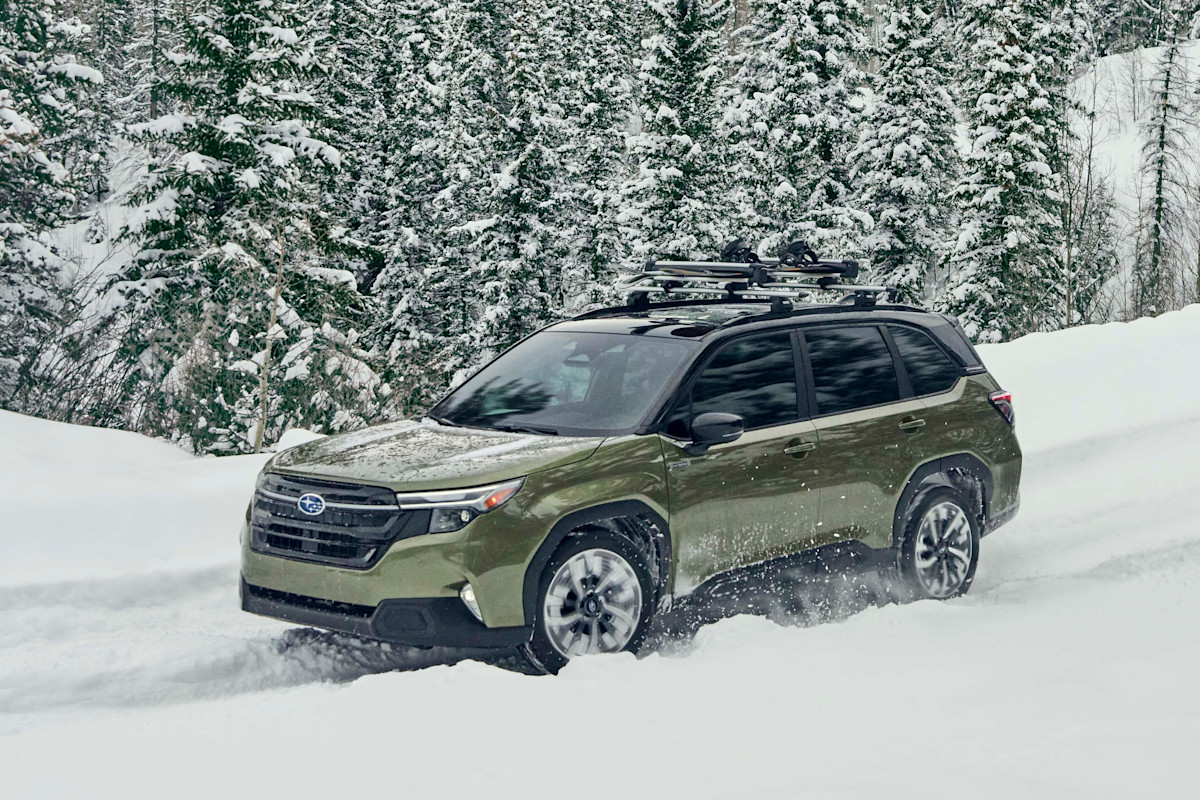
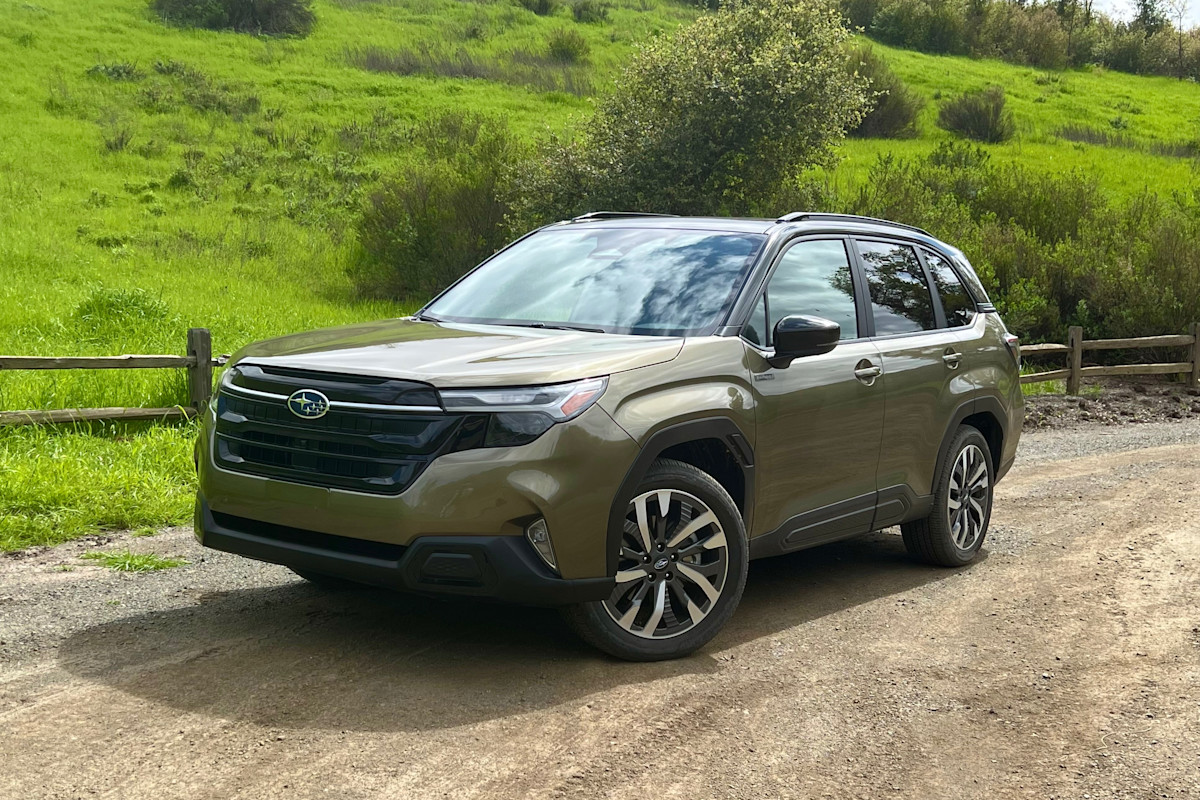
The Forester’s 2025 model year redesign debuted a new look for this sixth-generation compact SUV. The styling is more cohesive than its predecessor, though in the process the Forester lost some of its distinctiveness. The more conventional design has less body sculpting than before and, with its blockier overall shape, more visual heft. For better or worse, the new car looks a lot like a fun-sized Ford Explorer in your rearview mirror, and that's even more appropriate with its blue oval logo. Compared to other SUVs and crossovers in its class, the 2025 Forester has a more rugged appearance, with black plastic elements that hint at its off-road potential.
The new Forester Hybrid is in lockstep with its conventionally powered sibling, adding only a few subtle badges on the front doors and liftgate. The hybrid is eligible for a contrasting black roof, but just as with the standard Forester, it's only offered on the top Touring trim.
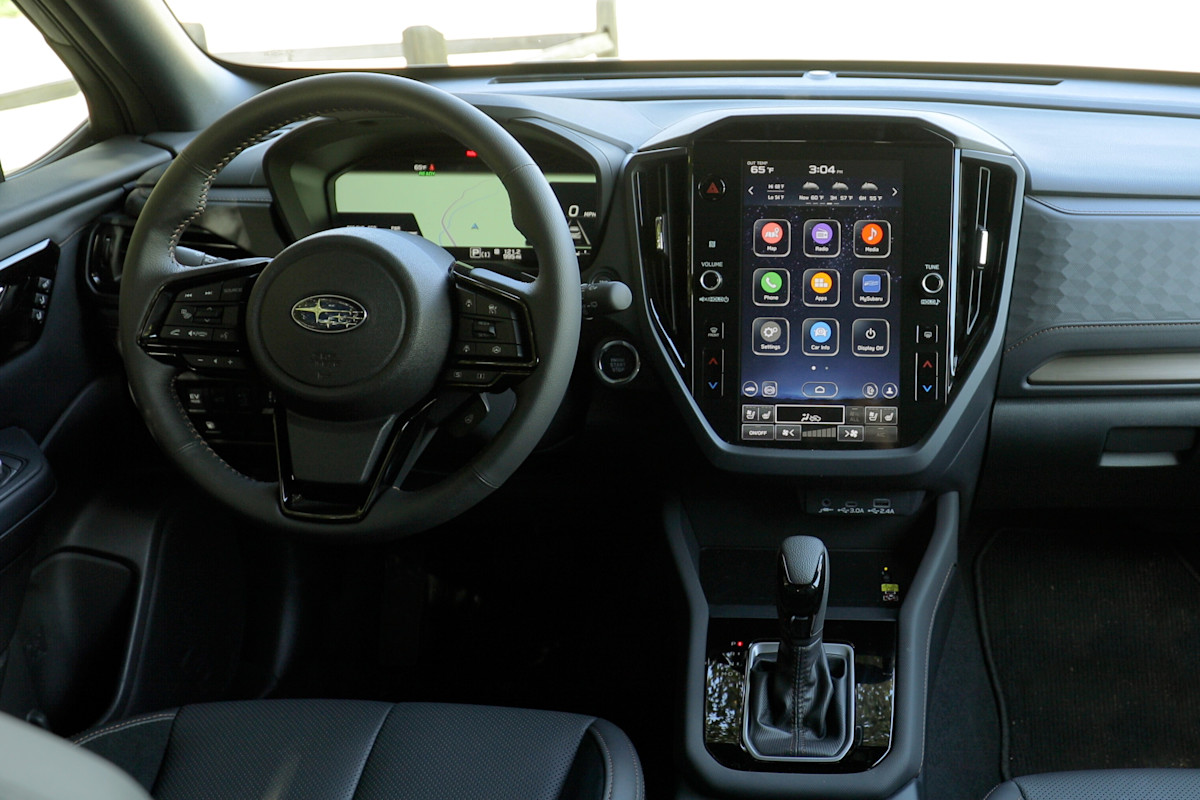
On the inside, the Forester retains some of its previous flavor with a beveled dashboard center section, though this time around, it's almost completely filled with a large vertical infotainment touchscreen. The flatter dashboard and embossed hexagonal pattern add a good amount of modernity, as does the digital instrument panel, which is exclusive to the Hybrid model.
The cabin has a lot of hard plastic, but areas you're likely to come in contact with are covered with nicer soft-touch materials. The rear seating area has fewer of those material upgrades in order to ensure durability and longevity against the wear that children and dogs can inflict. The front seats provide ample cushioning and support for hours of comfortable touring, and the top trim's ventilation makes them even more enjoyable on warmer days. That trim also includes heated outboard rear seats.
While some may argue that the Forester may have lost some of its personality, it could also be argued that it now has more mass appeal.
Performance
All Forester Hybrid models are powered by a 2.5-liter horizontally opposed flat four-cylinder "boxer" engine that is adapted for the constant start/stop cycles that hybrids are known for. The automaker’s new parallel hybrid system employs two motor/generators in place of the continuously variable transmission (CVT) in non-hybrid models, fed by a 1.1-kWh lithium-ion battery pack. Combined, they produce 194 horsepower, beating the standard Forester's 180 hp output.
The hybrid powertrain is similar to Toyota’s, but there’s a key difference. An all-wheel drive system (AWD) is standard, but where Toyota uses a separate electric motor to power the rear wheels, the Forester combines the new hybrid components with an old-school driveshaft, which promises better traction and more consistent reactions when off-roading.
Acceleration is more than adequate, but not impressive. The electric motor has immediate responses to a pedal press, with the internal combustion engine firing up a fraction of a second later. Objectively, the Forester gets up to speed just fine, but the hybrid transmission tends to make it feel much slower than it is. The engine revs at higher speeds and is uninterrupted by the typical transmission shifts, making it feel as though it has run out of steam as it emits a monotone groan. Thankfully, this is really only noticeable when you floor the pedal, and most drivers will notice it only on uphill highway on-ramps or when passing slower traffic.
The hybrid system is well-sorted out, and from the driver’s point-of-view, it functions much like the gas-only Forester. You'll hear the transition between electricity and the engine, but you'll have to pay much closer attention to feel that handoff. The same applies to the brakes, as the pedal remains consistent whether you're using regenerative braking or the physical pads and rotors in the wheels. On a very twisty road, the hybrid version of the Forester tracks predictably and confidently, though its body roll doesn't encourage sportier driving any more than most of its rivals.
The ride quality is firmer than expected, though small bumps and ruts are well smoothed over. Moderate undulations in the road tend to result in some passenger jostling, but it's not to the point that it would be objectionable. Some of the ride firmness could be attributed to the larger 19-inch wheels, as some of our colleagues who drove supporting trims with smaller wheels had no such issues.
Off-roading is where the Forester Hybrid really distinguishes itself. With Subie's X-Mode drive programming, it ably scales rutted trails that would damage or disable more conventional SUVs in the class. It's not nearly as capable as off-road specific SUVs like the Jeep Wrangler or Toyota 4Runner, but it also isn't as compromised when on pavement as those examples. The hill descent control is also noteworthy for its intuitive operation. When activated, it will maintain the speed at which you crested the hill, leaving you to concentrate more on steering. With these terrain-conquering abilities and agreeable on-road manners, the Forester Hybrid finds a desirable middle ground that should attract outward-bound shoppers and urbanites alike.
Form & function
From the driver's seat, we were pleasantly surprised by the unimpeded forward view. The front roof pillars are noticeably thinner than almost any other modern vehicle, providing an obstruction-free view through left turns, benefiting the driving experience in the city or the woods. The front seats offer ample space for a variety of body types, and overall, the cockpit has an open, airy feel.
The rear seats have more than enough room for an average-sized adult, with plenty of legroom and space for your feet under the front seats and a few inches to spare in headroom. The standard panoramic sunroof gives passengers back there a similar sense of openness, too.
Up front, a wireless charging pad is a welcome standard feature, but the harder plastic surface doesn't keep your phone from sliding around in turns. Moderately sized cup holders, a deep center armrest bin, and medium-sized door pockets provide adequate, but not generous storage for your personal items. USB-A and USB-C charge ports are included for rear passengers, as are air vents, but there are no separate temperature controls.
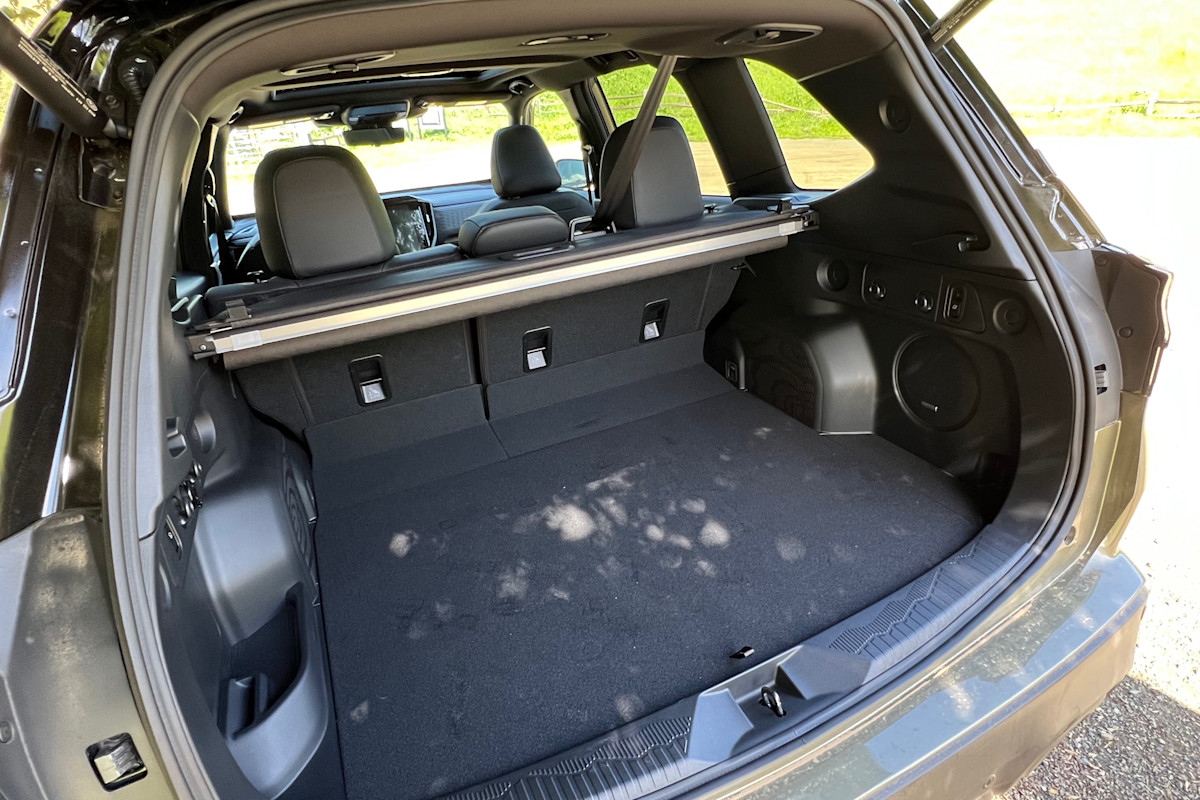
Behind those seats, the Forster Hybrid can hold up to 27.5 cubic feet of cargo. That's the same amount of cargo space as the non-hybrid, but less than some rivals. It's worth noting that the space is very usable and the Forester's more upright tail allows for bulkier items. A standard hands-free power liftgate makes loading those items easier, as do the power remote seatback releases that fold them flat into the cargo floor. If loaded to the roof, an optional digital rearview mirror still allows the driver to see what's behind the vehicle. Handy hooks also keep your groceries from tossing themselves into a salad on your drive home.
Technology
All Hybrid Foresters come with an 11.6-inch vertical infotainment touchscreen with built-in navigation, along with Apple CarPlay and Android Auto. Lower trim levels in the non-hybrid get a smaller eight-inch screen. This latest evolution of Subaru's Starlink infotainment system gets high marks for its large on-screen buttons that are less distracting to use than rival systems’. And with just a little time to acclimate, the menus are easy to figure out. It helps that some functions are anchored to the top of the screen, while the climate controls remain on the bottom. Physical buttons flanking the screen allow for no-look temperature adjustments while secondary functions and seat ventilation/heating can be distracting while driving.
Swiping the top section of the screen reveals the X-Mode off-road drive menu, which allows you to select between a few distinct driving conditions. There aren't any detailed controls for the numerous terrain-related features, favoring a simple approach for drivers instead. We were particularly happy with the many external camera views that come in handy when off-roading under 12 mph. The front camera shows you exactly what's over the crest, while other surrounding views help to keep your paint scratch-free.
Other tech features include a WiFi hotspot and in our higher trim levels, an 11-speaker Harman Kardon premium audio system.
Safety
In crash tests conducted by the National Highway Traffic Safety Administration (NHTSA), the 2025 Subaru Forester Hybrid earned five-out-of-five stars in every evaluation except for rollover protection, where it was awarded four stars.
While it hadn’t published separate results for the Forester Hybrid at press time, the Insurance Institute for Highway Safety (IIHS) gave the non-hybrid model impressive marks, with the top score of "Good" awarded in all categories except for the newer moderate frontal overlap test, where the Forester scored the second-best "Acceptable" rating. These helped it to earn the Forester an IIHS Top Safety Pick award, which is the Institute's second-highest honor.
All Forester Hybrid models come standard with Subaru's EyeSight suite of advanced safety features. It includes frontal collision warning with automatic emergency braking, adaptive cruise control, and lane-keep assist. Rear automatic braking and automatic high beams are also standard, while a driver attention monitor is included on the top Touring trim.
In our time with the Forester Hybrid, all of these systems functioned as they should, with no false alarms or glitches. We were initially annoyed by the loud beeping from the lane-keep assist, but thankfully, the audible alarm could be disabled in favor of visual warnings only. The adaptive cruise control is one of the smoothest operating systems we've tried.
Cost-effectiveness
The 2025 Subaru Forester has a starting price of $36,415 for the entry-level Premium trim (including $1,420 in destination fees). That equates to $2,685 more than the non-hybrid Forester in the same trim. The top Touring trim that we drove rings in at $43,115, which is only $1,400 more than its non-hybrid equivalent.
The EPA estimates the Hybrid will return fuel economy of up to 35 mpg in the city, 34 mpg on the highway, and 35 mpg in combined driving. The standard Forester is estimated as high as 26/33 mpg city/highway and 29 mpg combined. By the EPA's reckoning, owners can expect to save $300 per year in fuel costs with the Forester Hybrid, which means you should be able to recoup the Hybrid cost premium in less than five years in the top trim, but almost nine years in the Premium trim.
The Mazda CX-50 Meridian is the Forester's closest rival when you consider their off-road abilities, but it's not quite as able as the Forester and is estimated at only 25 mpg combined. There's also the Nissan Rogue Rock Creek that gets closer with its 29 mpg combined rating, as well as the Toyota RAV4 Hybrid Woodland Edition at 37 mpg combined. The Ford Bronco sacrifices some comfort for all-terrain prowess, and is estimated at 27 mpg combined. If efficiency is a priority over off-road capability, then the more city-bound Honda CR-V Hybrid is rated as high as 37 mpg combined with an AWD system, while the Hyundai Tucson Hybrid, also AWD, can return up to 38 mpg in its most efficient ‘Blue’ trim level.
Stacked up against these worthy competitors, the 2025 Subaru Forester Hybrid represents a more encompassing circle in the center of the Venn diagram. It makes few sacrifices for its off-road abilities, remains pleasantly comfortable in the city and on the highway, and is bolstered by admirable efficiency figures. If you want a compact SUV that can do a whole lot of everything well, this should be on your shortlist.

What owners say
Trims & specs
Base MSRP $38,995 | Seating 5 |
Engine N/A | Cargo Capacity 27.5 cu ft |
Combined MPG N/A | Drivetrain N/A |
Base MSRP $41,545 | Seating 5 |
Engine N/A | Cargo Capacity 27.5 cu ft |
Combined MPG N/A | Drivetrain N/A |
Base MSRP $34,730 | Seating 5 |
Engine N/A | Cargo Capacity 27.5 cu ft |
Combined MPG N/A | Drivetrain N/A |
Base MSRP N/A | Seating N/A |
Engine N/A | Cargo Capacity N/A |
Combined MPG N/A | Drivetrain N/A |
Base MSRP $37,930 | Seating 5 |
Engine N/A | Cargo Capacity 27.5 cu ft |
Combined MPG N/A | Drivetrain N/A |


Pricing trends
MSRP range
$36,595 - $43,295
Current avg. market price
$35,850
Trending down by 0.7% this month
May 2026 - October 2026