2025 Toyota Camry Reviews, Pricing & Specs



Pros & cons
What we like
Fuel-efficient
Competitively priced
All-wheel drive available on every trim
What to consider
Noisy engine
Finicky voice assistant
The CarGurus verdict
The now-hybrid-only Toyota Camry kicks off its ninth generation for model year 2025.
The Camry is a perennial favorite among families. It’s earned its popularity, with a reputation for reliability and safety, but it also hasn’t had as many competitors to contend with as its crossover siblings have. The few rivals it does have are all either new or recently refreshed, and now, the same can be said of the Camry. For 2025 it debuts a new look, new features, and a new hybrid powertrain, and it sets a new baseline standard for the high-selling midsize sedan.
Verdict: Toyota knows its audience. The new 2025 Toyota Camry gives the people what they want, with up-to-date styling and tech, a strong value proposition helped along by excellent fuel economy, and, most importantly, no fatal flaws that might push a brand loyalist out of their comfort zone.
out of 10 expert review
Look & feel
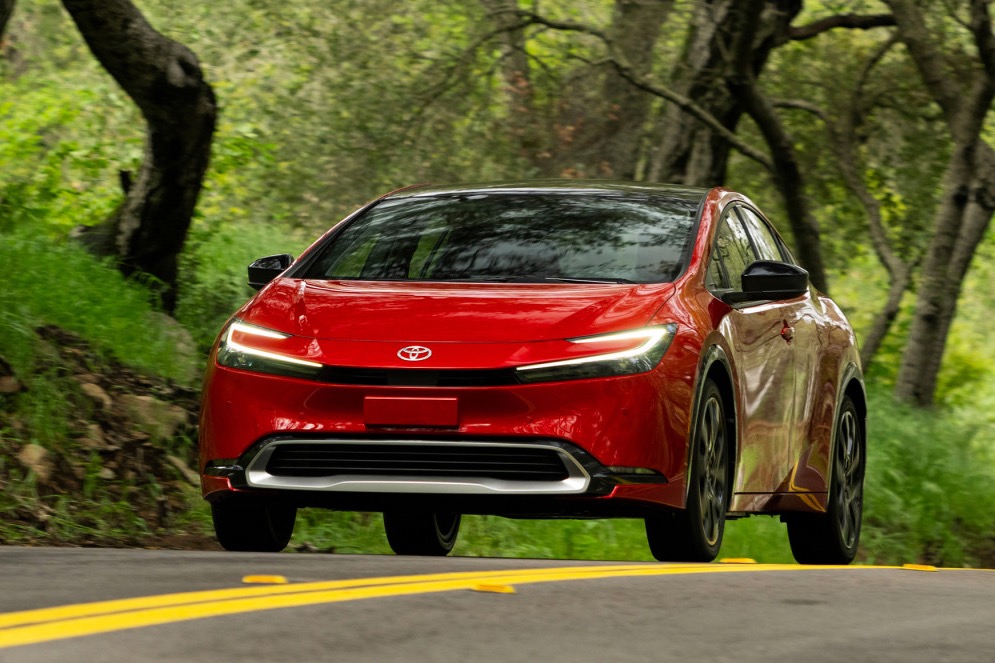
The Camry’s new look is most obvious from the front, where the redesign has rendered the more cohesive and business-like. It shows echos of the new Prius and some family resemblance to the Lexus spindle grille, too, though Toyota parlance terms it the “hammerhead front face.” LED headlights and daytime running lights (DRLs) are standard, and while the Camry doesn’t actually have a trendy slim light bar extending across the hood, it looks as though it could.
The profile is much the same, though the rear window surround extends further into the sail panel, helping to emphasize the coupe-like roof. The hood extends a little further forward, now meeting the vertical line of the grille, which makes the Camry look more assertive. The base Camry LE trim gets 16-inch alloy wheels. SE and XLE trims get black 18-inch, wheels, and the sporty, range-topping XSE gets 19-inch wheels finished in black and Smoke Gray.
SE and XSE get sporty touches like front air ducts, rear diffusers, sport-mesh grilles, and exposed dual-tip exhausts. The Camry XSE is also available with a two-tone paint job, an extra-cost option that pairs a Midnight Black Metallic roof with one of four exterior colors. These include the new Ocean Gem, which debuts with the new Camry, as well as Wind Chill Pearl, Supersonic Red, and the Heavy Metal color previously seen on the likes of the GR Corolla. (In total, nine exterior color options are available, but the black roof is not offered with the other five.)
The new Camry’s interior is more of a departure from its predecessor’s, with an entirely new dash layout. We liked how the center touchscreen’s housing flows across the passenger’s side and helped camouflage the vents, and we can imagine that the ridges in the piano black plastic will help minimize the appearance of smudges or dust from any one angle. We did not care for the quilted Dinamica microfiber in our XLE test car, however. It was a very light gray color in our car and found not only on the dash but also inside the door cards–lots of places, in short, that are at risk of attracting spills or accumulating oils from touch over time. Sorry to be graphic, but that’s what it made us think. Fortunately, the microfiber on our otherwise leather seats was limited to small patches on the shoulders, where we can hope it will stay relatively clean.
The base LE trim comes with fabric seating surfaces, while SE gets SofTex synthetic leather upholstery. Finally, the top Camry XSE comes with perforated leather seats in either Cockpit red or black lined with blue.

Performance
Camry shoppers no longer have to choose between hybrid and not. They’re all hybrid. The 2025 Camry is the first sedan to get Toyota’s fifth-generation hybrid system, which combines a 2.5-liter four-cylinder engine with additional power from electric motors. For front-wheel-drive (FWD) Camrys, those motors number two, and the system makes a total of 225 horsepower. For all-wheel-drive (AWD) models, there are three electric motors, and total power output lands at 232 horses. All four trims are offered in both FWD and AWD. The AWD system is of particular note: Because it’s electronic, not mechanical, all-wheel drive, it can provide extra traction with a very minimal impact on fuel economy. In fact, Toyota is estimating 50 mpg combined for AWD models, compared with 51 for FWD. (The EPA has yet to weigh in.)
The automaker has developed two distinct suspension tunings for the 2025 Camry. We drove the XLE which, like the LE, is more comfort-focused, so we did not experience the sport tune of the sport grades. We found that handling-wise, the Camry does feel planted. The hybrid system switches subtly between gas and electric power without jarring transitions, but that is not to say the powertrain is quiet: you do hear it working at higher speeds and when passing others on the highway. The acoustic laminated front side glass of the XLE (also found on the XSE) did limit road and wind noise, but not the sound coming from our own engine.
The braking feel will not give any regen detractors pause. It feels quite normal, just like the brakes in a traditional, gas-only sedan. And there is no need to fuss with regenerative braking settings, nor is there opportunity to do so. Toyota’s hybrid system operates in the background and leaves the driver out of it, with one exception: At speeds under 25 mph, it’s possible to switch the car into EV mode. Pressing the dedicated button on the center console will override the computer’s fuel optimization and force it to rely on the battery until it needs the engine or your speed picks up, a great feature for commuters.

Form & function
Our XLE test car had a heated steering wheel, an eight-way power-adjustable driver’s seat, and a six-way power-adjustable front passenger’s seat, all features that are standard on both X grades. Heated and ventilated front seats are available options for both the XLE and XSE trim levels, while dual-zone climate control and dedicated rear-seat air vents are standard across the board. The 2025 model year marks the first time that a panoramic moonroof will be offered on a hybrid Camry; it’s available on the top two trims.
Toyota has not yet published interior dimensions for the new Camry. However, the company has specified that changes will be minimal, meaning 2024’s numbers are either accurate or very close. That would place front-row legroom roughly on par with the 2024 Honda Accord Hybrid’s, with head room and back-seat leg room falling behind. The Hyundai Sonata Hybrid actually bests both for head room, but it affords significantly less leg room to passengers in the second row. Trunk space for the 2024 Camry measured 15.1 cubic feet to the Accord’s 16.7, and based on our experience spending time with the 2025 version, we would guesstimate that it remains about the same.

Technology
The new Camry comes standard with an 8-inch infotainment touchscreen running the Toyota Audio Multimedia system, which includes wireless Apple CarPlay and Android Auto and can manage simultaneous Bluetooth connections with two smartphones. A wireless charging pad is also standard, along with five USB ports. At least for 2025, the Camry offers both USB-A and USB-C charging technology, though only the front-row’s USB-A receptacle transmits data. Higher trims get a 12.3-inch touchscreen, much larger than the 9-inch optional upgrade from the previous generation, and also replace the standard 7-inch digital gauge cluster with a 12.3-inch fully digital driver information display. A 10-inch head-up display is available for XLE and XSE trims, as is a nine-speaker JBL Premium Audio system.
Subscription offerings include 4G Wi-Fi connectivity for up to five devices; a 30-day free trial is included. Drive Connect also requires an active subscription (once the trial period ends). This adds an Intelligent Assistant voice-recognition system, among other connected services such as real-time traffic updates. We struggled with the voice recognition and never actually got it to complete a command or find a destination for us, though we did see it respond appropriately to another journalist attending the program. Perhaps we mumble.

Safety
The 2025 Camry comes standard with the Toyota Safety Sense 3.0 (TSS 3.0) suite of advanced driver-assistance systems, which means blind-spot monitoring and rear cross-traffic alert are now included on every Camry. Adaptive cruise control, lane-tracing assist, lane-departure alert with steering assist, and road-sign assist are also among the standard features. An available Premium Plus Package, offered on the XLE and XSE trims, adds front cross-traffic alert, lane-change assist, front and rear parking assist with automatic braking, and a panoramic view monitor. It also adds traffic-jam assist, though Drive Connect must be active for that to work.
On our test drive, we were happy with the lane-keeping assist system, which we found to be firm but also deferential. It provided a strong nudge onto the straight and narrow without making us concerned whether we’d be able to override it in circumstances where we were intentionally diverging from the path the computer deemed correct.
The 2025 Camry is too new as of this writing to have completed crash testing with independent safety organizations. However, it’s reasonable to expect strong scores based on the aforementioned technology, Toyota’s reputation, and the Camry’s history in such evaluations. The 2024 Camry earned a Top Safety Pick award from the Insurance Institute for Highway Safety (IIHS) in testing which did include both the hybrid and the gas-only variants. It also scored well in frontal crash and rollover resistance tests with the National Highway Traffic Safety Administration (NHTSA).

Cost-effectiveness
As a general rule, the hybrid version of a model will cost more at purchase than the gas-only version, and with the new Camry, Toyota hasn’t given buyers a choice between the two. But what they have done is lowered the base price of the hybrid for the new model year: Base MSRP for the 2025 Toyota Camry is $28,400 (before destination), while the 2024 Toyota Camry Hybrid started at $28,855. This does represent an increase of about $2,000 over the non-hybrid base Camry from 2024, but a price hike of this size is expected at the start of an all-new generation, particularly when the baseline powertrain gets a substantial upgrade.
The all-new 2025 Camry (“Hybrid” no longer needs to be said as it’s assumed) now starts very close to the base price of the 2024 Honda Accord, which does not include hybrid technology at the lower end of its lineup. That’s reserved for higher trims, meaning that a hybrid Accord in the 2024 model year started around $33,000.
While Camry and Accord tend, historically, to dominate the midsize sedan market, there are of course other competitors to consider. Some of them are quite good, but looking for hybrid power narrows the field considerably. The Hyundai Sonata got a complete makeover just the year before the Camry; its hybrid variants start at $31,950, but all-wheel drive is not available. There are plug-in hybrid options to be found in the German luxury ranks, but for affordability purposes, the Camry is primarily up against the Accord, the Sonata, and other Toyota offerings.
In this exclusive group, virtually every competitor is either all-new or recently refreshed. You could argue that the Camry is the newest, or you could argue that it’s finally catching up. Either way, the time had come for a new generation, and we think Toyota accomplished what it wanted to with the new Camry.

What owners say
"Overall, owners are very pleased with the 2025 Toyota Camry, highlighting its smooth ride, exceptional fuel economy, and spacious interior. Many also appreciate its value compared to the rising prices of used cars. However, some owners have noted the absence of features like power folding mirrors and parking sensors as areas for improvement."
Good value for a new car considering used prices are a bit crazy right now. Ride is smooth , absorbs bumps and harsh roads are not a problem for this car. I average about 60 miles to and from work everyday and so far I average 52 mpg, most of it is highway miles too. 10/10 would recommend it to anyone.
December 31, 2024Bought a 2025 Toyota Camry hybrid yesterday and it seems like a great car. I really like the idea that I can recharge the electric battery just by breaking and letting off of the accelerator. It has a lot of room and it was comparably priced with the Corolla.
May 17, 2026Great value. Could use a power folding side mirror option.
December 26, 2025What owners say
Good value for a new car considering used prices are a bit crazy right now. Ride is smooth , absorbs bumps and harsh roads are not a problem for this car. I average about 60 miles to and from work everyday and so far I average 52 mpg, most of it is highway miles too. 10/10 would recommend it to anyone.
December 31, 2024Bought a 2025 Toyota Camry hybrid yesterday and it seems like a great car. I really like the idea that I can recharge the electric battery just by breaking and letting off of the accelerator. It has a lot of room and it was comparably priced with the Corolla.
May 17, 2026Great value. Could use a power folding side mirror option.
December 26, 2025This ocean gem color is unique and makes the car look sporty along with the black rims. The fuel economy is one of the main reasons I chose this car and it does not disappoint!
July 28, 2026Compared to other vehicles in its class the hybrid system and the overall technology it provides is well balanced.
June 1, 2025Good first car though lacks refined interior of SE trim level.
April 23, 2026I have owned a 1993 Toyota Camry LE V6 for five plus years. The Camry has been the best Daily Driver I have ever owned (Im almost seventy). It has had routine service three times a year and not much more. I couldnt be more pleased with this cat
January 5, 2024I have been driving Camry for the last 37 years and every year are even better, the 2025 hybrid looks great there is nothing better on gas .
September 23, 2024Smooth, comfortable, lots of room , drives amazing ! Would have liked sensors for parking and folding mirrors.
August 20, 2024Trims & specs
Base MSRP $35,225 | Seating 5 |
Engine 2.5L 232 hp I4 Hybrid | Cargo Capacity 15.1 cu ft |
Combined MPG 46 | Drivetrain AWD |
Base MSRP $34,900 | Seating 5 |
Engine 2.5L 225 hp I4 Hybrid | Cargo Capacity 15.1 cu ft |
Combined MPG 48 | Drivetrain FWD |
Base MSRP $32,525 | Seating 5 |
Engine 2.5L 232 hp I4 Hybrid | Cargo Capacity 15.1 cu ft |
Combined MPG 46 | Drivetrain AWD |
Base MSRP $33,700 | Seating 5 |
Engine 2.5L 225 hp I4 Hybrid | Cargo Capacity 15.1 cu ft |
Combined MPG 48 | Drivetrain FWD |
Base MSRP $30,225 | Seating 5 |
Engine 2.5L 232 hp I4 Hybrid | Cargo Capacity 15.1 cu ft |
Combined MPG 50 | Drivetrain AWD |
Base MSRP $31,000 | Seating 5 |
Engine 2.5L 225 hp I4 Hybrid | Cargo Capacity 15.1 cu ft |
Combined MPG 48 | Drivetrain FWD |
Base MSRP $28,700 | Seating 5 |
Engine 2.5L 225 hp I4 Hybrid | Cargo Capacity 15.1 cu ft |
Combined MPG 52 | Drivetrain FWD |
Base MSRP $36,425 | Seating 5 |
Engine 2.5L 232 hp I4 Hybrid | Cargo Capacity 15.1 cu ft |
Combined MPG 44 | Drivetrain AWD |


Pricing trends
MSRP range
$28,700 - $36,425
Current avg. market price
$28,065
Trending down by 1.6% this month
May 2026 - November 2026