2025 Toyota Land Cruiser Reviews, Pricing & Specs


Pros & cons
What we like
Stylish design
Impressive off-roading capability
Easy-to-use technology
What to consider
Poor fuel economy
Poor handling
Uncomfortable back seat
The CarGurus verdict
Got somewhere to go? You can count on the 2025 Toyota Land Cruiser to get you there.
This two-row midsize SUV is designed for traveling almost anywhere at almost any time. It shares its platform with the rugged Toyota 4Runner SUV and Tacoma pickup truck, and is equipped with a turbocharged hybrid powertrain better at supplying power than efficiency. Additionally, it is more affordable than it has been in the past, but still commands a premium over its primary rivals. The 2025 Land Cruiser is almost unchanged following its 2024 redesign, which introduced the current 250-series model (known as the Land Cruiser Prado overseas) to the United States.
Verdict: There is a lot to like about the Land Cruiser, especially if you don’t care about fuel economy. Our test vehicle averaged 15.7 mpg, falling well short of expectations. That thirst for fuel easily ranks as the worst thing about this SUV. Also, we recommend upgrading from the base 1958 trim level.
out of 10 expert review
Look & feel
With the First Edition no longer appropriate in this second model year, Toyota offers the 2025 Land Cruiser in two trim levels. The base model is called the 1958—the name referencing the year the model was first sold in the US. It has a retro look that harks back to that era, with round headlights, cloth seats, basic equipment and one of three paint colors. You’ll save $4,770 by choosing it, but if that matters you might reconsider shopping for an SUV that costs as much as a Land Cruiser 1958 does ($58,195).
In our opinion, the Land Cruiser model is the way to go ($62,965). It doesn’t have a trim level appended to the name; just call it Land Cruiser. This version of the SUV has a more modern, upscale look, is available in more colors, has a nicer interior with larger screens, and adds critical off-roading hardware and software. It’s also your pathway to a Premium Package that installs leather and more tech.
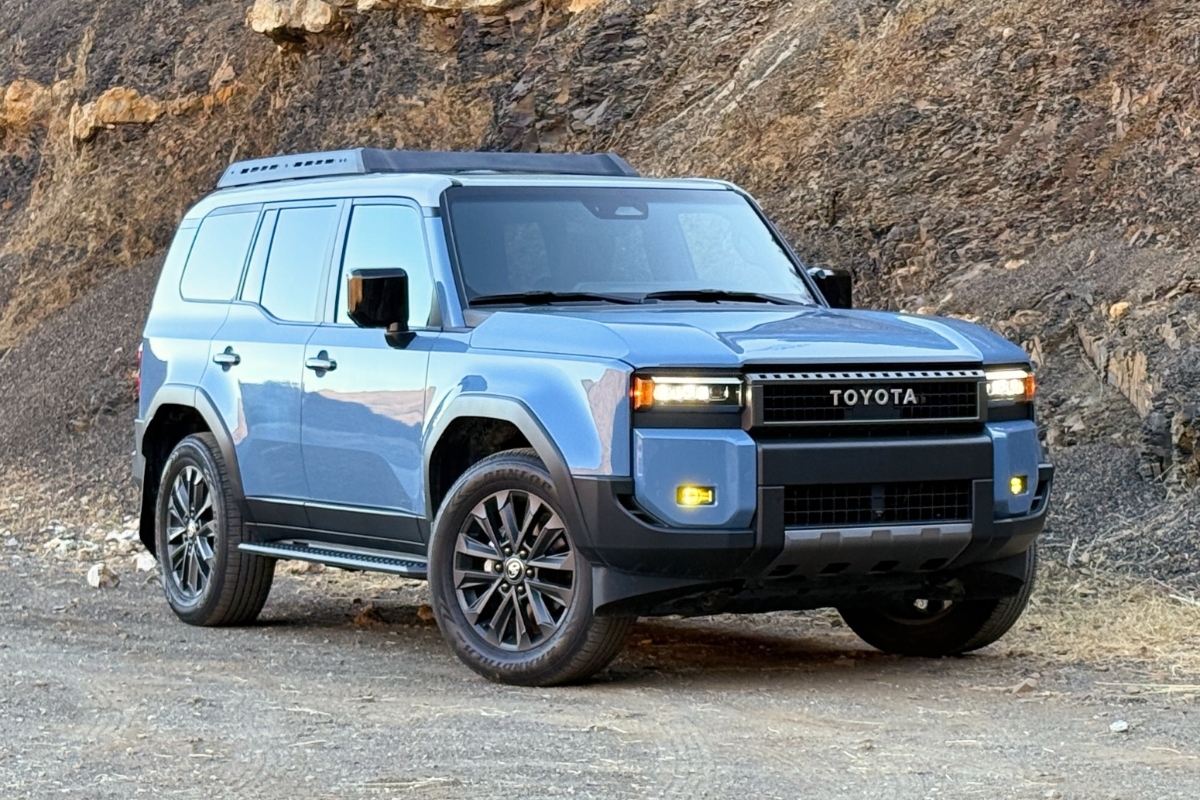
Our Land Cruiser test vehicle had the Premium Package, Heritage Blue and Grayscape paint, 20-inch wheels, carpeted floor and cargo mats, and an accessory roof rack. Those upgrades brought the manufacturer’s suggested retail price to $71,004, including the $1,495 destination charge.
Heritage Blue is one of two Land Cruiser colors that is not a shade of black, white, or gray. Trail Dust (gold) is the other one. It’s a little depressing that a vehicle with this much personality is forced to wear such drab and unimaginative paint, but that seems to be what the people want. Interior choices include black and Java (brown) in SofTex artificial leather or the real thing.
With no more than a glance, you can see the Land Cruiser has a traditional two-box SUV design that maximizes off-road clearances, outward visibility, and room for people and cargo. It has a purposeful look, and a ring of dark gray cladding around the lower perimeter underscores its utility. Our test vehicle had an optional roof rack to help leverage the SUV’s 770-pound static and 165-lb dynamic roof load ratings.
Utilitarian describes the Land Cruiser’s interior, where traditional switchgear rules. This version of the SUV is a lot nicer inside than the 1958, and that helps to make it feel worth the price you’re paying. The Java-colored leather brings desirable color contrast to the cabin, and the dual 12.3-inch digital driver and infotainment screens make it appear technologically advanced.
Additionally, having exited a Lexus RX the week prior to driving the Land Cruiser, we can say the steering-wheel controls are about 1,000 times more intuitive to use compared to what you’ll find in the Lexus.

Performance
Every Land Cruiser has Toyota’s i-Force Max hybrid system. It pairs a turbocharged 2.4-liter four-cylinder engine with an eight-speed automatic transmission and an electric motor located between those two components. The battery pack lives underneath the cargo area’s load floor.
Output measures 326 horsepower and 465 pound-feet of torque, transferred to through a full-time four-wheel-drive (4WD) system equipped with electronic locking rear and center differentials, enabling a maximum towing capacity of 6,000 pounds. Downhill Assist Control and Crawl Control are standard on both the 1958 and Land Cruiser trim levels. The more expensive Land Cruiser model adds Multi-Terrain Select off-roading modes, Multi-Terrain Monitor camera views, and a front stabilizer bar disconnect feature.
The official EPA ratings say a Land Cruiser will get 23 mpg combined, but that proved highly optimistic in our experience. Granted, on our testing day, heat baked Southern California so the air conditioning was blasting and the automatic engine stop/start system had seemingly taken a vacation. Still, we expected better than the 15.7 mpg we observed on the real-world evaluation loop.
In exchange for feeding this beast, you’ll get an impressive daily driver and weekend adventurer. The only thing the Land Cruiser does poorly is handle on a twisty mountain road, which… well, duh. You simply cannot hustle this thing, mainly due to its tires and roly-poly suspension tuning. But, if you spend Monday through Friday in urban and suburban driving situations and your off days off-roading, the Land Cruiser is terrific.
For example, if you’re so inclined, you can blaze over speed bumps at 30 mph and speed humps at 40 mph. There is no shudder, no shake, and nothing sounds like it might break. That suspension tuning also soaks up the crumbling pavement characterizing so many of America’s city streets like a cement-seeking sponge.
You sit up high with a great view out and can easily see every corner of this SUV. That makes it easy to park, and to maneuver on the trail. We’ve spent some quality time off-roading the Land Cruiser in the past, and it’s a capable vehicle, especially when you take advantage of its front stabilizer bar disconnect, Crawl Control low-speed cruise control, and Multi-Terrain Monitor camera views. These features, along with 8.7 inches of ground clearance, imbue the Land Cruiser with ample off-road capability.
During the daily drive, the Land Cruiser feels powerful and responsive, but that’s somewhat illusory and due to the electric assist motor and turbocharged torque. An impromptu acceleration test produced a modest result and plenty of rear-end squat. Also, hard braking results in nose dive, and when rounding curves and corners, the Land Cruiser leans over. Unless you enjoy these kinds of ride motions, slow and steady is best.

Form & function
Upgrade from the Land Cruiser 1958 and you swap cloth upholstery for Toyota’s SofTex artificial leather. The front seats also gain heated and ventilated cushions, and the steering wheel is heated. Our test vehicle had the Premium Package, which installed real leather and a standard-size power sunroof.
Both front seats are comfortable, providing excellent support on longer trips. We cannot say the same for the second-row seats. They lack thigh support and the backrest angle is uncomfortable, so you end up sitting in a slouched position. Also, long-legged people might find the Land Cruiser’s running boards get in the way when entering and exiting the cabin, though they’re undeniably helpful when strapping things to the roof rack.
Toyota erred with the Land Cruiser’s rear window. It would be better if it powered down into the tailgate like it does on the 4Runner, adding an open, airy, flow-through sensation to the cabin. Instead, you need to drive with the window glass flipped up. Also, the center console's cool box seems an unnecessary part of the optional Premium Package. Who needs this? It simply chews up storage space that’s in modest supply to start with.
Open the rear liftgate, and the Land Cruiser reveals 46.2 cubic feet of cargo space. That’s a generous amount, and in a handy cube-shaped area. Unfortunately, the load floor height is high, so you need to flex those muscles when loading heavy items. Maximum cargo space with the 60/40-split folding back seat dropped measures 82.1 cubic feet.

Technology
If you upgrade to a Land Cruiser from the Land Cruiser 1958, the 7-inch digital driver display and 8-inch touchscreen infotainment system are upgraded to two 12.3-inch displays with a more sophisticated appearance. The Toyota Audio Multimedia (TAM) infotainment system is well equipped with wireless Apple CarPlay and Android Auto, SiriusXM satellite radio, and log-in access to Apple Music and Amazon Music accounts. Five connected service plans are available, including Service Connect, Safety Connect, Remote Connect, Wi-Fi Connect, and Drive Connect.
Drive Connect installs a cloud-based navigation system and a conversational digital assistant. Say something like, “Hey Toyota, give me directions to the nearest Chipotle,” and it quickly and accurately provides them. It passed our standard voice recognition system evaluation with flying colors.
When you get the Premium Package, the Land Cruiser features a decent-sounding 14-speaker JBL premium sound system. That option package also installs a wireless smartphone charger that ought to be standard, a head-up display, a digital camera-based rearview mirror, and digital key technology.

Safety
Every 2025 Land Cruiser includes Toyota Safety Sense 3.0 (TSS 3.0). It is the automaker’s latest collection of advanced driving assistance systems (ADAS), and equips the SUV with lots of technology designed to prevent accidents from occurring.
The contents of TSS 3.0 include forward-collision warning, automatic emergency braking, and pedestrian, cyclist, and motorcyclist detection capability. Additionally, it equips the SUV with lane-departure warning, lane-keeping assist, and lane-centering assist. Use the adaptive cruise control and lane-centering assist together, and you have a hands-on semi-autonomous highway driving aid that can tell when a driver becomes unresponsive and can bring the Land Cruiser to a safe stop.
Additional safety features in TSS 3.0 include a road sign reader, automatic high-beam headlights, and Predictive Driving Assist (PDA). The standard blind-spot monitoring system is separate from TSS 3.0, as is the rear cross-traffic alert system. Upgrades as part of the Premium Package include front cross-traffic alert, lane-change assist, and Traffic Jam Assist.
Our experience with Toyota’s ADAS varies depending on the vehicle in which it is installed. In some models, we keep the tech engaged and active. In others, we selectively turn things off due to irritation and aggravation. For example, we didn’t keep the PDA system active in the Land Cruiser, partly because of how it produced unwanted ride motions.
Also, the adaptive cruise control and lane-centering assist struggled on Pacific Coast Highway heading into late afternoon sunlight. At one point, the SUV drifted out of the lane of travel because the lane-centering assist temporarily deactivated and we didn’t receive an audible warning to indicate that had occurred. On a curvy, uphill section of freeway, the ADAS required a manual override to settle the vehicle’s indecisive behavior.
In daily driving, you’ll find the front cross-traffic alert system to be active. Don’t turn it off, though, because it saved the day when attempting to make a right turn onto a 55-mph highway with limited visibility to see approaching vehicles. That’s the thing about some of these safety features. You don’t need them until the one time you do.
As far as crash-test ratings go, only the National Highway Traffic Safety Administration (NHTSA) has given the Land Cruiser a rating. It earns an overall rating of four stars out of five, receiving four stars in the frontal-impact test, five-stars in side-impact testing, and a mediocre three-star rollover resistance rating.

Cost-effectiveness
With pricing starting around $60,000, and an as-tested window sticker of more than $70,000, you might presume the Land Cruiser is not a cost-effective way to see the U.S.A. on roads paved and unpaved. Before you decide, you should check out how much damage a tricked-out Ford Bronco, Jeep Wrangler, or Land Rover Defender can do to your bank account.
In terms of a core mission, those two alternatives are better aligned with Toyota’s other rugged off-roader, the 4Runner. By comparison, the Land Cruiser is more refined than any member of that trio. So, what are its rivals? The Jeep Grand Cherokee is analogous to the Toyota, and costs less money. You might also cross-shop the Toyota with the larger and more expensive Nissan Armada Pro-4X.
Toyota offers some value-add in the form of two years or 25,000 miles of complimentary scheduled service, and our test vehicle’s free trial subscriptions to the various connected services plans is undeniably appealing. We also think the Land Cruiser upgrade over the base 1958 model is well worth the price.
Overall, we really like the Land Cruiser. The dismal observed fuel economy during our testing was the worst thing about it. So, if you don’t mind pumping plenty of premium into the i-Force Max powertrain, chances are you’ll be pretty happy with this SUV.

What owners say
Great value for the money. Love that it is a hybrid.
May 21, 2025Trims & specs
Base MSRP $56,700 | Seating 5 |
Engine 2.4L 326 hp I4 Hybrid | Cargo Capacity 46.2 cu ft |
Combined MPG 23 | Drivetrain 4X4 |
Base MSRP $61,470 | Seating 5 |
Engine 2.4L 326 hp I4 Hybrid | Cargo Capacity 46.2 cu ft |
Combined MPG 23 | Drivetrain 4X4 |


Pricing trends
MSRP range
$56,700 - $61,470
Current avg. market price
$61,466
Trending down by 0.9% this month
May 2026 - November 2026