2025 Toyota Prius Reviews, Pricing & Specs


Pros & cons
What we like
Stylish design
Easy-to-use technology
Great safety ratings
What to consider
Real-world fuel economy falls short of EPA ratings
Cramped back seat
Not much cargo space
The CarGurus verdict
Has the Toyota Prius, the iconic standard-bearer of hybrid cars, finally outlived its usefulness?
Decades ago, few cars were anywhere near as fuel efficient as the Toyota Prius. Today, the 2025 Prius remains the fuel economy champion, but numerous alternatives are close behind. Some even offer more interior room at a lower price. That reality, coupled with the Prius’ cramped interior, limited trunk space, and general weirdness, means hybrid car buyers have options. In response, Toyota adds a new Nightshade trim level with a blacked-out look to the 2025 Prius lineup.
Verdict: The point of the 2025 Toyota Prius is fuel economy, but our Prius Nightshade test car averaged 39.2 mpg, falling significantly short of the EPA estimate of 52 mpg in combined driving. That certainly isn’t superior to roomier hybrid cars from Honda, Hyundai, or from within Toyota’s own lineup.
out of 10 expert review
Look & feel
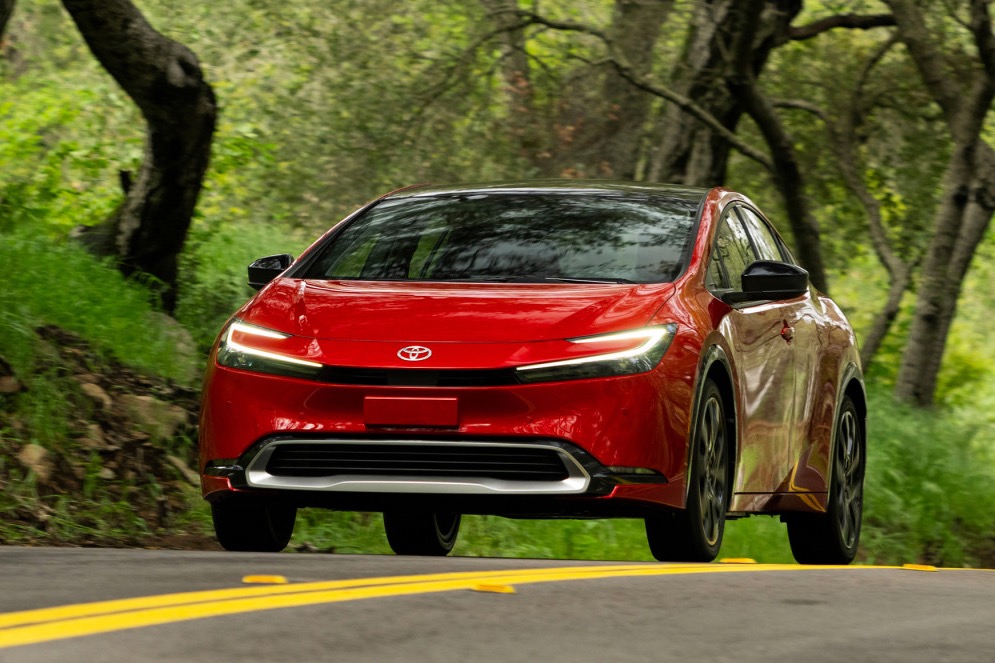
With this fifth-generation Prius, Toyota finally made the well-known hybrid attractive. The classic boomerang-shaped profile remains, but the styling details ensure the current Prius is futuristic, aerodynamic, and appealing.
For the 2025 model year, the Prius is available in LE, XLE, Nightshade Edition, and Limited trim levels. Pricing ranges from $29,545 to $36,560, including the $1,195 destination charge, with front-wheel drive (FWD). All-wheel drive (AWD) is available as an option, adding $1,400 to the car's cost. Prius Prime plug-in hybrid versions are also available, adding about five grand to the price while providing up to 45 miles of electric-only driving.
This review pertains to the standard 2025 Prius lineup. This year’s new Nightshade Edition adds black 19-inch wheels, black exterior trim, and an exclusive Karashi paint color in addition to choices that include Wind Chill Pearl and Midnight Black. Naturally, the only interior color is Black. Our test car arrived in Karashi, and we found it appealing on the Prius Nightshade. It’s a golden mustard yellow color that likely works only with expressive designs and vehicles with plenty of personality, so don’t expect to see it on Toyota’s mainstream models.
Until you walk up to a 2025 Prius, it is hard to see and understand just how low this car is to the ground. Toyota says it is 55.9 inches tall, only an inch less than a Camry sedan. Still, when you’re folding yourself in half to get in or out of the Prius, it seems like a sports car and not a hybrid hatch.
Once you tuck yourself inside, the base of the windshield appears to be in the next state. There is a lot of dashboard between the driver and the glass, and the 7-inch digital gauge cluster’s distant location and tiny markings don’t help. Glance into the rearview mirror, and cargo-area panels appear to block the lower portion of your view to the rear of the car. It may seem like visibility will be awful, but we found it adequate.
The materials are a mix of hard plastics, thin surface padding, and Toyota SofTex artificial leather. A strip of ambient lighting illuminates the dashboard, adding a touch of life to the cabin. The test car’s optional 12.3-inch touchscreen infotainment system dominates the otherwise minimalist interior.
In addition to the larger display, our FWD Prius Nightshade Edition had a fixed glass roof, a two-year extension of the Drive Connect and Remote Connect services, and wheel locks. A Preferred Accessory Package, which includes floor mats, a cargo mat, a cargo net, a first-aid kit, and a protective rear bumper appliqué, increased the manufacturer’s suggested retail price (MSRP) to $36,308, including destination.

Performance
The Prius’ hybrid powertrain includes a 2.0-liter four-cylinder gas engine and an 83-kilowatt electric motor. Toyota says the net output measures 194 horsepower. With AWD, Toyota adds a second 30-kW electric motor at the rear wheels to provide extra traction when necessary, which increases the net output to 196 hp.
Toyota builds the Prius on its Toyota New Global Architecture (TNGA), which debuted a decade ago underneath the previous-generation Prius. Engineered to give vehicles a lower center of gravity and more responsive handling characteristics, it has transformed modern Toyotas into vehicles that are enjoyable, if not always thrilling, to drive.
With 194 hp and its electric assist motor, the Prius is sprightly. When you see one holding up traffic, there isn’t a good reason for it other than an owner seeking to eke out every last mile from each drop of gasoline. This hybrid is zippy enough to chirp its tires, and has no trouble zooming up to highway speeds or slicing and dicing through moderate traffic.
The ride and handling are commendable, too. Despite its all-season rubber, the Nightshade’s sizable 19-inch wheels and tires offered good grip in the twists and turns of local mountain roads, squealing slightly but clearly conveying the upcoming limits of adhesion. Drive with enthusiasm, and you can establish a predictable rhythm with this car.
On the highway, there is more wind noise than you might expect from a car boasting a low 0.27 coefficient of drag. Nevertheless, a Prius effortlessly eats up miles while keeping the driver comfortable. Around town, it can be challenging to see out of the Prius and judge where the car’s corners are, so take care when parking.
That brings us to the elephant in the room: observed fuel economy. The EPA gave the Prius Nightshade Edition a 52 mpg rating in the combined, city, and highway categories. So the light Sunday evening traffic wasn’t to blame for the test vehicle’s dismal 39.2 mpg average on the testing loop. Granted, it is a mountainous route, and we did use the Sport driving mode on the canyon roads. Still, that’s a significant shortfall compared to expectations.

Form & function
You can get a dual-panel glass roof for a Prius, but it’s of dubious value. While it made the cramped, all-black interior of our test car seem a little bigger and allowed more natural light to enter the cabin, the upgrade costs $1,000 and doesn’t open like a traditional sunroof. Save your money.
Our Nightshade Edition test vehicle had an eight-way power-adjustable driver’s seat, heated front seats, and a heated steering wheel. It was comfortable to drive, but entry and exit required effort due to the car’s low-slung stance and low roof. Toyota’s SofTex artificial leather is soft, but it can feel a little sticky. Relatively mild summer weather meant the upholstery didn’t trap sweat as much as it would on hotter days.
The rear seat is snug, headroom in that row is tight, and people with larger feet might snag them when entering the car. Also, the Prius Nightshade lacks rear climate-control vents. However, the front seatbacks are soft and padded, making them kind to the knees and shins of taller passengers. Additionally, the seat itself is comfortable.
Storage space is decent, with storage slots in all four door armrests, a two-tiered bin located in front of the cupholders, and a reasonably sized bin underneath the center armrest. The smartphone charger is located to the right of the shifter and will likely prove to be a magnet for crumbs, dust, and dirt over time.
Toyota states that the Nightshade Edition has 20.3 cubic feet of cargo space behind the rear seat (23.8 cubic feet with LE trim). However, it doesn’t seem like it. After all, a Toyota Camry Hybrid’s trunk has 15.1 cubic feet of volume, and it seems much larger inside than the Prius’ cargo area. Toyota must include the storage space under the load floor and also the area above the cargo cover in the official measurement. A 60/40-split folding rear seat is standard. Fold it down, and a Prius can swallow a lot more cargo. Unfortunately, Toyota declines to provide a maximum cargo measurement.

Technology
Every 2025 Prius comes equipped with a Toyota Audio Multimedia (TAM) infotainment system. An 8-inch touchscreen is standard with LE, XLE, and Nightshade Edition trim levels, while the Limited gets a larger 12.3-inch touchscreen. The bigger screen is an option for the XLE and Nightshade, and our test car had it.
Both TAM systems include wireless Apple CarPlay and Android Auto, SiriusXM satellite radio with a complimentary three-month trial to service, and access to five different connected services plans with variable free trial subscriptions.
Service Connect and Safety Connect are available for up to 10 years at no charge, and Remote Connect includes a one-year subscription. WiFi Connect is available at no cost for 30 days or 3 GB of data use. Drive Connect is complimentary for one year with the Prius Limited; with LE, XLE, and Nightshade Edition trim, you must pay extra from the get-go.
The TAM system works best with an active Drive Connect subscription, which enables a native navigation system, a conversational digital voice assistant, Google points-of-interest data, and human concierge access. The voice assistant works well; however, if you say “Toyota” in conversation with someone inside the car, it wakes up to ask how it can assist you. That’s also the case if you say the brand name of the car within earshot of other automaker's’ voice assistants, though.
If you’d rather not pay for Drive Connect, it is easy enough to run the wireless Apple CarPlay or Android Auto. You can also sign in to your Apple Music or Amazon Music accounts right from the TAM system to stream music. Sadly, the Nightshade Edition’s six-speaker stereo is trash.

Safety
Toyota Safety Sense 3.0 (TSS 3.0) is standard in every 2025 Prius, equipping the car with a long list of safety features. The highlights include forward collision warning, automatic emergency braking, lane departure warning, lane-keeping assist, lane-centering assist, adaptive cruise control, and automatic high-beam headlights. Separately, blind-spot monitoring with rear cross-traffic alert is also standard.
The TSS 3.0 collection also includes Proactive Driving Assist (PDA). This feature can automatically brake and steer to help drivers maintain safe following distances from traffic ahead. In our experience, in some Toyotas, PDA can seem too aggressive and intrusive. In the Prius, it proved more agreeable. Still, we turned it off halfway through our week-long evaluation.
Our test car also featured front and rear parking sensors, as well as automatic low-speed braking. Considering how hard it can be to place the Prius’s corners, these features were helpful. A surround-view camera system is also available on the Prius Limited, further aiding visibility.
During our evaluation, TSS 3.0 behaved as we’ve come to expect. That means the lane-centering assist system can become somewhat argumentative with the driver on the curves of a coastal highway or a city freeway. Additionally, it can suffer momentary confusion when passing freeway exit and entrance ramps when the Prius is traveling in the right lane. Otherwise, we have no complaints.
Regarding crash-test ratings, the Prius earns a coveted Top Safety Pick+ nod from the Insurance Institute for Highway Safety (IIHS). The National Highway Traffic Safety Administration (NHTSA) gave the Prius five-star ratings in all crashworthiness assessments, as well as a four-star rating for rollover resistance. Translated, the 2025 Toyota Prius is a safe car.

Cost-effectiveness
For a long time, the Toyota Prius was at the center of a Venn diagram representing fuel economy, price, and practicality. Today, it shares that space with other models, including the Honda Civic and Accord hybrids, the Hyundai Elantra and Sonata hybrids, and the Toyota Corolla and Camry hybrids.
Of these rivals, the Honda Civic Hatchback Hybrid has the Prius dead in its sights. On paper, the Civic isn’t as fuel-efficient as the Prius but, in our real-world experience, the Toyota missed the mark by more than a mile. The Prius is more stylish and offers available AWD, but the Civic Hybrid is more satisfying to drive. The Honda also offers slightly more cargo room underneath its hatch, and is more affordable than the Toyota. Like the Prius, the Civic is an IIHS Top Safety Pick+.
There was a time when the Prius nameplate was so powerful that Toyota made it a sub-brand within its lineup, offering the smaller Prius c and larger Prius v in addition to the standard Prius. Today, in an era when every Toyota Camry has a hybrid powertrain capable of returning up to 51 mpg, it seems the Prius lives on primarily due to its legacy.

What owners say
Trims & specs
Base MSRP $32,495 | Seating 5 |
Engine 2.0L 194 hp I4 Hybrid | Cargo Capacity 20.3 cu ft |
Combined MPG 52 | Drivetrain FWD |
Base MSRP $31,795 | Seating 5 |
Engine 2.0L 194 hp I4 Hybrid | Cargo Capacity 20.3 cu ft |
Combined MPG 52 | Drivetrain FWD |
Base MSRP $33,195 | Seating 5 |
Engine 2.0L 196 hp I4 Hybrid | Cargo Capacity 20.3 cu ft |
Combined MPG 49 | Drivetrain AWD |
Base MSRP $28,350 | Seating 5 |
Engine 2.0L 194 hp I4 Hybrid | Cargo Capacity 23.8 cu ft |
Combined MPG 57 | Drivetrain FWD |
Base MSRP $33,895 | Seating 5 |
Engine 2.0L 196 hp I4 Hybrid | Cargo Capacity 20.3 cu ft |
Combined MPG 49 | Drivetrain AWD |
Base MSRP $29,750 | Seating 5 |
Engine 2.0L 196 hp I4 Hybrid | Cargo Capacity 23.8 cu ft |
Combined MPG 53 | Drivetrain AWD |
Base MSRP $35,365 | Seating 5 |
Engine 2.0L 194 hp I4 Hybrid | Cargo Capacity 20.3 cu ft |
Combined MPG 52 | Drivetrain FWD |
Base MSRP $36,765 | Seating 5 |
Engine 2.0L 196 hp I4 Hybrid | Cargo Capacity 20.3 cu ft |
Combined MPG 49 | Drivetrain AWD |


Pricing trends
MSRP range
$28,350 - $36,765
Current avg. market price
$27,864
Trending down by 2.6% this month
May 2026 - November 2026