2025 Toyota Sequoia Reviews, Pricing & Specs


Pros & cons
What we like
Stylish design
Powerful engine
Easy-to-use technology
What to consider
Poor fuel economy
Cramped third row
Not much cargo space
The CarGurus verdict
There’s a new reason to consider a 2025 Toyota Sequoia, and it goes by the name 1794 Edition.
The 2025 Sequoia is Toyota’s full-size SUV, based on the same platform as the Tundra pickup truck and using the same i-Force Max hybrid powertrain. It seats up to eight people, holds up to 86.9 cubic feet of cargo, carries up to 1,730 pounds of payload, and tows up to 9,520 pounds of trailer. The new Sequoia 1794 Edition slots into the lineup as a Texas-themed luxury model, and it certainly is nice. But it cannot mask this SUV’s fundamental flaws.
Verdict: People buy full-size SUVs to carry lots of people, haul lots of cargo, and tow lots of weight. However, due to its packaging requirements, the Sequoia is a rock star only if you’re attaching a trailer to it, and even then, it’s not class-leading in capability.
out of 10 expert review
Look & feel
New for 2025, the Sequoia 1794 Edition takes its name from the incorporation year of the ranch on which the San Antonio, Texas, assembly plant that builds the Sequoia and the Tundra pickup now stands. The Tundra already has a 1794 Edition trim level, so Toyota figured it might as well drum up some interest in its full-size SUV by giving it a matching model.
The Sequoia 1794 Edition builds on the Sequoia Platinum with machined-finish 20-inch wheels, more exterior chrome, Saddle Tan leather upholstery, open pore American walnut wood trim, and all-weather floor mats. It joins a lineup that includes the Sequoia SR5, Limited, Platinum, TRD Pro, and Capstone. Prices range from $62,425 to $83,915, plus the destination charge.
Our test vehicle had the optional TRD Off-Road Package, a TRD front skid plate, a 10-inch color head-up display, two extra years of Drive Connect and Remote Connect services, and a smart USB phone cable. Those upgrades brought the manufacturer’s suggested retail price (MSRP) to $85,700, including the $1,945 destination charge. The facts and opinions that follow pertain to the 2025 Sequoia 1794 Edition.
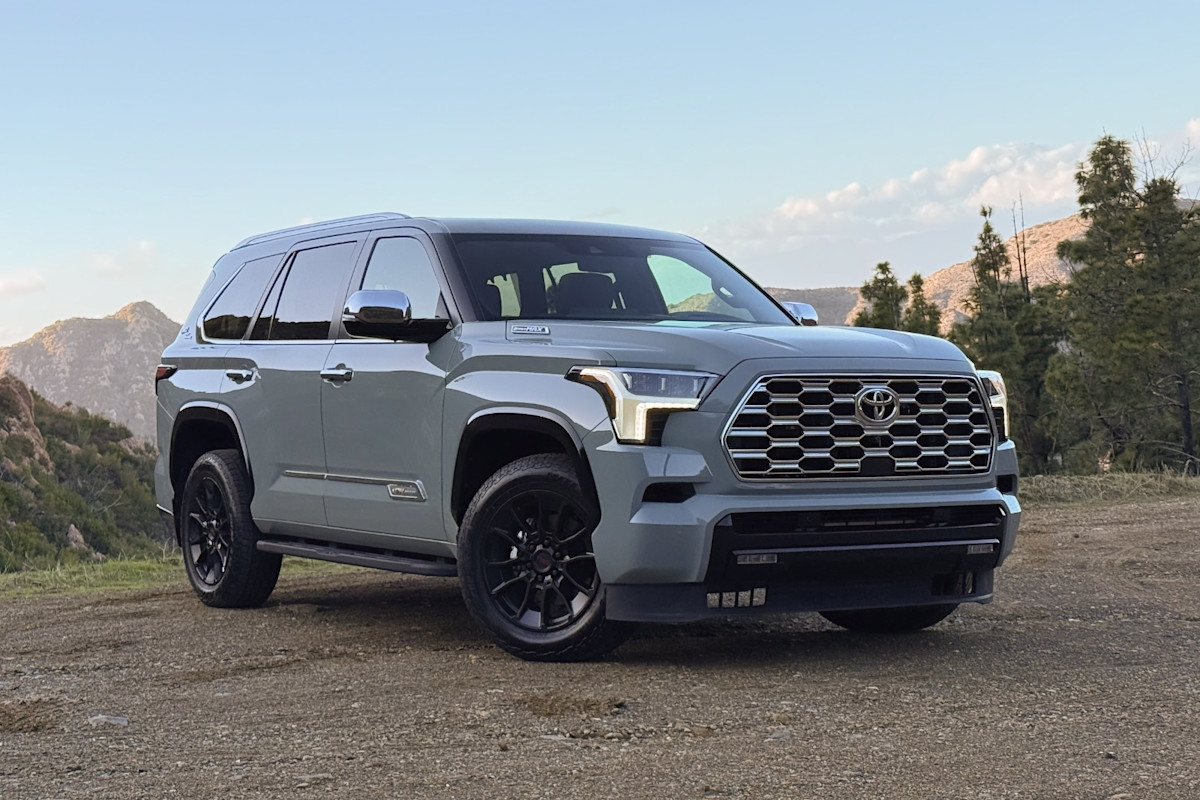
Dipped in Lunar Rock paint and equipped with black 20-inch TRD off-road wheels wrapped in all-terrain tires, our Sequoia grabbed attention everywhere from Santa Monica to Santa Barbara. That was surprising since the current-generation Sequoia has been out for a few years. However, it is a rarity on the road, and the test vehicle looked pretty cool.
Inside, the Saddle Tan leather upholstery, dashboard trim, and door panel decor contrasted sharply with the otherwise black interior. They also served as a perfect complement to the warm walnut wood, marked with a lone star symbol and “1794 Edition.”
Still, the rest of the cabin is covered in typical Toyota-grade plastic, which is not a compliment. The window sticker says 85 grand, but other than the wood and leather, the interior suggests 45 grand. In addition, the red TRD accents and logos added with the TRD Off-Road Package are totally out of place, but the aluminum pedals look great in the 1794 Edition.

Performance
The Sequoia comes standard with what Toyota calls an i-Force Max hybrid powertrain. It includes a twin-turbocharged 3.4-liter V6 engine, an electric motor, a 1.87-kilowatt-hour nickel metal hydride battery pack, and a 10-speed automatic transmission.
Output measures 437 horsepower and 583 pound-feet of torque, and with 1794 Edition trim, a part-time four-wheel-drive (4WD) system with 2-Hi, 4-Hi, and 4-Lo settings is standard. In addition, drivers can choose from Eco, Normal, Sport, and Tow/Haul driving modes.
Weighing 6,150 pounds, the Sequoia 1794 Edition requires plenty from its twin-turbo hybrid drivetrain. Still, it is undeniably muscular, offering quick acceleration and a terrific engine note. However, this hybrid is about supplying competitive power, not getting good gas mileage.
In our experience, the fuel economy falls short of expectations. According to the EPA, a Sequoia with 4WD should average 20 mpg in combined driving. However, when running the SUV in rear-wheel drive (RWD) 2-Hi and the Normal driving mode, the test vehicle averaged only 16.2 mpg on the evaluation loop.
The 1794 Edition’s maximum towing and payload capacities are 9,010 pounds and 1,410 pounds, respectively. Those figures beat several rivals, and Toyota offers a Tow Tech Package with a digital rearview mirror, Trailer Backup Guide system, and Straight Path Assist technology. A self-leveling rear air suspension is also available and recommended for towing.
But the Sequoia suffers from compromised packaging and, in turn, driving dynamics. The battery pack is mounted under the rear seats, adding weight at the rear. And Toyota elected to use a solid rear axle, which cuts into rear-sear room and cargo space.
When driving in urban areas, the added mass at the rear axle produces unwanted body motion when traveling over speed humps and through drainage dips, even with the optional TRD Off-Road suspension. On smaller and sharper bumps, the ride is jittery and truck-like. Mid-curve undulations on two-lane roads produce excessive lateral weight transfer. You might want to upgrade to the adaptive suspension with rear self-leveling to reduce these undesirable characteristics.
The 2025 Sequoia 1794 Edition has 8.6 inches of ground clearance, and the standard front air dam that limits the approach angle to 15 degrees. The test vehicle’s optional TRD Off-Road Package installs black 20-inch TRD Off-Road wheels, Falken Wildpeak all-terrain tires, an off-road-tuned suspension, a locking rear differential, and all of the off-roading tech Toyota can put on a Sequoia. But with that silly air dam and less ground clearance than a base Subaru Crosstrek, it writes a check the Sequoia can’t cash.
Due to that air dam, we thought it was a bad idea to venture anywhere a RAV4 couldn’t go. Therefore, we can’t comment on how the TRD-tuned suspension performs off-road or review any of the trick tech, such as Crawl Control and Multi-Terrain Select. However, as with the Toyota Tacoma pickup, owners can remove the air dam and chuck it into the garage to collect dust. It’s not like it’s helping much with fuel economy.
The Falken Wildpeak all-terrain tires are excellent on pavement. Often, these types of tires produce added road noise and sloppy handling, but that’s not the case with the Falkens. In addition, the steering is light and fluid, like a Lexus, and the Sequoia boasts a tight turning radius. Switch to Sport mode, and the steering firms up but doesn’t offer much feel.
We didn’t like the brakes, which offer poor initial bite and are hard to modulate. Specifically, the pedal feel is too firm sometimes, requiring extra effort to depress. In heavy traffic, the pedal just doesn’t feel good underfoot. Also, after a hard braking test from a high speed, fade was a problem as we wound down a mountain. It’s best if you always leave yourself some extra room.

Form & function
Like other full-size SUVs, the Sequoia carries up to eight people (seven with the available second-row captain’s chairs). However, seven (or six) will be happier, and the people riding in the third row should be shorter in stature.
The 1794 Edition’s front seats offer 10-way power adjustment with heating, ventilation, and massage. A heated steering wheel is also standard. Both the driver and front passenger are sure to find their accommodations comfortable.
Long rear doors make it easier to access the second- and third-row seats, but only when you have plenty of room on either side. During a day trip to Santa Barbara, the doors were a liability due to cramped parking situations.
The 1794 Edition has standard second-row heated and ventilated captain’s chairs in the second row that proved comfortable. They do not slide forward and back, or offer a console between them. Instead, middle-row occupants get a floor-mounted set of cupholders and a tray. Toyota carves additional storage space into the rear door panels, and rear window sunshades cover most of the glass.
Our test vehicle had step rails, which are helpful primarily for accessing the third-row seats or tying things down to the roof rack. To enter the third row, you can fold and tumble the standard second-row bench seat or crawl between the two captain’s chairs, if so equipped. The Sequoia’s high floor and low roof make it awkward for adults to enter and exit this seating area, though.
Due to the high floor, the third row’s stadium-style seating offers a good view forward, but headroom is in short supply. Also, passengers can easily bounce when the SUV goes over a speed hump or a drainage dip, hitting their heads on the roof. Adults can fit, but the shorter they are, the happier they’ll be.
With the third-row seats in use, the Sequoia offers no more than 11.5 cubic feet of cargo space. An adjustable shelf helps you make the most of it, but there simply isn’t much space. The rear window glass opens independently of the liftgate, and with the shelf in a high position, you can load the upper portion that way.
Most Sequoia owners will fold the third row down and slide it forward to enjoy the resulting 49 cubic feet of cargo space. The maximum cargo volume, with both the third and second rows folded, measures 86.9 cubic feet. All three figures are less than rival full-size SUVs, and even Toyota’s own Grand Highlander midsize SUV offers more room. The more affordable Toyota 4Runner is on par with the Sequoia in five-passenger format, and the Land Cruiser is not far behind.

Technology
Our Sequoia 1794 Edition test vehicle was equipped with a 12.3-inch digital instrumentation panel and a 14-inch touchscreen infotainment system. Five different connected services plans are available, with complementary trial subscriptions ranging from one to ten years. The Wi-Fi Connect plan offers a 30-day/3GB trial period.
Many of the Toyota Audio Multimedia system’s advanced features depend on active subscriptions to these plans. For example, the cloud-based navigation system with natural voice recognition relies on Drive Connect. Safety Connect provides an emergency assistance button and automatic collision notification. Remote Connect offers remote engine starting and the ability to find where you parked the SUV. The tech also supports a subscription to SiriusXM satellite radio.
If you’d rather not pay for these subscriptions when the free trials end, wireless Apple CarPlay and Android Auto are standard. In addition, you can charge your device on the wireless charging pad, but it doesn’t hold phones securely. The 1794 Edition also includes a 14-speaker JBL premium sound system.
Toyota provides an oversized volume knob on the dashboard, making it easy to adjust sound levels. Opposite the volume knob, there isn’t a tuning knob. That’s maddening. Not only does it throw off the visual balance, but the USB port located there could move to any number of places. You can tune radio stations using the steering wheel controls, the touchscreen, or the voice recognition system, but we still want a simple, easy knob to twist without looking away from the road.
Drive Connect’s natural voice recognition system, Intelligent Assistant, responds to a “Hey Toyota” wake command. From there, you can request different things. It is reasonably capable but cannot execute some commands. We asked for a different cabin temperature to no avail, and the Intelligent Assistant could not activate the driver’s seat massage. It also did not respond to a request to listen to reggae music on SiriusXM. An urgent request for directions to a hospital was mostly successful.
In addition to the Toyota Audio Multimedia infotainment system, our 1794 Edition had a surround-view camera system and a digital rearview mirror. Both were helpful, particularly the surround-view cameras when parking in close quarters.

Safety
Every 2025 Sequoia has Toyota Safety Sense 2.5 (TSS 2.5), a collection of driving assistance features. They include adaptive cruise control, forward collision warning with pedestrian detection, automatic emergency braking, lane departure warning, lane keep assist, lane-centering assist, and automatic high-beam headlights. Blind-spot monitoring and rear cross-traffic alert are also standard, but aren’t branded as part of TSS 2.5.
In short, TSS 2.5 provides everything you expect to find in a modern vehicle without any frivolous extras. The tech is helpful, but as is often the case, the lane assist features cause aggravation. The Sequoia suffered many false lane departure warnings vibrating through the steering wheel rim, and the lane keep assist is frequently too obvious about its activity. Turn those off, and you might find the Sequoia more satisfying, if not as safe, to drive.
Neither the Insurance Institute for Highway Safety (IIHS) nor the National Highway Traffic Safety Administration (NHTSA) had released crash-test ratings for the Sequoia at the time of publication.

Cost-effectiveness
There is one reason to choose a Sequoia over a Toyota 4Runner, Grand Highlander, or Land Cruiser, and that reason is towing capacity. If you’re not planning to tow anything, Toyota’s other, smaller, SUVs are better bets.
Let’s start with the 4Runner. In its five-passenger configuration, it offers just as much cargo room as the Sequoia and a rear window that powers down into the liftgate. The 4Runner is narrower, and its optional third-row seat is less accommodating, but it is more nimble on trails. The 4Runner is also substantially more affordable than the Sequoia.
Similarly, the five-passenger Land Cruiser offers nearly as much cargo capacity wrapped in a retro design at a lower price. Like the 4Runner, the Land Cruiser is off-road capable, and its smaller dimensions make it better to drive on a trail.
If you aren’t heading off-road, consider the three-row Grand Highlander. It offers more cargo room than the Sequoia, but limits maximum seating capacity to seven people. On pavement, the ride and handling are more agreeable, and the Grand Highlander is more efficient, especially with its optional hybrid powertrain, which returns an estimated 34 to 36 mpg in combined driving.
If you require more than 5,000 to 6,000 pounds of towing capacity, then the Sequoia is the only Toyota SUV that can deliver. But it competes against numerous rivals that also tow significant weight without its packaging compromises. The Chevrolet Tahoe, Ford Expedition, GMC Yukon, and Jeep Wagoneer all boast more comfortable third-row seats and significantly more cargo space. The redesigned 2025 Nissan Armada is also an appealing alternative.
Overall, the 2025 Toyota Sequoia is synonymous with compromise, making it a rare miss from an automaker known for best-selling home runs like the Camry, Corolla, RAV4, and Tacoma.

What owners say
I love everything about the Sequoia except for the cargo space.
December 21, 2024I think this car is a good value. I think the gas mileage really isn't any better than my 2021 Toyota Tundra TRD Pro V8 that I traded in for the Sequoia. However the features of the 2025 Toyota Sequoia TRD Pro cannot be beat. I don't think Toyota missed a detail on this beauty. The vehicle has the smoothest ride of any vehicle I have ever been in. This SUV turns on a dime. I would compare it closest to the GMC Yukon Denali, except the Sequoia is cooler not just for it's rugged exterior but the red camo leather interior that is a perfect compliment to the Toyota Sequoia TRD Pro unique character and customer base.
August 7, 2025Trims & specs
Base MSRP $62,425 | Seating 8 |
Engine 3.4L 437 hp V6 Hybrid | Cargo Capacity 22.3 cu ft |
Combined MPG 22 | Drivetrain 4X2 |
Base MSRP $71,825 | Seating 8 |
Engine 3.4L 437 hp V6 Hybrid | Cargo Capacity 22.3 cu ft |
Combined MPG 20 | Drivetrain 4X4 |
Base MSRP $68,825 | Seating 8 |
Engine 3.4L 437 hp V6 Hybrid | Cargo Capacity 22.3 cu ft |
Combined MPG 22 | Drivetrain 4X2 |
Base MSRP $80,385 | Seating 7 |
Engine 3.4L 437 hp V6 Hybrid | Cargo Capacity 22.3 cu ft |
Combined MPG 20 | Drivetrain 4X4 |
Base MSRP $83,915 | Seating 7 |
Engine 3.4L 437 hp V6 Hybrid | Cargo Capacity 22.3 cu ft |
Combined MPG 20 | Drivetrain 4X4 |
Base MSRP $79,570 | Seating 7 |
Engine 3.4L 437 hp V6 Hybrid | Cargo Capacity 22.3 cu ft |
Combined MPG 20 | Drivetrain 4X4 |
Base MSRP $80,295 | Seating 7 |
Engine 3.4L 437 hp V6 Hybrid | Cargo Capacity 22.3 cu ft |
Combined MPG 20 | Drivetrain 4X4 |
Base MSRP $65,425 | Seating 8 |
Engine 3.4L 437 hp V6 Hybrid | Cargo Capacity 22.3 cu ft |
Combined MPG 20 | Drivetrain 4X4 |


Pricing trends
MSRP range
$62,425 - $83,915
Current avg. market price
$69,585
Trending down by 1.2% this month
May 2026 - November 2026