2025 Volkswagen ID.Buzz Reviews, Pricing & Specs



Pros & cons
What we like
Fab style
Excellent passenger space
What to consider
Peculiar steering feel
Bouncy ride
Pricey
Expert review
The Volkswagen ID.Buzz electric van finally arrives in the United States.
Volkswagen’s new halo vehicle goes all-in on nostalgia as it attempts to resurrect some brand identity while moving toward an electrified future. In its North American debut, the ID.Buzz took to the streets of San Francisco, a city now known for progressive policies and tech-forward business, but also where a culture of peace, love, and the Grateful Dead made the original Volkswagen Bus a million-units-sold success.
Verdict: The ID.Buzz’s nostalgia is undeniable. During a day of test driving, we drew stares, questions, and plenty of photographs from onlookers. It's not perfect: the driving dynamics are a bit funny, and we expect its long-term sales success may be tempered by the dramatic styling, short electric driving range, and high price tag. But in the short term, we expect this Microbus reincarnation to be the talk of the town.
out of 10 expert review
Look & feel
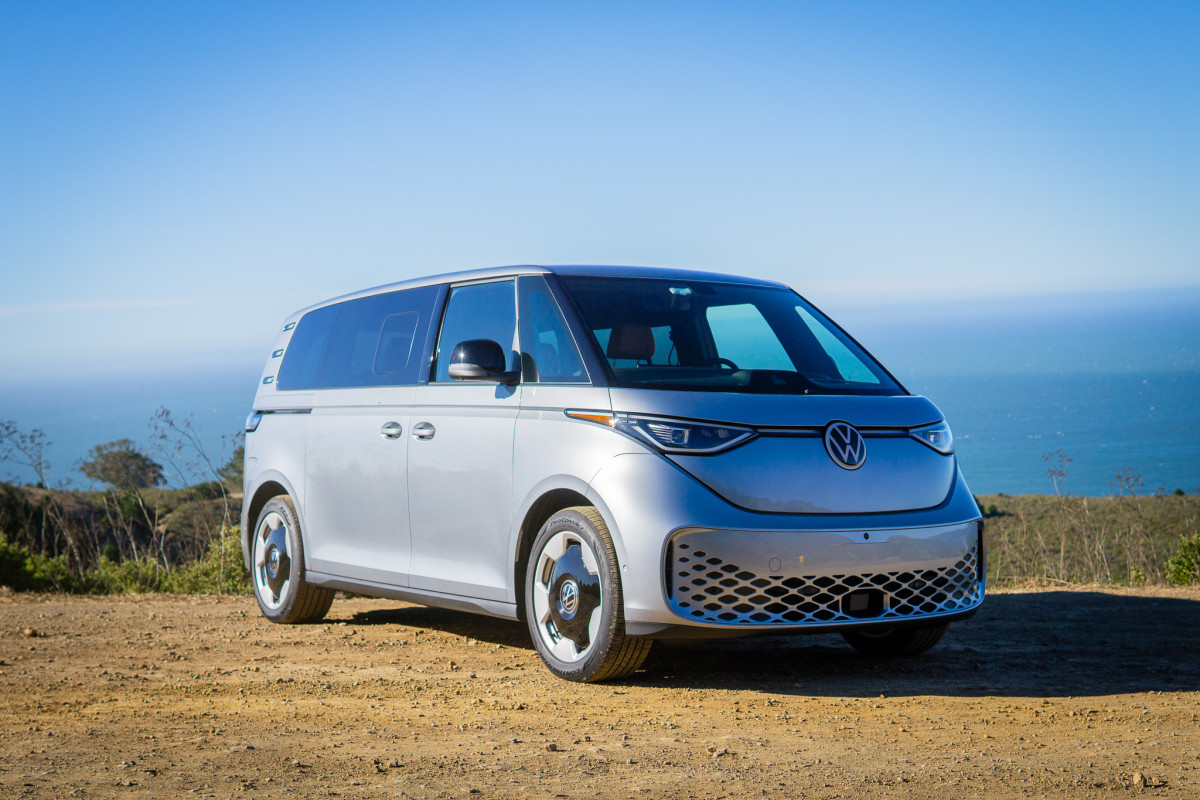
Title this section simply “Look,” and the ID.Buzz would deserve a perfect score. "Distinctive" doesn’t do this retro Volkswagen justice. With a tall profile, massive VW badges, and a stunning array of colors to choose from (as well as two-tone paint options), the ID.Buzz is a delight to behold.
At its launch, Volkswagen will sell the Buzz in three trim levels. The base model, the Pro S, will feature 20-inch wheels, power-folding mirrors, and seating for seven passengers courtesy of a middle-row bench seat. Step up to the Pro S Plus, and you’ll get a choice of either a standard middle-row bench or middle-row captain’s chairs (a $695 option available only on RWD models). The Pro S Plus also features easy open and close sliding rear doors and tailgate, a retractable tow hitch, and a Flexboard storage solution for the trunk, which provides a flat load floor even with the folded rear seats. Shoppers can also equip the ID.Buzz Pro S Plus with an electrochromic panoramic glass roof ($1,495)
Available only in the ID.Buzz’s first model year, the 1st Edition trim builds on the Pros S Plus, adding unique wheels, roof rail cross bars, and exterior 1st Edition badging. The electrochromic roof is also included as standard equipment in the 1st Edition.
The “Feel” portion of this section falls a bit flat on the inside, where the ID.Buzz is a case of “look but don’t touch.” Three interior design palettes are offered (Copper, Dune, and Moonlight), but each makes heavy use of hard plastic materials; outside the steering wheel, seating surfaces, and a small armrest on the doors, virtually every touchpoint for front passengers is made of plastic. It’s not all dull grays or blacks, but it’s plastic all the same.
Performance
While the European-spec ID.Buzz sits on a shorter wheelbase and employs a lower-powered electric motor, the North American ID.Buzz rides a long wheelbase, comes equipped with a 91-kWh battery pack, and can be ordered with a more boisterous single-motor rear-wheel-drive (RWD) powertrain or a dual-motor all-wheel-drive (AWD) system. With RWD, power output measures 282 horsepower and 413 pound-feet of torque. Add the second motor, and the AWD models get a 53-hp boost (bringing the total number up to 335 hp) and an extra 99 lb-ft of torque from the front motor. RWD models manage an EPA-estimated range of 234 miles, while AWD models pay a slight penalty, offering only 231 miles of range. Those figures equate to roughly 2.6 miles per kWH, but we never saw better than 2 miles per kWh. It’s a great looking van, but the ID.Buzz seems to pay quite a steep efficiency penalty for its retro styling.
Many electric vehicles demonstrate very light steering feel and pedal feel, exacerbated by the instant-torque acceleration that’s become a hallmark for EVs. Despite being a larger car, the ID.Buzz demonstrates these same characteristics. We noticed almost no resistance behind the accelerator or brake pedal, and the steering wheel has an incredibly light feel, particularly at turn-in. We did note a sizable dead spot in the steering feel past turn-in, with resistance building again only once we had the wheel turned at least 15 degrees. Most shoppers looking to purchase a minivan won’t be dissuaded by a lack of razor sharp performance, but this dead spot quirk is notable enough that it makes a test drive a near-necessity when considering the ID.Buzz.
The Buzz is a big vehicle. At 127.5 inches, the wheelbase outstretches any minivan on the market. The front and rear overhangs are also very short, and the driver has a commandingly high seating position. Put it all together, and drivers may feel that the ID.Buzz is almost a cab-over design like the original VW microbuses. However, unlike those earlier iterations, this one should perform better in crash tests.
The tall seating position and short hood are great for forward visibility, but we found that the lack of reference points ahead of the windshield made it tricky to gauge the exterior bounds of the vehicle while driving, particularly with regards to the passenger’s side. When driving on city streets, we routinely found ourselves drifting to the left lane in an ultimately unnecessary attempt to avoid side-swiping cars parked on the right-hand side of the road. Further, although long wheelbases generally lead to smoother rides, we were surprised by how much the VW ID.Buzz jostled over uneven pavement.
We tested the ID.Buzz on packed city streets, wide-open freeway, curving mountain roads, and flowing rural highways. Without a doubt, this VW is most at home on the latter. Although it has a tall, upright design and a big greenhouse, we were impressed by the relative quiet and great wind-noise dampening. It’s plenty quick–Volkswagen says AWD models will hit 60 mph in roughly six seconds–but between the finicky steering and disconnected pedal feel, we wouldn’t pick an ID.Buzz for spirited driving.
Form & function
Volkswagen claims that the 2025 ID.Buzz delivers 146 cubic feet of total cargo space. We can believe it, but only if you’re packing the bus from floor to ceiling all the way back from behind the front seats to the rear glass. 146 cubic feet is an astonishing number; it’s ever-so-slightly more than a Chevrolet Suburban. After our (admittedly unofficial) eye test, it’s a bit hard to believe.
Questions about max cargo space aside, the ID.Buzz is undoubtedly a packaging marvel. Even third-row passengers have gobs of leg- and headroom. The interior is full of cubbies and storage solutions, from a movable (and removable) Buzz Box center console to the available Flexboard trunk organizer. VW didn’t provide us with a weight limit for the Flexboard but said that it could support a mattress and two adults, so sleeping in the back of your van is a legitimate option, regardless of whether you live down by the river.
The ID.Buzz is comfortable, too. The tall seating position provides great visibility and the seats themselves are soft and supportive (a tricky combination to pull off). Both front seats receive 12-way power adjustment and massage, and they’re heated and ventilated, too. The outboard second-row seats are also heated, and the ID.Buzz comes standard with eight 45-watt USB-C ports, a 12-volt trunk outlet, and a 150-watt 110V passenger-seat outlet. Add in standard tri-zone climate control, and everyone on the bus should be happy.
Finally, Volkswagen also includes a manually retractable tow hitch on the Pro S Plus and 1st Edition trim levels. RWD models offer a maximum towing capacity of 2,600 pounds with a braked trailer, while AWD models can pull up to 3,500 pounds. Unlike most trailer hitches, this one easily retracts down below the rear bumper, meaning you can preserve the ID.Buzz’s stylish design when the trailer isn’t needed.
Technology
In addition to the eight USB-C ports, our ID.Buzz Pro S Plus test vehicle was also equipped with a wireless charger, and our phone connected seamlessly to the infotainment system via wireless Android Auto (wireless Apple CarPlay is also included).
Most of the car’s infotainment tech is managed via a 12.9-inch center touchscreen display. A small, 5.3-inch driver information display (which Volkswagen calls ID.Cockpit) shows speed, battery status and driving range, and other key data like the adaptive cruise control readout and seat-occupancy information. The Pros S Plus and 1st Edition also come standard with a head-up display (HUD).
All of the displays are bright and beautiful, but the main infotainment screen can be frustrating to use. We appreciate the tile layout of the home screen, but far too many controls are managed either via the touchscreen icons or–worse–poorly placed touch-sensitive buttons. The volume and climate controls are the worst offenders; they’re placed on a ledge below the display and are far too easy to touch inadvertently while trying to navigate through other features within the screen.
Volkswagen Car-Net is loaded with new features, including Amazon Alexa integration and–if you pay for the Volkswagen Car-Net Plus Speech with AI subscription–ChatGPT functionality for its voice assistant.
We commend Volkswagen for including so much tech on the ID.Buzz’s list of standard equipment, and the addition of extra-cost features like a ChatGPT-supported voice assistant help keep it on the cutting edge. However, much of the interface still needs refining.
Safety
In addition to the HUD, the Pro S Plus and 1st Edition also come standard with a helpful 360-degree camera system, which Volkswagen calls Area View. Given the ID.Buzz’s dimensions, having this bird’s-eye-view can be helpful in tight parking lots.
Regardless of trim, every Volkswagen ID.Buzz comes with five years of Safe & Secure EV, a Car-Net connected service that provides emergency assistance, crash notifications, and information assistance. Other standard safety features include automatic emergency braking with pedestrian and cyclist detection, adaptive cruise control with stop-and-go capability, rear traffic alert, and lane-keeping assist.
Being a brand new vehicle, neither the National Highway Traffic Safety Administration (NHTSA) nor the Insurance Institute for Highway Safety (IIHS) had evaluated the ID.Buzz in crash tests at the time of this review.
Cost-effectiveness
Expect to see the 2025 Volkswagen ID.Buzz on sale in November, 2024. Pricing starts at $61,545 for the Pro S trim, including a $1,550 destination fee. The Pro S Plus trim starts at $65,045 for a RWD model; AWD brings the cost up to $69,545. The 1st Edition trim with RWD opens at $67,045 with AWD costing $71,545, again with all prices including the destination charge. Built in Hanover, Germany, these vehicles won’t qualify for a United States federal EV tax credit unless the benefit is rolled into a lease.
In short, this is not an inexpensive vehicle. Compared with top-spec minivans, the all-electric ID.Buzz predictably costs more. However, the ID.Buzz’s starting price is also more than $5,000 more than that of the three-row Kia EV9 SUV, which delivers similar range (but admittedly less interior space and less power). While some shoppers may clamor for a stripped-down version of the ID.Buzz with a sub-$60,000 price tag, it’s likely more economical for Volkswagen to offer their newest model with more features, a higher price, and a bigger profit margin.
Further, while we expect that Volkswagen will enjoy strong demand for the ID.Buzz in the early months, it’s clearly positioning the minivan as a halo vehicle designed to draw attention back to the brand and bring shoppers into showrooms, even if those shoppers end up driving home an Atlas or a Tiguan instead of an ID.Buzz. The halo car strategy isn’t novel, many automakers do it. But while we normally see high-performance or uber-luxury vehicles playing this role, Volkswagen’s decided to lean back into its rich heritage to win back consumer attention. Hey, it worked for them twenty years ago when they relaunched the Beetle, perhaps it will work again with the Buzz.

What owners say
Trims & specs
Base MSRP $65,495 | Seating 7 |
Engine 282 hp Electric | Cargo Capacity 18.6 cu ft |
Combined MPG 83 | Drivetrain RWD |
Base MSRP $63,495 | Seating 7 |
Engine 282 hp Electric | Cargo Capacity 18.6 cu ft |
Combined MPG 83 | Drivetrain RWD |
Base MSRP $69,995 | Seating 6 |
Engine 335 hp Electric | Cargo Capacity 18.6 cu ft |
Combined MPG 81 | Drivetrain AWD |
Base MSRP $67,995 | Seating 6 |
Engine 335 hp Electric | Cargo Capacity 18.6 cu ft |
Combined MPG 81 | Drivetrain AWD |
Base MSRP $59,995 | Seating 7 |
Engine 282 hp Electric | Cargo Capacity 18.6 cu ft |
Combined MPG 83 | Drivetrain RWD |


Pricing trends
MSRP range
$59,995 - $69,995
Current avg. market price
$62,330
Trending up by 3.9% this month
May 2026 - October 2026