2026 BMW X3 Reviews, Pricing & Specs


Pros & cons
What we like
Fun to drive
Comfortable
Good value for money
What to consider
Potentially polarizing design
Interior materials feel cheap
Quirky technology
The CarGurus verdict
Want a sports sedan but need an SUV? Check out the 2026 BMW X3.
BMW offers the 2026 X3 in two flavors: 30 xDrive and M50. The latter is tuned for performance, but the base X3 30 xDrive is so good that you might be happy trading the M50’s outright speed and sheer capability for significant savings. BMW redesigned this compact luxury crossover in 2025, and the only tweaks for 2026 make the base model look and feel a little more upscale inside.
Verdict: For this review, we evaluated the BMW X3 M50. It was terrific, but with a sticker price more than $15,000 higher than the rewarding X3 30 xDrive, it’s hard to justify the extra money.
out of 10 expert review
Look & feel
You can buy a 2026 BMW X3 30 xDrive for as little as $52,650 (including the $1,350 destination charge), but you’ll want upgrades. Our preferred build of this model would cost nearly $62,500 and would look and feel worth every penny.
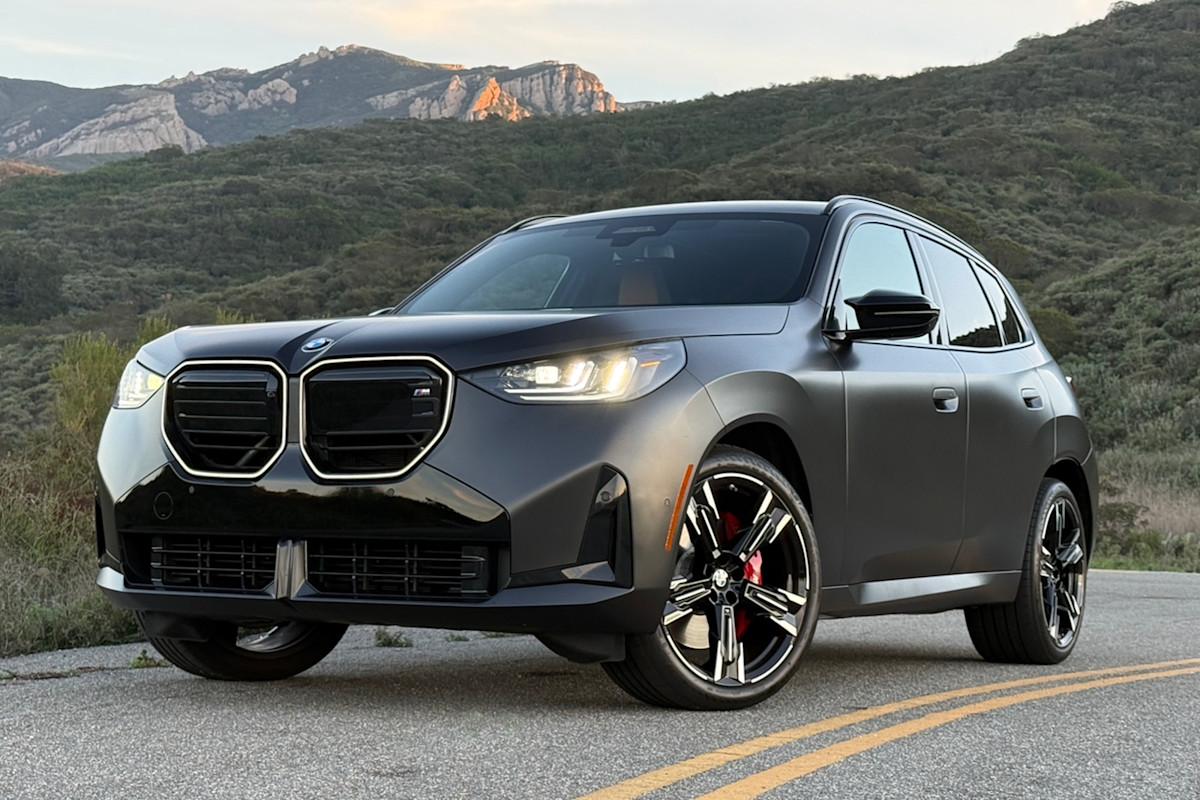
This review is about the X3 M50, priced from $67,850 with destination. Our test vehicle had numerous upgrades, including a mighty expensive Frozen Deep Grey paint job. That, plus the 21-inch wheels, Merino leather upholstery, ventilated front seats, and a trifecta of option packages, brought the manufacturer’s suggested retail price (MSRP) to $79,100, including destination.
Does that paint cook? You bet. But it also costs $3,600. And while the test model’s Amber over Atlas Gray leather looked, felt, and smelled expensive, the quality of the X3’s austere cabin cannot justify a price of nearly $80,000.
The X3’s cold, industrial design is also an acquired taste. BMW calls it “monolithic.” We like it well enough, except for the M50’s standard illuminated grille surround. At night, it gives “pick-me” vibes. Instead, BMW should let the M badges, the available 21-inch wheels, the optional red or blue brake calipers, and quad-outlet exhaust system do the talking.
The use of nighttime lighting is excellent inside, but during the day, the move to touch-sensing controls grouped together on panels, plus the cabin's general austerity, feel cheap—and apparently, we’re not the only ones who think so. BMW tried to improve matters for the 2026 model year by adding standard artificial leather to the dashboard and door panels and upgrading the X3 30 xDrive’s interior trim.

Performance
Choose the X3 M50, and you get a silky-sweet turbocharged 3.0-liter inline six-cylinder engine making 393 horsepower and 428 pound-feet of torque. Horsepower and torque are available almost continuously between 1,900 and 6,250 rpm, the engine and exhaust sound sensational, and the acceleration is exhilarating. BMW claims the M50 will zoom to 60 mph in 4.4 seconds.
The M50 also gets performance hardware including an M Sport rear differential, M Sport brakes, an Adaptive M suspension, variable sport steering, and an exclusive exhaust system that creates that sensational sound.
As enticing as all that sounds, the base X3 30 xDrive’s 255-horsepower, turbocharged 2.0-liter four-cylinder engine is remarkably sprightly. You can scoot to 60 mph in six seconds, and by selecting the optional M Sport Package, 21-inch wheels, M Sport brakes, and adaptive damping suspension, it's plenty of fun to drive in its own right. And, like the M50, it comes standard with all-wheel drive (AWD).
Still, the X3 M50’s turbo six is magical, and its outright speed is intoxicating. If you have the means and don’t mind the cheap interior or a firm ride, the M50 is the one to get if a speedy SUV is what you want. On the other hand, if the BMW X3 is already stretching your budget, the X3 30 xDrive is still a satisfying choice.
Commendably, the straight six’s 48-volt mild hybrid system (also standard with the 30 xDrive) ensures the automatic engine stop/start system is barely noticeable. Unexpectedly, this version of the X3 is reasonably fuel efficient as well. The official fuel economy rating is 27 mpg in combined driving, and we averaged 24.1 mpg on our mountainous Southern California test loop.
Despite the low-profile tires and stiff suspension, the X3 M50 didn’t beat us up as much as we expected, although it occasionally feels a little unnatural as it instantly attempts to quell unwanted body motions, depending on the road surface. The M Sport brakes are sometimes grabby, but overall the M50 is an agreeable commuter vessel.
The X3 has a remarkably tight turning radius, even equipped with optional 21-inch wheels. Add the responsive variable steering, outstanding surround-view camera system, and Parking Assistant Plus technologies (part of the Premium Package), and it’s easy to squeeze the X3 into places and spaces you might not otherwise attempt.
Towing isn’t off the table, either, as the M50’s 4,850-pound capacity is higher than that of some midsize SUVs. Even the base 30 xDrive can handle a substantial 4,000 pounds of trailer.

Form & function
Every X3 features heated, power-adjustable front sport seats wrapped in Veganza, which is BMW’s vegan artificial leather upholstery. Perforated surfaces assist with comfort and breathability, and ventilated front seats are a reasonably priced standalone option. Extended Merino leather is available, but in our experience, the Veganza will fool most people most of the time.
The front seats are all-day comfortable and do an excellent job of holding you in place when ripping along a favorite back road. However, rear passengers might not be as satisfied with their accommodation, because the seat cushion is too low and the front seatback storage nets have hard plastic frames that can be a literal pain in the shin. Road trippers will want the Travel and Comfort system (standard on the M50), which provides mounting points for smartphones or tablets and USB charging ports to power them.
Everyone is bathed in natural light beneath a panoramic glass sunroof (standard on the M50). Storage is surprisingly generous, but BMW left surface liners off the menu, so items placed in the compartments make quite a racket while driving.
Open the power liftgate, and you’ll find a generous cargo space measuring 31.5 cubic feet. It’s bisected by a robust retractable cargo cover, mounted high enough so that you can slide three or four full-size suitcases in on their sides. A temporary spare tire lives under the cargo floor, which is an increasing rarity in a modern vehicle. Fold the 40/20/40-split rear seat to expand the cargo area to 67.1 cubic feet.

Technology
The BMW Curved Display dominates the X3’s dashboard. It features a 12.3-inch digital driver display and a 14.9-inch touchscreen infotainment system. The Premium Package adds a head-up display, a 15-speaker Harman Kardon surround-sound system, and several driving assistance systems.
The infotainment system runs BMW Operating System 9 with QuickSelect. It offers cloud-based navigation, Augmented View video with directions superimposed on the display, access to a BMW app store, in-vehicle gaming and video streaming capability, and more. But as impressive as it seems on paper, we had some real-world issues.
The system allows owners to customize several driver profiles using BMW ID technology. Log in using an email address and password or a QR code shown on the display, sync your preferred vehicle settings with a key fob or smartphone digital key, and the X3 will feel custom-tailored each time you get in. That probably works a treat for owners with their own profiles, but if you’re using Guest mode, as we did, it is a gigantic hassle. Guest mode doesn’t remember settings, and unless you log in, you can’t change existing profiles.
BMW Intelligent Assistant voice recognition is also included, but it did not seem to be active in our test vehicle. Enter Apple CarPlay, which worked great all week except for a super-weird instance. We fired up the X3 and Apple CarPlay loaded on the touchscreen, but the music played through our smartphone speaker instead of the impressive Harman Kardon stereo. We’ve never experienced that before.

Safety
Our test vehicle had all of the driver assistance systems available with the 2026 BMW X3. That included expected standard features such as forward collision warning, automatic emergency braking, lane departure warning, lane keeping assist, and an active blind-spot monitor that can add steering to help prevent unsafe lane changes. The optional Driving Assistance Professional Package added lane-centering assist, lane-change assist, evasive steering assist, and adaptive cruise control with hands-free traffic jam assist.
By delving deep into the BMW OS 9 menus, we discovered other features including drive-off monitoring (which reduces power and applies the brakes if obstacles are detected when setting off), side collision protection, rear emergency braking, traffic light and traffic sign recognition, speed limit warning, Route Control automatic speed adjustment, safe exit warning, and an emergency stop system. That latter feature can bring the X3 to a safe stop if the driver becomes unresponsive while using the adaptive cruise with lane-centering or the traffic jam assist system.
BMW thoughtfully allows you to customize most of these features, with sensitivity settings and the ability to turn individual features on or off as you prefer. Before departing on the evaluation drive, we configured the settings to medium sensitivity when available, and turned off the features we knew would cause irritation.
The tech proved refined, smooth, and accurate, with a few glaring hiccups. The worst happened on the Pacific Coast Highway, where the X3 mistook two cyclists in the bike lane as obstacles when rounding a curve. In response to this hallucination, the X3 unexpectedly braked hard, surprising us and absolutely infuriating the driver of a vintage Corvette following close behind. We swear, that wasn’t a brake check.
Later, in dense traffic on Highway 101, we received a notification that Assisted Driving Plus was ready to use. That’s the hands-free traffic jam assist technology, and when this prompt appears on the driver display and head-up display, you simply let go of the steering wheel. Green lights illuminate on the wheel spokes, and you can allow the BMW to drive itself under your supervision. The system works under 40 mph, and as we learned on this outing, it does not move over for lane-splitting motorcyclists, resulting in extra-loud Harley revving to ensure you know they’re unhappy with you.
The X3’s crash-test ratings from the National Highway Traffic Safety Administration (NHTSA) are imperfect—a mix of four- and five-star ratings that result in an overall four-star rating. The Insurance Institute for Highway Safety (IIHS) is more bullish about the SUV’s ability to protect you in a crash, and gave the 2026 X3 its highest Top Safety Pick+ rating for the 2025 calendar year.

Cost-effectiveness
You could get a well-equipped and far more luxurious BMW X5 xDrive40i for about the same price as our heavily-optioned X3 M50 test car. But if the point is to feed a need for speed, our M50 undercuts an X5 M60i by about $14,000. If you don’t need the X5’s extra space, the X3 is definitely cost-effective.
But what about the X3’s rivals—the Audi Q5 and the Mercedes-Benz GLC-Class? When comparing base models with AWD, the BMW costs the least, gets the best gas mileage, and includes complimentary scheduled maintenance for three years or 36,000 miles. All three of these compact luxury SUVs include a four-year/50,000-mile warranty.
The X3 M50 also costs less than an equally sporty Mercedes-AMG GLC 43, but the Audi SQ5 has the lowest base price of the three. The BMW remains far more efficient than its two performance-tuned competitors, and has that free maintenance plan.
It’s important to mention the Mercedes GLC 350e 4Matic, too. It’s a plug-in hybrid offering an estimated 54 miles of electric-only range before switching to gas-electric operation. It costs about $60,000, and is just a little slower to 60 mph than the X3 30 xDrive. Depending on how you use your vehicle, it could save money over the long run, even if it has a higher purchase price.
The 2026 BMW X3 is a cost-effective choice compared to its primary rivals and to the larger BMW X5. With some technological sorting and more attention to interior details, it could be even more compelling than it already is.

What owners say
Trims & specs
Base MSRP $66,500 | Seating 5 |
Engine 3.0L 393 hp I6 | Cargo Capacity 31.5 cu ft |
Combined MPG 27 | Drivetrain AWD |
Base MSRP $51,300 | Seating 5 |
Engine 2.0L 255 hp I4 | Cargo Capacity 31.5 cu ft |
Combined MPG 30 | Drivetrain AWD |


Pricing trends
MSRP range
$51,300 - $66,500
Current avg. market price
$51,690
Trending down by 0.2% this month
May 2026 - November 2026


