2026 Ford Ranger Reviews, Pricing & Specs


Pros & cons
What we like
Comfortable seats
Easy-to-use technology
Multiple powertrain options
What to consider
Cramped back seat
Advanced safety features are not standard
Uninspired styling
The CarGurus verdict
The 2026 Ford Ranger has great standard features but goes from basic to bougie fast.
While the 2026 Ford Ranger is mostly a carryover model, there are some new options and a new gray paint. The biggest news, though, is that the FX4 Off-Road Package is now available on even the base XL trim, adding features such as an electronic-locking rear differential, extra skid plates, off-road tuned shocks, and low-speed off-road cruise control. This makes off-road equipment more accessible but takes the manufacturer's suggested retail price over $40,000.
Verdict: The Ford Ranger is a solid midsize truck, but unless buyers go all the way up to the Raptor trim, there isn’t anything that really helps it stand out from the crowd. And while we love the standard wireless Apple CarPlay and Android Auto on a large vertical screen, we wish there were more advanced standard safety tech. The XL trim is great for a basic no-frills work truck, but shoppers need the XLT for a larger engine, heated seats, and more safety features.
out of 10 expert review
Look & feel
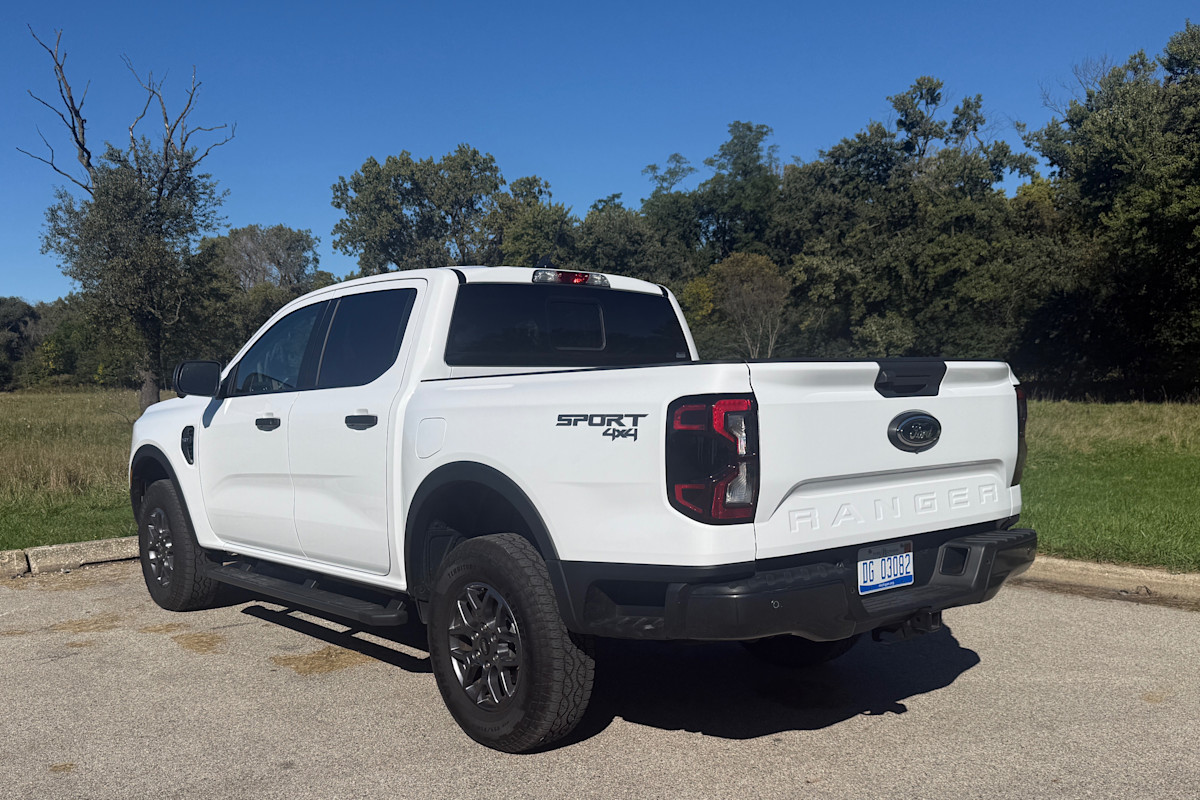
The Ford Ranger is the Plain Jane of the midsize truck segment. It’s not unattractive, but in the XL, XLT, and Lariat trims, there’s nothing exceptional about it, either. It’s only available with a crew cab and 5-foot bed, and all the cool colors cost an additional $395. It has basic pickup truck styling, and the no-cost white paint on our test truck didn’t do it any favors. Depending on the trim, there are a few low-cost appearance packages that add some visual interest, and the FX4 Off-Road Package adds functional off-road features as well as some design extras.
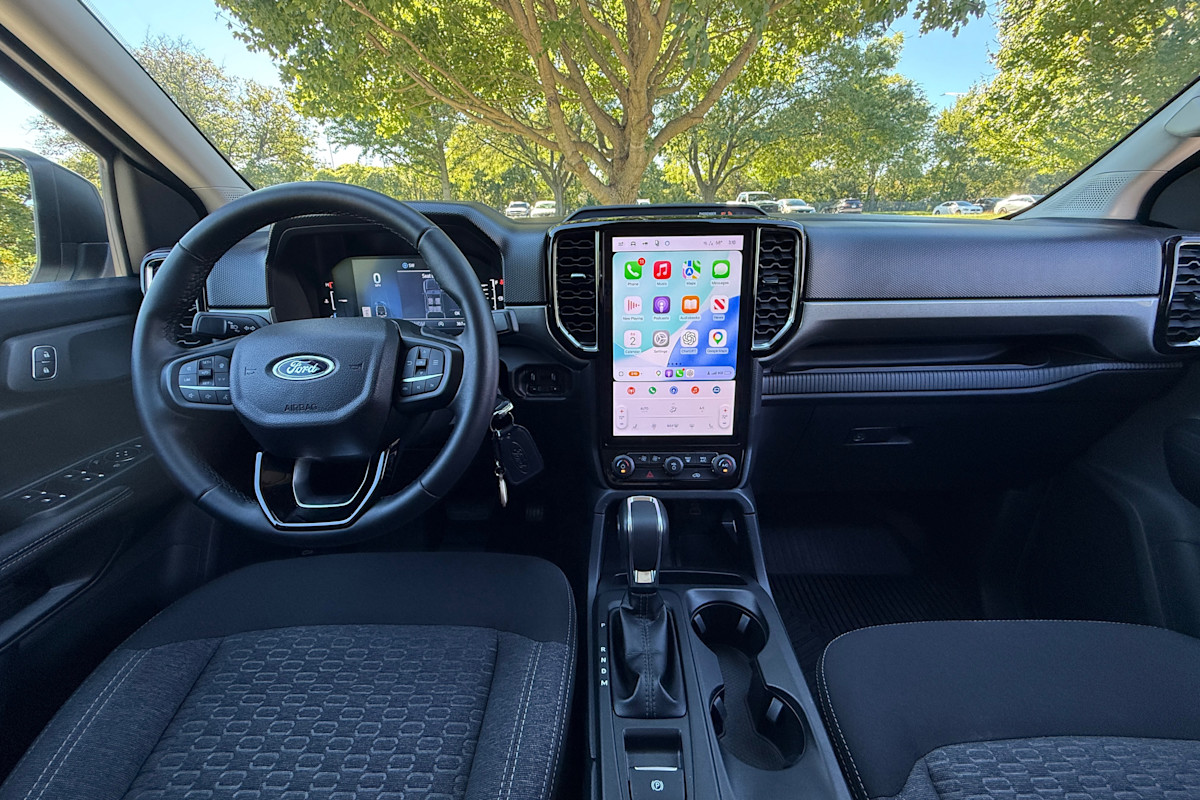
The interior is also fairly humdrum with a lot of hard plastic on the dash and surrounding the gearshift. Perhaps the most interesting element is the large vertical screen, which can be a polarizing design. Standard seating surfaces on the XL are black cloth, and the XLT offers both black and khaki cloth seat options. It isn’t until the Lariat trim that light and dark synthetic leather seating surfaces are available.
The Ranger Raptor, however, is a different story. In addition to extra off-road capability, it has a different grille, chunkier fender flares, beefier tires, better interior materials, and bright orange interior accents, all of which add up to a more aggressive and attractive truck. It also costs a pretty penny, at $13,000 more than the top Lariat trim.
Performance
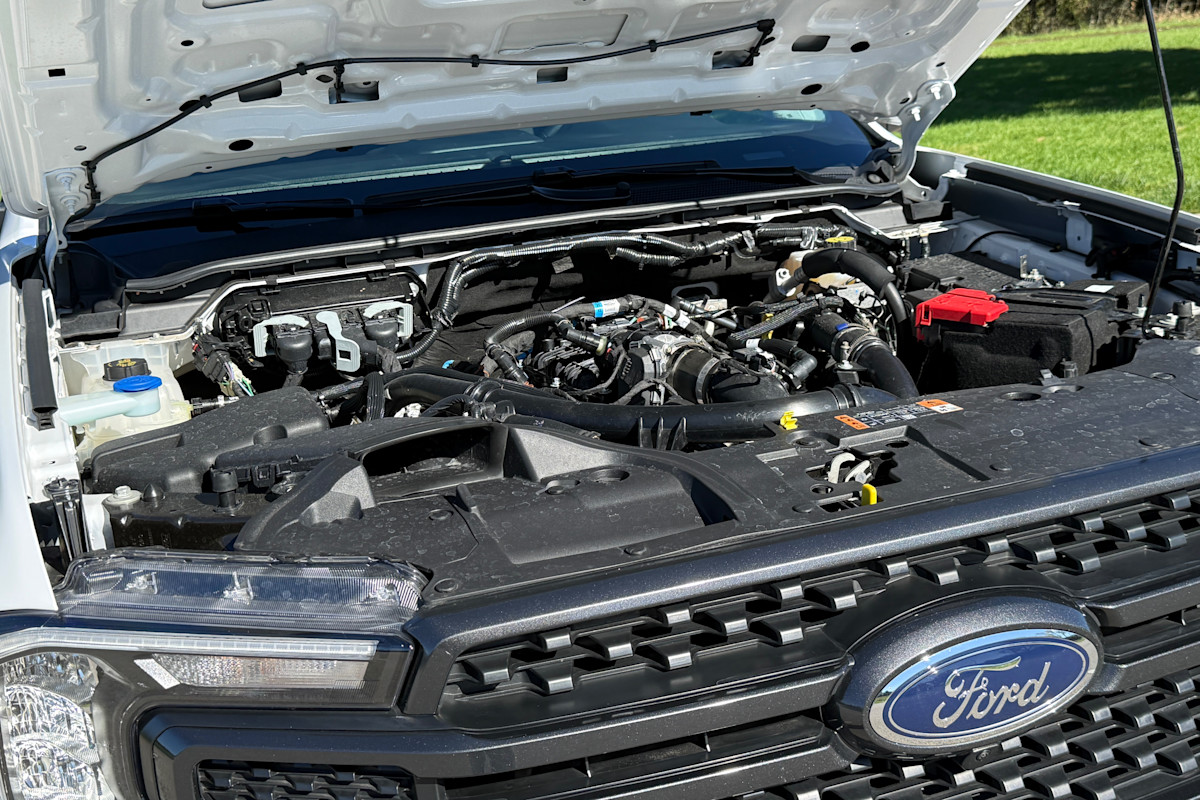
The powertrains are the Ranger's strong suit. The non-Raptor trims have two really good engine options: a 270-horsepower 2.3-liter turbocharged four-cylinder and a 315-hp 2.7-liter twin-turbo V6. The former is available on all three trims, with the latter only available on XLT and Lariat four-wheel drive (4WD) models. Both are paired with a 10-speed automatic transmission, and rear-wheel drive (RWD) is standard on XL, XLT, and Lariat models.
The test vehicle was equipped with the V6, and while we liked this engine in the Ford Bronco we tested previously, we loved it in the Ranger. Because the Ranger weighs just a bit less than the Bronco, the V6 felt faster and smoother off the mark. This powertrain provided quick and seamless accelerations for highway merges but also had the right amount of pep for passing maneuvers at highway speeds.
The Ranger has a maximum towing capacity of 7,500 pounds with both the 2.3-liter and 2.7-liter engines. This isn’t best-in-class but is just 200 pounds shy of GM's midsize trucks, which are the class leaders. As an off-road-ready truck, the Raptor has a significantly lower towing capacity of 5,510 pounds. Buyers get the best payload numbers from the base engine with RWD at 1,767 pounds, and the figures drop from there, with the Raptor bottoming out at 1,373 pounds.
Without the Raptor's large fender flares and knobby tires, the XLT test vehicle felt fairly light and nimble. While we did a little highway driving, this truck spent most of the test week trekking through Chicago's narrow streets and alleys and handled tight spaces like a champ. It has an excellent turning radius for parallel parking maneuvers and traversing urban parking lots, and the low-end torque on the V6 was perfect for the slow drive up the 22-degree-angle parking ramp to our parking space.
The top-tier Ranger Raptor gets a 405-horsepower 3.0-liter twin-turbo V6. Though we didn’t have access to the Ranger Raptor in this test period, we have driven it off-road in previous tests, and it is a ton of fun. High-speed desert running in Baja mode is a hoot. Plus, we had the opportunity to do a belly-flipping jump in this truck that left us laughing with glee. On-road, the trade-off is tire noise and less comfortable ride and handling.
Form & function
The Ford Ranger does not offer the option of a front bench seat, so it's a five-passenger truck only. While once a common feature, this can’t be found in any other midsize pickup currently sold in the U.S., and buyers who want a front bench/seating for six have to upgrade to the full-size F-150.
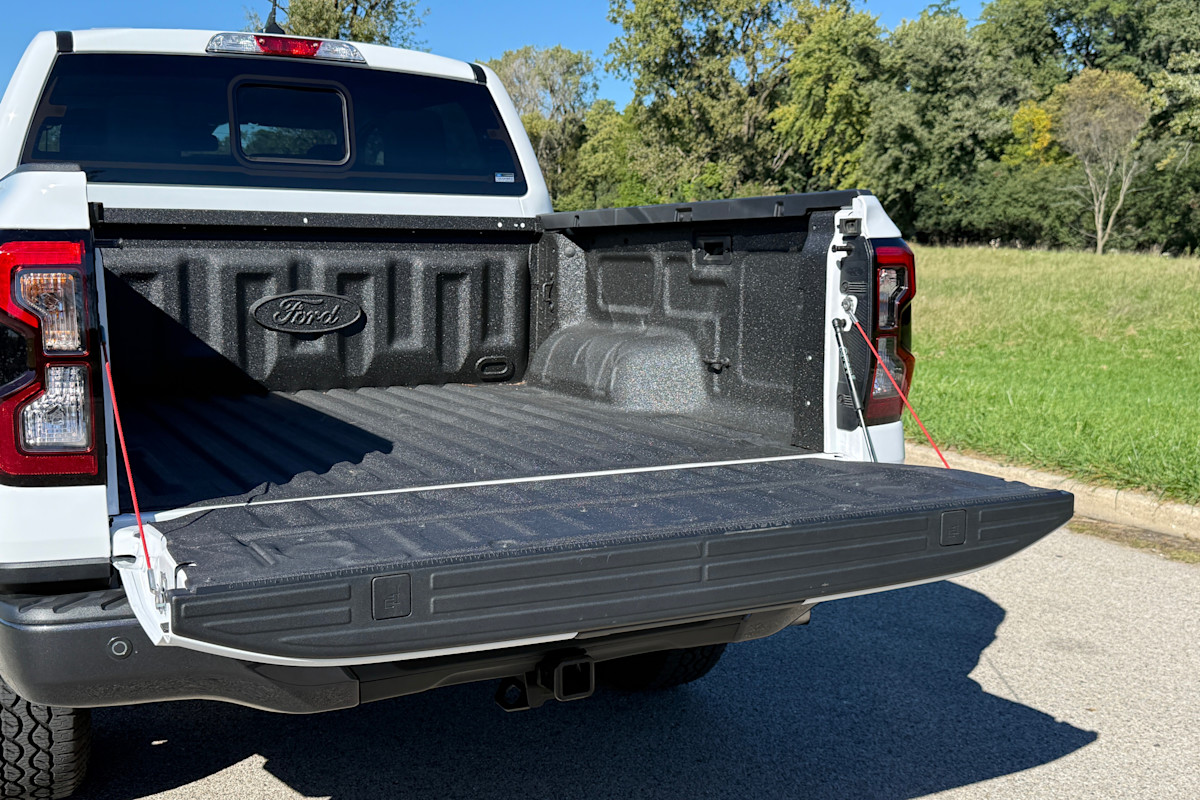
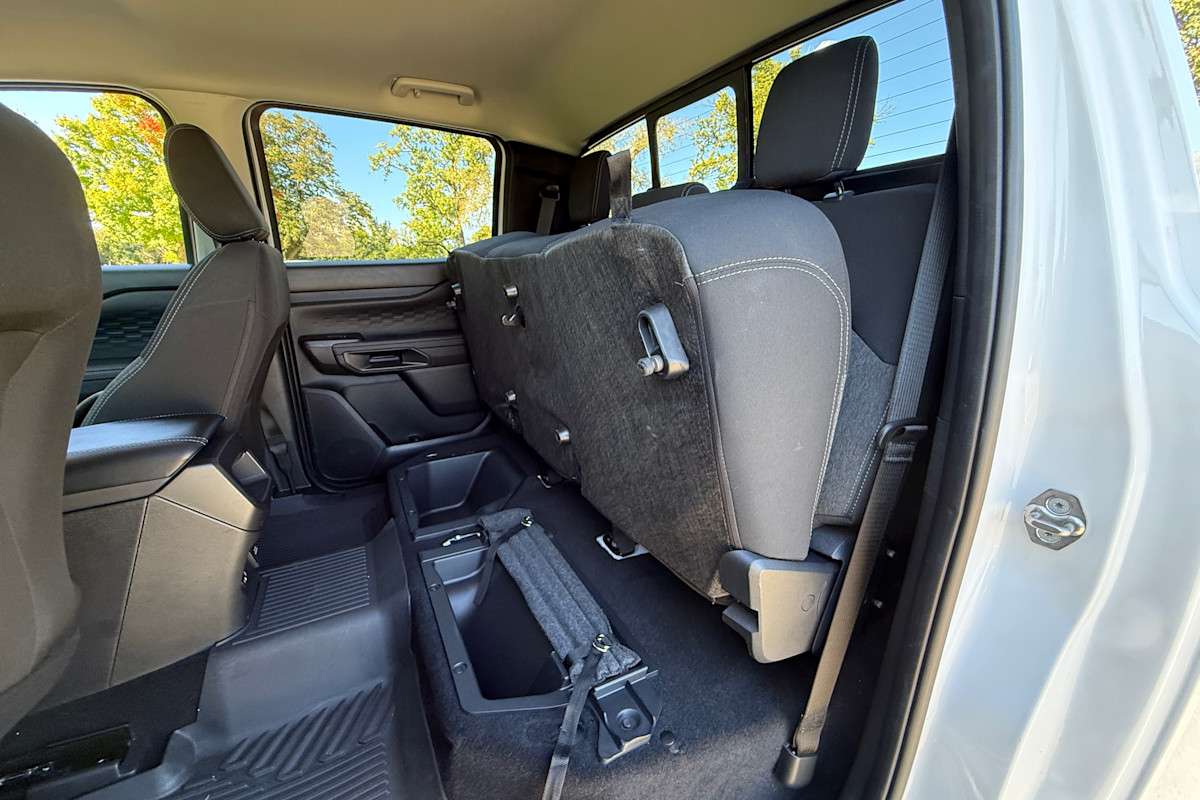
While the dash materials are a swath of plastic, there is a helpful ledge in front of the passenger on which to set the likes of a phone, keys, or a wallet. We also like the flip-up rear seats that can hide some small items underneath and the rear seat backs fold down, creating a flat surface to hold boxes or other large, bulky items. As for the bed, there are six standard tie-down points and a tailgate work surface with an integrated ruler and clamp pockets. However, the Ranger doesn’t offer a long-bed option like the Nissan Frontier or the Toyota Tacoma.
There are several available practical features on the Ranger, but buyers typically have to level up to the XLT to get them, and even then, they cost extra. For anyone who intends to use the bed regularly, we recommend the standalone side step integrated into the bumper and the Convenience Package (on both XLT and Lariat trims) that includes both LED bed lighting and the 400-watt Pro Power Onboard in-bed outlet for tools and camping accessories. The Pro Power Onboard is also offered as a standalone option on the base XL trim.
Technology
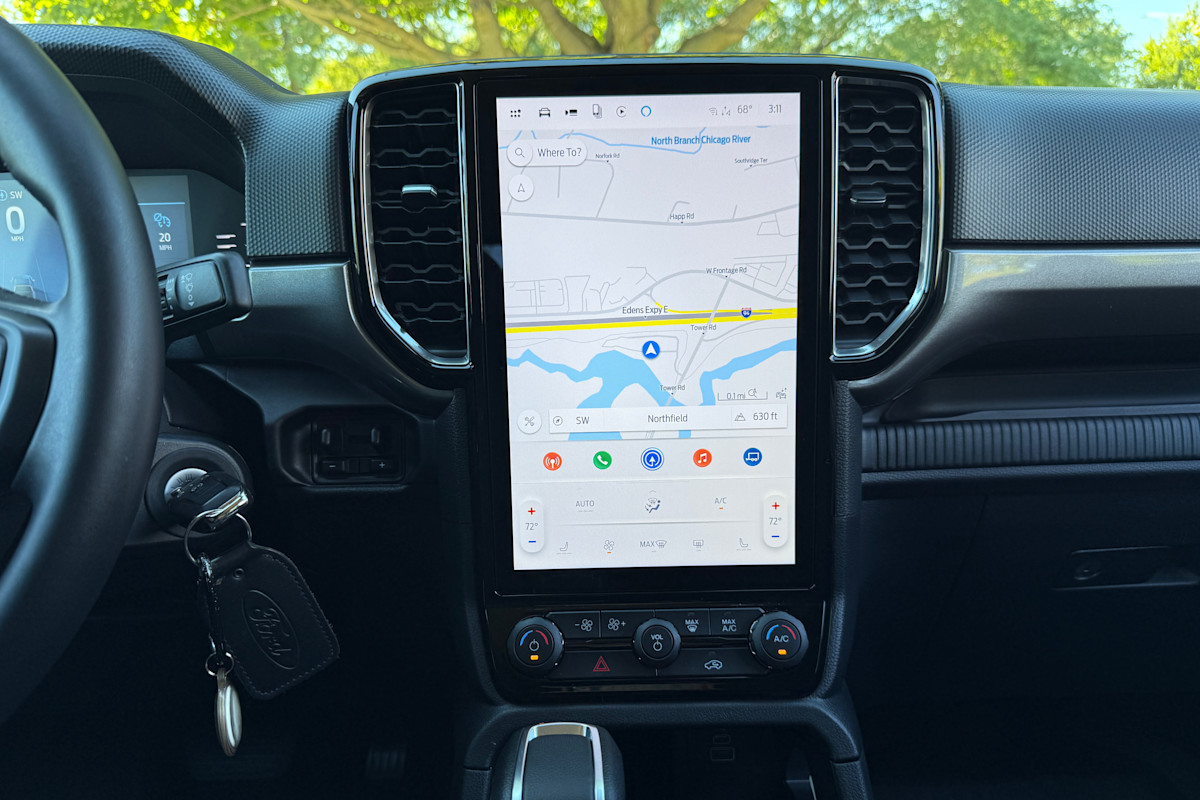
For a truck that can be fairly basic, the Ford Ranger has good standard and available technology. Even the base XL trim has an 8-inch digital gauge cluster, a 10-inch vertical infotainment touchscreen, USB-A and USB-C ports, and wireless Apple CarPlay and Android Auto. Available features include a 12-inch digital cluster, 12-inch touchscreen, a wireless phone charger, navigation, dual-zone automatic climate control, ambient lighting, 400-watt Pro Power Onboard, LED bed lighting, rain sensing wipers, and a Bang & Olufsen sound system.
Overall, the tech works really well. The test truck had the XLT High Package that includes the 12-inch touchscreen, power sliding rear window, and dual-zone automatic climate control. The larger screen fills out the space on the dash better than the smaller one, and even though there is a climate control panel on the screen, we like the redundant controls for high-touch features such as temperature and fan speed.
The test truck also had the Advanced Towing Plus Technology Package. The towing part of that package includes a trailer brake controller, Pro Trailer Backup Assist, a four-pin/seven-pin wiring harness, and Class IV trailer hitch receiver. The tech part includes adaptive cruise control and a super helpful surround-view camera system for tight city spaces. We didn’t tow during the test week, but we previously tested Pro Trailer Backup Assist, and it is a phenomenal system, especially for those who don’t tow very often.
Safety
One of the Ranger's big drawbacks is the lack of standard advanced safety equipment. The base XL comes standard only with a rearview camera, front airbags, side curtain airbags, a tire pressure monitoring system, and a seat belt reminder—most of which are legally required anyway. Features such as blind-spot monitors, rear cross-traffic alert, lane-keep assist, adaptive cruise control, rear parking sensors, high-beam assist, a rearview camera mirror, and a surround-view camera system are all optional.
Thankfully, we didn’t need to try out most of the safety features, but we definitely appreciated the parking sensors and surround-view camera system when traversing our garage space and small urban parking lots. The adaptive cruise control was also a huge help in stop-and-go traffic, and we liked that it not only took the Ranger all the way to a stop but also had a natural feel to it.
The 2026 Ranger doesn’t get top marks in crash tests. The National Highway Traffic Safety Administration gave it a four-star (out of a possible five) overall safety rating. The Insurance Institute for Highway Safety (IIHS) gave the Ford a mix of Good, Acceptable, and Marginal crashworthiness scores. No midsize pickup earns an IIHS Top Safety Pick or Top Safety Pick+ award, but other trucks in this segment have better scores than the Ranger in individual tests.
Cost-effectiveness
The Ranger is not for buyers who want the best price, the best tech, and the best standard safety features. The base price of the Ranger XL is $35,445 before options, which puts it at the high end of the spectrum, with the base Chevrolet Colorado, Toyota Tacoma, and Nissan Frontier costing less by about $1,000 to start with. The GMC Canyon is about $5,000 more, but it’s positioned as a premium offering.
At the time of writing, the Colorado had a base price of $34,495 and included large screens, a more powerful base engine, and more standard safety tech than the Ranger. For buyers looking for more configurability and even more standard safety tech, the Toyota Tacoma is their best bet.
We’d recommend upgrading to the XLT trim, which adds fog lamps, rear parking sensors, navigation, and remote start as well as a lot of optional features that just aren't available on the XL trim. We’d add the XLT High Package for the 12-inch screen, heated front seats, and dual-zone automatic climate controls. And we’d throw in the Technology Package for the front parking sensors, surround-view camera system, adaptive cruise control, and Ford’s Co-Pilot 360 safety suite. Oh, and any color other than the free black, white, or gray exterior paint. With $2,745 in options, that would bring the price to $40,715.
4WD adds another $3,500 to the bottom line, and those who plan on towing might also want the Advanced Towing Package for $865. That makes for a well-equipped pickup that can do truck things with ease, but not a great value.
What owners say
Trims & specs
Base MSRP $37,050 | Seating 5 |
Engine 2.3L 270 hp I4 | Cargo Capacity N/A |
Combined MPG 21 | Drivetrain 4X4 |
Base MSRP $33,550 | Seating 5 |
Engine 2.3L 270 hp I4 | Cargo Capacity N/A |
Combined MPG 23 | Drivetrain 4X2 |
Base MSRP $57,270 | Seating 5 |
Engine 3.0L 405 hp V6 | Cargo Capacity N/A |
Combined MPG 17 | Drivetrain 4X4 |
Base MSRP $36,075 | Seating 5 |
Engine 2.3L 270 hp I4 | Cargo Capacity N/A |
Combined MPG 23 | Drivetrain 4X2 |
Base MSRP $39,575 | Seating 5 |
Engine 2.3L 270 hp I4 | Cargo Capacity N/A |
Combined MPG 21 | Drivetrain 4X4 |
Base MSRP $43,955 | Seating 5 |
Engine 2.3L 270 hp I4 | Cargo Capacity N/A |
Combined MPG 23 | Drivetrain 4X2 |
Base MSRP $47,455 | Seating 5 |
Engine 2.3L 270 hp I4 | Cargo Capacity N/A |
Combined MPG 21 | Drivetrain 4X4 |


Pricing trends
MSRP range
$33,550 - $57,270
Current avg. market price
$44,240
Trending down by 1.7% this month
July 2026 - November 2026


