2026 Hyundai Santa Fe Reviews, Pricing & Specs


Pros & cons
What we like
Ample storage cubbies and compartments
Great safety ratings
Excellent value
What to consider
Polarizing design
Poor fuel economy
Cramped third row
Expert review
Form follows function with the 2026 Hyundai Santa Fe.
The Hyundai Santa Fe is a midsize, three-row SUV that sits at the smaller end of the segment, while the Hyundai Palisade lives among the larger players in the class. Nevertheless, thanks to its boxy shape and thoughtfully crafted interior, shoppers might decide bigger isn’t necessarily better. The 2026 Santa Fe gets a new transmission, added safety features, and minor equipment and packaging updates. The Santa Fe Hybrid returns, too, but we’ll cover that in a separate review.
Verdict: Polarizing design aside, the 2026 Hyundai Santa Fe is a brilliant, family-friendly crossover SUV. We tested the XRT version, which trades fuel economy for off-road capability, so buyers who don’t need that should pick a different trim level.
out of 10 expert review
Look & feel
Hyundai sells the 2026 Santa Fe in SE, SEL, XRT, Limited, and Calligraphy trim levels, with prices ranging from $36,650 to $49,400, including the $1,600 destination charge. Our test vehicle arrived in XRT trim, equipped with a set of optional carpeted floor mats that brought the manufacturer’s suggested retail price (MSRP) to $44,380 with destination.
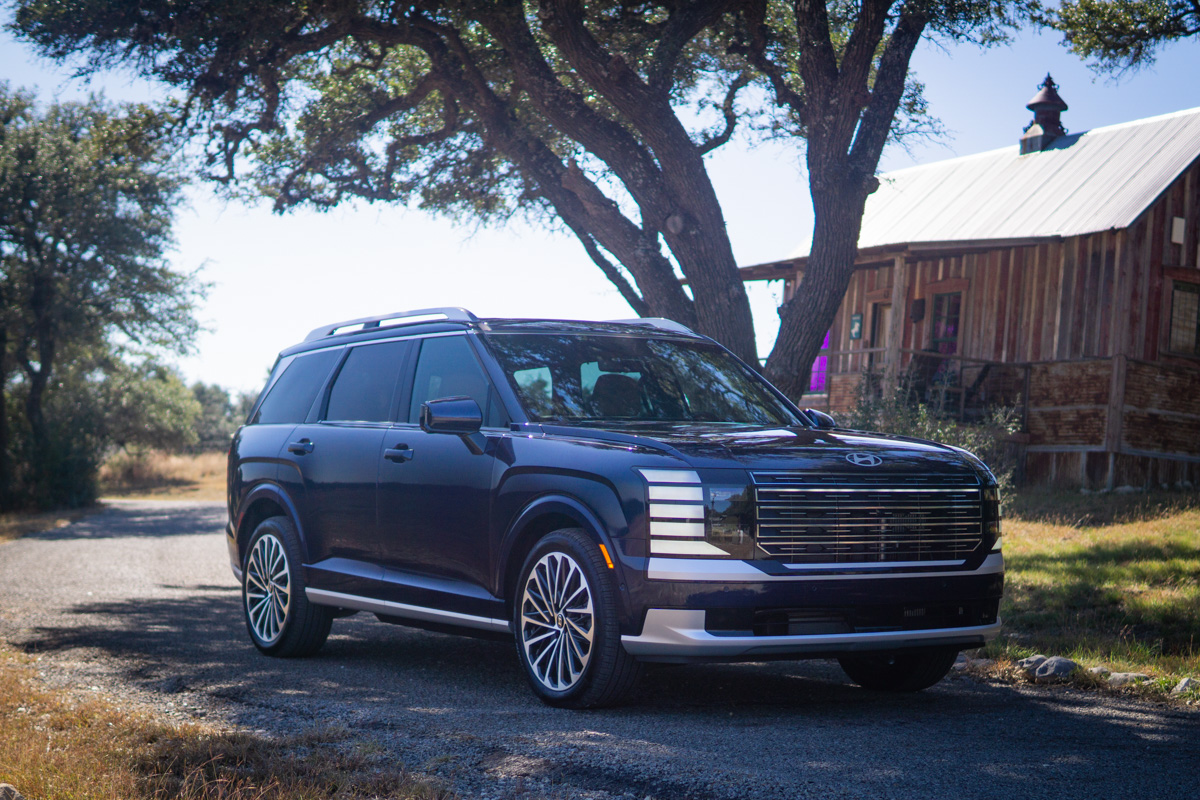
When Hyundai last redesigned the Santa Fe for the 2024 model year, it wanted to maximize practicality with a third-row seat. That required a boxy back end with an overlay of the automaker’s techno-funk styling language. The result, as with so many Hyundai designs, is polarizing. Buyers either love it or hate it, and we encountered plenty of people in the latter camp.
The Santa Fe XRT has a more rugged look and a trendy blacked-out appearance. We thought it looked great in white, but in darker colors, the lack of contrast between the wheels, trim, and dark-tinted windows is less appealing. This model’s all-terrain tires stick out just enough to reduce concerns over curbing the black wheels.
Its taller stance makes it seem like bigger than it actually is. The interior welcomes drivers with a high-tech display, quality materials, and more storage space than anyone probably needs. Better yet, Hyundai included easy-to-use knobs and buttons, although the gloss-black angled control panel containing them collects a ridiculous amount of dust.
Performance
A standard 2.5-liter turbocharged four-cylinder engine produces 277 horsepower at 5,800 rpm and 311 pound-feet of torque at 4,000 rpm. For 2026, Hyundai swapped out the previous eight-speed dual-clutch automatic transmission for a traditional eight-speed automatic with a torque converter, and the result is a smoother overall driving experience.
Front-wheel drive (FWD) is standard, with all-wheel-drive (AWD) optional on most trim levels and standard on the XRT. The off-road model also has the aforementioned all-terrain tires (mounted on 18-inch wheels), a raised suspension with 1.3 inches of extra ground clearance, and greater approach, breakover, and departure angles. Added driving modes help the XRT to churn through sand and mud, and a Terrain mode—also designed for off-roading—is new for 2026.
However, the Santa Fe XRT isn’t as aerodynamic as other trim levels, so the EPA fuel economy rating drops from 23 mpg combined for other AWD models to 21 mpg for the XRT. We observed 21.7 mpg on a relatively flat fuel-economy loop split 50:50 between city and highway driving. On our mountainous Southern California evaluation route, the XRT averaged 18.6 mpg. The Santa Fe Hybrid, in contrast, is rated at 34 mpg combined with AWD but costs $1,100 to $1,350 extra, and isn’t available in XRT trim. Still, the hybrid seems like a no-brainer to us.
While the XRT isn’t quite as capable off-road as a Jeep Grand Cherokee or a Subaru Outback, the lifted suspension, all-terrain tires, decent wheel articulation, and off-road drive modes help support adventuring off the beaten path. We subjected the XRT to a moderately rutted trail, and it performed confidently without scraping its underbelly on anything.
However, this version of the Santa Fe desperately needs a front-view and surround-view camera system for tighter trail work, as we discovered upon reaching an impassable section. To get those features, buyers have to trade up to the Palisade XRT. The off-road focus of the Santa Fe XRT was also detrimental to on-road handling. The tires’ thick sidewalls made for a good ride, though, and without the additional road noise that often comes with all-terrains.
Thanks to its clear sightlines and boxy dimensions, the Santa Fe is easy to park at the local shopping plaza. On the road, the engine provides effortless acceleration following a brief initial delay in response. The new automatic is smooth and unobtrusive compared to the previous dual-clutch gearbox, which is what most people prefer. The XRT boasts a 1,000-pound improvement in the Santa Fe’s towing capacity, to 4,500 pounds with trailer brakes.
Form & function
Practicality and utility rule within the 2026 Hyundai Santa Fe, making this SUV exceptionally easy to live with. However, the XRT we tested was missing some features available elsewhere in the lineup that we think would have made a big difference.
It’s odd that there is no panoramic sunroof with this trim level. After all, if drivers are exploring parts unknown, passengers likely want to look out of the windows, including through a nice, big sunroof. There are no ventilated front seats in the XRT, either, and if there’s a version of the Santa Fe likely to carry sweaty or otherwise damp people, this is it. And the interior comes only in black, making it a heat sink to start with.
Nevertheless, entry and exit for the front and second-row seats is effortless, and everyone is comfortable sitting up high with a good view out. Adults will struggle to access the third-row seat, but once they’re back there, it’s more accommodating than expected as long as the people in the middle row are willing to slide forward a bit. Still, it’s best reserved for occasional use only.
Thoughtful touches include the dual wireless charging pads, the manually height-adjustable front passenger’s seat, and the bi-directional access to the under-armrest storage area with a lower slide-out bin for second-row passengers. Every door panel armrest contains a slot perfect for holding a smartphone, the rear door panels include upper cupholders for the convenience of children riding in car seats, and there is a hidden storage well under the cargo load floor.
Speaking of cargo, every Santa Fe has a power hands-free liftgate that automatically opens when it detects the keyfob nearby. When the liftgate rises, it reveals a scant 14.6 cubic feet of cargo space behind the third-row seat. Fold it flat, and the Santa Fe’s cargo hold transforms into a handy 40.5 cubic-foot box for carrying all manner of luggage, gear, or retail purchases. That expands to 79.6 cubic feet with the second row folded.
Technology
Drivers face a dual-screen panel that stretches across a significant portion of the Santa Fe’s dashboard. To the left, SE, SEL, and XRT models have digital gauges with a 4.2-inch center panel allowing configuration of certain features. The Limited and Calligraphy trims have a larger and fancier 12.3-inch display, but we didn’t miss that in our XRT tester.
To the right, a 12.3-inch touchscreen infotainment system is canted towards the driver for easier access. It is graphically pleasing with simple layout and menu structures, but the driver-assistance settings are buried too deep, and should be more accessible.
Standard tech highlights include wireless Apple CarPlay and Android Auto, SiriusXM satellite radio with a free trial subscription, and Bluelink+ connected services. Optional features include a native navigation system, dynamic voice recognition (in our experience, this was very reliable), and Hyundai Pay technology. A Bose premium audio system is standard from the Limited trim upwards.
Bluelink+ is complimentary for original owners of the Santa Fe, for the lifetime of the vehicle. That’s a significant perk, because it provides safety-related features such as automatic collision notification, an SOS emergency assistance button, safe teen driver settings, and smartphone app notifications about children or pets inadvertently left inside the car. Additionally, conveniences such as remote engine starting, remote door lock/unlock, a car finder, and more are all a part of Bluelink+.
Safety
Hyundai equips the Santa Fe with a long list of standard safety features. The common ones are all here, plus some unusual upgrades such as a junction turning detection system that can automatically brake the SUV if drivers attempt a left turn at an intersection and an oncoming driver is running the light. Front and rear parking sensors are also standard, as well as a safe-exit assist system that warns occupants not to open a door and get out if traffic is approaching from behind.
On higher trim levels, including our XRT test car, the standard adaptive cruise control and lane-keep assist systems operate as Highway Driving Assist. It still requires drivers to keep their hands on the steering wheel, but in our experience, can operate for extended periods with only a light touch. A driver-attention monitor ensures those behind the wheel are paying attention while using Highway Driving Assist, and can also identify an unresponsive driver and bring the SUV to safe stop if necessary.
Another optional feature is navigation-based speed and curve control for the adaptive cruise control system, but we found that slowed down the Santa Fe too much—to the point where it became much slower than surrounding traffic. That was aggravating, and didn’t make us feel safe.
Safety ratings are impressive. The National Highway Traffic Safety Administration (NHTSA) gave the Santa Fe a five-star overall rating, five-star individual scores for frontal and side crashworthiness, and four stars for rollover resistance. The Insurance Institute for Highway Safety (IIHS) named the Santa Fe a 2026 Top Safety Pick+, its highest award.
Cost-effectiveness
The 2026 Santa Fe isn’t very fuel efficient when equipped with its standard turbocharged engine. That’s the biggest knock against it in terms of cost effectiveness, and shoppers can solve that by paying a little extra for the Santa Fe Hybrid. We’d also advise buyers to skip the XRT unless they really plan on going off-road, because it's the least-efficient version and arguably the worst value of the lineup.
Otherwise, from its outstanding warranty and roadside assistance coverage to its complimentary lifetime Bluelink+ connected services for original owners, the Santa Fe is compelling value. And even for the luxurious Calligraphy trim, the price rises only into the same neighborhood as the average paid for a new vehicle in the United States.
As we mentioned, the Santa Fe lives at the lower end of the midsize SUV class. Size-wise, its primary three-row rival is the Kia Sorento, which is slightly more affordable due to its less-powerful base engine and its less-generous access to connected services. However, Kia one-ups Hyundai by offering a plug-in hybrid in addition to gas, turbo-gas, and turbo-hybrid powertrains.
The significantly more affordable Mitsubishi Outlander might also be worth consideration. It's smaller and less powerful than the Santa Fe, but Mitsubishi still crams in a third-row seat. Also, the Outlander offers similar warranty coverage and, like the Kia, is available as a plug-in hybrid. However, the Mitsubishi dealer network is thin, the tech isn’t nearly as advanced, and the safety ratings aren’t as impressive.
Another midsize three-row alternative, yet again with less interior space, is the Mazda CX-90. While the Mazda’s base price is higher, there is plenty of overlap with the Santa Fe lineup, and the CX-90 looks like something other than the box it came in. But the warranty isn’t as good, the tech isn’t as sophisticated, and the hybrid is a plug-in with relatively mediocre electric range and fuel economy.
With the 2026 Santa Fe, Hyundai has carved out a strong value proposition. Better yet, this is a fundamentally impressive crossover SUV, easy to live with on a daily basis and loaded with thoughtful details. The polarizing looks do it no favors, but it doesn’t undermine those good points.

What owners say
Trims & specs
Base MSRP $37,590 | Seating 7 |
Engine 2.5L 277 hp I4 | Cargo Capacity 14.6 cu ft |
Combined MPG 24 | Drivetrain FWD |
Base MSRP $44,600 | Seating 7 |
Engine 2.5L 277 hp I4 | Cargo Capacity 14.6 cu ft |
Combined MPG 24 | Drivetrain FWD |
Base MSRP $39,390 | Seating 7 |
Engine 2.5L 277 hp I4 | Cargo Capacity 14.6 cu ft |
Combined MPG 24 | Drivetrain AWD |
Base MSRP $49,400 | Seating 6 |
Engine 2.5L 277 hp I4 | Cargo Capacity 14.6 cu ft |
Combined MPG 24 | Drivetrain AWD |
Base MSRP $46,400 | Seating 7 |
Engine 2.5L 277 hp I4 | Cargo Capacity 14.6 cu ft |
Combined MPG 24 | Drivetrain AWD |
Base MSRP $42,040 | Seating 7 |
Engine 2.5L 277 hp I4 | Cargo Capacity 14.6 cu ft |
Combined MPG 22 | Drivetrain AWD |
Base MSRP $36,850 | Seating 7 |
Engine 2.5L 277 hp I4 | Cargo Capacity 14.6 cu ft |
Combined MPG 24 | Drivetrain AWD |
Base MSRP $47,600 | Seating 6 |
Engine 2.5L 277 hp I4 | Cargo Capacity 14.6 cu ft |
Combined MPG 24 | Drivetrain FWD |
Base MSRP $35,050 | Seating 7 |
Engine 2.5L 277 hp I4 | Cargo Capacity 14.6 cu ft |
Combined MPG 24 | Drivetrain FWD |


Pricing trends
MSRP range
$35,050 - $49,400
Current avg. market price
$31,994
Trending down by 2.1% this month
May 2026 - October 2026