2026 Nissan Sentra Reviews, Pricing & Specs


Pros & cons
What we like
Impressive tech for the price
Comfortable zero-gravity seats
Great value for money
What to consider
Lackluster performance
Tight rear-seat legroom
The CarGurus verdict
The 2026 Nissan Sentra adds the content shoppers want.
If you’re hoping for a more powerful Sentra, the new 2026 model won’t bring you joy. However, if you have the need for speed, you’re likely not a typical Sentra buyer. Instead of focusing on what’s under the hood, Nissan has imbued the 2026 Sentra with tech and features that more and more shoppers are coming to value. Bright touchscreens, comfortable seats, and a stylish design make this the most appealing Sentra in recent memory.
Verdict: The 2026 Nissan Sentra is a stylish and safe compact sedan that delivers impressive technology at an attractive, affordable price. It’s not the most thrilling car in its segment (look to the Honda Civic or Mazda3 for that honor), but it nevertheless delivers premium, in-demand features.
out of 10 expert review
Look & feel
Now in its ninth generation, the 2026 Nissan Sentra wears significantly more dramatic sheetmetal than ever before. A massive grille sits low to the ground, appearing ready to hoover up the road ahead. Nissan still uses the “V-motion” name for this style, but it shares only a slight resemblance to the outgoing, eighth-generation design.
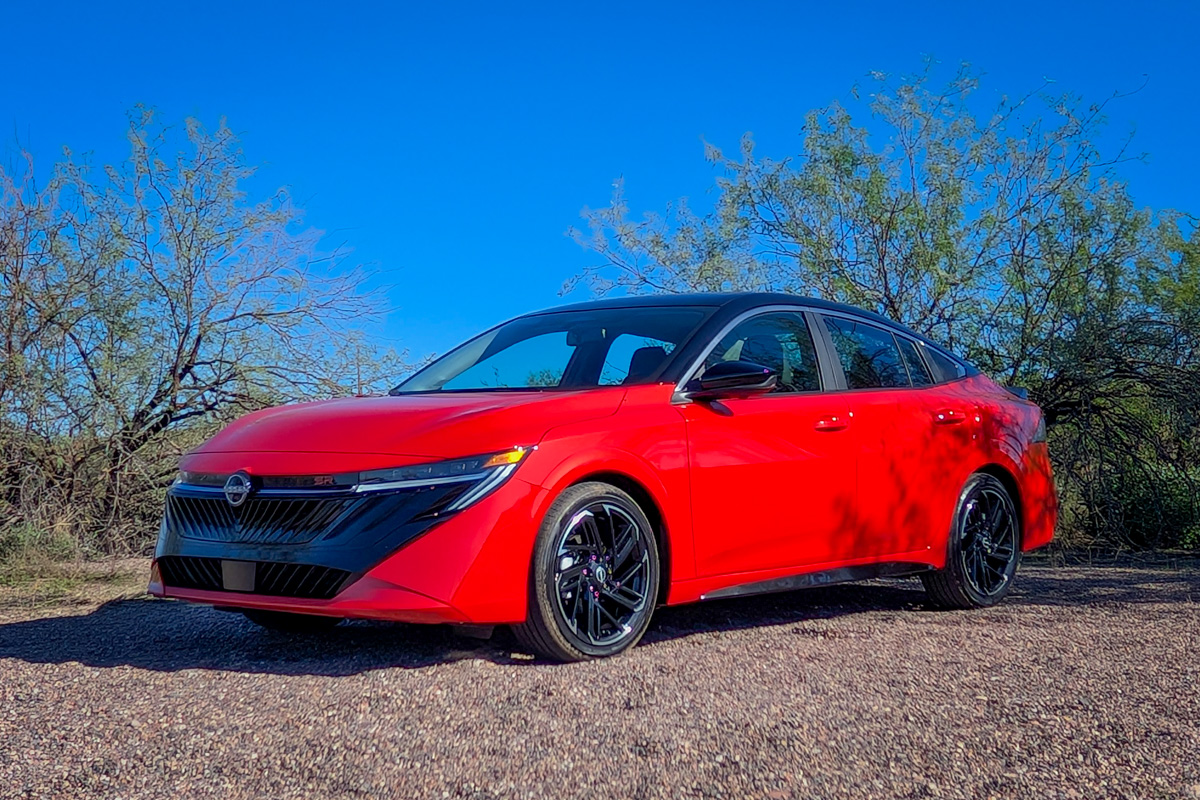
Slim, projector LED headlights peek out from the corners of the Sentra’s face, giving the front end a bit of a Cheshire-cat smile. When painted Energetic Ember like our test vehicle, it’s a downright aggressive look for a generally toothless commuter car.
Nissan sells the Sentra in four trim levels: S, SV, SR, and SL. Each of them is priced competitively (excluding dealer-installed accessories, you won’t break $30,000 in a fully loaded Sentra). The base S trim comes standard with the LED headlights and taillights, gloss black and chrome finishing on the grille, and gloss black wing mirrors, but it rides on small, 16-inch steel wheels fitted with plastic covers. The SV trim is better equipped with aluminum-alloy wheels, but they’re also only 16 inches–good for craggy pavement and cheap replacement rubber, but not the most dramatic styling.
The SR and SL are where the value lives. The SL’s 17-inch wheels look sharp, as do the more performance-oriented 18-inch wheels on the SR trim. Further, both the SR and SL wear a full-width LED taillight and boast heated wing mirrors. A power moonroof with manual sunshade is optional on the SR, standard on the SL.
Particularly when painted a more muted color like Imperial Bronze or Aspen White, the SL trim looks reserved and almost dull. Compare it to an SR in Bluestone Pearl or Energetic Ember–and especially with the contrasting Super Black roof–and the latter looks closer to a sports car than a boring commuter car. Our tester was also fitted with black machined finish alloy wheels (a $610 option) that glinted beautifully under bright sun.
Thanks to the $2,300 Premium Package, our SR trim came equipped with synthetic leather seats sporting contrast stitching, and a six-way power-adjustable driver’s seat with four-way lumbar support. The front passenger seat in every Sentra offers only four-way manual adjustment. Moving up to the SL trim swaps in quilted leatherette upholstery, but the S and SV both also use cloth; there is no option for genuine leather seats in the 2026 Sentra. Heated front seats are optional in the S, SV, and SR, and they’re standard in the SL. We had them as part of the $650 all-weather package but hardly needed to use them, given the weather when we tested the car in Phoenix, Arizona.
A fully digital driver information display comes standard on every 2026 Nissan Sentra, nestled ahead of the new two-spoke steering wheel. It measures 12.3 inches in the SV, SR, and SL trims but only 7 inches in the base S. The center touchscreen, on the other hand, measures 12.3 inches on all trim levels. In a car as small as the Sentra, our tester’s dual 12.3-inch displays dominated the dashboard and added some flash to a segment stalwart that hasn’t historically been a leader in technology.

Performance
The 2026 Nissan Sentra looks modern on the outside and, when equipped at the SR or SL trim level, feels modern on the inside. However, in terms of driving dynamics, it’s essentially unchanged from earlier years. That’s likely to disappoint some potential buyers, but Nissan is betting that more of the market will care about tech and visual appeal than fast acceleration and sharp handling.
A dual-overhead-cam 2.0-liter four-cylinder engine makes 149 horsepower and 146 pound-feet of torque. There are no turbos, just a naturally aspirated four-cylinder focused on smooth operation and cheap operating costs. With regards to fuel economy, Nissan estimates 29 mpg city, 38 highway, and 33 combined in the S and SV trims, 28/36/32 in the SR and SL trims. Those are reasonably good figures–particularly given that the Sentra is not a hybrid–but weirdly, they’re also a bit lower than the 2025 model, which delivered up to 34 mpg in combined driving (and 40 on the highway), as rated by the EPA. All Sentras are front-wheel drive; there is no all-wheel drive option.
Some of the fuel-economy differences between 2025 and 2026 may be attributed to refinements made to the continuously variable transmission (CVT). According to Nissan, the new transmission has been tweaked to provide smoother acceleration. However, we still found accelerating from a stop to be a loud, groaning affair. Even in the SR trim level, the Nissan Sentra is not a sporty car.
Get onboard with the Sentra’s low heart rate, and you’ll come to enjoy it as a smooth and impressively quiet commuter car (as long as you don’t stomp on the gas pedal). The steering feels well-weighted and impressively accurate, and the pedals are equally well managed. Nissan claims to have closed off some structural gaps in the Sentra’s metal, which likely helped on our nice and quiet drive.
A drive mode selector cycles between normal and Sport on the SV, SR, and SL, providing a barely noticeable improvement in throttle response. Ultimately, you should not buy the Sentra for its performance or driving dynamics. It just isn’t a very exciting car to drive. Instead, the Sentra impresses on tech, price, and–if you buy a higher-tier trim–interior appointments.

Form & function
2026 Nissan Sentras in SR and SL trim offer interiors that far exceed their price tags. The touchscreen and instrument cluster look beautiful, but the entire dashboard is a huge step forward for the new Sentra. Our SR tester had beautiful, 64-way ambient lighting. The SL trim can be equipped with handsome two-tone leatherette; blue on the seatbacks and dash, white on the cushions and doors.
The climate controls are a bit frustrating, being touch-sensitive icons on a piano black slat situated beneath the center air vents, but beyond that, everything in the Sentra feels well considered. Two tandem-style cupholders sit ahead of a large center console bin. The PRNDL-style shift-lever is refreshing in a world increasingly full of shift knobs or steering-column-mounted levers. Rear-seat legroom is a bit tight, falling behind most competitors but exactly in line with the Toyota Corolla. Headroom in the back is a similar story; the Sentra doesn’t match up well on paper with the rest of the compact sedan class, but a fully-grown adult will still fit easily and be comfortable for regular trips.
Nissan redesigned the Sentra’s trunk for 2026, providing a 50-millimeter wider opening and a lower load height than the Honda Civic, Hyundai Elantra, and Toyota Corolla. The latter detail is likely more important in everyday use than the former.
Finally, every Sentra receives Nissan’s zero-gravity seats. Supportive and soft, we’ve been a huge fan of these since they debuted over a decade ago. Nissan has been including them in a wide range of vehicles, and we’re glad to see the Sentra’s low price tag doesn’t preclude it from them.

Technology
Along with high-quality interior materials, great in-car tech is a surefire way to upgrade a vehicle into a class-above experience. Nissan clearly received that memo, because despite a sub-$30,000 price tag, the 2026 Sentra’s tech looks modern and performs beautifully.
We’ve dinged Nissan tech in the past for looking boring, despite offering pretty much everything we want on a day-to-day basis. The Sentra solves the boring issue. The new touchscreen is big and bright, with the menus organized in stylish rectangular icons. You can customize the layout, but there is always a dock of icons on the left-hand side for home, music, phone (or phone projection), and a tile button for apps. At the bottom, another set of static icons helps direct you toward alerts and settings, HVAC controls, and other status information.
A Nissan Intelligent Key is available. It allows you to set up your Sentra so it will automatically unlock as you approach and lock as you walk away. Further, Sentra SR includes a myQ Universal Garage Door Opener, which can be set up to operate three compatible garage door openers and includes a geofencing function.
Three USB-C ports come standard, one in the rear and two up front. As we’ve come to expect, Apple CarPlay and Android Auto are standard, but wireless phone projection is limited to only the SV grade and above–the S trim requires a wired connection. The SL and SR trim (with the Premium Package) also receive an eight-speaker Bose stereo. It’s undoubtedly better than the standard stereo, but it still didn’t leave us overly impressed. Finally, a wireless device charger is standard on the SR and SL, optional on the SV.
The compact sedan segment isn’t exactly a technology-rich part of the marketplace. With its tech glow-up, the 2026 Nissan Sentra aims to find buyers who value a high-tech experience in a low-cost vehicle.

Safety
At the time of this writing, neither the National Highway Traffic Safety Administration (NHTSA) nor the Insurance Institute for Highway Safety (IIHS) have crash-tested the 2026 Nissan Sentra. The vehicle comes with a wide array of standard features included under the Nissan Safety Shield 360 umbrella, but not all advanced driver assistance systems (ADAS) come standard.
Included on every Sentra, automatic emergency braking, lane-departure mitigation, and forward collision warning should help drivers avoid a collision. New for 2026, blind-spot intervention also helps protect drivers and passengers from accidentally merging into traffic. More convenience-focused, the Sentra also includes high-beam assist and traffic sign recognition. Most of this tech is expected, but we don’t usually see traffic sign recognition included on $23,000 sedans. It’s great to see it on this Nissan.
A surround-view monitor and Nissan ProPilot Assist are also available on the SR and standard on the SL trim levels. ProPilot Assist is a semi-autonomous driving aid that leverages the adaptive cruise control and lane-keeping tech to help drivers navigate highway and traffic driving.

Cost-effectiveness
The 2026 Nissan Sentra delivers exceptional value in the compact sedan segment. With a starting price of $23,645 (including a $1,245 destination fee) and a fully loaded model that won't break $30,000, the Sentra punches well above its weight class.
Every trim level comes impressively equipped. Even the base S model includes a 12.3-inch center touchscreen, smartphone integration, and an impressive list of driver assistance technologies. Finding features like traffic sign recognition on a $23,000 sedan is genuinely rare; most automakers reserve this technology for higher-priced models.
The sweet spot appears to be the SR and SL trims, priced at $26,245 and $29,235 respectively. These trims combine tech and interior comfort to push the Sentra into segment-leader territory. Even though the Sentra isn’t the most fun car to drive, and even though there is no hybrid option, it still makes a good case for itself as an economic commuter car. Good fuel economy keeps operating costs reasonable, and the naturally aspirated engine's simplicity should translate to lower maintenance costs over time.
For shoppers prioritizing technology and features over driving thrills, the Sentra offers an impressive amount of content at an accessible price. It's hard to find a more feature-rich compact sedan that stays comfortably under $30,000 fully loaded.

What owners say
Trims & specs
Base MSRP $27,990 | Seating 5 |
Engine 2.0L 149 hp I4 | Cargo Capacity 14.3 cu ft |
Combined MPG 32 | Drivetrain FWD |
Base MSRP $22,600 | Seating 5 |
Engine 2.0L 149 hp I4 | Cargo Capacity 14.3 cu ft |
Combined MPG 34 | Drivetrain FWD |
Base MSRP $25,000 | Seating 5 |
Engine 2.0L 149 hp I4 | Cargo Capacity 14.3 cu ft |
Combined MPG 32 | Drivetrain FWD |
Base MSRP $23,370 | Seating 5 |
Engine 2.0L 149 hp I4 | Cargo Capacity 14.3 cu ft |
Combined MPG 34 | Drivetrain FWD |
Base MSRP N/A | Seating N/A |
Engine N/A | Cargo Capacity N/A |
Combined MPG N/A | Drivetrain N/A |
Base MSRP N/A | Seating N/A |
Engine N/A | Cargo Capacity N/A |
Combined MPG N/A | Drivetrain N/A |


Pricing trends
MSRP range
$22,600 - $27,990
Current avg. market price
$22,699
Trending down by 0.9% this month
May 2026 - November 2026


