2026 Toyota Supra Reviews, Pricing & Specs


Pros & cons
What we like
Fun to drive
Great handling
Manual transmission available
What to consider
Polarizing design
Not much cargo space
Outdated technology
Expert review
Toyota's sports car experiment ends with a whimper.
This model year marks the end of the line for the BMW-sourced Toyota GR Supra. While it was an entertaining sports coupe to drive, it was held back by odd styling, old tech, and a price tag that scared off some shoppers. As a result, we think you'd be better served by some of its rivals, including some of the BMW coupes this Toyota shares components with.
Verdict: With plenty of sports car competition, the GR Supra hasn’t made enough of an impression to justify its continued presence in the market.
out of 10 expert review
Look & feel
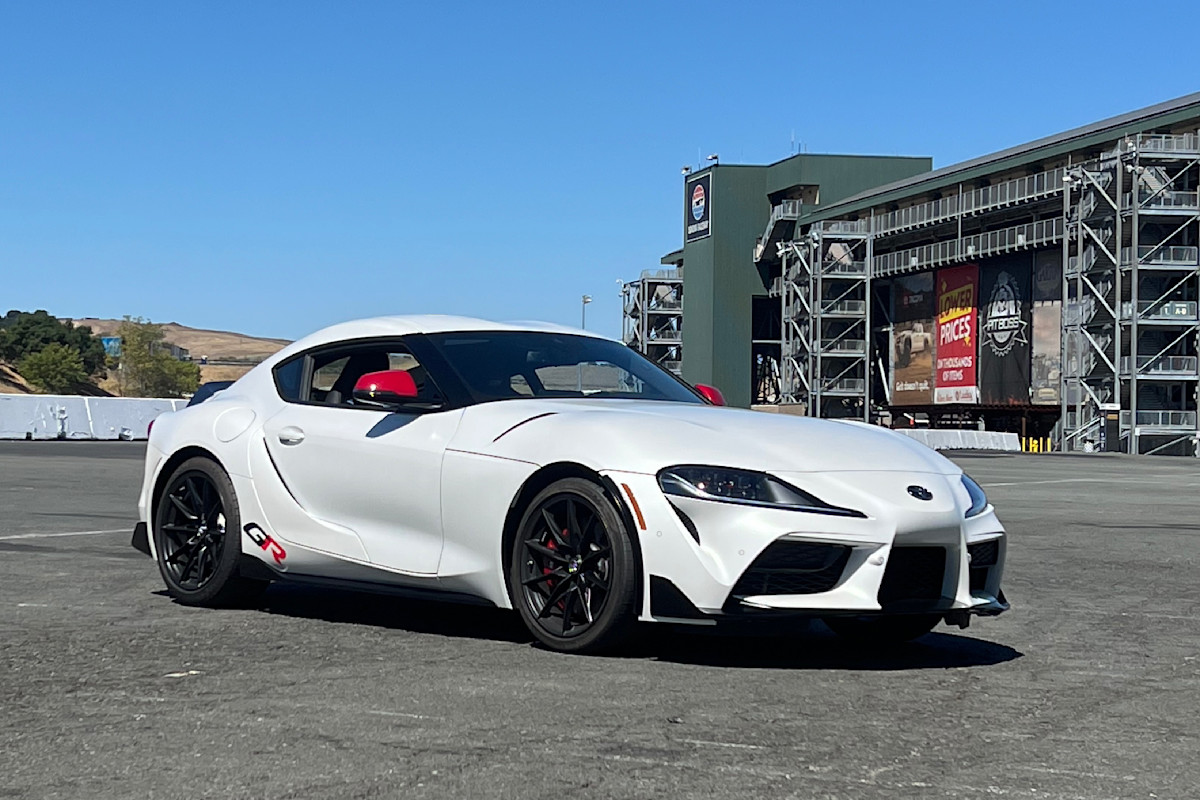
Stylistically, the GR Supra is a bit of a mess. The exterior is a mashup of conflicting themes that mask any connection to the BMW platform (shared with the Z4 convertible) that lurks underneath. The nose has oddly shaped air inlets that seem to float above a camouflaged lip spoiler, with a rounded nose that appears to mimic a Formula One race car—and none of these details are harmoniously integrated with the others. The hood holds an unusual amount of visual weight in its massive clamshell, with awkward bulges and fake vents that make it look even more portly.
Down the sides, a bloated body section surrounds the rear wheels, with a tacked-on section that meets up with the trailing edge of the doors. Together, they form a curving design motif that Toyota incorporated into almost all of its vehicles with similarly off-putting results. The rear view doesn't fare much better, with organic shapes that droop lazily over the taillights like the jowls of a bloodhound.
While style may be subjective, the Toyota GR Supra hasn't captured the hearts of the sports car-buying public. That's too bad since this coupe has potential in its basic form and proportions, as well as its racy double-bubble roof. To mark the end of production, the GR Supra MkV Final Edition adds a few subtle aerodynamic flaps at the corners that we're told will improve high-speed stability, along with glossy carbon fiber mirror caps. A GR (short for “Gazoo Racing,” Toyota’s performance division) graphic is also stuck to the rocker panel just ahead of the rear wheels, and around back, a carbon fiber extension is added to the ducktail rear spoiler. All Supra models wear Michelin Pilot Super Sport tires, with 19-inch matte black wheels on the Final Edition.
On the inside, the Supra's BMW roots are on full display. All of the buttons and their arrangement are essentially copied and pasted from the German automaker's parts bin—and that's not a bad thing. The cockpit has the kind of sturdiness that BMW is known for, and the controls harken back to a time before touchscreens. The quality of materials in the Supra interior is not up to BMW standards, though. The door panels aren't graced with well-grained leather-like plastics, but the leather upholstery is at least nicer than the typical Toyota SofTex synthetic substitute.
Performance
While it can be argued that the 2026 Toyota GR Supra is one of the more homely sports cars to look at, its driving experience tells a different story. It's powered by a 3.0-liter turbocharged inline-six-cylinder engine that produces 382 horsepower and 368 pound-feet of torque, with enthusiast-friendly rear-wheel drive (RWD). Buyers can choose between six-speed manual or eight-speed automatic transmissions that, by Toyota’s reckoning, provide zero to 60 mph acceleration of 4.2 seconds or 3.9 seconds, respectively.
In addition to the cosmetic embellishments, the Final Edition Supra also adds a new control system for the differential, larger Brembo brakes, and a sportier suspension tuning with recalibrated dampers and stronger rubber bushings, among other tweaks. These have little effect on overall performance, and considering how well the Supra drove to begin with, we'd be just as satisfied with the standard model.
We were given the opportunity to explore the GR Supra's full performance potential at Sonoma Raceway under controlled conditions, and we can attest that it gets the fundamentals right. The six-speed manual transmission is a joy to operate, with an intuitive clutch pedal and a precise shifter. Rev-matched downshifts allow the driver to slam the transmission into lower gears without the requisite finesse needed for traditional heel-toe pedal dances, and the gear ratios are well spaced to keep power on tap.
The engine noise isn't all that inspiring with the windows down, and even less so with a helmet on. Power delivery is very linear, though, making the Supra more approachable and easier to drive than some of the more high-strung sports coupes. The brakes are adept at getting things slowed down in a hurry, and even after repeated heavy use, the pedal never softened. The pedal also has the right amount of effort for track driving, allowing for precise adjustments when trailing them off as the nose of the vehicle edges towards apexes.
Handling is perhaps the GR Supra's greatest asset. It tracks faithfully along the path you lay out with the precise steering, and when pushed to the edge, or just past, the nose and tail are balanced to maintain control. The suspension is tuned to be predictable, and in some of the more challenging turns on track, you can provoke just a little bit of oversteer to get the rear end rotating around the central axis.
The Toyota GR Supra probably won't be the fastest car at a track day, but it will be one of the more engaging choices from the driver’s seat. There's a directness felt through the steering wheel and pedals, and while responses are sharp, they're not overly sensitive or jumpy. The Supra is also well-mannered on public roads, with enough compliance in the suspension to soak up any harshness or comfortably cruise for hundreds of miles on the highway. With all of this in mind, it begins to make more sense why Toyota partnered with BMW, as these are all descriptors for the sportier Bimmer models.
Form & function
Space is at a premium inside the GR Supra, and that should come as no surprise when you realize it's based on the BMW Z4. The small door aperture forces most drivers to duck and bend to get in or out, and once inside, it feels more like the cockpit surrounds you, keeping you snugly tucked into the sport seats. The manual shifter is placed perfectly within reach of the driver, while the shift paddles for the automatic are well-situated on the back of the steering wheel.
The use of last-generation BMW buttons and knobs allows for look-free adjustments of the audio or temperature, helping to reduce distraction while driving. As a small two-seat coupe, convenience takes a back seat to performance, though. There aren't many places to stow your personal items, as you're limited to some rather small door pockets and cupholders. A wireless charging pad does at least give you a solid spot for your phone, though the larger Max-sized models may not fit.
Not surprisingly, cargo space is also at a premium. The trunk can only hold up to 10.2 cubic feet. That should be enough for a couple of small roller bags, but not much else. It's possible longer items can fit between the seats, but you'd risk damaging the padded center console and the seats themselves.
Technology
Standard features include a digital instrument panel, an 8.8-inch infotainment touchscreen, a 10-speaker audio system, Bluetooth, and a wireless phone charger. Apple CarPlay and Android Auto are available as options on the base model, while all others come with a wireless version of both, along with a 12-speaker JBL sound system.
The infotainment runs one of the older BMW iDrive systems, which we prefer to some of the newer versions. It's not overcomplicated with the mass of features and apps of the latest BMWs, giving users simpler and more intuitive menus that are logically arranged. The touchscreen is on the small side, especially for its positioning atop the dashboard, and with the smaller on-screen buttons, it can be a little difficult and distracting to use while driving.
Thankfully, this older system still has the old BMW dial controller. It lets you navigate menu options by clicking the wheel one way or the other, then pushing down on it to activate. If you opt for the Safety and Technology package, the dial also has a touchpad on top, which allows for handwriting recognition.
Overall, the GR Supra is far from the technological powerhouse that some other vehicles aim to be. It's well behind the times compared to its contemporaries, but it gains an advantage for its simplicity and ease of use. For most sports car drivers, the tech features should suffice, but they'll always know that the competition has more features.
Safety
In the base GR Supra 3.0 trim, only a few advanced safety features are standard. These include: forward collision warning with pedestrian detection and automatic emergency braking, lane-keep assist, lane-departure warning, and automatic high beams. We suggest adding the optional Safety and Technology Package, which includes a blind-spot monitor with rear cross-traffic alert, parking sensors, reverse automatic braking and adaptive cruise control.
Most of these features are also available on higher trims as the Driver Assist Package, while a head-up display is included with the 3.0 Premium trim. It's worth noting that adaptive cruise control is not available with the manual transmission. Lane-keep assist also doesn't keep the vehicle centered in its lane. Instead, it's more like the older systems that prevent you from crossing over paint stripes, waddling back and forth between them. In our experiences with the Supra, false alarms or technical glitches were nonexistent.
Neither the National Highway Traffic Safety Administration (NHTSA) nor the Insurance Institute for Highway Safety (IIHS) have published crash test results for the GR Supra over its six-year production run.
Cost-effectiveness
The base 2026 Toyota GR Supra 3.0 has a manufacturer's suggested retail price (MSRP) of $58,695 (including $1,195 in destination fees). The 3.0 Premium model starts at $61,845 with destination, and the GR Supra MkV Final Edition increases that price to $69,745. All models have the same powertrain and performance specs, so there's no tangible advantage from one trim or another. Considering that it's also not poised for all-out track dominance, we'd suggest cashing in on driver engagement, and that means opting for the six-speed manual transmission.
The stickshift variant does come with a notable fuel economy hit, though. It's estimated by the EPA to return 19 mpg city, 27 mpg highway, and 21 mpg combined. By comparison, the automatic should return 23 mpg city, 31 mpg highway, and 26 mpg combined, according to the EPA. Over the course of a year, you could save as much as $600 in fuel costs by going with the automatic. But fuel efficiency is an afterthought to most sports car drivers.
There is no shortage of sport coupes (or coupe-like sedans) that we'd consider alongside the GR Supra, each with its own advantages and drawbacks. The BMW M240i Coupe has a similar drivetrain and comes with extras like adaptive suspension, as well as rear seats.
Price-wise, the Final Edition Supra is in line with the more serious BMW M2 or the Audi RS 3 sedan. The Porsche 718 Cayman is easily one of the best sports cars at any price, though it outpaces even the top GR Supra in price by several thousand dollars. For some American flavor, the mid-engined Chevrolet Corvette gets you plenty of high-performance bang for the buck, as does the Ford Mustang Dark Horse. The Nissan Z has been one of the Supra’s historical rivals, but the current version is more of an outdated rehash instead of a legitimate competitor.

What owners say
Trims & specs
Base MSRP $69,350 | Seating 2 |
Engine 3.0L 382 hp I6 | Cargo Capacity 10.2 cu ft |
Combined MPG 22 | Drivetrain RWD |
Base MSRP $58,300 | Seating 2 |
Engine 3.0L 382 hp I6 | Cargo Capacity 10.2 cu ft |
Combined MPG 22 | Drivetrain RWD |
Base MSRP $61,450 | Seating 2 |
Engine 3.0L 382 hp I6 | Cargo Capacity 10.2 cu ft |
Combined MPG 22 | Drivetrain RWD |


Pricing trends
MSRP range
$58,300 - $69,350
Current avg. market price
$68,873
Trending up by 0.8% this month
May 2026 - August 2026


