2026 Volkswagen Atlas Cross Sport Reviews, Pricing & Specs


Pros & cons
What we like
Well-crafted interior
Spacious back seat and deep cargo area
Well equipped for the money
What to consider
Underpowered
Firm ride
Annoying climate controls
Expert review
The Cross Sport is a premium-feeling midsize SUV at an ordinary price.
Unless buyers want a luxury model, the herd of midsize two-row crossovers is thinning as buyers gravitate to three-rows. Like the Mazda CX-70 and the Honda Passport, the Volkswagen Atlas Cross Sport is a two-row version of a more popular three-row crossover, but its lowered roof and unique tail make it feel like a distinctive, standalone model akin to the Nissan Murano or the Chevrolet Blazer. Last refreshed for the 2024 model year, the Atlas Cross Sport is essentially unchanged for 2026, ahead of the arrival of a redesigned model for 2027. For this review, we grabbed a lower-level front-wheel drive (FWD) SE with Technology model to experience the value equation of this Volkswagen at a palatable price.
Verdict: The Atlas Cross Sport is a great value and well made, even if it's not enjoyable to drive.
out of 10 expert review
Look & feel
With high-sided, slabby body panels, large wheels, oversized fenders, and a fascia that would be most at home on a pickup truck, the Atlas Cross Sport is as American as a German vehicle can be.
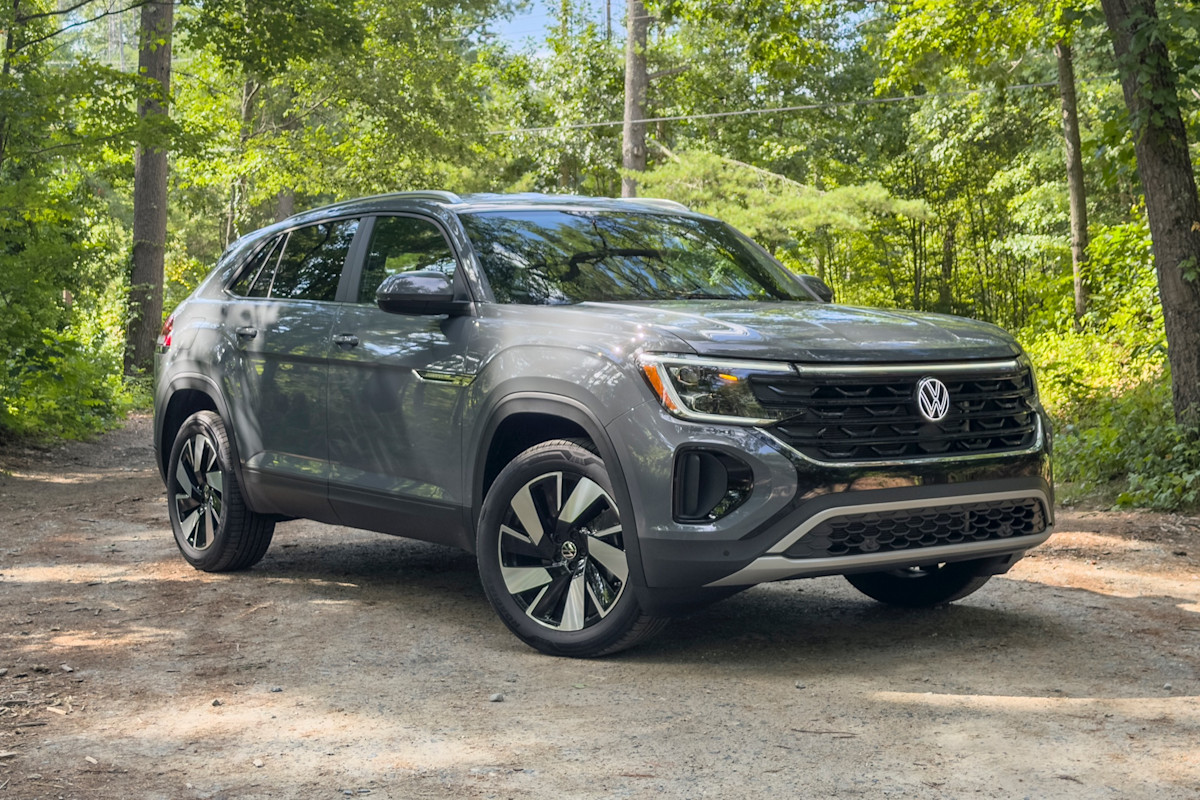
The front fascia is attractive and identical to that of the larger Atlas, with a wide, dark grille with a pleasant honeycomb texture, chrome trim that sweeps into the sleek, stacked headlights, a contrasting gray chin spoiler and lower trim, and modest side air cutouts. The flashiest element is the light bar with the illuminated VW logo. The Atlas Cross Sport looks far better than the Ford Expedition that copied this look. The wide front end goes well with the thick U-shaped fenders, 20-inch two-tone wheels with a spiffy rotor design, and gently sloping roof. That's the style brief for the Atlas Cross Sport—it's not overburdened with lines, creases, or trendy accents.
The rear lighting is a bit busy with arching LEDs that cross over each other at random points, but it's crisp and clean. If anything, the thick chrome bar below the taillight strip ages the Atlas Cross Sport, as do the chrome bumper trim pieces meant to look like exhaust tips. The lowered roof, combined with this wide, tall tailgate, isn't as pretty as the front. But after seven model years, it's also inoffensive.
Also underwhelming is the limited choice of colors. Our car's Pure Gray paint was $455 extra without delivering any pizazz; a flat black could have done just as well here.
The interior, however, is smart with good-quality materials. The single touchscreen that stays within the center stack, double-stacked air vents at the corners, very convincing aluminum-look trim, and a gauge cluster set into the dash rather than stuck on top are all great starting points. The seats have an upscale look and feel with diamond-contrast stitch inserts, a carbon twill fabric on the bolsters, and perforations on the lower seat cushion and upper seat back. Both rows are equally well-dressed, especially in our car's Dark Beige and Black upholstery (leatherette is standard, with real leather on SEL models), and there are plenty of soft touch points on the dash and door panels. It's easily the most expensive-looking interior in this class.
Performance
All of the Atlas Cross Sport's five trim levels come with a turbocharged 2.0-liter inline-four rated at 269 horsepower and 273 pound-feet of torque, sent through an eight-speed automatic transmission. FWD, like on our test car, is standard on the SE and SE with Technology. All-wheel drive (AWD, labeled by VW as 4Motion) is optional on those trims and standard on the SEL, SEL R-Line Black, and SEL Premium R-Line. EPA-rated fuel economy is 20 mpg city, 27 mpg highway, and 23 mpg combined with FWD, and 20 mpg city, 26 mpg highway, and 22 mpg combined with AWD, regardless of trim level. This is competitive but unremarkable.
At low speeds, we initially thought there was a hole in the exhaust, but it turns out this engine is quite raspy in the lower gears when pulling away from a stop. Things calm down when it's up to speed and the engine is mostly tranquil but ask it to pull this heavy SUV up a highway on-ramp and drivers will not like the answer. The engine simply runs out of steam. It's not acceptable for a vehicle this large, and that's with only the driver on board. We don’t want to imagine doing the same thing with three more adults and their luggage.
There's definitely no “Sport” in Atlas Cross Sport, not even with the paddle shifters in Sport mode. In addition to the underpowered engine, the steering is light and lifeless, though this car tracks straight and feels very solid, while the transmission shifts quickly and smoothly. Braking is another strong point, with solid pedal feel.
The rough ride means the Cross Sport doesn’t excel at comfort, either. We noted this on a 2024 Atlas Cross Sport wearing 21-inch wheels, and the effect was the same with our 2026 test car's 20-inchers. Thankfully, body motion is kept in check, and the seats have more give than their cushions might suggest.
Form & function
The Atlas Cross Sport offers ample headroom and legroom, which is the reason for buying a midsize crossover instead of a compact such as the VW Tiguan. The back seat, which reclines a few inches, is palatial and supportive. Sightlines are good even with the smaller rear windows necessitated by the Cross Sport’s lowered roof. The infotainment interface is generally easy to use, and there are still enough physical switches (or touch-sensitive buttons) to avoid total reliance on the touchscreen, but it does feel like a step backward.
The interface is clear and crisp, but the color theme can't be changed and there is no day/night option, so the touchscreen is bright white all the time. The climate controls are fully digital, which causes a delay when first starting the vehicle, and the touch-sensitive bar below the screen that controls audio volume and temperature is not illuminated. On pre-refresh models (2020-2023), a row of manual climate controls sat below the screen on the center stack, there was a driving mode dial on the center console, and touch-sensitive shortcut buttons for major functions on both sides of the screen's bezel, as well as volume and tuning knobs. That was a lot more user-friendly, and it’s not as though the Cross Sport is lacking in dashboard real estate for those controls.
Heated and ventilated front seats are standard, but only the driver is afforded power adjustment unless shoppers upgrade to one of the SEL grades. The SEL Premium R-Line adds lumbar support and massagers for the front seats, as well as heated outboard second-row seats.
Maximum towing capacity is 5,000 pounds with a braked trailer (even with FWD), meeting segment standards. The SE, which cannot be ordered with a factory hitch, is rated at 2,000 pounds. Cargo space is plentiful, with 40.3 cubic feet behind the rear seats and 77.6 cubic feet behind the front seats. The center console has lots of storage space, including a deep center cubby and large cupholders in the door pockets. An additional flat storage shelf is located underneath the center console. The LED map lights are almost too bright, but that's a good thing when it's completely dark outside.
Technology
A 12-inch touchscreen and 10.25-inch digital instrument cluster are standard, along with wireless Apple CarPlay and Android Auto. That’s good, because our test car’s infotainment display and the instrument panel showed a selection or app icon for navigation in three different areas, only for the car to tell us it didn't have navigation. Volkswagen did this years ago when Bluetooth was still an option by placing a phone button on the steering wheel that did nothing on lower trim levels. There's a better way to say "You didn't buy our more expensive trim" than passive-aggressive icons that do nothing. It was even worse when our test car's official trim name was "with Technology".
The upgrades this trim brings are adaptive front headlights with cornering lights that illuminate when the wheel turns at low speeds, illuminated VW emblems at the front and rear with light bars, a hands-free power tailgate, trailer hitch, 115-volt power outlet, garage door opener, front and rear parking sensors, and remote start.
An advantage of putting all the climate controls on the screen is several presets that can, for example, make drivers' feet cooler or their hands warmer. One tap, and the system does all the adjustments. The proximity key works at all four doors, there are four USB-C ports rated at 45 watts for fast-charging, a wireless charging pad, and remote connectivity with the myVW+ app.
Safety
The National Highway Traffic Safety Administration rated the Atlas Cross Sport at five stars overall, despite four-star ratings for both the driver and passenger in a frontal crash and a four-star rollover rating. The Atlas received a five-star side-impact rating from the agency. These ratings apply to all 2020-2026 models.
The Insurance Institute for Highway Safety named the 2026 Atlas Cross Sport a 2026 Top Safety Pick for scoring the top Good rating in the requisite crash tests and Acceptable in forward emergency-braking tests.
Automatic emergency braking, lane keep assist, blind spot monitors, high-beam assist, adaptive cruise control, and an exit warning system for the doors are standard, along with the Travel Assist highway-driving aid and Emergency Assist, which can pull the Cross Sport off the road if the driver becomes unresponsive.
Like other VW models, the Atlas Cross Sport also comes standard with automatic post-collision braking and the Intelligent Crash Response System, which automatically shuts off the fuel pump, unlocks the doors, and turns on the hazards after certain collisions.
Cost-effectiveness
The 2026 Volkswagen Atlas Cross Sport starts at $39,775 for the SE. The midrange SEL is $50,085 while the range-topping SEL Premium R-Line is $55,550 with extra-cost paint, the only factory option available. Our car was the second-from-the-bottom SE with Technology, which rang up to $44,650. All prices include a $1,475 destination fee.
Volkswagen offers a four-year/50,000-mile warranty that is one year and 14,000 miles longer than any of the competition, plus two years of scheduled maintenance. Given this coverage, the long list of features on our tested trim, the generous amount of space, the stylish exterior, and the high level of interior quality, the Atlas Cross Sport is a great value in the two-row midsize segment.
Looking at the competition, the Mazda CX-70 offers a six-cylinder engine with more torque and standard AWD, but its tech is ancient. The Chevrolet Blazer is much smaller and has a very plasticky cabin. The Subaru Outback is an off-road champ and comes well-equipped at a similar price to our Atlas Cross Sport SE with Technology tester but is also smaller. The Honda Passport RTL and Jeep Grand Cherokee Limited come the closest in size, price, and amenities.
Despite some caveats with the infotainment, everything else Volkswagen is doing is pretty spot-on for this segment, which is why we can confidently recommend an Atlas Cross Sport.

What owners say
Trims & specs
Base MSRP $50,560 | Seating 5 |
Engine 2.0L 269 hp I4 | Cargo Capacity 40.3 cu ft |
Combined MPG 23 | Drivetrain AWD |
Base MSRP N/A | Seating N/A |
Engine N/A | Cargo Capacity N/A |
Combined MPG N/A | Drivetrain N/A |
Base MSRP $53,620 | Seating 5 |
Engine 2.0L 269 hp I4 | Cargo Capacity 40.3 cu ft |
Combined MPG 23 | Drivetrain AWD |
Base MSRP $38,300 | Seating 5 |
Engine 2.0L 269 hp I4 | Cargo Capacity 40.3 cu ft |
Combined MPG 23 | Drivetrain FWD |
Base MSRP $40,200 | Seating 5 |
Engine 2.0L 269 hp I4 | Cargo Capacity 40.3 cu ft |
Combined MPG 23 | Drivetrain AWD |
Base MSRP N/A | Seating N/A |
Engine N/A | Cargo Capacity N/A |
Combined MPG N/A | Drivetrain N/A |
Base MSRP $48,610 | Seating 5 |
Engine 2.0L 269 hp I4 | Cargo Capacity 40.3 cu ft |
Combined MPG 23 | Drivetrain AWD |
Base MSRP N/A | Seating N/A |
Engine N/A | Cargo Capacity N/A |
Combined MPG N/A | Drivetrain N/A |
Base MSRP $44,620 | Seating 5 |
Engine 2.0L 269 hp I4 | Cargo Capacity 40.3 cu ft |
Combined MPG 23 | Drivetrain AWD |
Base MSRP $42,720 | Seating 5 |
Engine 2.0L 269 hp I4 | Cargo Capacity 40.3 cu ft |
Combined MPG 23 | Drivetrain FWD |


Pricing trends
MSRP range
$38,300 - $53,620
Current avg. market price
$37,077
Trending down by 1.4% this month
May 2026 - October 2026


