2027 Honda Prelude Reviews, Pricing & Specs


Pros & cons
What we like
Stylish design
Fun to drive
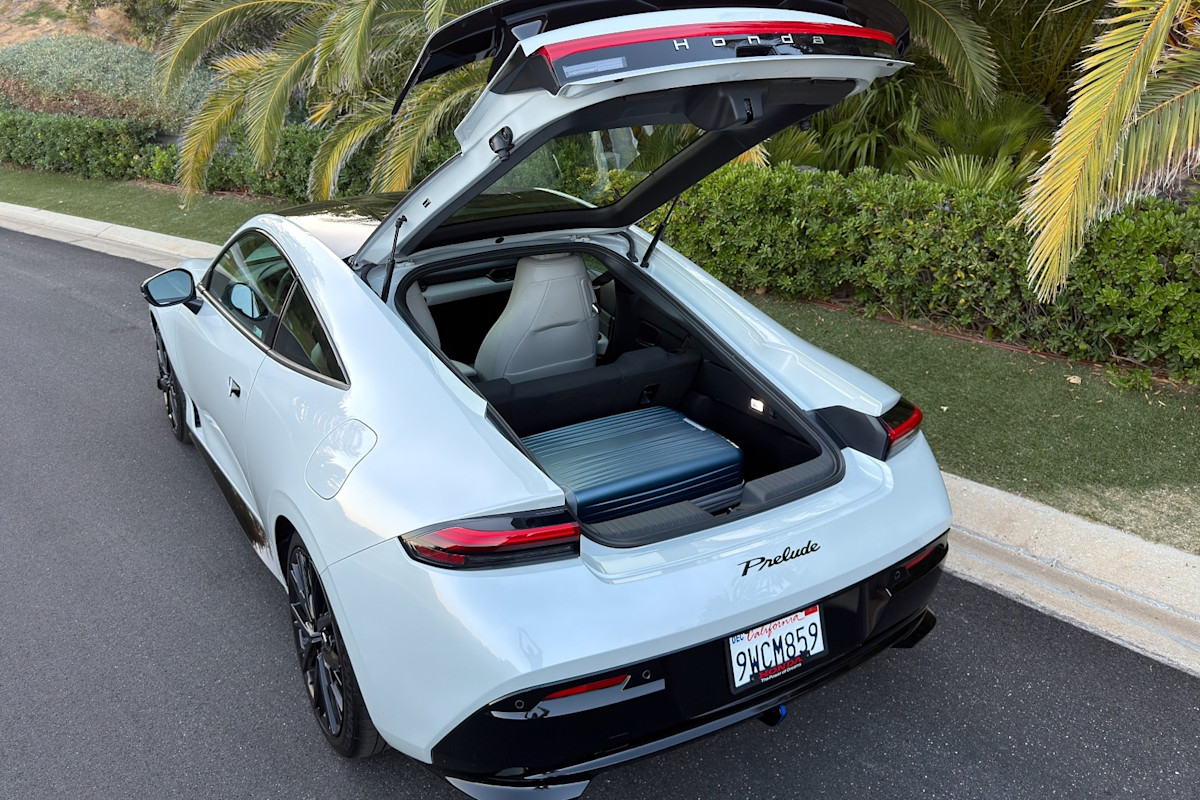
Plenty of cargo space
What to consider
Sluggish passing power
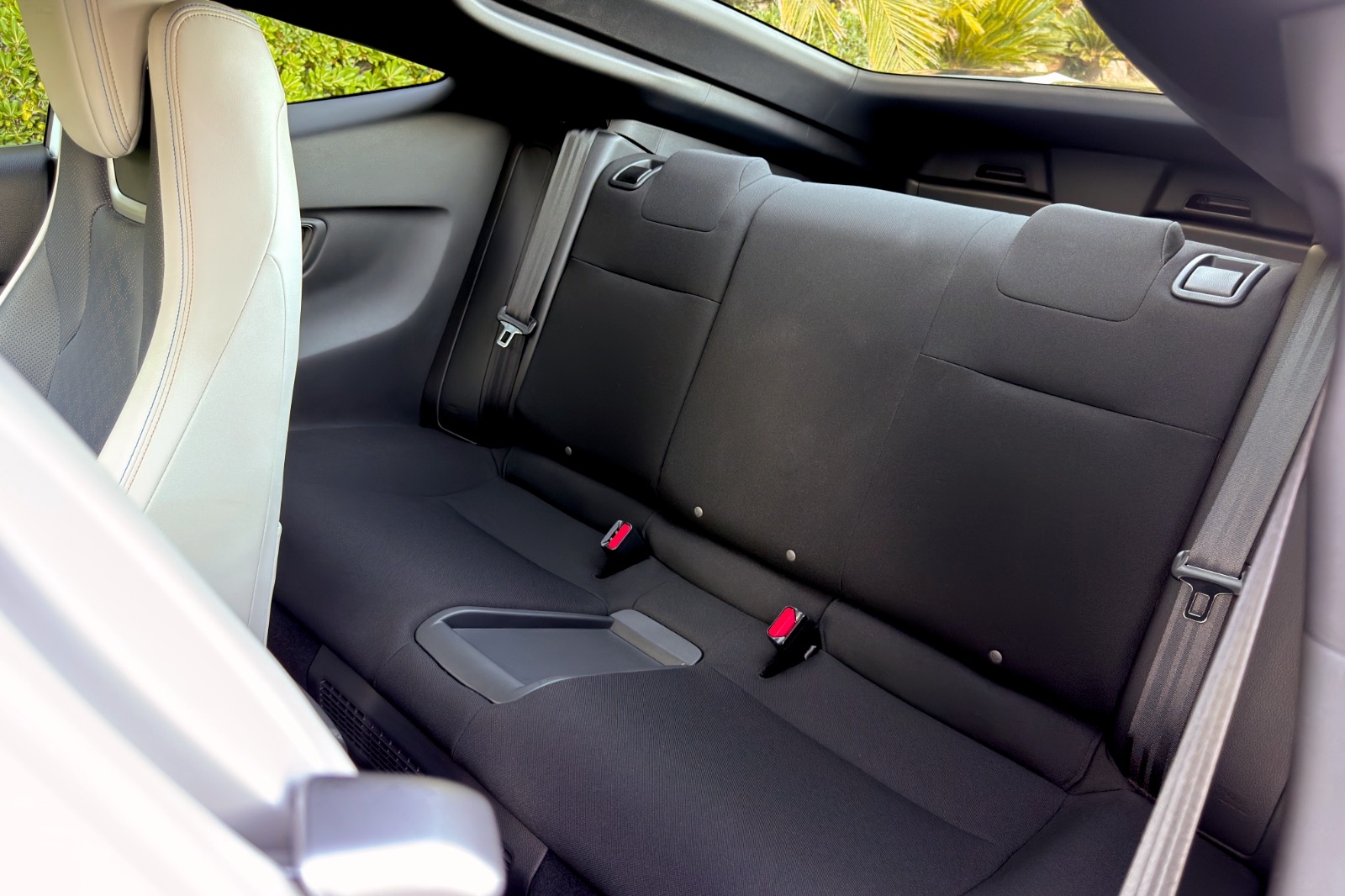
Cramped back seat
Noisy
The CarGurus verdict
Ignore the haters. The 2027 Honda Prelude is an enjoyable sports coupe.
Based on the same foundation as the Acura Integra and Honda Civic, the 2027 Prelude is a two-door coupe with four-passenger seating and a large liftback that reveals a generous trunk. It comes only with a 200-horsepower hybrid powertrain, which makes it fuel-efficient but not fast. Nevertheless, the driving dynamics are dialed-in and the Prelude’s rarity ensures buyers won’t see many others on the road.
Verdict: The 2027 Honda Prelude is a fitting successor to those that came before it. It trades high-revving power for low-end torque, but remains a stylish, fun, and remarkably fuel-efficient sports coupe.
out of 10 expert review
Look & feel
Honda sells the Prelude one way: fully loaded for $43,695 including the $1,295 destination charge. Our test vehicle had extra-cost two-tone paint, a front underbody spoiler, and a rear decklid spoiler, bringing the manufacturer’s suggested retail price to $45,700. Honda also fitted a set of sticky P235/40ZR19 Continental Extreme Contact Sport Plus summer performance tires, which a Honda representative told us cost around $1,200. With those tires, buyers are looking at just under $47,000 all-in.
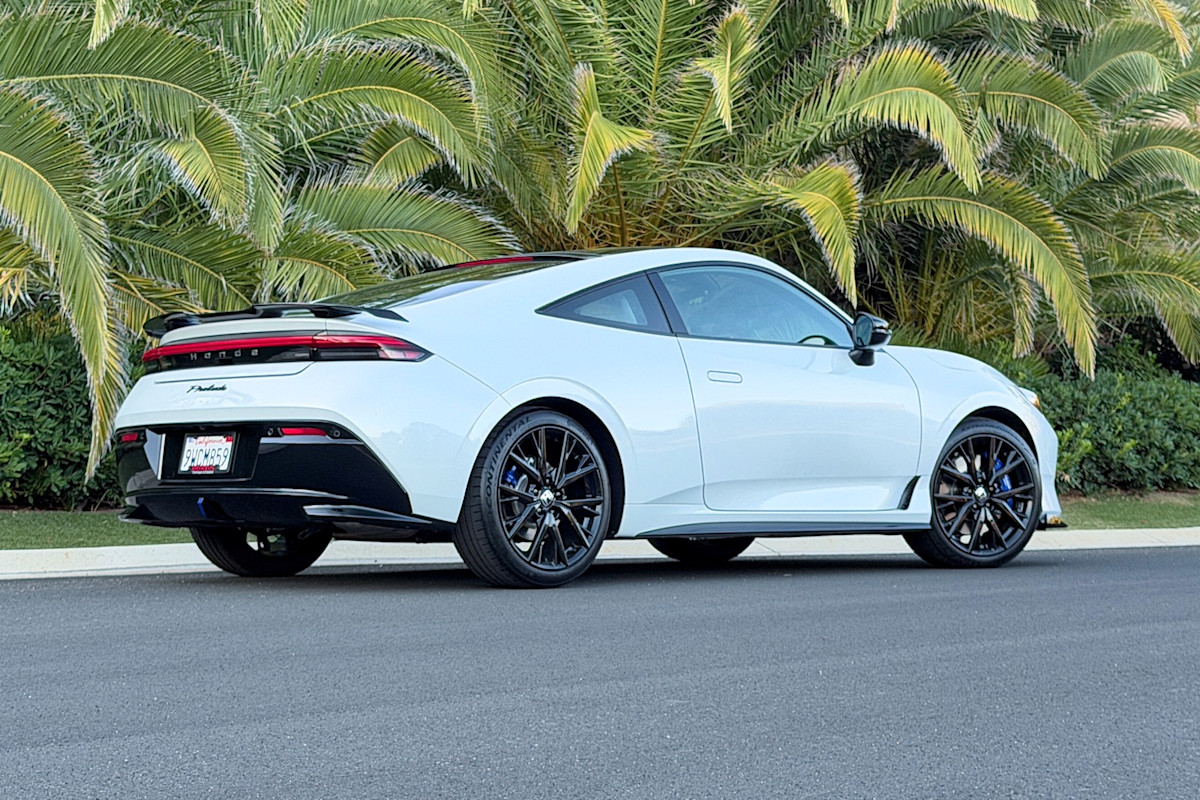
That white paint color is called Winter Frost Pearl, a fitting name. It has a blue undertone and looks terrific, as it should for $655. The black 19-inch wheels are also appealing, with an intricate design and just enough shine that observers can actually see the spokes and detailing. The blue brake calipers added to the sporting appearance.
The Prelude’s front-end styling has been likened to a Toyota Prius, and we can see the resemblance. Similarly, the rear end is reminiscent of a modern Porsche. In profile, the roofline kinks just beyond the windshield and tapers into the tail at a consistent angle with subtle curvatures at each end. Overall, the Prelude looks dramatic, but there’s no hiding its front-wheel-drive proportions, especially regarding the excessive front overhang and short dash-to-axle ratio.
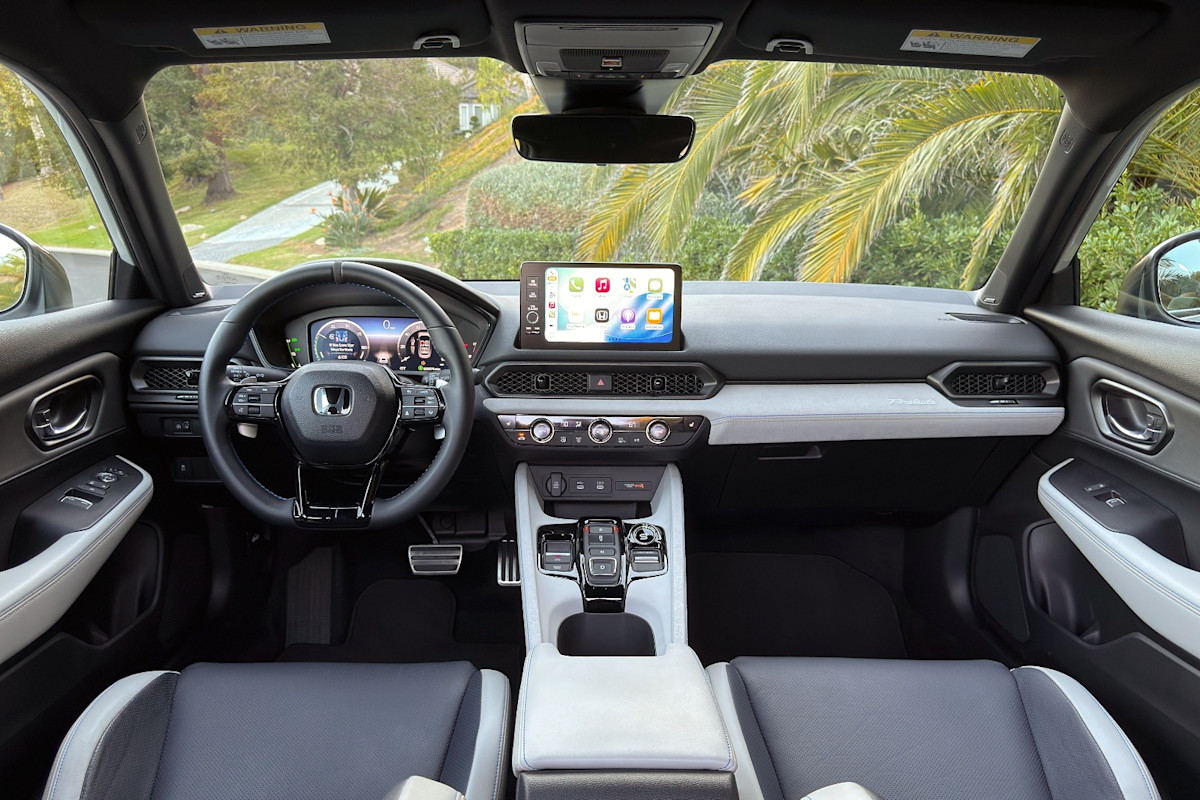
Inside, the test car had an upscale mix of blue-and-white leather over the black core interior elements. The dashboard and control layout blend elements and switchgear of the Acura Integra and the Honda Civic, with a few differences exclusive to the Prelude. It’s a familiar space, executed with quality components and materials, and appropriately sporty detailing. Anyone familiar with Honda and Acura products will feel right at home.
From the driver’s seat, there are a couple of other aspects of the Prelude seemingly inspired by Porsche. Looking forward, the low, flat hood dips between two fender blisters, reminding us of the 718 and 911. Likewise, the rear view through the tapering glass is straight out of the 718 Cayman playbook. These might be small details, but those in the know will get them, and they make the Prelude seem that much sportier.
Performance
Critics and Prelude fans have taken the latest model to task over its standard hybrid powertrain. It’s true that it lacks the high-revving performance inherent to the Honda VTEC engines that powered Preludes in the distant past, that a manual transmission is unavailable, and that it sounds too synthetic. But those who want straight internal combustion and a clutch pedal can still get an Acura Integra Type S or a Honda Civic Type R.
The Honda Prelude is not a high-performance car like those two models, and it never was. Historically, the Prelude was always a sports coupe to which customers graduated from a Civic or an Accord for its stylish looks, strong level of equipment, and rewarding driving character. The latest Prelude is exactly that kind of car.
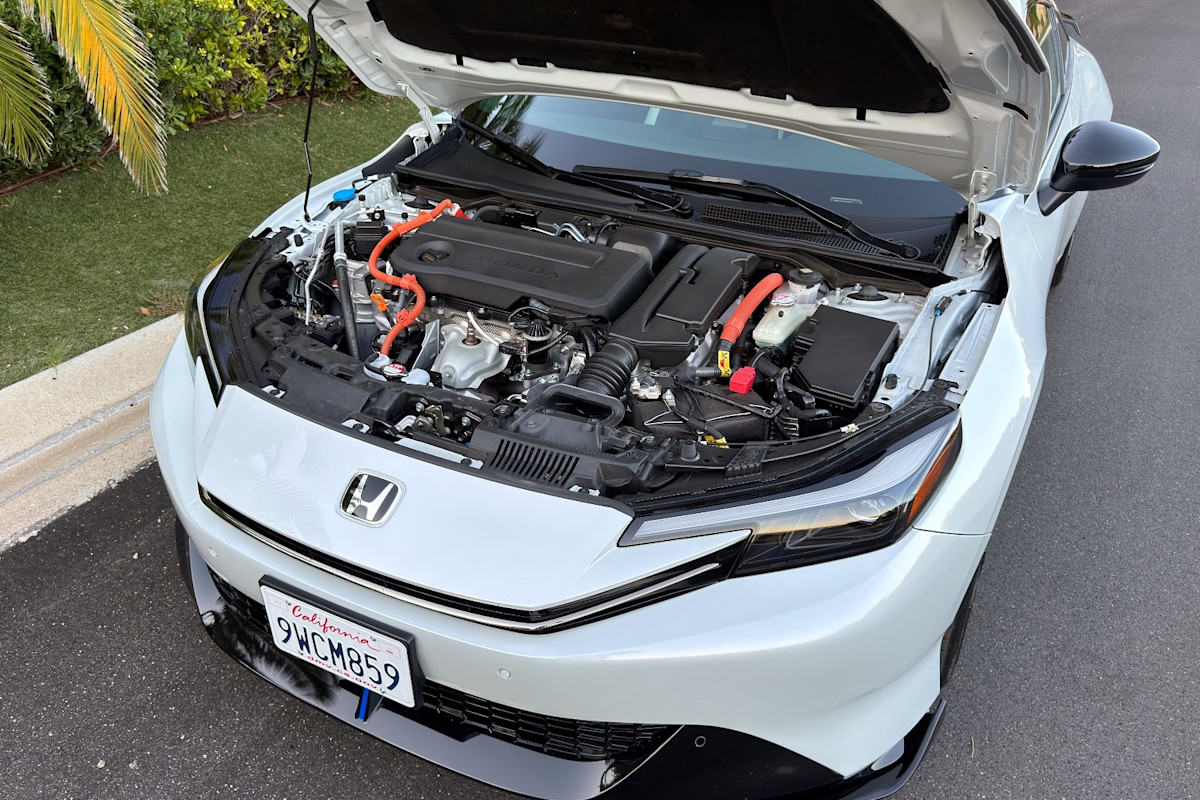
Honda’s hybrid powertrain is what has everyone flustered. It’s the same setup found in the Civic, CR-V, and Accord, and it’s undeniably sophisticated. However, due to its electric propulsion motor, it makes all its thrust right off the line, with a leisurely mid-range response. We’re talking 232 pound-feet of torque available as soon as drivers step on the go pedal, replaced by a more modest 200 hp as revs and velocity climb.
By contrast, the VTEC-powered Preludes available over a quarter century ago felt gutless until the second set of cams activated, and only then did the engine scream. People remember that engine’s high-revving nature with more fondness than it deserves, in our opinion, because its lack of low-end gutsiness meant drivers had to constantly beat on it to get the most out of it.
Today’s hybrid Prelude uses a 2.0-liter four-cylinder engine that serves primarily as a gas-fueled generator for two electric motors. One of the two motors recovers energy through regenerative braking and sends that power to the battery pack; the other is responsible for powering the front wheels. The electric propulsion motor serves as the Prelude’s primary source of power, not the gasoline engine.
However, when cruising at higher speeds on the highway, the gasoline engine powers the wheels because it’s more efficient than the electric motor in that situation.
Available driver-selectable modes include Comfort, GT, Sport, and Individual. In all modes, Honda calibrates the propulsion motor to mimic the sound and feel of traditional transmission shifts under acceleration, but drivers can take that further with S+ Shift mode. This causes the Prelude to hold “gears” longer, generating “downshift blips” and “matching revs”. The car’s artificial soundtrack is also calibrated for heightened driving engagement. All this makes using the paddle shifters more legit.
Speaking of legitimacy, the Prelude has the same dual-axis front strut suspension as the Civic Type R, though the adaptive dampers are tuned differently. Other Type R components include the front and rear brakes with four-piston Brembo monoblock brake calipers, also calibrated specifically for the Prelude.
Honda Agile Handling Assist brake-based active torque vectoring is also standard. Is it as sophisticated as the brilliant Active Torque Transfer System (ATTS) that Honda installed in the fifth-generation 1997–2001 Prelude Type-SH? That’s debatable, but based on our evaluation, the end result is the same.
So, how does it drive? Starting from a stop, all 232 lb-ft of torque is available from 0–2,000 rpm. It makes the Prelude feel lively, and drivers can even break the front wheels loose, especially if they're accelerating around a corner or a curve. All that instant torque available at low revs makes the Prelude delightful to drive in urban areas and when slicing and dicing through traffic.
The torque starts to fade after that, and so does some of the fun. Drivers had better plan ahead to pass another vehicle at highway speeds, especially when climbing a mountain grade, because that's when the Prelude feels a little gutless.
As a daily driver, the Prelude proved satisfying. The tires made more noise than was desirable, and the suspension could feel a little choppy at times, but otherwise it was stylish, quick, and responsive. Gas mileage impressed us, too, scoring 43 mpg on our fuel-economy evaluation route—just shy of the official rating of 44 mpg combined.
As expected, the crisp steering, stout brakes, and adaptive damping all made quick and joyous work of Mulholland Highway, one of California’s best driving roads. Undoubtedly, the seemingly limitless grip of the Continental summer tires was a big help, but in our experience, all Hondas are tuned to provide unexpected delight—even the Odyssey minivan. The Prelude might not be fast, but it sure is fun.
Form & function
As well as being fun, the Prelude is somewhat practical. It sits low to the ground and, because it’s a coupe, the longer doors can make entry and exit even more of a hassle in tight parking situations, while rear-seat access is compromised compared to a four-door sedan.
The front seats look better than they feel. They offer six-way manual adjustment, which leaves something to be desired. This car needs an adjustable thigh bolster, for sure. Seat track travel is limited, too, so taller people simply might not fit well.
Compared to the stylish front seats, the Prelude’s back seat is a black fabric bench with seat belts for two people, a useless tray in the middle, and no head restraints. Despite a tall and supportive lower cushion, it is not a good place for passengers to sit, and anyone taller than five feet will probably leave a greasy smudge from their head on the rear window. Getting in and out is a genuine hassle, too.
Interior storage space is adequate. There is just enough room for a smartphone, keys, sunglasses, and a water bottle. Cargo space behind the back seat measures 15.1 cubic feet, accessible only by lifting luggage over a tall sill. Honda doesn’t provide a cargo volume number when the rear seats are folded down, which is a shame, because the Prelude makes all kinds of sense as a two-seater with a huge trunk.
Technology
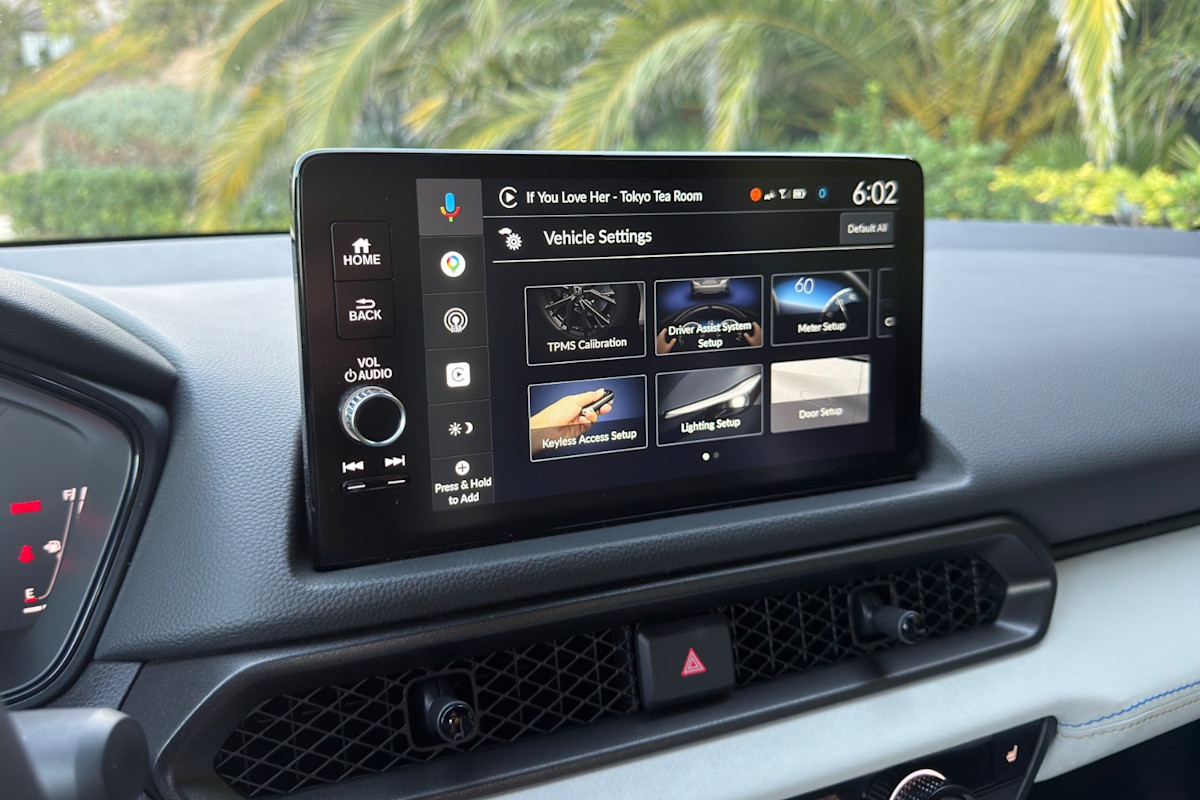
Like other Hondas, the Prelude’s in-cabin tech is relatively basic. It has a configurable 10.2-inch digital instrumentation panel shared with other Honda models and a 9-inch touchscreen sticking up from the dashboard over the center air vents.
The infotainment system offers analog Home and Back shortcut buttons, a volume knob, and tuning buttons in addition to virtual buttons and tiles on the screen. The system’s layout and features make it easy and intuitive to use. Google built-in is standard, but Honda provides complimentary access to Google Maps, Google Assistant, and Google Play for only three months.
For those who'd rather not pay extra for Google Built-in access, the standard wireless Apple CarPlay and Android Auto serve as capable alternatives. Additional infotainment features include Alexa built-in, HondaLink connected services with access to a Wi-Fi hotspot, wireless phone charging, and a decent eight-speaker Bose audio system.
Safety
The Prelude’s standard complement of driver-assistance features includes forward-collision warning, automatic emergency braking, adaptive cruise control with traffic-jam assist, lane-departure warning, lane-keep assist, lane-centering assist, blind-spot monitors, and rear cross-traffic alert.
Those features fall under the Honda Sensing banner, but the Prelude also comes standard with front and rear parking sensors, high-beam assist, and a post-collision braking system that brings the car to a stop as soon as possible following a collision (after the airbags are deployed) to prevent secondary impacts.
Honda Sensing operated smoothly and accurately for the most part. It struggled to identify obscured lane markings, but that’s not uncommon. We were more irritated by the lack of touch sensors for the steering wheel, which means small steering inputs are required periodically to confirm that the driver is still paying attention. Visibility to the rear is also problematic, as it is in most coupes.
At the time of writing, neither the National Highway Traffic Safety Administration nor the Insurance Institute for Highway Safety had published safety ratings for the Honda Prelude.
Cost-effectiveness
There are a few alternatives to the 2027 Honda Prelude. Buyers could choose a smaller and more affordable Subaru BRZ or Toyota GR 86, or a larger and potentially more expensive Ford Mustang. The two-seat Mazda MX-5 Miata or Nissan Z might also make sense if rear seats and luggage room are not priorities.
None of those competitors have an efficient hybrid powertrain like the Prelude's, but all of them enjoy significant credibility within the enthusiast community. That’s where the ire aimed at the Honda Prelude originates. People recalling the engineering brilliance of a manual transmission, a VTEC engine, and that transformational ATTS system don’t assign the same level of reverence to the equally unique and intelligent Honda hybrid system paired with Agile Handling Assist.
Nonetheless, we like the 2027 Honda Prelude. While it lacks mid-range power and isn’t fast, it is plenty of fun. Priced in the mid-$40,000s, well equipped, and impressively fuel-efficient, the 2027 Prelude checks all the boxes. And when those 19-inch wheels are wrapped in super-sticky rubber, fond memories of driving the fifth-generation Prelude Type-SH on the same roads where we tested this 2027 model came flooding back.
Like the generations that came before it, the newest Prelude is something more than just a fancy Civic or an Accord coupe, which makes it a valid replacement for the old Preludes. With that said, it strikes us as a little too expensive. Still, since Honda plans to build and sell only 4,000 annually, scarcity should also help resale values, further contributing to the car’s cost-effectiveness.
What owners say
Trims & specs
Base MSRP $42,900 | Seating 4 |
Engine N/A | Cargo Capacity 15.1 cu ft |
Combined MPG N/A | Drivetrain N/A |
Base MSRP $42,400 | Seating 4 |
Engine N/A | Cargo Capacity 15.1 cu ft |
Combined MPG N/A | Drivetrain N/A |


