2027 Nissan Rogue Hybrid Reviews, Pricing & Specs


Pros & cons
What we like
Stylish design
Pleasant to drive
Interior exceeds expectations
What to consider
Not an ounce of fun
Less cargo space and rear-seat legroom than rivals
Fuel economy is merely adequate
The CarGurus verdict
The 2027 Rogue Hybrid ushers in the fourth generation of Nissan’s compact crossover SUV with a unique hybrid system.
The 2027 Nissan Rogue Hybrid is notable for a number of reasons. It finally brings an in-house hybrid powertrain to Nissan’s compact crossover. It’s not a rebadged Mitsubishi Outlander like the current Rogue Plug-In Hybrid, and it doesn’t have to be plugged in, making it a more direct competitor to hybrid versions of the Honda CR-V, the Hyundai Tucson, the Kia Sportage, the Subaru Forester, and the Toyota RAV4. Last but not least, the hybrid model introduces the redesigned fourth-generation Rogue (the previous-generation non-hybrid continues for 2027) and a hybrid system never before seen in the U.S.
Verdict: Long missing from a hybrid-happy market segment, the Rogue Hybrid is worth the wait. It’s better to drive than rivals, and more stylish inside and out. However, fuel economy is merely acceptable.
out of 10 expert review
Look & feel
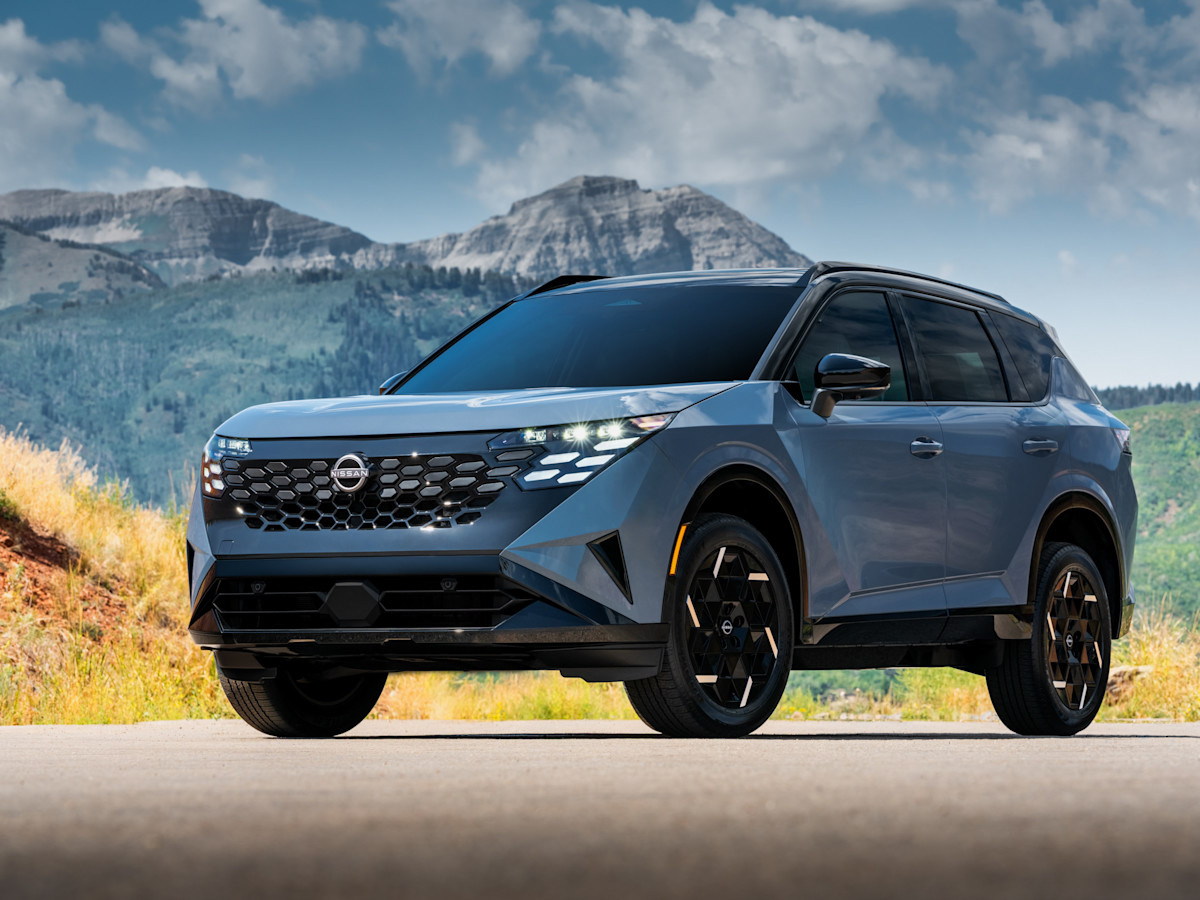
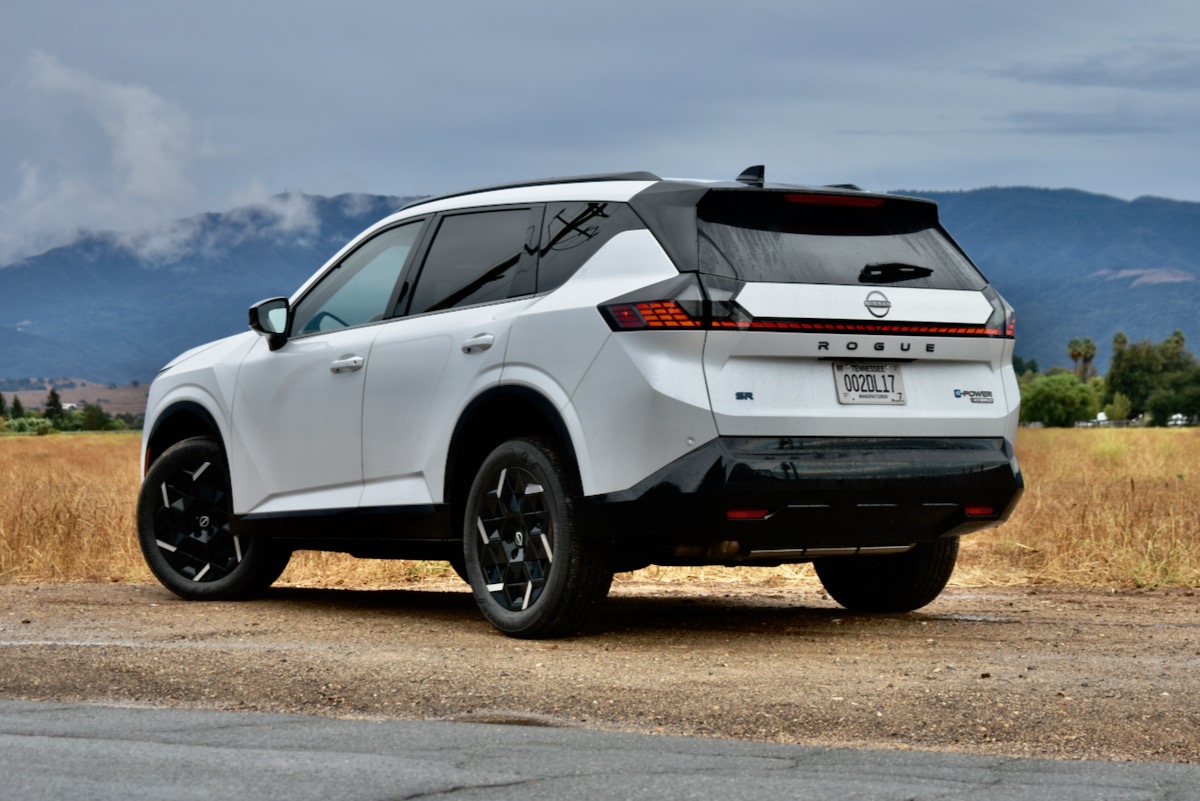
Each generation of Rogue has gone in a different direction styling-wise, and that continues with the 2027 Rogue Hybrid. The all-important SUV proportions remain, but the design theme emphasizes faceted surfaces and pixel-like details that admittedly bring to mind the outgoing Hyundai Tucson (a radically different version is on the way for 2027) but still give the Rogue Hybrid a unique appearance.
The imposing grille doesn’t look tacked-on, as is so often the case, but is instead defined by headlights that blend into it (thanks in part to smaller elements that match the grille texture) and the triangular thrust of the surrounding bodywork. This neat arrangement of interlocking shapes creates a cohesive design, rather than a collection of unorganized elements.
In profile view, a depressed hexagonal area surrounding the doors and window glass helps give the fenders more definition, providing a different take on the muscular fender extensions that are shorthand for SUV toughness. A sheet metal peak at the D-pillar is supposed to represent Japan’s iconic Mount Fuji, and the pixelated lighting theme continues at the back, with taillights folded around the corners of the body in a way that reminds us of the ubiquitous second-generation Rogue.
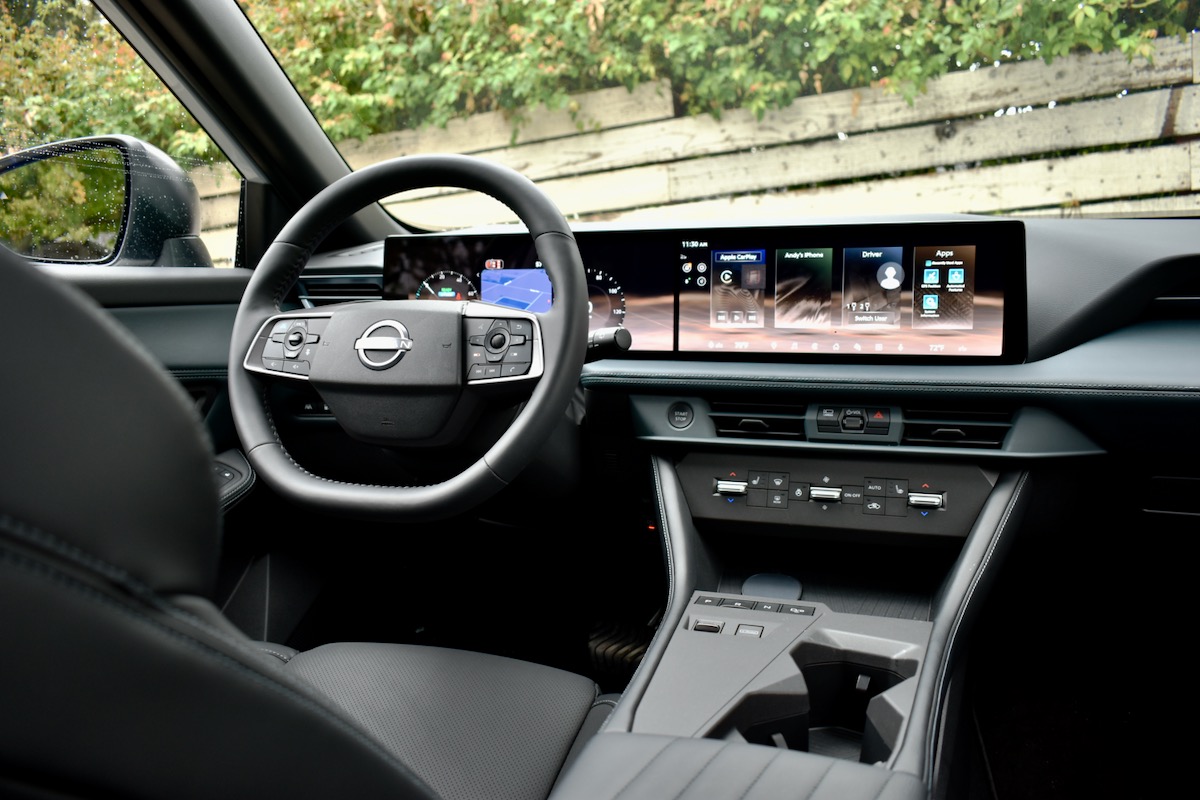
The interior is equally creative. The dashboard screen is backed by a waterfall-like upper level that also integrates the air vents. Areas designers normally gloss over have cool detailing. The center console is divided in two by a diagonal slash that separates the controls and cupholders, which themselves have a neat angular shape, as do the door panels.
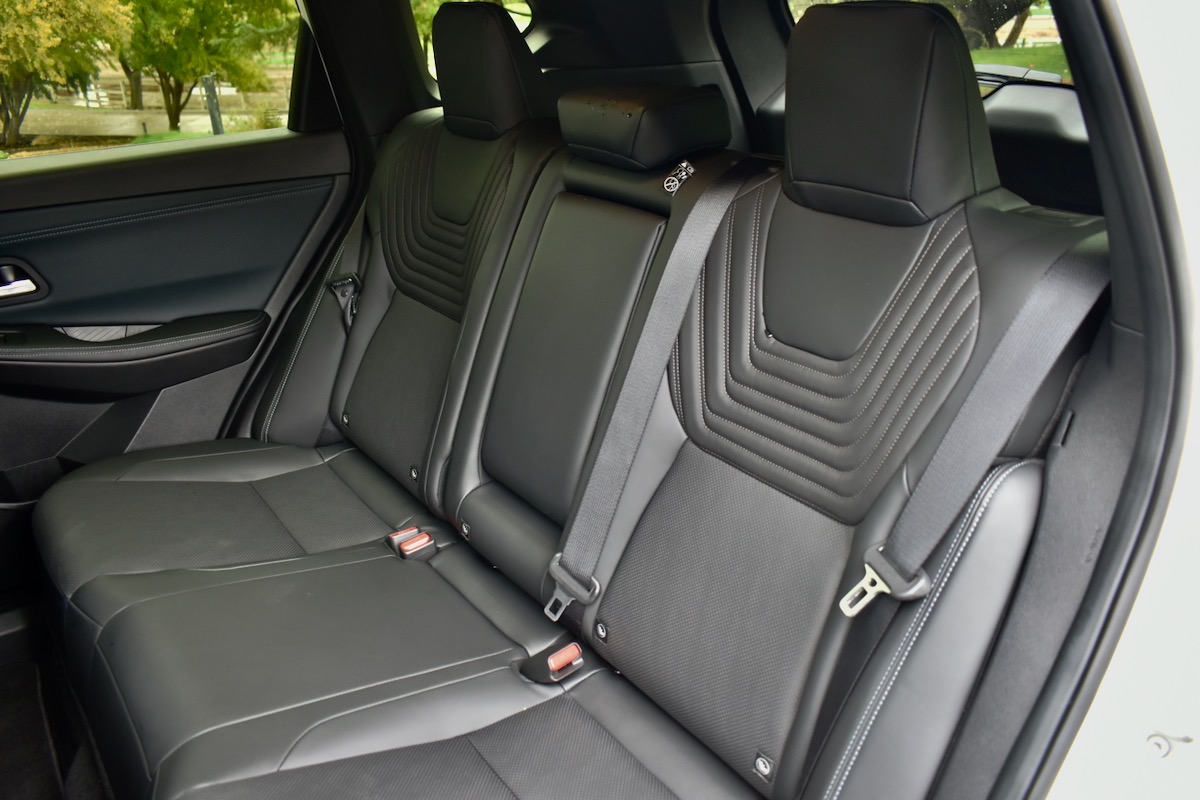
Button-heavy areas look plainer, but they’re functional, and we appreciate that Nissan chose a satin finish instead of shiny piano black that produces glare and gets dirty quickly. The overall quality of materials was also impressive for the price point. We tested a mid-level SR with Technology Package (the first model that will arrive at dealerships) but it still had a two-tone interior with quilted stitching in a pattern inspired by puffer jackets, and much better plastics than many competitors. The quilted leather upholstery is standard with the SR Technology Package and on the top Platinum trim level; base SV trims have cloth seats, while the SR without the Technology Package has plain leatherette.
Performance
Nearly every one of the Rogue’s competitors offers a hybrid powertrain, but none are like this. Dubbed e-Power by Nissan, it’s a series hybrid system in which the gasoline engine serves only as a generator, with all drive power coming from electric motors. Most competitors use parallel hybrid systems in which the gasoline engine and electric motors share propulsion duties. Honda’s system comes close to series functionality, however, only looping the gasoline engine into the drivetrain under very specific circumstances.
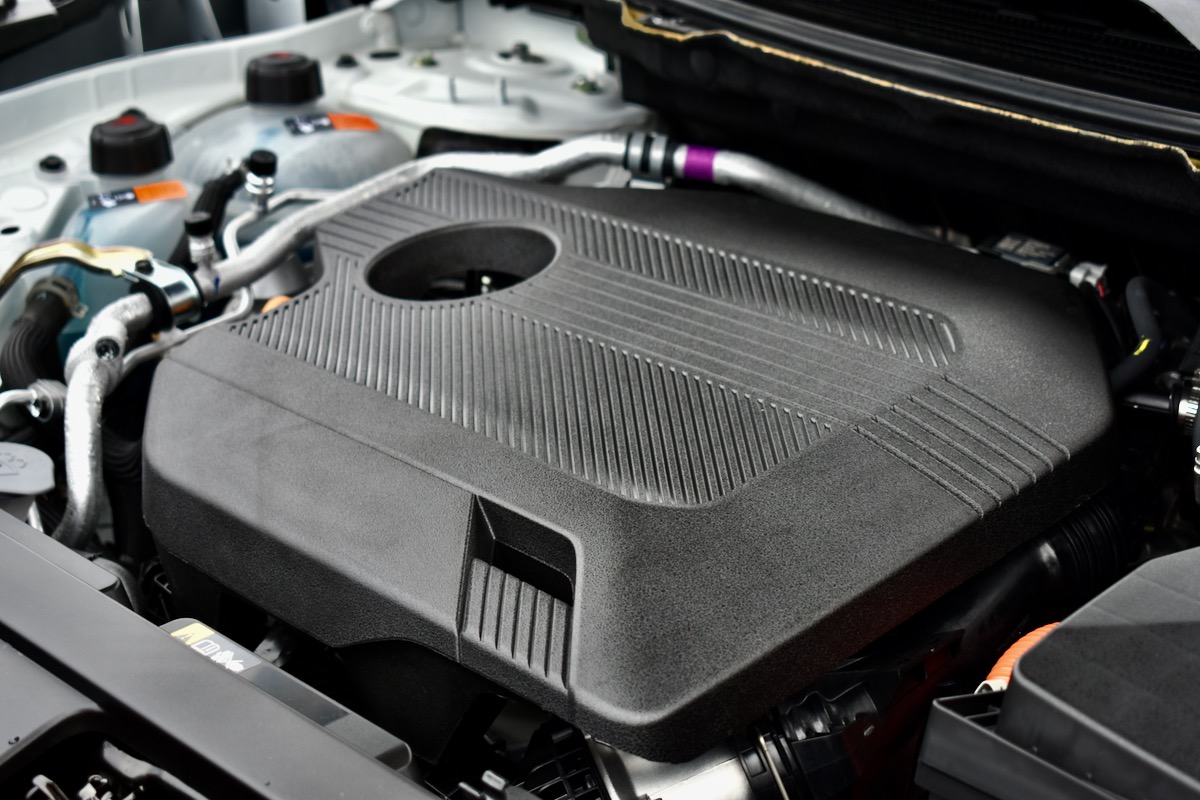
The e-Power system returns decent fuel economy like other hybrids (see below), but the real difference is in drivability. Consisting of a turbocharged 1.3-liter three-cylinder engine, electric motors front and rear for all-wheel drive (AWD), and a 1.6-kilowatt-hour battery pack, it produces an unremarkable 225 horsepower. But the system makes full use of its motors’ instant torque (which ramps up nonlinearly, hence no peak torque figure) to zip off the line more assertively. Nissan quotes a 0–60 mph time of 6.4 seconds, which is pretty good for a non-performance car.
Once underway, we were concerned that the engine would buzz at high rpm as it worked to keep the battery topped off. Yet at sustained highway speeds, we could barely tell when the engine was running. Both noise and vibration were minimal compared to other hybrids, and the less-direct approach of using the engine to charge the battery to power the motors didn't affect responsiveness. Accelerating to overtake was just as confidence inspiring as accelerating from a stop.
Another unique feature is strong regenerative braking. When it comes to slowing down, the Rogue Hybrid is more like an EV than a conventional hybrid. It’s capable of one-pedal driving; on twisty roads or creeping forward in traffic, drivers can modulate speed simply by adjusting pressure on the accelerator pedal, and with the “smooth stop” feature, they can mash the brake pedal and let software automatically adjust braking force to limit head toss.
All of this makes the Rogue Hybrid much more pleasant to drive in everyday situations than its competitors. What it doesn’t do is make it fun or exciting. The steering is responsive enough, and the suspension can maintain its composure and a comfortable ride, but there’s nothing engaging about the way they work. While we wouldn’t be surprised to see a Rock Creek model in the future, right now Nissan doesn’t have an off-road trim level to match the Honda CR-V Hybrid TrailSport and the Toyota RAV4 Woodland, or the Subaru Forester Hybrid Wilderness and the Hyundai Tucson XRT Pro (the latter two are new for 2027).
Form & function
The redesigned Rogue offers competitive first-row headroom, and a bit more than a CR-V Hybrid or a RAV4. Front-seat legroom is less than a Subaru Forester Hybrid's, but pretty much the same as in all other competitors. Nissan may have taken the puffer-jacket design of the front seats in our SR with Technology Package test car a little too far, as they felt overstuffed to the point that it was hard to get comfortable.
The steering wheel, designed to avoid blocking the instrument cluster, was also a bit too big for our tastes, but we appreciated the thin rim and inclusion of real buttons. A heated steering wheel is standard, as are heated front seats. However, buyers have to upgrade to the top Platinum trim level for a power-adjustable front passenger’s seat. Ventilated front seats are also available, along with heated rear seats.
Speaking of rear seats, the Rogue Hybrid has the least rear legroom of any vehicle in its class. Headroom is about average for the segment, though, and more than in a Subaru Forester Hybrid. Subjectively speaking, the rear seats were also reasonably comfortable, with a more supportive feel than a RAV4’s flat rear-seat cushions.
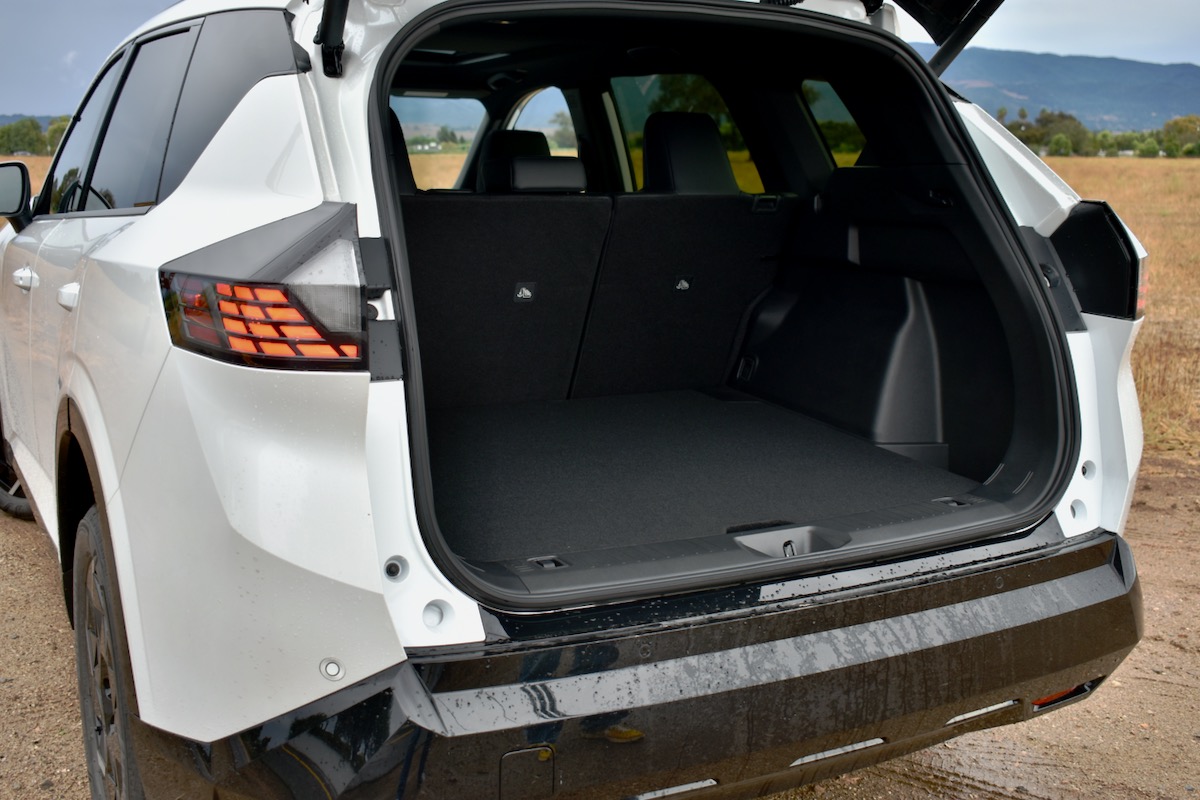
The 34.4 cubic feet of cargo space behind the rear seats trails the CR-V, the RAV4, and the Kia Sportage Hybrid, but is more than in a Forester Hybrid or a Jeep Cherokee. Cargo space expands to 65.9 cubic feet with the rear seats folded, which is the smallest in the Rogue Hybrid’s competitive set. A standard power liftgate is a plus, though.
Those unusual cupholders work well, but the in-door bottle holders are on the small side. Like the previous-generation Rogue, an elevated center console also leaves room for a storage nook underneath. Unlike some executions of this idea, it’s big enough to be useful, so items don’t get stuck when drivers and passengers retrieve them.
Technology
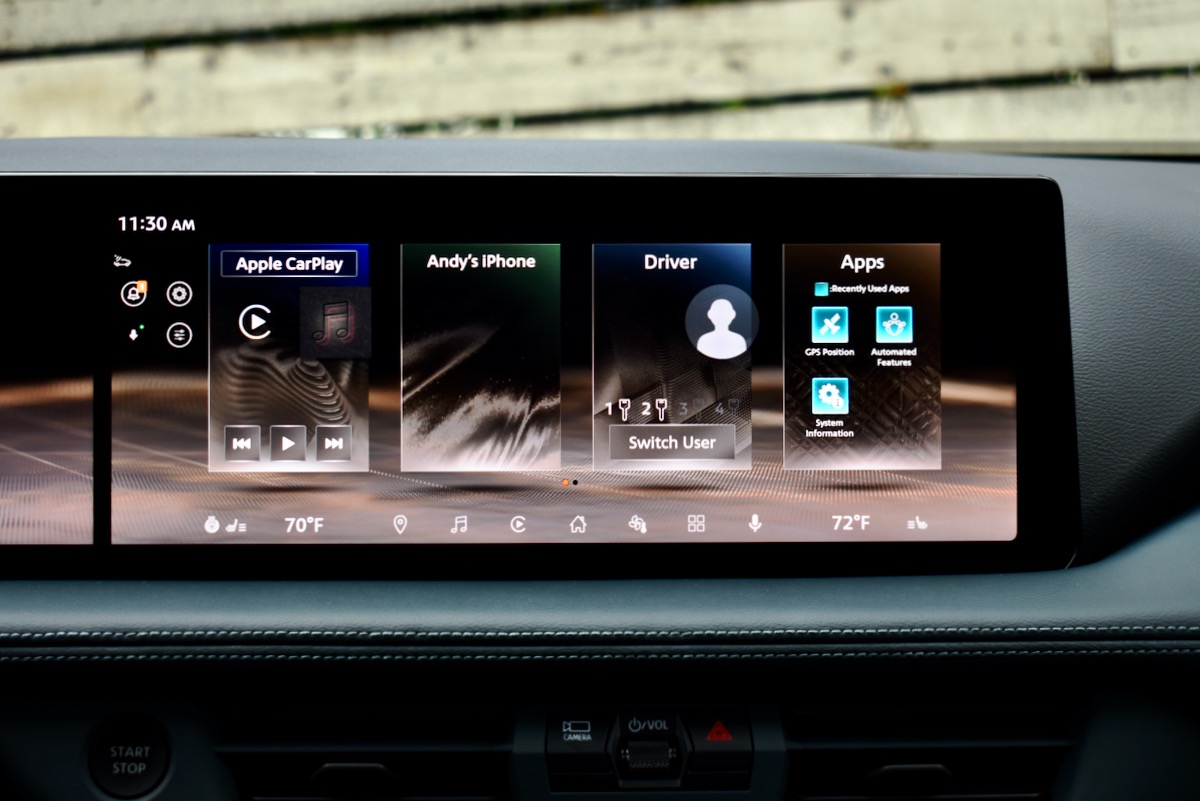
A 12.3-inch digital instrument cluster and 12.3-inch touchscreen are standard, while 14.3-inch versions of both are part of the Technology Package for the SR trim level and standard on the Platinum model. Either way, the two screens are placed side-by-side to form one long display, as is optionally available in the Kia Sportage Hybrid. Wireless Apple CarPlay and Android Auto are standard, with Google built-in apps available on the SR with Technology Package and Platinum. Wi-Fi connectivity and over-the-air updates are standard (with a one-year free trial) on SR and Platinum models.
Everything on both the instrument cluster and touchscreen appears to float off the background in a way that would have looked cool in 1999, but that we found a bit disconcerting. The graphics look equally dated, but everything is easy to read and well organized. More than the infotainment system itself, though, what we appreciated the most were the simple analog controls for temperature, audio volume, and camera views.
Dual front and rear USB-C ports are standard, as is a magnetic induction wireless device charger up front. The Platinum trim level gets a second one of these, which have a hockey-puck-sized magnet that holds a phone in place to ensure continuous charging (assuming the driver has the right case).
The unbranded six-speaker audio system that’s standard in SV and SR models sounded about as good as can be expected of a basic system. A 10-speaker Bose system with a subwoofer is available only on the top Platinum trim level. SiriusXM with 360L satellite radio is also available, but not on the base SV trim level.
Safety
The 2027 Rogue Hybrid comes standard with expected driver-assistance features such as adaptive cruise control, forward-collision warning, automatic emergency braking (with pedestrian, cyclist, and intersection detection), blind spot monitors, rear cross traffic alert, lane-keep assist, lane-departure warning, traffic-sign recognition, a driver-attention monitor, and high-beam assist.
Rear automatic braking, front and rear parking sensors, and a surround-view camera system are part of the Technology Package for the SR trim level, and standard on the Platinum. The camera system also includes a widescreen front view that helps eliminate blind spots and an “invisible hood” view that does the same when looking directly in front.
ProPilot Assist, which adds automated lane centering to adaptive cruise control for highway driving, is standard. SR with Technology Package and Platinum models add a traffic-jam assist feature that allows hands-free driving at low speeds. Performance of ProPilot Assist and the other driver aids was in line with expectations for vehicles at this price point.
Because the 2027 Rogue Hybrid is a new model, safety ratings from the Insurance Institute for Highway Safety and National Highway Traffic Safety Administration were not available at the time of writing.
Cost-effectiveness
Nissan’s new hybrid system delivers a much better driving experience, but fuel economy is about the same as rival hybrids. EPA ratings weren’t available at the time of writing, but Nissan estimates 38 mpg combined (41 mpg city, 36 mpg highway). That’s only slightly better than an AWD Honda CR-V Hybrid, which is rated at 37 mpg combined (40 mpg city, 34 mpg highway), or a Kia Sportage Hybrid, rated at 35 mpg combined (35 mpg city, 36 mpg highway).
The Toyota RAV4 does even better at 42 mpg combined (46 mpg city, 39 mpg highway) with AWD. And while a few mpg is a fair trade for a superior driving experience, we also managed only 31.4 mpg during our day with the Rogue Hybrid. The route was heavy on backroads and highways, with little stop-and-go city driving, so those in suburban or rural locales might have trouble matching Nissan’s estimates.
It's also important to note that Nissan is staggering the launch of Rogue Hybrid trim levels. Only the SR with Technology Package will be available during the 2026 calendar year, with a starting price of $43,065 (all prices include a $1,575 destination charge). Other trim levels will be available in early 2027.
Those trim levels will include the SV base model priced from $37,065. A Premium Package with additional convenience features will also be available for the SV for $2,100 more and shoppers will be able to spec the SR without the Technology Package and save $4,000. Finally, the Platinum trim level will start at $45,065 when it goes on sale.
The Rogue Hybrid SV will undercut the least-expensive AWD Honda CR-V Hybrid by about $2,000, but an AWD RAV4 (which has a standard hybrid powertrain) is cheaper still. And while Honda and Toyota have proven their hybrid systems, Nissan e-Power is an unknown when it comes to long-term reliability. That’s counterbalanced by a superior driving experience and, in the most popular mid-level trims, a better interior and good equipment levels. And that makes the Rogue Hybrid worth a try.
What owners say
Trims & specs
Base MSRP N/A | Seating N/A |
Engine N/A | Cargo Capacity N/A |
Combined MPG N/A | Drivetrain N/A |
Base MSRP N/A | Seating N/A |
Engine N/A | Cargo Capacity N/A |
Combined MPG N/A | Drivetrain N/A |
Base MSRP N/A | Seating N/A |
Engine N/A | Cargo Capacity N/A |
Combined MPG N/A | Drivetrain N/A |