2027 Subaru Forester Hybrid Reviews, Pricing & Specs



Pros & cons
What we like
Impressive off-road ability
Quieter and more efficient than the gas Wilderness
Comfortable
What to consider
No spare tire
Sluggish touchscreen response
Reduced towing capacity
The CarGurus verdict
A hybrid powertrain fixes the Forester Wilderness's biggest weakness.
The 2027 Subaru Forester Wilderness Hybrid is the first Wilderness model with a hybrid powertrain. It keeps the raised suspension, all-terrain tires, and mechanical all-wheel drive (AWD), but drops the gas model's shorter gearing. The result is a quieter, more efficient daily driver at 31 mpg combined. The trade-offs are a 1,500-pound towing limit and an inflator kit where the full-size spare tire used to be.
Verdict: The Wilderness Hybrid gives up capability most owners won't miss in exchange for refinement the gas Wilderness always lacked. It's capable enough to take shoppers far beyond cell service, but those who go there often should think hard about the missing spare tire.
out of 10 expert review
Look & feel
Subaru introduced the Wilderness badge on the Outback in 2021, and since then rugged trims have become seemingly standard issue for compact SUVs. Honda has TrailSport, Hyundai has XRT, Kia has X-Pro, Nissan has Rock Creek, and Toyota has Woodland. What sets the Wilderness apart is that its go-anywhere styling comes backed by go-anywhere hardware. A Wilderness Subaru can actually go where its name suggests.
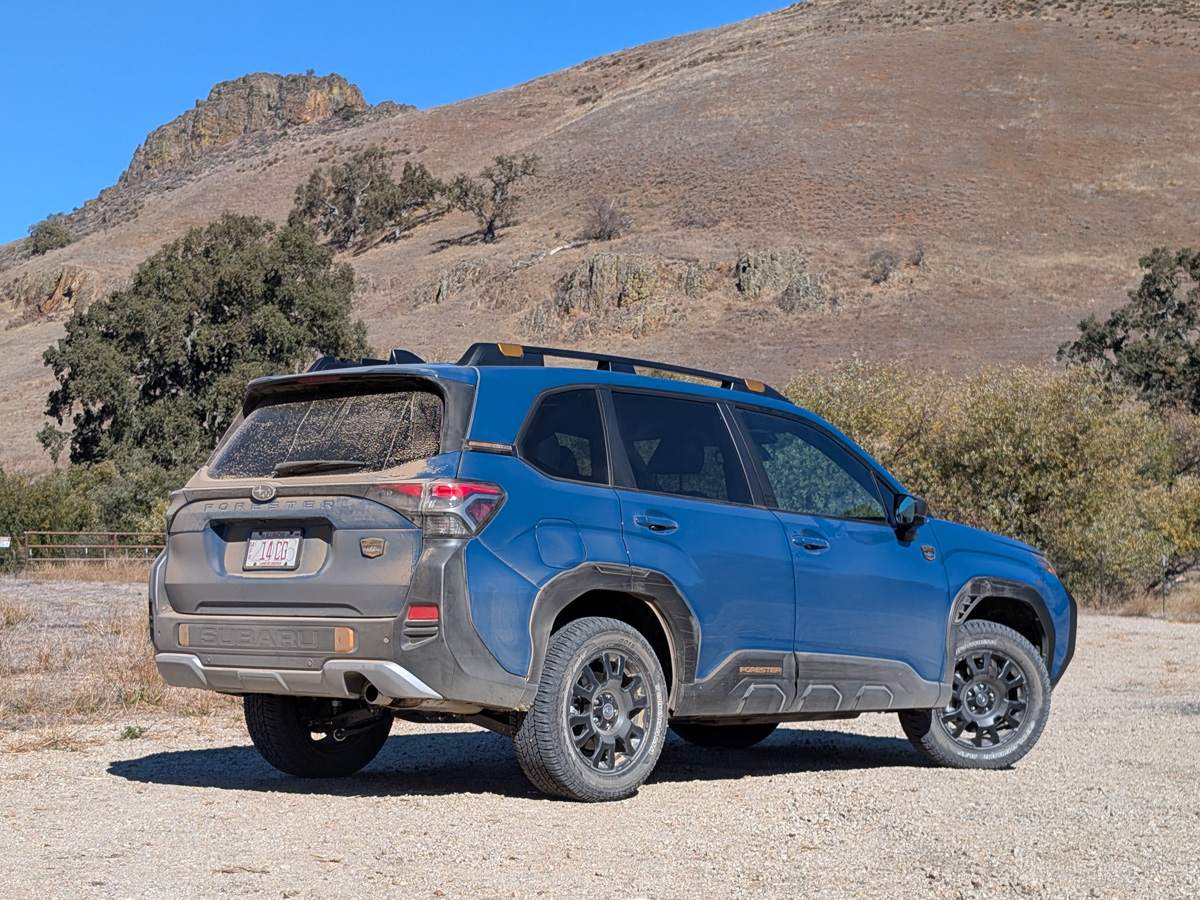
The new 2027 Subaru Forester Wilderness Hybrid looks nearly identical to the gas Wilderness. A matte black decal on the hood cuts glare off the paint, which we appreciated while testing under a cloudless California sky. Up front there's a revised fascia with a skid plate below it, and anodized copper accents dress up the bumpers, roof rails, and badges. Small "Hybrid" text under the Wilderness logo on the liftgate is the easiest way to tell the two models apart.
Plastic cladding wraps the wheel arches and lower doors to protect the paint from rock chips. That cladding has become a Subaru staple, and while it doesn't flatter every model, it's more restrained here than on the Crosstrek Wilderness or Outback Wilderness, where the cladding creeps up the body and crowds out the sheet metal. The 17-inch matte black wheels and chunky Yokohama all-terrain tires finish a look that reads as quietly but confidently capable. Unlike some off-road-oriented family crossovers, the Forester isn't trying too hard.
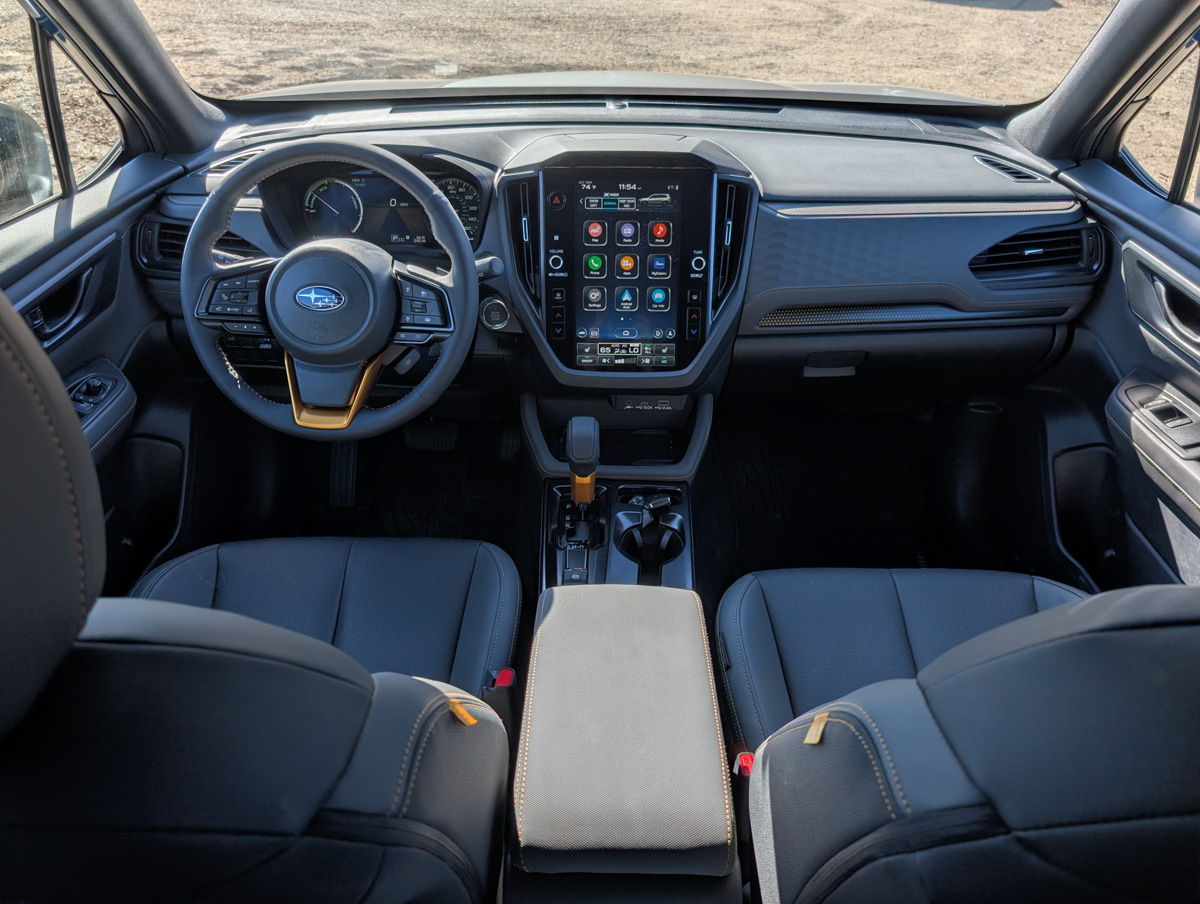
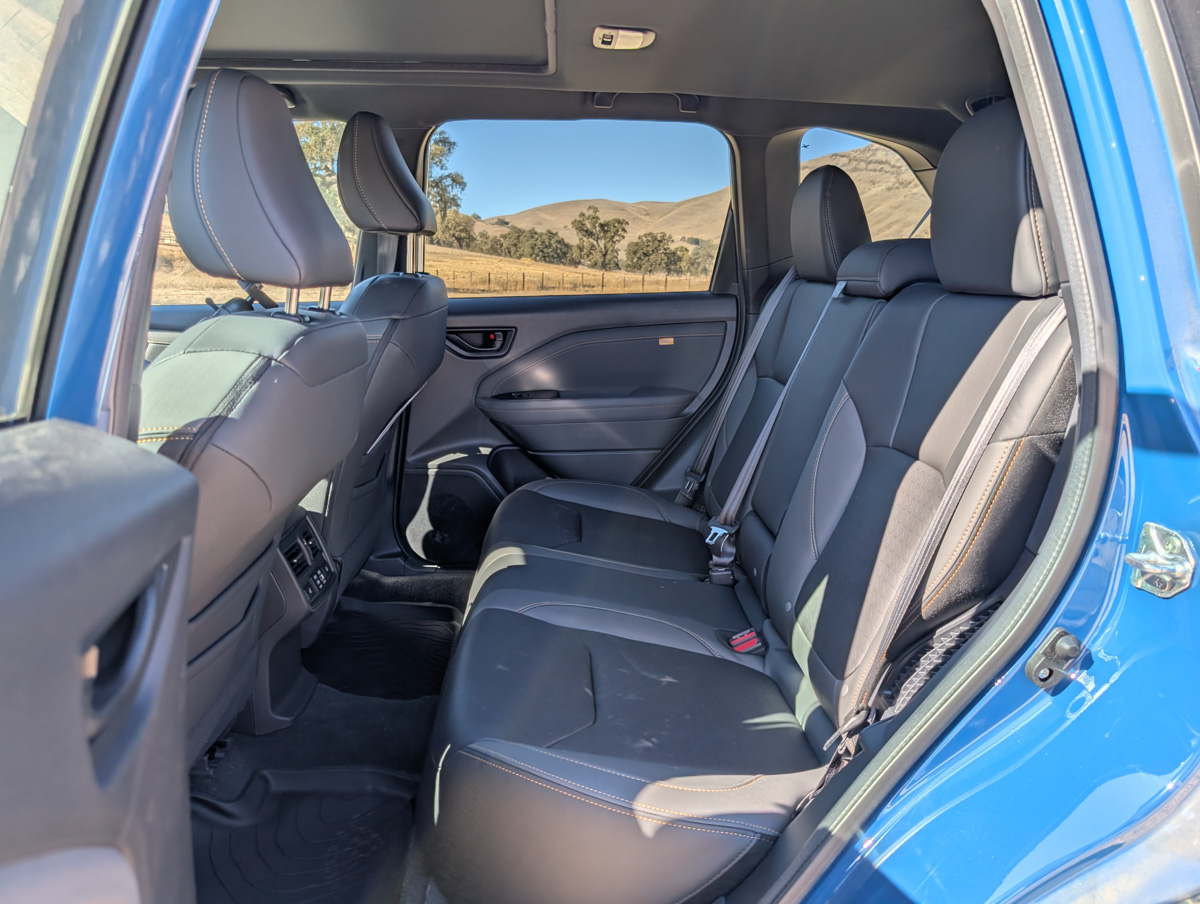
Inside, the copper accents continue on the steering wheel, in the contrast stitching, and on small trim tags, and "Wilderness" is debossed into the front headrests. The upholstery is a water-resistant synthetic leather that wipes clean easily, which makes sense for muddy boots and wet gear. Every Wilderness Hybrid also comes with a rubber cargo tray. All-weather floor mats are optional. (We got this wrong in our accompanying video review, but we'd add them on day one.)
Materials are durable rather than luxurious, and that suits the Wilderness mission. Sure, the Forester's upright, boxy shape won't win over shoppers who want something sleek. Spend some time with it, though, and you may come to appreciate its function-first style. Every design decision makes sense.
Performance
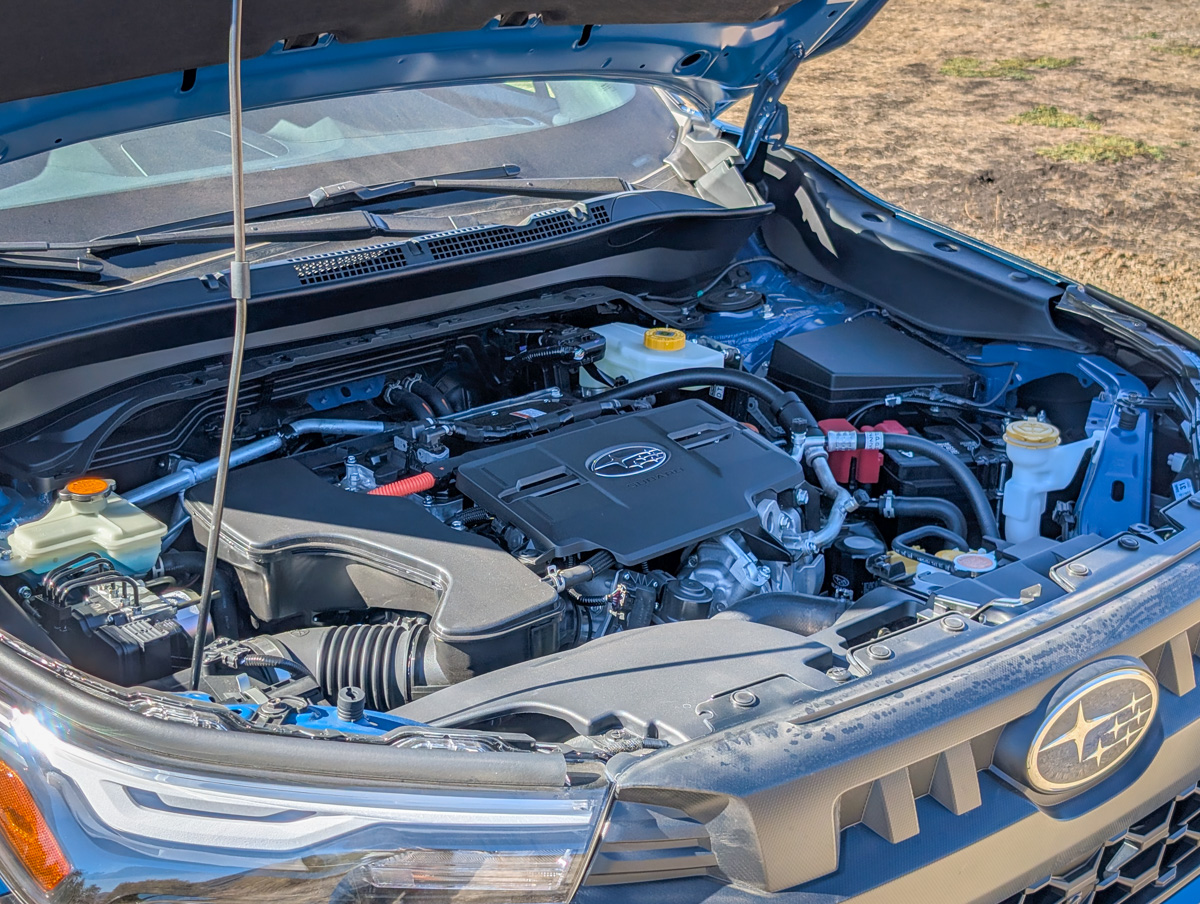
Every Forester Hybrid pairs a 2.5-liter four-cylinder boxer engine with two electric motor-generators and a small lithium-ion battery, for 194 horsepower combined. That's 14 hp more than the gas Forester, and the bump is noticeable on- and off-road. While the Toyota RAV4 Woodland powers its rear wheels with a separate electric motor, Subaru sends power to all four wheels through a mechanical driveshaft, the same way the gas model does.
The bigger change is the gearing. The gas Wilderness uses a 4.111 final drive ratio for quicker acceleration and stronger climbing, but that keeps the engine spinning faster at highway speeds. It costs fuel economy and fills the cabin with engine drone. For shoppers who like the Wilderness looks but don't need all of its capability, that revised final drive ratio ends up being a nuisance rather than a feature.
And the hybrid provides a solution to that problem. The 2027 Forester Wilderness Hybrid uses the regular Forester's 3.700 ratio and leans on electric torque instead. We expected to miss the shorter gearing, but thanks to the on-demand nature of electric power, we didn't.
We spent about seven hours testing the 2027 Forester Wilderness Hybrid on unpaved trail in the California hills, over ruts, rocks, and roots, and with fabulous cattle as our only traffic. Electric torque made slow, steep climbs easy without revving the engine hard. We used X-Mode (Subaru's off-road drive modes for snow/dirt and deep snow/mud) often, but the chunky tires and AWD system rarely needed the help. Hill descent control earned its keep on several steep downhill sections, holding a steady crawl so we could focus on steering. Through it all, the ride stayed cushioned. We weren't getting beaten up, even if our camera operator in the passenger seat was having trouble keeping us centered in the frame.
Back on pavement at 55–60 mph, the Wilderness Hybrid's difference from the gas Wilderness is obvious. There's no high-rpm drone, and the cabin is noticeably calmer. The handoff between electric and gas power is smooth. You can hear the engine start, but you can't really feel it. Press hard on the accelerator, however, and the CVT lets the revs climb before the speed catches up, a rubber-band feeling that's typical of this kind of transmission.
The steering is light, which made the Forester easy to place on narrow trails. We'd like a bit more weight at highway speeds, but it's precise and connected, and we'd take that over heavy and numb. The brake pedal is firm and linear. After a full day of climbing and descending in 80-degree heat, we noticed no fade.
Form & function
The Subaru Forester has long been one of the easiest compact SUVs to see out of, and it doesn't lose that advantage in 2027. The windshield and side windows are tall, and the front roof pillars are thin enough that they rarely block your view through a turn or around a switchback. A standard panoramic moonroof brightens the cabin, though on a hot California afternoon we could have done with a little less sun.
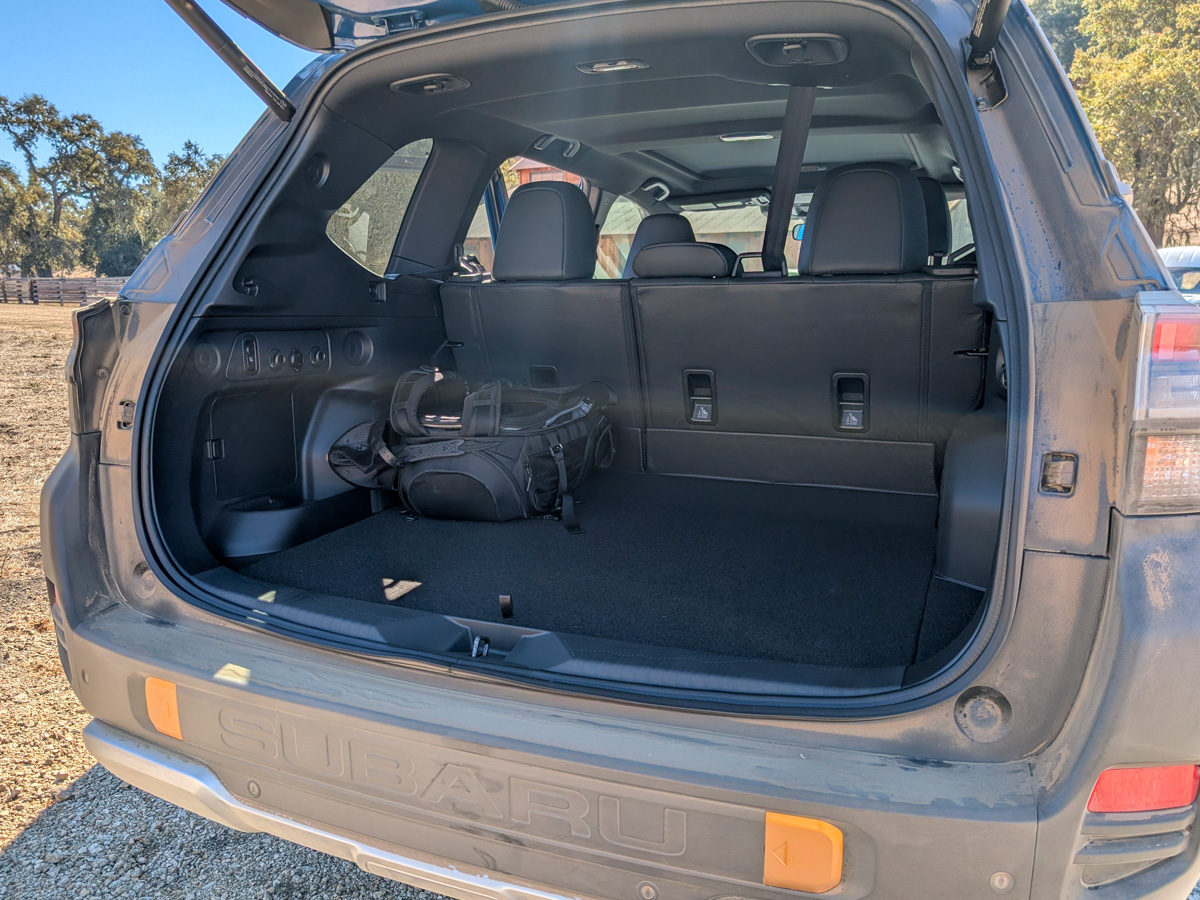
There's generous headroom up front, and the back seat offers plenty of head and legroom for adults. The rear seat reclines, and the seatbacks fold with one touch. Behind the rear seat there's 33.1 cubic feet of cargo space, which grows to 64.1 cubic feet with the seats folded. A power liftgate is standard, and the rubber cargo tray means snowy ski boots and muddy hiking gear won't be an issue. The raised suspension puts the cargo floor at 29.5 inches, slightly higher than in other Foresters, but a great sitting height for a 5-foot-11 driver.
The Wilderness-specific roof rails are rated for 220 pounds on the move and 800 pounds parked, more than other Foresters and useful if you plan to sleep up there in a rooftop tent.
Opting for the hybrid rather than the gas Wilderness requires a couple of trade-offs. First, the gas Wilderness carries a full-size spare wheel with an all-terrain tire, while the hybrid gets a tire inflator kit. An inflator can handle a nail in the tread, but it won't help you if a sharp rock rips through the sidewall, and that's exactly the damage a trail is capable of doing. If you regularly drive far from cell service, the full-size spare is the best reason to choose the gas model over the hybrid. Second, towing capacity drops from 3,500 pounds in the gas Wilderness to 1,500 pounds, enough for a small utility trailer but not much more.
Up front, the wireless charging pad is new for 2027. Taller ridges keep phones from sliding around, and it charged our Android phone at 15 watts. Physical knobs and buttons for volume, tuning, and temperature are easy to find without looking.
Technology
The Forester's tech is a split decision. The standard 12.3-inch digital instrument cluster is crisp, bright, and easy to read at a glance. It's not overly complicated or customizable, but it looks great. More on the list of positives, wireless Apple CarPlay and Android Auto are standard, as are built-in navigation, HD radio, and the new wireless charging pad. An 11-speaker Harman Kardon stereo comes standard on the Sport trim and above.
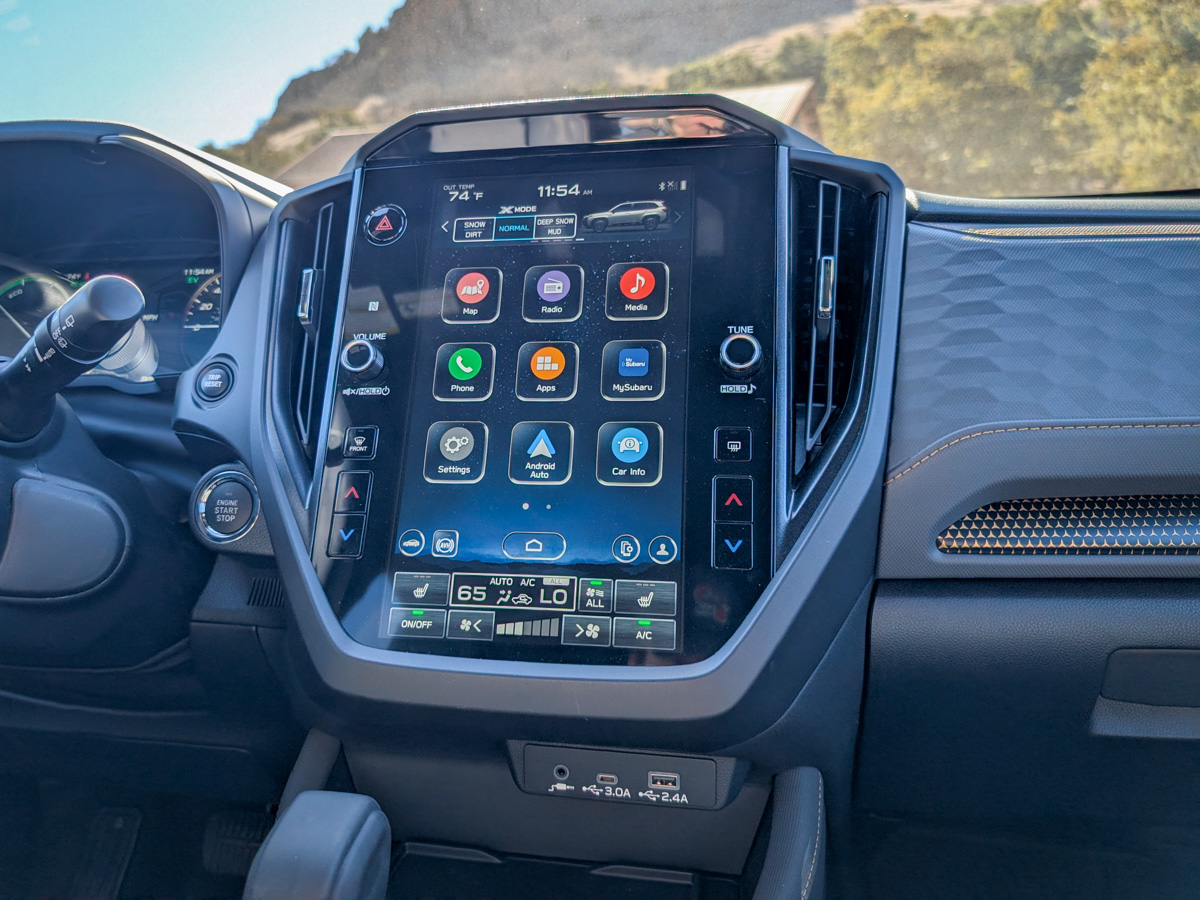
The trouble is the 11.6-inch vertical touchscreen that every Forester shares. It's bright and colorful, but it's slow. Inputs lag, and Android Auto took a noticeably long time to load. This kind of performance is hard to excuse in a new vehicle. While still a bit slow, once we had Android Auto running, it was easy to use, and we leaned on it for an off-road mapping app when we lost cell service in the hills.
Some controls are in the right place. There are physical knobs for volume and tuning, plus buttons for temperature and the defrosters. Most other climate controls sit as anchored icons along the bottom of the touchscreen, though, and the X-Mode controls require a swipe through the carousel menu at the top of the screen. Anything we might need while bouncing down a trail should have a physical button. A dedicated button does bring up the 180-degree front camera, which is genuinely useful for seeing what's over a crest. Unfortunately, its low resolution makes the image harder to read than it should be.
Subaru already has a better answer. The redesigned Outback uses a newer infotainment system with different hardware and software, and it's time for the Forester to get it. Next to the crisp instrument cluster a few inches away, the touchscreen looks and feels a generation behind.
Connected services, including remote start through Subaru's smartphone app and an onboard Wi-Fi hotspot, are available but require subscriptions.
Safety
Every Forester Wilderness Hybrid comes with Subaru's full suite of driver-assistance features, and there are no safety packages to add. Standard equipment includes forward automatic emergency braking, adaptive cruise control with lane centering, lane-departure warning, a blind-spot monitor with lane-change assist, rear cross-traffic alert, and rear automatic braking. It also adds automatic emergency steering, emergency lane-keep assist, and a rear-seat reminder. If the driver stops responding, the vehicle can bring itself to a stop.
That list matches what shoppers have come to expect in this class, and Subaru doesn't make you climb the trim ladder to get it. Only two features are held back for the top Touring Hybrid: a driver-attention monitor and a surround-view camera. The Wilderness Hybrid gets the 180-degree front camera instead, which is more useful off-road anyway. Subaru also covers the driver-assistance hardware with its own five-year, 60,000-mile warranty.
On the highway, the adaptive cruise control works well. Lane centering is better than in earlier Subarus, but it still ping-pongs between the lane lines from time to time.
The Forester's excellent outward visibility is a safety feature in its own right. Thin roof pillars and tall windows make it easier to spot pedestrians at intersections and obstacles on the trail.
In crash testing, the National Highway Traffic Safety Administration gave the 2027 Forester and Forester Hybrid five-star overall ratings. The Insurance Institute for Highway Safety hadn't rated the 2027 model at the time of writing, but the 2026 Forester earned the institute's top award, Top Safety Pick+. Since the 2027 model is mechanically similar, we expect it to do well, and we'll update this section when results arrive.
Cost-effectiveness
The 2027 Forester Wilderness Hybrid costs $42,020, including a $1,525 destination fee. That's $1,000 more than the gas Wilderness. Subaru offers no factory options beyond the floor mats and paint, and our Geyser Blue tester cost nothing extra.
The EPA rates the Wilderness Hybrid at 33 mpg city, 29 highway, and 31 combined, compared with 24, 28, and 26 for the gas Wilderness. At 15,000 miles a year and $4 per gallon, the hybrid saves about $370 a year in fuel, so it pays back its premium in under three years. Its 16.6-gallon tank gives it over 500 miles of range. Off-road is another story. We saw mileage in the low teens on the trail.
The problem is the competition. The only other off-road-themed hybrids in this class are the Toyota RAV4 Woodland and the Honda CR-V TrailSport, and both cost less and use less fuel. The RAV4 Woodland starts at $41,495 and is rated at 38 mpg combined. The CR-V TrailSport starts at $40,750 and is rated at 35 mpg combined. Using the same math, the RAV4 would save about $350 a year in fuel over the Subaru, and the CR-V about $220. Neither is nearly as capable as the Forester Wilderness Hybrid in serious off-road conditions, but for owners planning to spend far more time on pavement than on dirt, they're the better choices.
It's also worth noting that the Wilderness Hybrid trails its own siblings in fuel economy, and those siblings are no slouches off-road in their own right. Other Forester Hybrid trims are rated as high as 36 mpg combined, and the Premium Hybrid starts at $36,255.
Some shoppers may be lured by the Outback Wilderness and its 260-hp turbocharged engine, but it costs $45,540 and is rated at just 23 mpg combined.
Subaru's warranty is typical for the class, at three years or 36,000 miles bumper to bumper and five years or 60,000 miles on the powertrain. The hybrid components are covered for eight years or 100,000 miles.
The Wilderness Hybrid makes the most sense for buyers who will actually use its capability. Think of someone who lives in a city in a snowy climate and spends weekends skiing, camping, or hiking. For that driver, the small footprint and better mileage pay off on weekdays, and the hardware pays off on weekends. Shoppers who rarely leave the pavement will spend less to buy and run a Toyota RAV4 or Honda CR-V.


