2027 Toyota Sequoia Reviews, Pricing & Specs

Pros & cons
What we like
Efficient for the class
Off-road models get even more capable
Big and spacious
What to consider
Cargo and passenger space trail rivals
Not efficient compared to the overall market
It’s a lumbering beast
The CarGurus verdict
Consumers buy full-size SUVs not only for their practicality and capability, but also for adventure. The 2027 Toyota Sequoia fills all those needs.
For 2027, the Toyota Sequoia adds to its capability with more towing features as well as improved infotainment technology. It also doubles down on adventure, with a new Trailhunter package for overlanding and an improved TRD Pro trim for even more off-road capability. But those changes don’t address the Sequoia's key weaknesses.
Verdict: Full-size body-on-frame SUVs can carry the family to the lake while towing the boat. The Sequoia fills those needs, and it stands out from its full-size SUV rivals with a hybrid powertrain, albeit one that only mildly improves fuel efficiency. Its main drawbacks remain unchanged: it still lacks full-time four-wheel drive (4WD) and can’t match the competition for interior space.
out of 10 expert review
Look & feel
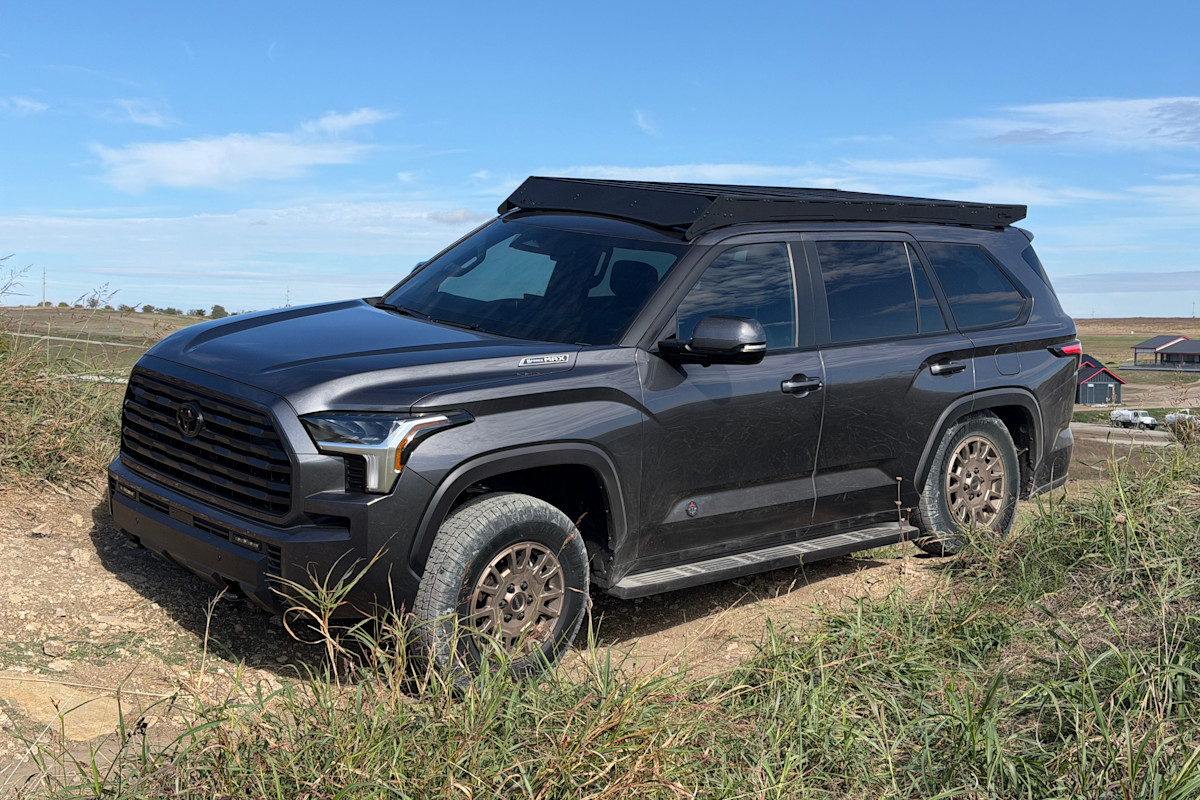
The Sequoia gets a revised look for 2027, but it will take a keen eye to spot the differences. The biggest one is a front bumper that angles up at the sides in a slight grin rather than being entirely horizontal. Otherwise, the chunky shapes from last year remain, though they are slightly tweaked in the front bumper, headlights, and front air intakes. One important change is a newly-standard pair of red tow hooks on the TRD Pro. The grille changes by model and it, too, is ever-so-slightly revised while keeping its six-sided shape that pinches in at the top.
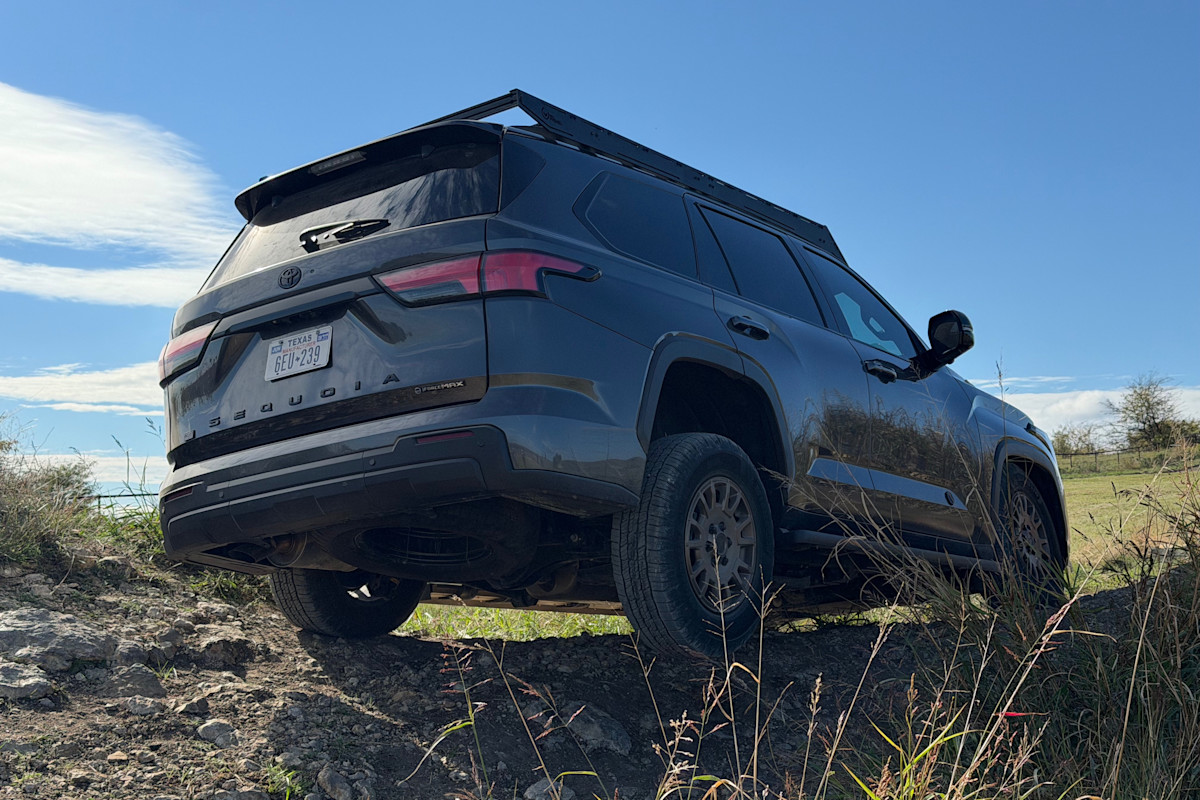
The flanks remain unchanged, with a shoulder line that drops down from a tall hood to the front doors. Delineated fender haunches front and rear also look chunky while imparting a sense of power. Black fender flares add a more rugged look to the off-road trims, while the more street-oriented models get body-color flares. At the rear, “Sequoia” lettering runs along the bottom of the tailgate and right-angle tail lights are connected by a black trim piece. Buyers have a choice of 18-, 20-, or 22-inch wheels, with the 18s reserved for the TRD Pro and Trailhunter, both with all-terrain tires.
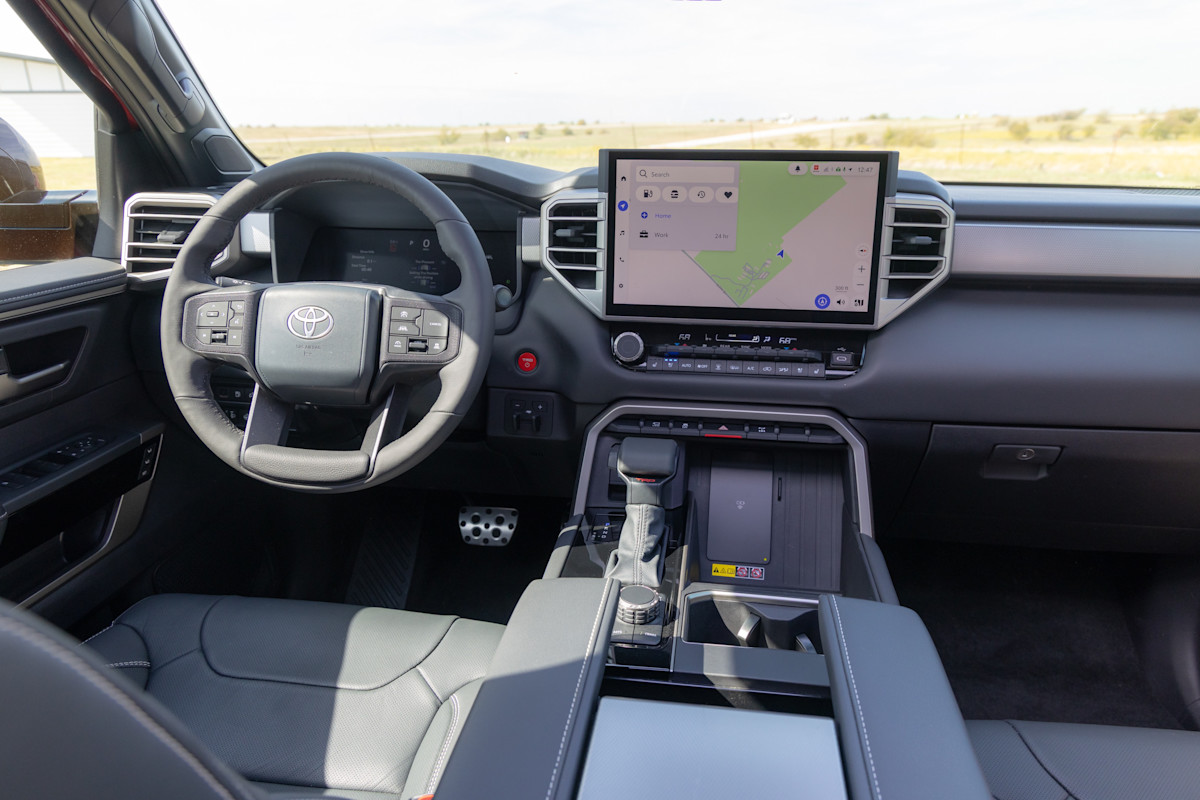
The blocky exterior design rubs off on the cabin, where large gray air vents dot a dash that emphasizes a horizontal design. The large touchscreen sits in the middle of it all, and the chunkiness extends to a large, squarish shifter and large dials that respond well to gloved hands. The controls work well and are within easy reach, but at these prices, the Sequoia’s reliance on hard plastic is disappointing. Toyota does apply soft-touch surfaces to the places occupants might rest their limbs, such as on the center console, door tops, and armrests.
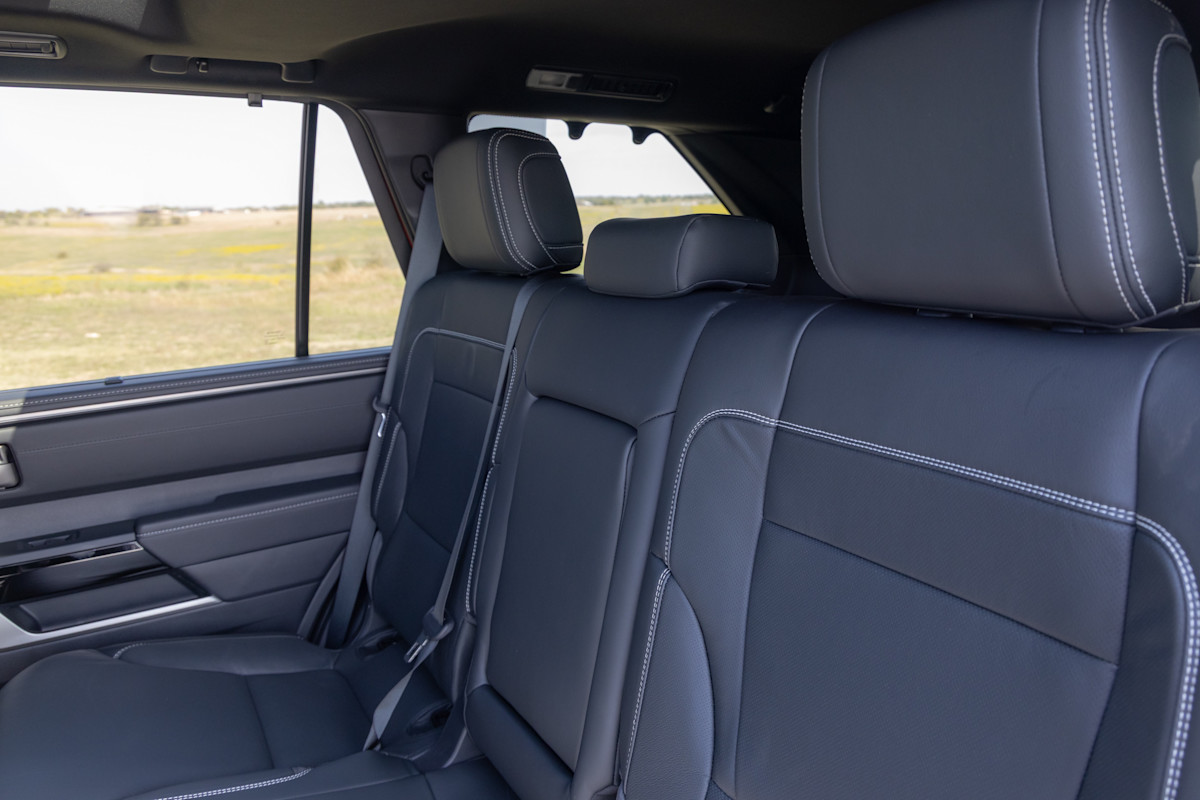
The upholstery quality increases as you move up the trim ladder. Cloth upholstery adorns the SR5, the TRD Pro gets synthetic leather in a camouflage pattern that feels appropriately utilitarian, and two grades of leather are offered on higher street-focused trims. All trims also improve comfort with standard heated front seats and a power driver’s seat. Ventilated front seats come in most models, and the Capstone gets massaging front seats. Heated and ventilated rear seats are available for several trims. A heated steering wheel is standard on all but the two base trims.
Performance
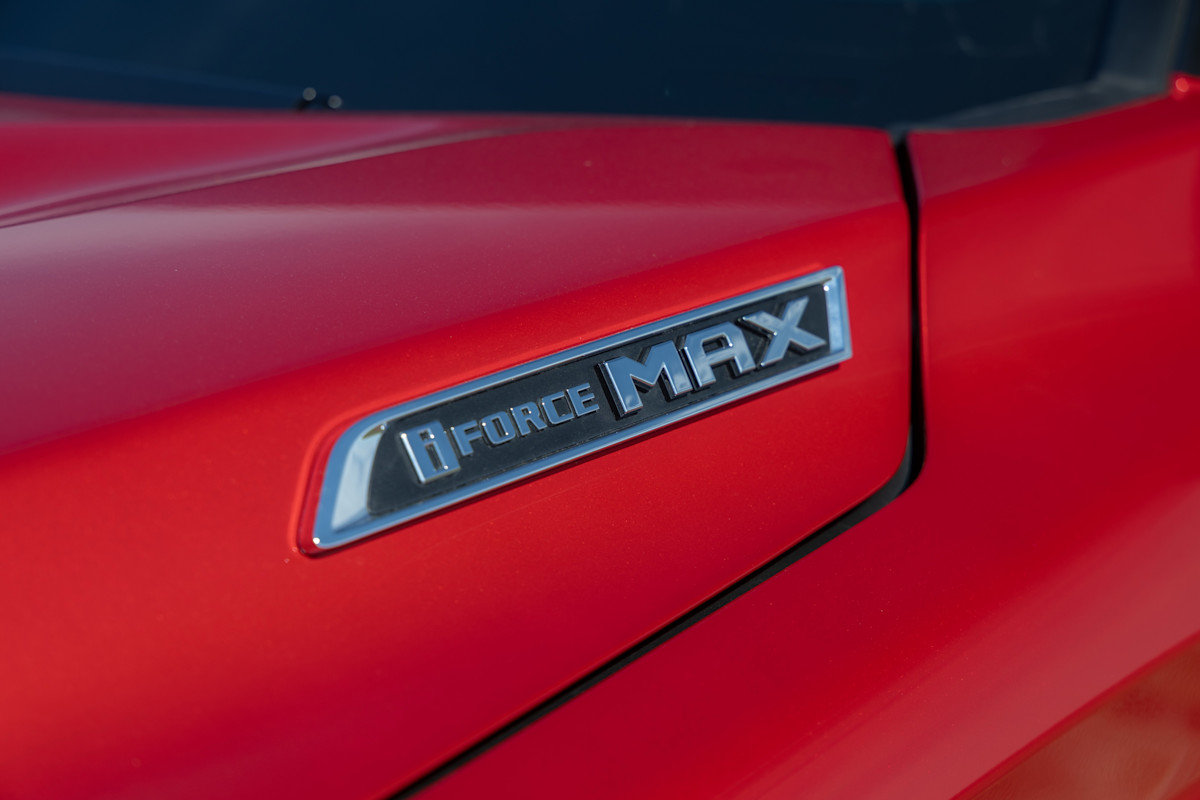
The Sequoia comes only as a powerful hybrid. The powertrain is called i-Force Max and it teams a twin-turbocharged 3.4-liter V6 with an electric motor between the engine and 10-speed automatic transmission. The motor can add 49 horsepower and 184 pound-feet of torque to aid acceleration, and total output is 437 hp and 583 lb-ft of torque. The motor is powered by a 1.87-kWh battery pack below the rear floor.
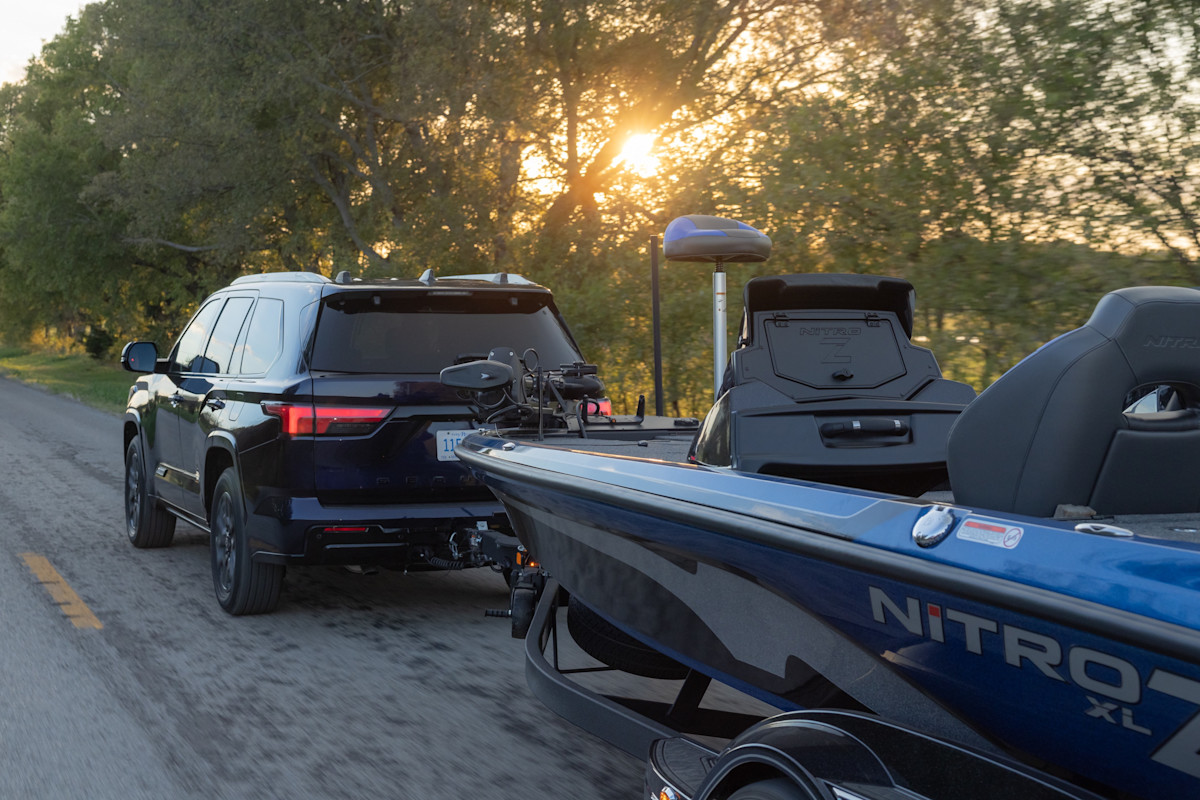
This is a robust powertrain with a V8 feel. It provides quick acceleration, with a 0-60 mph time of about 6 seconds, and it has plentiful passing power. In our experience, it never felt flat-footed when power was needed; the smooth 10-speed does a good job of keeping it in the powerband. It also emits a loud, almost V8-like growl whenever you get on the throttle. The Sequoia is rated to tow up to 9,120 pounds. That’s 400 pounds less than last year but still quite a lot for the class. An integrated trailer brake controller helps drivers manage the load behind the vehicle.
As a body-on-frame full-size SUV that weighs about three tons, the Sequoia’s handling is ponderous. It’s a plodder with slow but direct steering and plenty of body lean in corners, thanks in part to a standard 8.7 inches of ground clearance. However, it’s no worse than its rivals, and the double-wishbone front suspension and coil-sprung multi-link rear suspension make it fairly well controlled.
We drove the two off-road-oriented models, the TRD Pro and the SR5 with the Trailhunter package. Both come with 18-inch wheels with all-terrain tires, front tow hooks, a front skid plate, all-weather floor mats, Rigid Industries fog lights, an electronically controlled locking rear differential, Crawl Control, and Multi-Terrain Select with several off-road driving modes.
The Trailhunter features Old Man Emu dampers and Michelin LTX Trail all-terrain tires, while the TRD Pro gets Falken Wildpeak all-terrains, a unique front stabilizer bar, and new Fox QS3 shocks with three-way adjustment (you have to reach behind the tires to do that). The middle setting is about as firm as the TRD Pro was last year, the base setting is softer and the top setting is firmer.
On low- and high-speed off-road courses the Trailhunter’s suspension was the softest by far. It allows more body lean but it’s more likely to mitigate the effects of hard bumps on passengers. The TRD Pro, was far more firm in its middle setting and the top setting might even be too stiff, though we didn’t get the chance to try it. However, the TRD Pro has less body lean and is better at absorbing the impact on the suspension (though perhaps not the passengers) of harsh bumps, jumps, and broken or bumpy surfaces at high speeds.
The Sequoia’s 4WD system has low-range gearing for low-speed crawling over rocks, but it only works part time. It teams with the features mentioned above to make the Sequioa’s off-road variants true billy goats. They can handle some technical terrain most rivals can’t match (in part because they’re too big). However, some rivals have full-time 4WD systems with an Auto mode for use on dry pavement. Most buyers will prefer that type of set-it-and-forget-it system. Once in 4Hi or 4Lo, drivers can choose from modes that adjust the traction control and other vehicle systems for Deep Snow, Mud, Sand, or Dirt conditions. Unlike the 4WD system, there is an Auto setting for these drive modes.
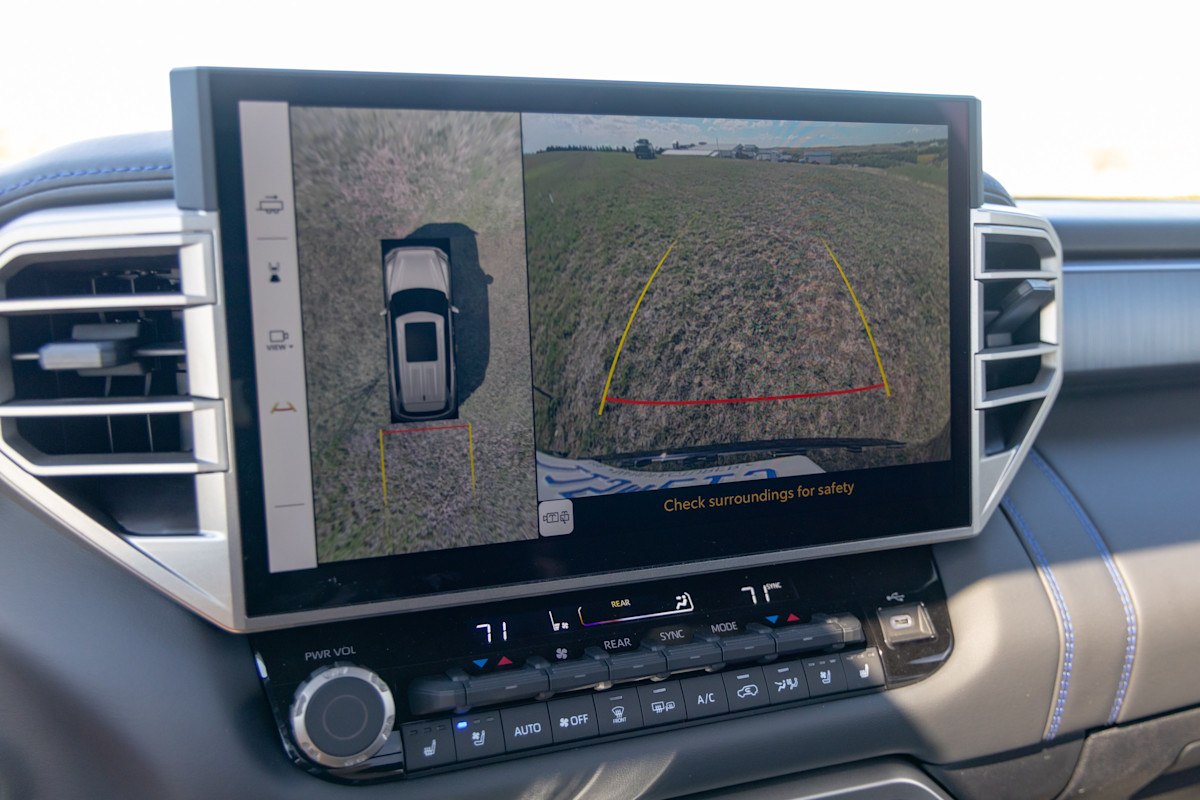
Finally, the surround-view camera system helps when off the beaten path thanks to its forward, rear, and front and rear side views; it also has readouts for degrees of pitch and yaw.
Form & function
The 2027 changes do nothing for the Sequoia's compromised interior space. By virtue of its enormous size, it’s still quite roomy, and its three rows of seats can accommodate up to eight passengers, but the hybrid components sap room from the rear cargo floor, and third-row space trails rivals.
Front-row occupants have it good, with standard eight-way power seat adjustment and two-way power lumbar adjustment. The seats are wide enough for bigger backsides, but they’re a bit too flat to keep people comfortable on a long trip.
It’s also rather pleasant in the second row, especially for two when buyers pick the available captain’s chairs. With the bench seat, the Sequoia’s width makes three across a comfortable proposition as well. The second row offers two USB-C ports to charge phones, plus a 115-volt outlet to plug in electronics.
The second-row seats tilt and slide forward for access to the third row, and that gets even easier with the walk-through between the captain’s chairs. The third row has enough headroom for six-footers, but the seat bottoms are low, creating a knees-to-your chin seating position that hurts long-trip comfort with its lack of thigh support. Third-row riders can recline their seat backs for a bit more room.
While the Sequoia has lots of cargo space, it trails its full-size SUV rivals. It has only 11.5 cubic feet of cargo space behind the third row, which grows to 22.5 cubic feet if you push the third row forward. Fold down the third row and cargo space improves to 49 cubic feet, and tops out at 86.9 cubic feet with the second and third rows folded flat. All of the Sequoia’s competitors are roomier and most have a flat load floor instead of the Sequoia’s stepped floor. For instance, the Chevy Tahoe has 25.5 cubic feet of space behind the third row, 77.5 cubes behind the second row, and 122.7 cubic feet with the rear rows down. Toyota provides a cargo shelf that flattens out the load floor by sitting above the folded third row.
Technology
For 2027, Toyota improves the Sequoia's connected technology across the board. The biggest change is to the base system as the SR5’s an 8-inch infotainment touchscreen gives way to the 14-inch touchscreen that was already standard in all other trims. It also has a standard 12.3-inch digital instrument cluster.
The touchscreen works on a new software platform called Arene. It upgrades the voice recognition, connectivity, and safety and security features, and offers over-the-air updates. It’s also updated with AT&T 5G network connectivity, and it has a permanent Quick Control menu on the left side of the screen with icons for home, navigation, entertainment, phone, and settings screens. Also standard are wireless Apple CarPlay and Android Auto, a wireless smartphone charger, a three-month satellite radio trial, and an eight-speaker audio system. Most trims upgrade to a 14-speaker JBL audio system.
The screen is large and easy to reach, and it can split the screen to allow for native controls while using Apple CarPlay or Android Auto. This makes it much easier to change your satellite radio stations while using CarPlay, and every automaker should follow suit. The climate controls remain separate from the screen, making them easier to locate and use.
A new standard dash cam uses the external camera to record 20-second clips either when the driver manually starts recording or when the system detects a triggering driving event. In our case, sliding the Sequoia around an off-road course was enough of a trigger.
Toyota also gives buyers several connected subscriptions. Wi-Fi Connect comes standard for a month. Safety Connect with emergency roadside assistance and a stolen vehicle locator is standard for five years. Also free for half a decade are Remote Connect (which provides access to the Toyota app and a digital key), and Service Connect (with maintenance reminders and vehicle health reports). Finally, Drive Connect with cloud navigation, Google points of interest data, and destination assist is free for three months.
Safety
The 2027 Toyota Sequoia gets an upgraded safety suite called Toyota Safety Sense 4.0 (up from 2.5) that improves its sensing capabilities and adds some new features. Standard features include: forward collision warning with pedestrian detection, adaptive cruise control, lane-departure warning, lane-tracing assist, road sign recognition, high-beam assist, safe exit alert, a surround-view camera system, and an emergency drive-stop system that stops the vehicle if the driver is not attentive when using lane-tracing assist.
Also standard are trailer-specific features like automatic trailer detection, trailer blind-spot monitoring, and trailer lane-tracing assist, as well as an updated version of the previous trailer backup guide.
Outside of Safety Sense 4.0 are standard front and rear parking sensors with automatic braking, blind-spot monitoring, rear cross-traffic alert, and an advanced rear-seat reminder that can detect movement in the back seats and warn the driver with the horn, hazard lights, chimes, and even text messages and phone calls.
Safety ratings for the 2027 Sequoia were not available at the time of writing. However, it should do better than the 2026 model, which received mixed ratings from the Insurance Institute for Highway Safety (IIHS). The 2026 model received a top Good score in the small overlap and updated side crash tests, but a Marginal rating in the updated moderate front overlap test. Its base headlights got the worst Poor score but headlights on higher trim levels received a Good score. Its front crash prevention system received a Good vehicle-to-pedestrian rating and a Marginal vehicle-to-vehicle rating.
We tested the new trailer backup guide that can turn the steering wheel and show the trailer’s path as you back up. The driver uses a slider on the center screen to direct the vehicle and trailer. This system makes the tough job of reversing with a trailer easier, but it’s still tough. The screen slider isn’t too hard to use, but the Ford Expedition has an easier-to-use dial. In addition, an optional Tow Tech package includes a wireless trailer camera system so you can see behind the trailer from the cabin. We should mention that we tested a previous-model-year Sequoia with the optional tow mirrors and found they blocked the view of pedestrians and even other vehicles at neighborhood stop signs.
The Sequoia also lacks any type of hands-free driver-assist system, which puts it behind the competition from Ford and General Motors. In addition, the windshield is short due to a high hood, which blocks the view in the immediate front of the vehicle.
Cost-effectiveness
Toyota offers the 2027 Toyota Sequoia in SR5, Limited, Platinum, TRD Pro, 1794 Edition, and Capstone trims. The SR5 starts at $72,095, an increase of more than $4,000 from last year, but 4WD is now standard; it was $3,000 extra on 2026 models. The Limited runs $77,695, the Platinum costs $85,595, the TRD Pro commands $88,120, and the appropriately-named Capstone sits at the top of the heap at $90,095. Those prices are higher than most rivals.
The Sequoia comes only as a hybrid and while it does offer better fuel economy than most rivals, it’s not really fuel-efficient. Toyota estimates fuel economy at 19 mpg city, 22 mpg highway, and 20 mpg combined for all trims. In our drive of a 2026 TRD Pro model, we got 15.2 mpg over 120 miles of driving on city streets and freeways, and you can expect similar real-world mpg in the 2027 model. That’s not great, but the only competitors that can better that are GM models equipped with the optional diesel engine.
The Sequoia stands out for its hybrid powertrain and the advanced off-road capability of its Trailhunter and TRD Pro variants. However, the lack of rear cargo space and full-time 4WD may send some potential buyers to other brands.
What owners say
Trims & specs
Base MSRP $69,900 | Seating 8 |
Engine N/A | Cargo Capacity 22.3 cu ft |
Fuel Economy N/A | Drivetrain N/A |
Base MSRP N/A | Seating 8 |
Engine N/A | Cargo Capacity 22.3 cu ft |
Fuel Economy N/A | Drivetrain N/A |
Base MSRP $75,500 | Seating 8 |
Engine N/A | Cargo Capacity 22.3 cu ft |
Fuel Economy N/A | Drivetrain N/A |
Base MSRP N/A | Seating 8 |
Engine N/A | Cargo Capacity 22.3 cu ft |
Fuel Economy N/A | Drivetrain N/A |
Base MSRP $85,925 | Seating 7 |
Engine N/A | Cargo Capacity 22.3 cu ft |
Fuel Economy N/A | Drivetrain N/A |
Base MSRP $84,400 | Seating 7 |
Engine N/A | Cargo Capacity 22.3 cu ft |
Fuel Economy N/A | Drivetrain N/A |
Base MSRP $87,900 | Seating 7 |
Engine N/A | Cargo Capacity 22.3 cu ft |
Fuel Economy N/A | Drivetrain N/A |
Base MSRP $83,400 | Seating 7 |
Engine N/A | Cargo Capacity 22.3 cu ft |
Fuel Economy N/A | Drivetrain N/A |


