2027 Volkswagen Atlas Reviews, Pricing & Specs


Pros & cons
What we like
Spacious third row
Premium interior materials
Comfortable ride
What to consider
Polarizing design
Unintuitive technology
No hybrid option
Expert review
A new Atlas fixes the ride, updates the cabin, and complicates the face.
Nearly a decade after its debut, the 2027 Volkswagen Atlas is finally all-new. The second-generation model brings real wood trim, bigger screens, and a better ride. It also costs about $2,000 more, and its new face is a step backward. Still, the redesign gives one of Volkswagen’s best-selling models plenty of new reasons to shop it.
Verdict: The 2027 Volkswagen Atlas fixes its predecessor’s biggest flaw and adds a lot of standard equipment for only a little more money. If buyers can live with a touch-heavy dashboard and a face that isn’t as handsome as the old one, it’s an easy SUV to recommend.
out of 10 expert review
Look & feel
Looking at the 2027 Volkswagen Atlas, it's easy to feel bad for the car’s designers. Updating a vehicle’s appearance and injecting life and style into sheet metal is hard enough, but to reskin an already beautiful car? It’s why Porsche has evolved the 911 so gradually that only enthusiasts can easily tell one generation from the next. If it’s not broken, don’t fix it.
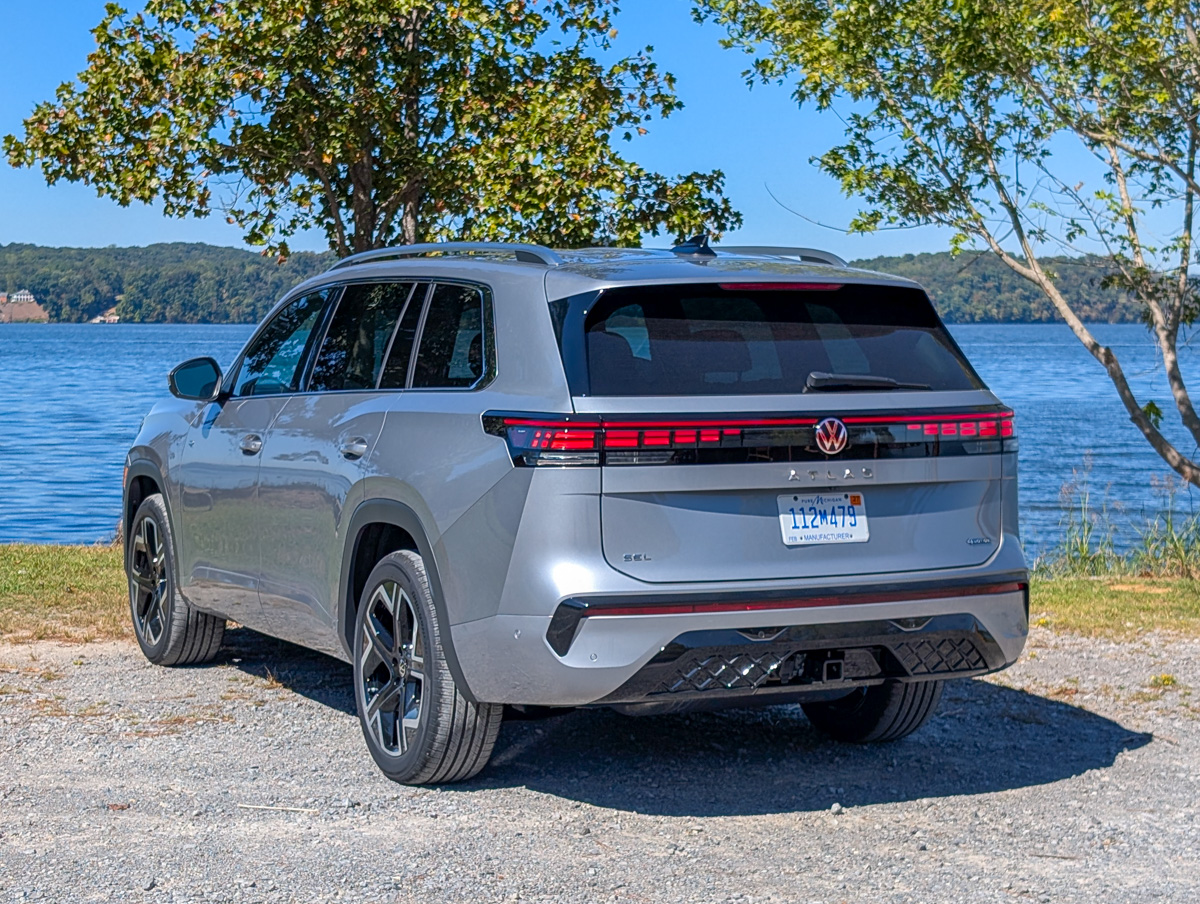
Most of the redesign works, and the profile is terrific. A crisp character line runs high down the side and swells over the rear fenders, and together with the flared wheel arches, it gives the Atlas the kind of shoulders a big SUV ought to have. The rear is even better, with cascading taillights that span the liftgate and offer three selectable lighting animations to greet drivers as they walk up. We don’t love the honeycomb lower diffuser, which looks busy, but that’s a small issue.
The front is where the Atlas loses us. There are two light bars, stacked headlights on each side, a big plastic chin, and a VW badge that sits just under the top bar rather than evenly between the two. Everything seems to come in pairs, and the effect is a little like seeing double. Judged on its own, it’s a perfectly fine face. Judged against the old Atlas, it’s a downgrade.
Wheel sizes run from 18 inches on the SE to 20 inches on the SE w/Tech and SEL R-Line. Our SEL Premium R-Line rolled on 21-inch machined wheels. We didn’t care for them in photos, but they look a lot better in person.
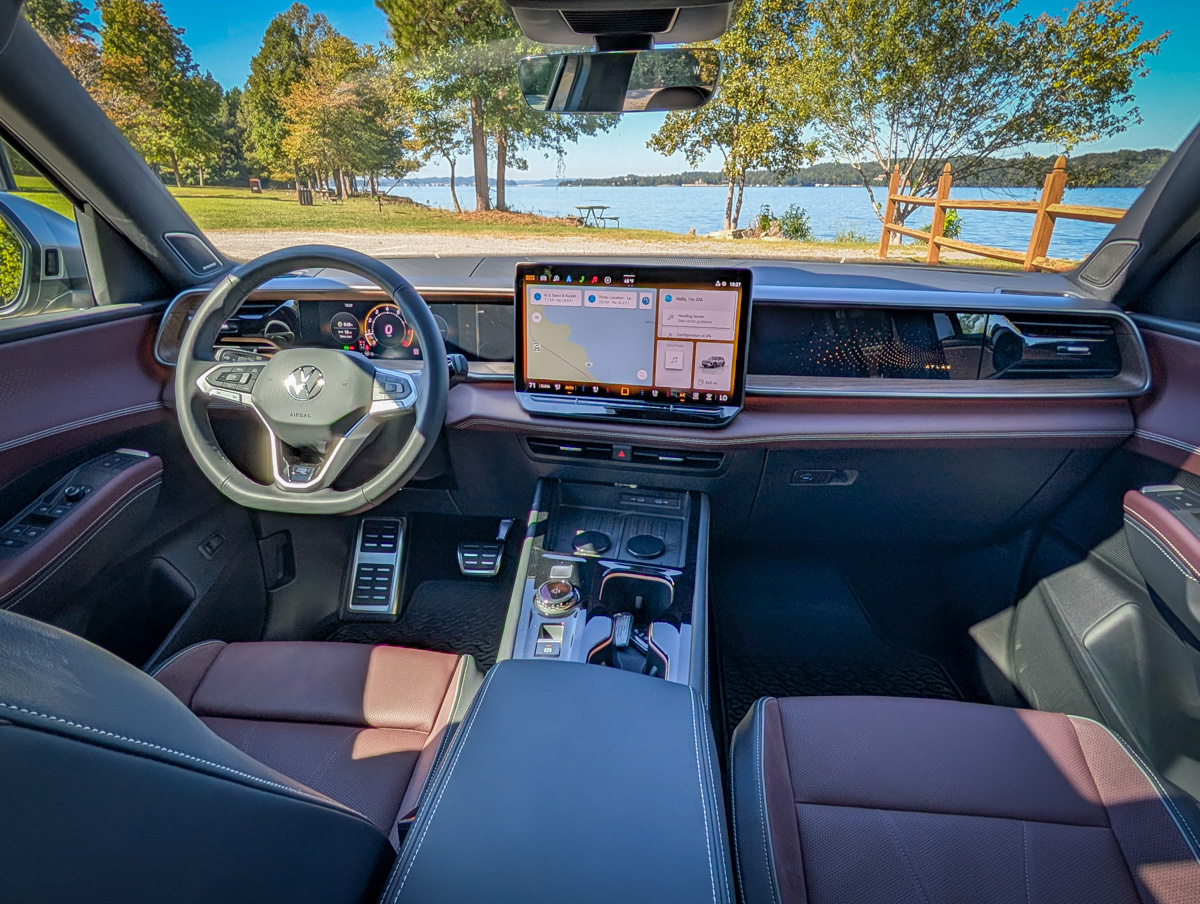
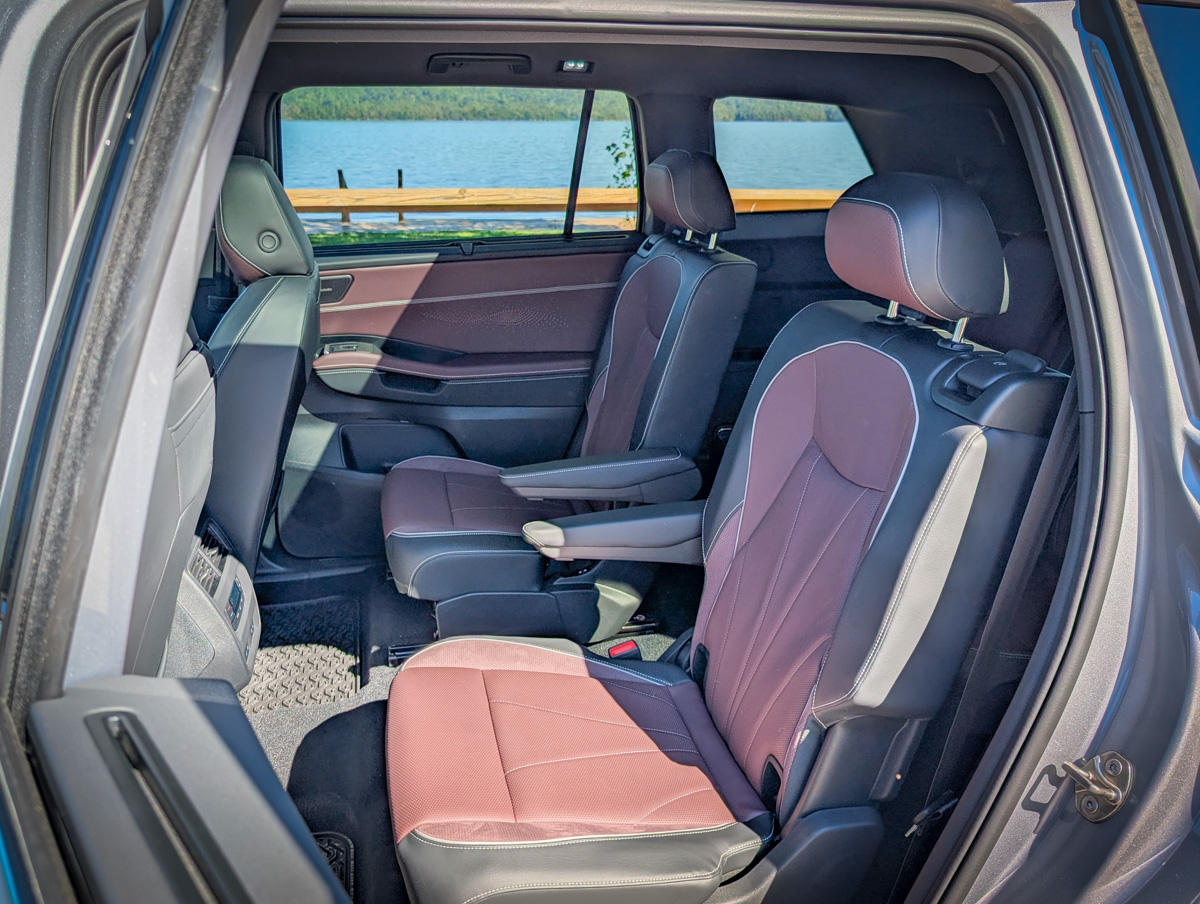
The interior is a big step up. Every trim now gets real wood on the dash, something you won’t find in the base model of any key rival. Leatherette is standard, the SEL R-Line moves to Varenna leather, and the SEL Premium R-Line gets Nappa. Our car’s Garnet Red Nappa, a deep burgundy, makes the cabin feel warm and special in a way black and gray interiors rarely manage. For those buying the top trim, it’s the one to get. We’ve been complaining about Volkswagen’s piano-black plastic for years, and for Pete’s sake, it’s still here. It picks up fingerprints and is nearly impossible to keep smudge-free.
Then there’s the light show: 10 colors of ambient lighting come standard, the SE w/Tech adds a glowing loop around the dashboard, and the R-Line trims step up to 30 colors with backlit patterns in the door panels. After dark, it’s less “relaxing drive home” and more “we’re going clubbing”. Some buyers will love it, others will go looking for the off switch.
Even so, this cabin looks and feels more expensive than the price suggests. The Honda Pilot and the Toyota Grand Highlander look downright utilitarian by comparison.
Performance
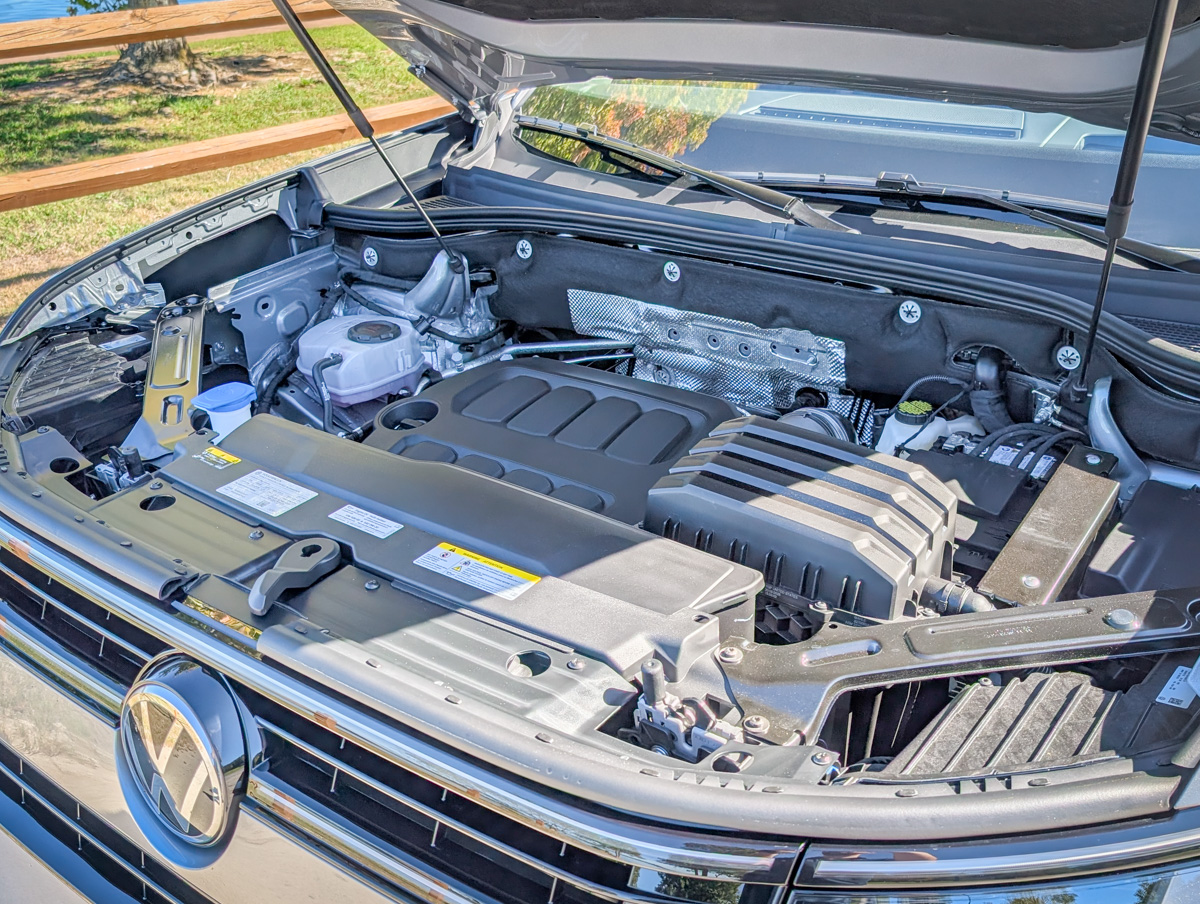
Volkswagen has been tinkering with its EA888 engine for nearly 20 years, and the latest version makes 282 horsepower in the Atlas. That’s 13 more than last year and an impressive number from a 2.0-liter turbocharged four-cylinder. But curiously, torque heads the other direction, dropping 15 pound-feet this year to 258. Despite the reduced torque, this vehicle is hardly slow, and a light touch of the accelerator has the Atlas scooting like it’s late for something.
That said, this eagerness is also sort of a problem. The engine always seems a little busy and frantic when what we want from a nearly 4,600-pound family hauler is something lazier, that gathers speed without making a fuss. The old VR6, which Volkswagen retired for the 2024 model year, did that beautifully, even if it came at the expense of fuel economy. For shoppers who want swells of power rather than jolts of acceleration, the Honda Pilot’s V6 remains the segment’s most satisfying engine. The Atlas engine is perfectly good, but it never lets drivers forget it’s working.
At least the eight-speed automatic is easy to live with. It delivers smooth, well-timed shifts. Front-wheel drive (FWD) is standard on the SE and SE w/Tech, all-wheel drive (AWD) costs $2,000 on those trims, and both R-Lines come with AWD standard.
It sounds like a cliché, but the Atlas just drives like a Volkswagen. The steering tightens up at highway speeds with almost no slack off center, so the Atlas tracks straight without the constant small corrections many big SUVs demand. Find a curvy road and it’s a hoot, which isn’t something we say about many three-row family vehicles. From the driver’s seat, it even feels smaller than it is, though the beltline sits higher than we’d like.
Better still, Volkswagen has fixed the ride. On 21-inch wheels, the 2026 Atlas was harsh enough that we called ride quality its biggest weakness. The 2027 model wears the same size wheels and tires yet rides like a different vehicle. It’s quiet, too, at least until about 60 mph, when wind noise starts whistling around the side mirrors.
Fuel economy improves, too. The Environmental Protection Agency (EPA) rates the Atlas at 25 mpg combined with FWD and 23 mpg with AWD, two mpg better than before in both cases. We saw 22 mpg over 133 mostly highway miles in our AWD tester, a touch below the estimate. Every trim except the SE gets a factory hitch and a 5,000-pound tow rating. SE owners who add an aftermarket hitch are limited to 2,000 pounds.
Form & function
The Atlas has always been one of the roomiest SUVs in its class, and the new one gives almost none of that space back.
The front seats are pure Volkswagen, firmer and more supportive than plush, and they kept us comfortable through nearly a full day behind the wheel. The R-Line trims add memory and thigh support for the driver, and the SEL Premium R-Line adds massage for both front occupants.
The second row has plenty of room to stretch out. With the seat slid all the way back, a 5-foot-11-inch adult has legroom to spare. Rear climate controls and new B-pillar vents are standard, and the R-Line trims add heated and ventilated outboard seats, which we put to good use on a sweltering Alabama afternoon. Our car had the $695 captain’s chairs, which drop seating from seven to six. Either way, the second row flips and slides forward for third-row access, even with a child seat installed.
The third row is where most three-row SUVs start making excuses, but the Atlas offers genuine, adult-friendly space. With the second row slid forward to a spot its passenger could tolerate, that same 5-foot-11-inch adult fit in the way back without complaint. The wheel wells eat into foot space, and the cupholders are small and plasticky, but 34.1 inches of legroom is plenty for most adults. There are only two seats back there, so this is a six- or seven-seater, never an eight.
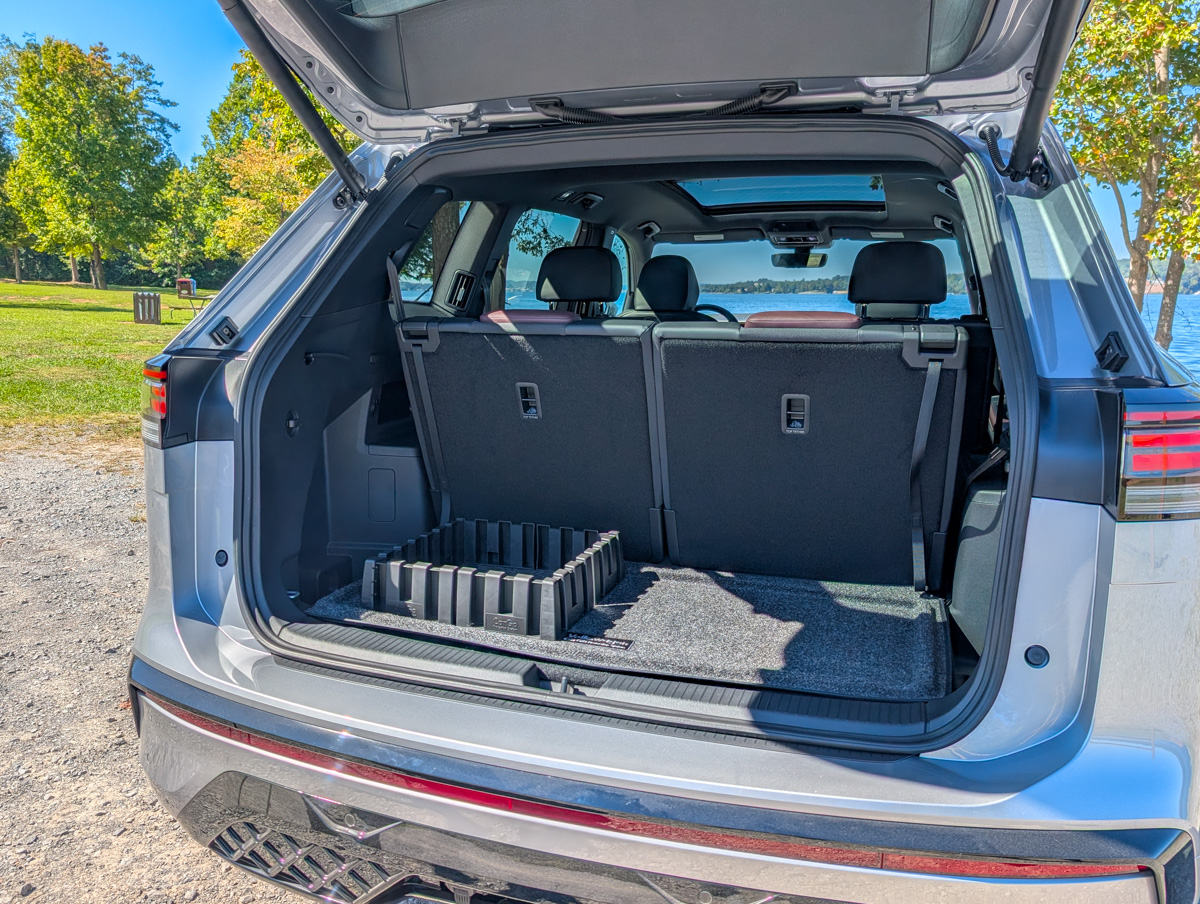
Behind the third row, the Atlas holds 21.2 cubic feet, more than the Hyundai Palisade (19.2) or Toyota Grand Highlander (20.6). Fold the third row and it opens up to 55.9 cubic feet—well ahead of the Palisade’s 46.3 but shy of the Grand Highlander’s 57.9. With every rear seat folded, the Atlas swallows 95.4 cubic feet. That’s nearly nine cubic feet more than the Palisade's, a bit less than the Grand Highlander’s 97.5, and, oddly, 1.2 cubic feet less than that of the outgoing Atlas.
A hands-free power liftgate, second-row sunshades, and dual cargo-area lights are now standard. Hardly groundbreaking stuff, but parents will notice.
Technology
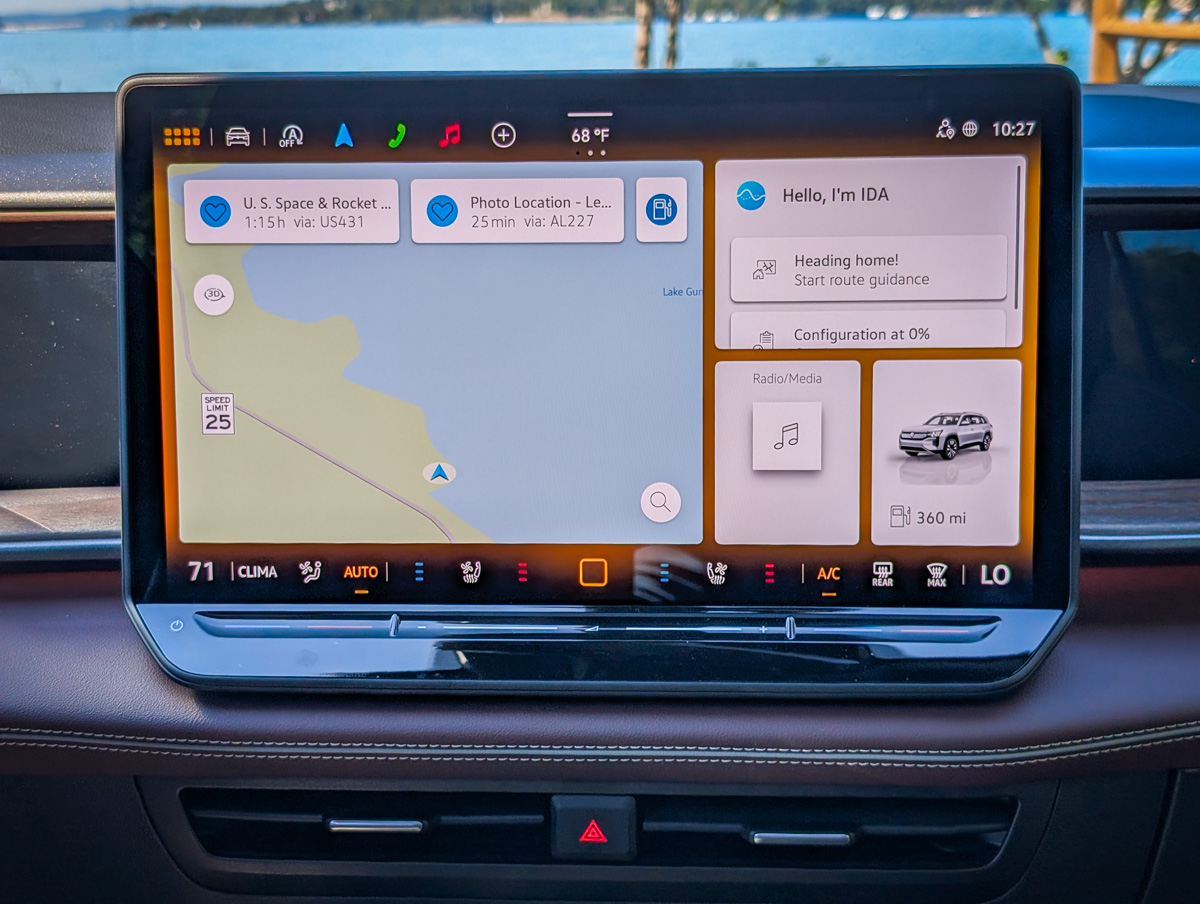
Every Atlas has a 15-inch touchscreen except the base SE, which makes do with a 12.9-inch unit that’s still enormous. Both look sharp and respond quickly, a 10.25-inch digital gauge cluster comes standard, and the R-Line trims add a head-up display.
The problem is that those screens do nearly all the work, and too many everyday tasks take too many taps. The climate and volume sliders beneath the display are backlit now, which should fix our biggest complaint about the 2026 model, whose sliders all but vanished at night. They still offer no haptic feedback, though, so using them on the move takes more guesswork than it should. Drivers can adjust the temperature on the touchscreen instead, and a new Driver Experience Dial finally brings back a real volume knob. It also cycles through drive modes and Atmospheres, VW’s five preset combinations of ambient lighting and audio settings. Set everything once, leave it alone, and none of this will be much trouble, but those who like to fiddle should expect a learning curve.
Device charging, on the other hand, is generous. Two Qi2 wireless pads come standard, along with seven USB-C ports spread across all three rows, six of them rated at 45 watts. Nobody will be fighting over an outlet in this car. A nine-speaker stereo is standard, and the SEL Premium R-Line gets a 14-speaker Harman Kardon system.
Some features require a subscription after a three-month trial, including Premium Navigation, the Wi-Fi hotspot, AirConsole games that turn passengers’ phones into controllers, and a ChatGPT-powered voice assistant. We spent a good part of our drive chatting with that assistant. It handles basic commands well, but more complex questions trip it up, and its answers come with little context. Ask it for good local lunch spots, for example, and it produces a list of names with no further information. Wireless Apple CarPlay and Android Auto are standard, and plenty of owners will happily use them instead.
Safety
At the time of writing, the 2027 Atlas hadn’t been crash-tested by the Insurance Institute for Highway Safety (IIHS) or the National Highway Traffic Safety Administration (NHTSA). The outgoing model earned a five-star overall rating from the NHTSA and a Top Safety Pick+ from the IIHS, but those results don’t carry over to an all-new vehicle.
What we do know is that the standard safety roster is long. Every Atlas gets VW’s IQ.Drive suite, which includes automatic emergency braking with pedestrian and cyclist detection, blind-spot monitors, rear cross-traffic alert, lane-keep assist, and adaptive cruise control with stop-and-go. Travel Assist, VW’s hands-on driving aid, can now make driver-initiated lane changes.
The most interesting new feature is one we hope nobody ever uses. If Emergency Assist Plus decides the driver has become unresponsive, it tries to rouse them with brake jolts and the horn. If that doesn’t work, it steers the Atlas to the right side of the road and stops. We didn’t test it, for obvious reasons.
A new front center airbag brings the total to seven, and front and rear parking sensors, auto hold, and safe-exit assist are now standard. The R-Line trims add predictive adaptive cruise control, and the SEL Premium R-Line adds a surround-view camera and automatic parking.
Cost-effectiveness
The 2027 Atlas starts at $43,135 for an SE with FWD, and all prices here include the $1,525 destination fee. The SE w/Tech starts at $47,135, with AWD adding $2,000 to either trim. The SEL R-Line costs $53,635, the SEL Premium R-Line costs $58,135, and our test car came to $58,830 with captain’s chairs.
That’s about $2,000 more than last year’s Atlas. Nobody likes seeing a price climb, but the truth is that big family SUVs aren’t as cheap as they used to be, and the new Atlas packs a lot more standard equipment for the money. It also helps that most of the lineup stays within reach. The average list price of a new vehicle on CarGurus hit $51,700 in August 2026, and four of the six Atlas configurations come in under that. Even the top trim stays below $60,000.
Against the competition, the Atlas’s starting price lands right in the middle.
| Model | Base Price | Hybrid Base Price |
|---|---|---|
| Ford Explorer Active RWD | $40,475 | N/A (no hybrid) |
| Kia Telluride LX FWD (EX FWD) | $40,735 | $48,035 |
| Hyundai Palisade SE FWD (SEL FWD) | $41,385 | $46,210 |
| Volkswagen Atlas SE FWD | $43,135 | N/A (no hybrid) |
| Toyota Grand Highlander LE FWD (Hybrid LE AWD) | $43,855 | $47,205 |
| Honda Pilot Sport FWD | $43,990 | N/A (no hybrid) |
All prices include each manufacturer’s destination fee.
On fuel economy, the Atlas is right in line with other gas-only three-row SUVs and noticeably better than the V6-powered Pilot and Palisade, but there’s no hybrid, and three of its rivals offer one. The Palisade, the Grand Highlander, and the Telluride hybrids cost more up front, but they’re far more efficient, and high-mileage families will see real savings.
VW’s four-year/50,000-mile warranty, two years of complimentary scheduled maintenance, and three years of roadside assistance are fine, but Hyundai and Kia back their powertrains for 10 years or 100,000 miles.
Our pick is the Atlas SE w/Tech. At $47,135 with FWD or $49,135 with AWD, it adds the 15-inch screen, factory hitch, remote start, and illuminated light bar while staying under the market average. The R-Line trims are lovely, and that Garnet Red Nappa is hard to forget, but the SE w/Tech delivers most of what makes the new Atlas worth buying for a lot less money.

What owners say
Trims & specs
Base MSRP $41,610 | Seating 7 |
Engine 2.0L 282 hp I4 | Cargo Capacity 21.2 cu ft |
Combined MPG 25 | Drivetrain FWD |
Base MSRP $52,110 | Seating 7 |
Engine 2.0L 282 hp I4 | Cargo Capacity 21.2 cu ft |
Combined MPG 23 | Drivetrain AWD |
Base MSRP N/A | Seating N/A |
Engine N/A | Cargo Capacity N/A |
Combined MPG N/A | Drivetrain N/A |
Base MSRP N/A | Seating N/A |
Engine N/A | Cargo Capacity N/A |
Combined MPG N/A | Drivetrain N/A |
Base MSRP N/A | Seating N/A |
Engine N/A | Cargo Capacity N/A |
Combined MPG N/A | Drivetrain N/A |
Base MSRP $43,610 | Seating 7 |
Engine 2.0L 282 hp I4 | Cargo Capacity 21.2 cu ft |
Combined MPG 23 | Drivetrain AWD |
Base MSRP $56,610 | Seating 7 |
Engine 2.0L 282 hp I4 | Cargo Capacity 21.2 cu ft |
Combined MPG 23 | Drivetrain AWD |
Base MSRP N/A | Seating 7 |
Engine 2.0L 282 hp I4 | Cargo Capacity 20.6 cu ft |
Combined MPG 23 | Drivetrain AWD |
Base MSRP $45,610 | Seating 7 |
Engine 2.0L 282 hp I4 | Cargo Capacity 21.2 cu ft |
Combined MPG 25 | Drivetrain FWD |
Base MSRP $47,610 | Seating 7 |
Engine 2.0L 282 hp I4 | Cargo Capacity 21.2 cu ft |
Combined MPG 23 | Drivetrain AWD |


