A five-star safety rating from the National Highway Traffic Safety Administration (NHTSA) sounds reassuring, and on the right Ford F-150, it's well earned. But walk onto a used lot and that rating might apply equally to a 2021 truck with three open recalls and halogen headlights that the Insurance Institute for Highway Safety (IIHS) rates Poor, and a 2024 Lariat with none of those problems. So how do you know what to look for? In this guide, we'll explain how trim level, build date, and open recalls can make a significant difference in how well a specific F-150 actually protects you.
This guide covers the F-150's crash test performance, active recall status, driver assistance technology, and how protection has evolved across recent generations, so you know exactly what to look for before you buy.
- Ford F-150 Safety Rating: The Crash Test Results Decoded
- Advanced Ford F-150 Safety: Collision Avoidance and Driver Assistance
- Headlight Performance: A Critical Variable by Trim That Most Buyers Ignore
- Towing Safety Technology
- BlueCruise: Hands-Free Highway Driving
- Active Recalls: What Every F-150 Buyer Needs to Verify
- Safety Evolution: How the Ford F-150's Protection Has Changed Over the Years
- Is the Ford F-150 Safe?
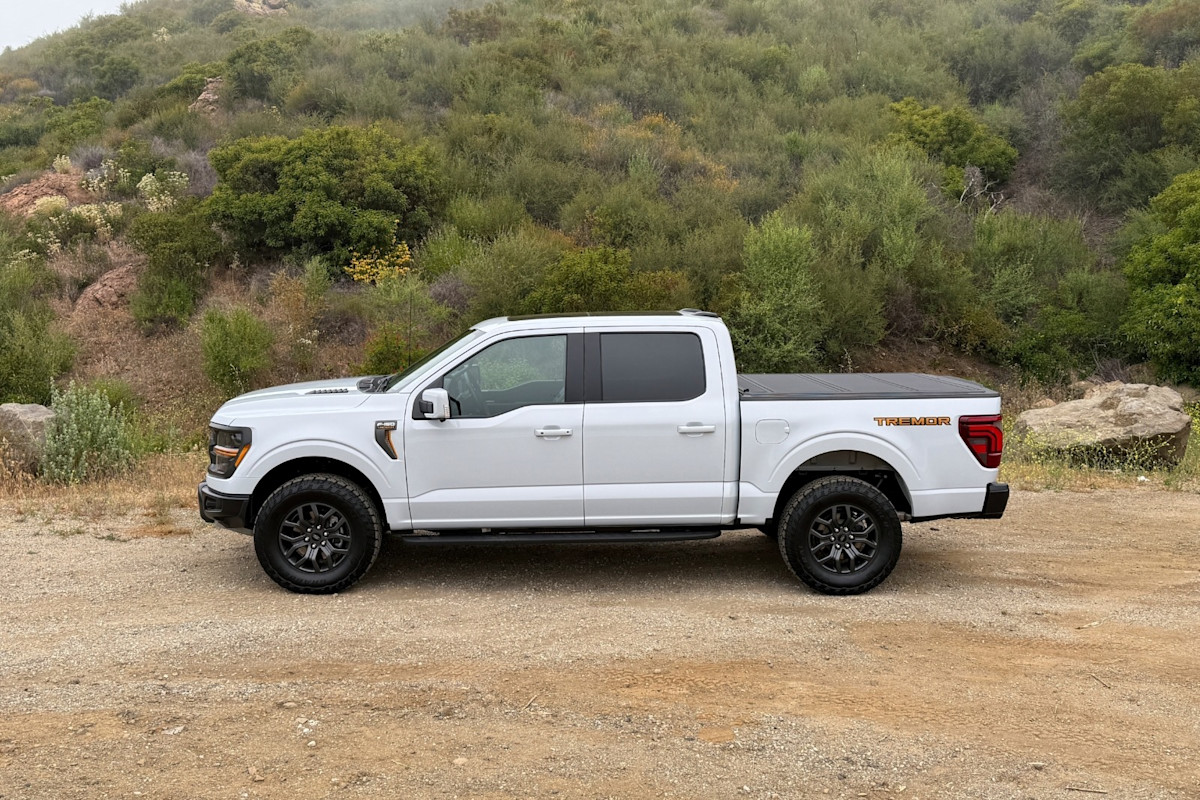
Ford F-150 Safety Rating: At a Glance
| NHTSA Overall Rating | ★★★★★ (5 Stars — 2022–2025 crew cab) |
| IIHS Evaluation | Top Safety Pick — 2024+ crew cab built after Sept 2024 |
| Most Critical Recall | Recall 26C10 — Integrated Trailer Module (ITRM) software fault |
| Standard Driver Tech | Ford Co-Pilot360 2.0 (standard on all 2021+ trims) |
| Safest Configuration | 2024–2025 crew cab, Lariat or higher |
Ford F-150 Safety Rating: The Crash Test Results in Detail
The 2024–2025 F-150 crew cab earned the National Highway Traffic Safety Administration (NHTSA) 5-star overall rating, with 5-star scores in both frontal and side crash tests. The Insurance Institute for Highway Safety (IIHS) also awarded the 2024–2025 crew cab its Top Safety Pick designation for models built after September 2024.
IIHS Crash Test Performance Breakdown
The IIHS rates crash test performance in four brackets: Good, Acceptable, Marginal, Poor.
| IIHS Test | Rating & Assessment |
|---|---|
| Small overlap front test (corner strike) | Good — High level of protection for both driver and passenger. The structure was maintained well, though some "Acceptable" leg/foot injury risk was noted for the driver |
| Moderate overlap front original test | Good — Standard head-on test. Minimal risk of injuries to the head, neck, chest, or legs for the driver |
| Moderate overlap front updated test | Poor — While the driver is well-protected, rear-seat occupants face meaningful injury risk. The shoulder belt migrated toward the neck, and the lap belt slid onto the abdomen ("submarining"), increasing internal injury risk |
| Updated side test (T-bone) | Good — The cabin structure remained strong. However, rear passenger head protection was rated Acceptable because the dummy's head moved past the side curtain airbag and hit the C-pillar |
The "Poor" rating in the Moderate overlap front updated test is worth understanding in context. It's driven by rear occupant shoulder belt migration and lap belt submarining in a frontal crash, and it's consistent across all current half-ton trucks. This is an unresolved industry-wide problem, not something specific to the F-150.
Rollover Resistance
The F-150 carries a 4-star NHTSA rollover rating, consistent with the full-size truck segment. Its high-strength aluminum alloy body (introduced with the 13th generation) contributes significantly to roof crush resistance and structural performance, working alongside the side-curtain airbags that are standard across all trims.

Advanced Ford F-150 Safety: Collision Avoidance and Driver Assistance
Since its 2021 redesign, Ford has moved from offering active safety technology as a trim-level luxury to making a baseline standard across every F-150. Every 2021 and newer truck comes equipped with Ford Co-Pilot360 2.0 regardless of trim.
| Feature | What It Does |
|---|---|
| Pre-Collision Assist with AEB | Detects potential collisions with vehicles, pedestrians, and cyclists. In IIHS testing, the F-150 avoided collisions entirely in both vehicle and pedestrian scenarios at 25 mph |
| BLIS with Cross-Traffic Alert | Monitors adjacent lanes and warns of vehicles alongside; alerts to approaching vehicles when reversing |
| Lane-Keeping System | Detects unintentional lane departures and applies corrective steering input |
| Forward Collision Warning | Provides early alerts when a gap with the vehicle ahead closes rapidly |
| Post-Collision Braking | Applies the brakes after an initial impact to reduce secondary collision severity |
| Auto High-Beam Headlamps | Switches automatically between high and low beams based on oncoming traffic |
| Rear View Camera | Standard on all trims to assist with parking and hitching |
Headlight Performance: An Important Variable by Trim That Many Buyers Ignore
Headlight performance on the F-150 varies significantly by trim and build year—and it's one of the most consequential things to check on any used example. The IIHS rates headlights on the same scale as crash tests: Good, Acceptable, Marginal, Poor.
| Trim / Headlight Type | IIHS Rating |
|---|---|
| 2024–2026 XL, STX, XLT (LED reflector) | Good |
| 2024–2026 Lariat and higher (LED projector) | Acceptable |
| Pre-2024 XL/XLT (Halogen) | Poor |
Buyer Tip: A "Poor" halogen rating on a pre-2024 truck isn't a dead end. The F-150's aftermarket support is extensive, and DOT-compliant LED assemblies that replace the entire housing are widely available. They're a genuine step up over stock halogens—sharper cutoff, better night visibility—without the glare problems that come with simple bulb swaps.
Towing Safety Technology
For regular towers, a properly equipped F-150 adds a set of towing-specific features that standard driver assistance doesn't cover:
- Trailer Sway Control: Part of AdvanceTrac with Roll Stability Control. Detects trailer sway and applies selective braking to stabilise both truck and trailer.
- Blind Spot Assist with Trailer Coverage: Extends BLIS monitoring to cover the full length of an attached trailer.
- Pro Trailer Backup Assist: Lets you control the trailer's direction with a dashboard knob, removing the counterintuitive steering reversal that catches most people out.
- Dynamic Hitch Assist: Overlays an alignment guide on the SYNC screen using the rear camera, making hitch-to-coupler lining up considerably less frustrating.
To get these features, look for trucks with the Tow/Haul Package (or Max Trailer Tow Package on older models).
BlueCruise: Hands-Free Highway Driving
BlueCruise is available on XLT and higher trims on 2025 F-150s. It operates on over 130,000 miles of pre-mapped divided highways in the U.S. and Canada (known as "Blue Zones") where the system manages speed and lane position without requiring hands on the wheel.
Two things to know before relying on it:
- Driver monitoring: A cabin-facing camera watches for attention lapses and disengages the system if your focus drifts.
- Subscription: After an initial trial period of around 90 days, a paid subscription is required.

Active Recalls: What Every F-150 Buyer Needs to Verify
Every F-150 purchase, regardless of model year, should include a VIN check at NHTSA.gov. For 14th-generation trucks (2021–2026) in particular, several significant recalls require confirmation before you commit.
Major Safety Recalls (2021–2026)
| Recall / Issue | Affected Models | The Safety Risk |
|---|---|---|
| Trailer Module (26C10) | 2021–2026 | Loss of trailer brake lights and/or trailer braking function. A "Trailer Brake Module Fault" message will usually appear on the dashboard |
| Transmission Downshift | 2015–2017 | Trucks may abruptly downshift to first gear at highway speeds, potentially locking the rear wheels. (2026 investigation currently active) |
| Rear Axle Bolts (25V512) | 2021–2025* | Fatigued bolts can snap, causing loss of drive power or allowing the truck to roll away while in Park |
| Steering Column (25V309) | 2021–2023 | A loose or missing bolt in the steering gear can result in loss of steering control |
| Rearview Camera | 2021–2022 | Camera image may fail to display, increasing the risk of an accident while reversing |
- Note: The axle bolt recall primarily affects trucks equipped with the Max Trailer Tow Package. Trucks built after May 2025 received redesigned hardware from the factory.
All safety recall repairs are carried out by Ford at no charge. Software-based issues, like the 2026 Trailer Module fault, can often be resolved via Over-the-Air (OTA) update if the truck is connected to Wi-Fi. Hardware issues require a dealership visit. One important caveat: for active investigations like the 2015–2017 transmission downshift probe, Ford isn't yet obligated to provide free repairs until NHTSA formally upgrades the investigation to a recall.
How the Ford F-150's Safety Tech Has Changed Over the Years
The F-150's safety has improved considerably across generations, in structural engineering, and in how consistently Ford has pushed active safety technology down to base trim levels.
| Generation | Active Safety Tech | Key Structural Changes | Safety Considerations |
|---|---|---|---|
| 12th Gen (2009–2014) | Minimal — ABS, Traction Control, SOS Post-Crash Alert | High-strength steel body; standard front and side airbags | No Forward Collision Warning or Automatic Braking available |
| 13th Gen (2015–2020) | Progressive — AEB and Blind Spot Monitoring standardised by 2019 | Aluminum alloy body; first 5-star overall NHTSA rating | Base halogen headlights rated Poor by IIHS; adaptive cruise was a rare, expensive option |
| 14th Gen (2021–Present) | Full suite — Co-Pilot360 2.0 (AEB, Lane-Keeping, BLIS) standard on all trims | Frame reinforcements added for better offset crash protection (March 2021+) | Rear occupant Poor IIHS rating; Recall 26C10 (Trailer Module) affects 2021–2026 |
As with most vehicles, the clearest trend is the standardisation of active safety technology across trim levels. The unresolved gap—rear occupant protection in the updated IIHS moderate overlap test—remains an industry-wide issue with current half-ton trucks, not one Ford can solve in isolation.
Related Reading: For a detailed breakdown of the F-150's mechanical reliability, common powertrain failure points, and which model years to prioritise on the used market, see the Ford F-150 Reliability Guide on CarGurus.
Is the Ford F-150 Safe?
The F-150 is among the better-protected trucks in the full-size segment. Strong crash test scores, standardized driver assistance technology, and a well-established dealer network make it a solid choice for most buyers, though it's worth confirming headlight ratings and open recall status on any specific example before purchase.
For the strongest available configuration, our research shows that a 2024–2026 crew cab in Lariat or higher trim, built after September 2024, offers the best combination of crash test performance, headlight ratings, and standard driver assistance technology in the current F-150 lineup.
Ready to start shopping? Browse Ford F-150 listings on CarGurus to compare safety features and access free vehicle history through AutoCheck reports on most models.