Nissan beat every other automaker to the market when it introduced the Leaf. As the first mass-market electric vehicle from a mainstream automaker in history, the Nissan Leaf, which debuted for the 2011 model year in the United States, came with a 24-kWh lithium-ion battery pack that sent electricity to an 80-kilowatt synchronous electric motor powering the front wheels. When it first launched, Nissan said the first-generation Leaf would have around 100 miles of range per charge, while the EPA rated it at 73 miles on a single charge, which later rose to 84 miles with no changes to the vehicle. Nissan also quoted a charge time of 30 minutes to get to 80% capacity when using the proper type of charger.
Nissan Leaf Buying Guide: Cost, Reliability, and the Best Years to Buy
Search for Nissan Leaf
See all


Although the Nissan Leaf was predated by electric cars such as the Tesla Roadster, which sold in very limited numbers, and the GM EV1, which was only available to lease, the little electric hatchback from Nissan set the stage for the electric vehicle market in America.
Now entering its third generation for the 2026 model year, the Nissan Leaf remains one of the best electric car bargains on the market. The 2026 Nissan Leaf in S+ trim with a 75-kWh battery pack carried an MSRP of $29,990 at the time of writing, which increased to $31,485 with the mandatory destination charge. That price represents an impressive bargain for an electric car with a driving range of up to 303 miles per charge.
Nissan Leaf Buying Guide: Cost, Reliability, and the Best Years to Buy
- Frequently Asked Questions
- Nissan Leaf Pros and Cons
- Nissan Leaf Generations
- Nissan Leaf Third Generation (2026-Present)
- Nissan Leaf Second Generation (2018-2025)
- Nissan Leaf First Generation (2011-2017)
Frequently Asked Questions
Which Nissan Leaf years are the best?
The 2026 Nissan Leaf is undoubtedly the best yet, but since it’s a brand-new car, there aren’t many used examples available yet. Buyers looking at a first- or second-generation Nissan Leaf model will need to carefully consider the estimated range provided by whatever battery pack is fitted to the car they are considering.
Those who only need to commute short distances of less than 100 miles each day could conceivably use a 2011-2015 Nissan Leaf. Most buyers, however, would surely prefer a bit more range. First-generation leaf models from 2016 or 2017 have a slightly more potent battery and are therefore the best of that breed.
A second-generation Nissan Leaf Plus model from 2019-2025 would be the best choice for a reasonably priced daily driver for owners who can charge from home in their garages or driveways.
What are the worst Nissan Leaf years?
The very first 2011 Nissan Leaf has more complaints than any other according to CarComplaints.com, though the actual number of issues experienced by owners of any Leaf model year has been pretty low. Combined with their low EPA-rated ranges of 75-84 miles, 2011-2015 Nissan Leaf models are only reasonable for buyers who don’t need to travel very far.
Is a used Nissan Leaf a good deal?
For most buyers, the only used first- or second-generation Nissan Leaf models we would recommend considering come from the 2019-2025 model years, and only Plus versions with the larger battery pack. Fortunately, such Leaf models are priced very reasonably on the used market. A previously owned Nissan Leaf Plus in SV or SL trim with low miles should sell in the $15,000 to $20,000 range.
All first- and second-generation Nissan Leaf EVs use an air-cooled battery pack that is likely to lose range as it ages, so it’s important for buyers to have any used Leaf checked by a qualified mechanic prior to purchasing to ensure the battery pack is in good health. Buyers of first- or second-generation Leaf models should also be aware that these electric cars use a CHAdeMO plug that isn’t as common as the North American Charging Standard (NACS) plug popularized by Tesla and now almost universally adopted in the United States.
Nissan Leaf Pros and Cons
Pros:
- Excellent value for money
- Comfortable
- Quiet cabin
Cons:
- Pedestrian performance
- Limited range of older models
- Old charging tech in first two generations
Nissan Leaf Generations
Nissan Leaf Third Generation (2026-Present)
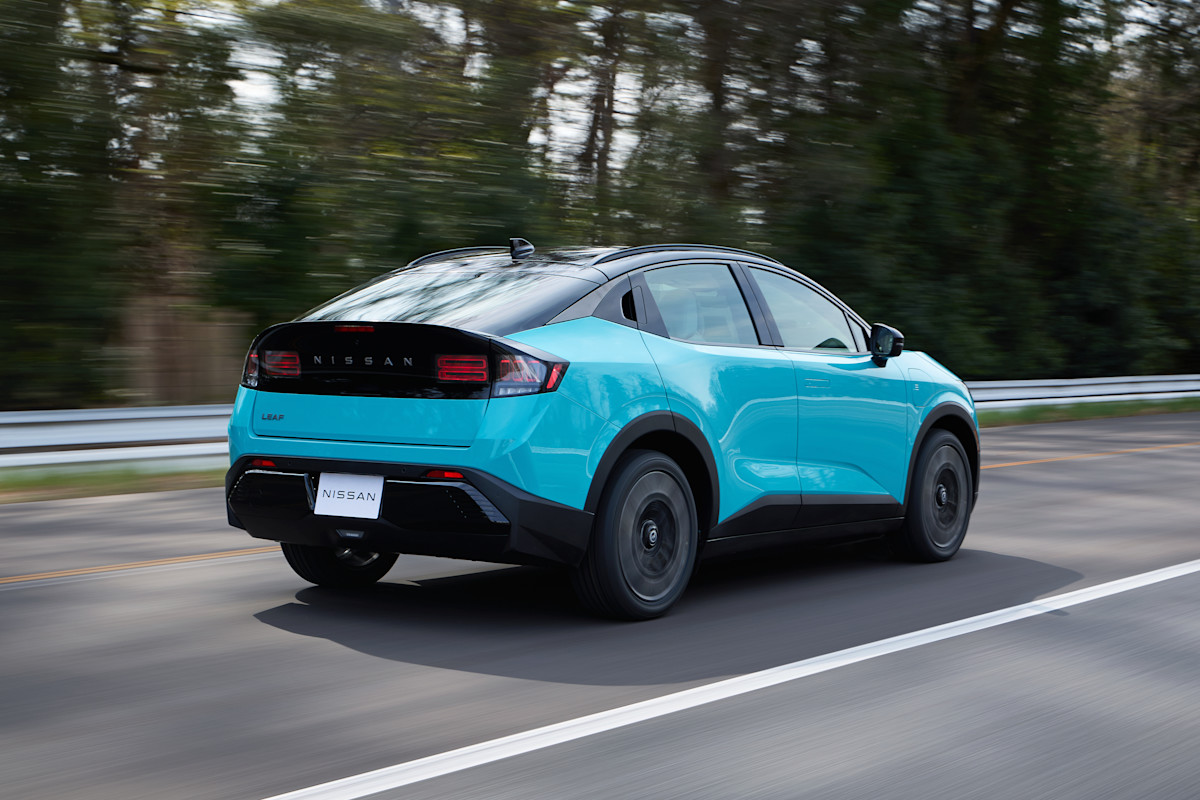
The third-generation Nissan Leaf that debuted for the 2026 model year represents a major upgrade for the first mainstream electric car sold in the United States. It’s now more of a little SUV than a hatchback, and it boasts a more powerful electric motor for quicker acceleration, larger battery packs for more driving range, and a pair of charge ports (J1772 and NACS) that allow the new Nissan Leaf to charge at multiple types of DC fast-charging stations, including Tesla Superchargers. Nissan says that with the right Level 3 charger, the 2026 Leaf can charge from 10% to 80% in 35 minutes.
The 2026 Nissan Leaf S+ (a base Nissan Leaf S model with lower specs such as lower battery capacity and weaker powertrain is scheduled to appear later) features a 214-horsepower electric motor that drives the front wheels, and Nissan estimates driving range at 303 miles per charge. All-wheel drive is not available. Standard equipment includes 18-inch wheels, LED headlights, keyless entry and starting and a 12.3-inch NissanConnect touchscreen infotainment system that features wireless Apple CarPlay and Android Auto. A second 12.3-inch digital display sits in front of the driver and serves as the gauge cluster.
The Nissan Leaf SV+ (that’s pronounced Leaf SV Plus) gets 18-inch alloy wheels, synthetic leather seats (heated up front), wireless phone charging, and upgrades the twin screens to 14.3 inches apiece. Importantly, the SV+ also benefits from a heat pump for greater efficiency in cold weather and regenerative braking paddles. At the top of the lineup sits the Nissan Leaf Platinum+, with 19-inch alloy wheels, a head-up display, a panoramic sunroof with a dimming feature, a power liftgate, heated steering wheel, heated synthetic leather rear seats and a 10-speaker Bose audio system. The 2026 Nissan Leaf SV+ has a driving range of 288 miles, and the Platinum+ has 259 miles of range.
All 2026 Nissan Leaf models get a driver assistance technology package called Nissan Safety Shield 360 that includes automatic emergency braking with pedestrian detection, rear cross traffic alert, lane departure prevention, blind-spot monitor and forward collision warning. Nissan’s intelligent around-view monitor is also standard, providing a virtual overhead view of the car that helps get into tight parking spots, as well as the automaker’s ProPILOT Assist, which combines intelligent cruise control with steering assistance that the automaker says helps the driver stay centered in their lane and maintain a set speed and distance to the vehicle ahead.
Perhaps the biggest update for the third-generation Nissan Leaf was a liquid-cooled battery pack that replaced the older air-cooled unit of earlier Leaf models. Since it’s such a new machine and has yet to prove its reliability, we’ll have to wait and see if the liquid-cooled battery lessens the degradation concerns of older Leaf models, but the technology, also used in the Nissan Ariya electric vehicle, is sound.
Nissan Leaf Second Generation (2018-2025)
Nissan released the second-generation Leaf for the 2018 model year with a larger battery that could deliver up to 150 miles of range (the 40-kWh battery pack replaced the old 29.9-kWh battery) and a more powerful drivetrain (147 horsepower and 236 pound-feet of torque versus 107 hp and 187 lb-ft). All Leaf models featured a 6.6-kW onboard charger that could charge the battery pack in about eight hours on a Level 2 charger. Nissan’s new e-Pedal technology allowed drivers to rely on regenerative braking for a one-pedal solution that the automaker claimed could be used up to 90% of the time.
The second-generation Nissan Leaf was also wrapped in much sharper bodywork that looked modern and crisp. Forward collision warning and mitigation with automatic braking was standard for the 2018 Leaf. Additional advanced safety features were available, including intelligent lane intervention, lane departure warning, automatic emergency braking with pedestrian detection, a blind-spot monitor and rear cross traffic alert.
The 2018 Nissan Leaf was offered in three trim levels, starting with the base Leaf S that did not include the Charge package with CHAdeMO fast charging capability that upper models did, or the new Level 1 and Level 2 combination charging cord. The 2018 Leaf SV got the Charge package along with an infotainment system that included navigation, Apple CarPlay and Android Auto capability, and NissanConnect. The SV also got 17-inch alloy wheels and adaptive cruise control. The Nissan Leaf’s top SL trim received a leather interior, a Bose audio system, a power driver’s seat and a blind-spot monitor with rear cross-traffic alert. An optional Technology Package came with Nissan ProPilot Assist.
A new Nissan Leaf Plus model appeared in 2019 with a larger battery pack that provided up to 226 miles of range. Nissan Safety Shield 360 became standard for 2020, as did Apple CarPlay and Android Auto. A small exterior refresh for 2023 included an illuminated Nissan badge, and the trim levels were reduced to a base Leaf S and a smarter Leaf SV Plus with a more powerful electric motor and a 62-kWh battery that provided 215 miles of range.
Through NissanConnect software, the second-generation Nissan Leaf offered vehicle-to-home technology so the battery could store surplus power during the day then use it to help power the owner’s home in the evening. In the event of a power outage, Nissan said the Leaf could meet typical household electricity needs for up to two days.
Nissan Leaf First Generation (2011-2017)
The 2011 Nissan Leaf debuted to much fanfare in the United States, as it represented the first fully electric vehicle from an established mainstream automaker. The Tesla Roadster was already on sale but sold in very limited quantities. The plug-in EV1 from General Motors predated both the Tesla and the Leaf but was never actually sold to the public. The Leaf was a small hatchback but slightly larger than the Nissan Versa.
While groundbreaking, aerodynamic, affordable and widely available, the first-generation Nissan Leaf couldn’t travel very far on a single charge. Nissan estimated its zero-emission EV could go up to 100 miles, but the EPA officially rated it at just 73 miles of range. With such limited range, courtesy of a 24-kWh lithium-ion battery pack, commuters had to consider how many miles they were likely to drive each day, and even whether using the car’s climate control might reduce range to an unacceptable level. The EPA awarded the 2011 Nissan Leaf an energy efficiency equivalent rating (called MPGe) of 106 mpg city/92 mpg highway and 99 mpg combined.
The 2011 Nissan Leaf was offered in both SV and SL trim levels, but at first there wasn’t much difference between them. For 2012, the Nissan Leaf got a bit more expensive but now included heated front and rear seats and a heated steering wheel. The SL trim got an improved charging port, a new 6.6-kW onboard charger showed up for the 2013 model year, and an affordable S trim level arrived. In 2014, the EPA raised the Leaf’s estimated range from 75 to 84 miles, but there weren’t any real changes to the car’s electric drivetrain. An improved regenerative braking system was launched in 2015.
The 2016 Nissan Leaf received a larger battery pack that increased range to 107 miles for the top upper Leaf trim levels (the battery capacity was 24 kWh in base S Leaf models and 30 kWh in the SV and SL trims). The 30-kWh battery pack became standard for the 2017 model year.
Related Topics

by Jeremy Korzeniewski
Jeremy Korzeniewski grew up as the son of an automotive engineer in a family obsessed with cars and trucks and turned that passion into a career in 2006 when he accepted a position with Autoblog. Over the next 18 years, Jeremy published more than 8,000 articles while serving as a Senior Editor and has contributed to respected brands that include Yahoo, Edmunds, Robb Report and AutoGuide. Jeremy is also an avid motorcyclist and spends the majority of his evenings at home with his wife hoping to cook up a delicious meal for dinner.
The content above is for informational purposes only and should be independently verified. Please see our Terms of Use for more details.


