The Toyota RAV4 has topped compact SUV sales charts for years, and its safety reputation is a big part of why families keep choosing it. The five-star National Highway Traffic Safety Administration (NHTSA) rating and Insurance Institute for Highway Safety (IIHS) Top Safety Pick credentials are reassuring — but they're model-level scores, and the used market doesn't sell you a model, it sells you a specific vehicle with a specific trim, a specific build date, and a specific recall history.
For example, a 2019 LE with an open steering gear recall and Marginal-rated headlights is a meaningfully different proposition to a 2023 XLE Premium with neither of those issues. So which one are you actually looking at? In this guide, we'll explain exactly what to check — and why it matters.
This guide covers the RAV4's crash test performance, active recall status, driver assistance technology, and how protection has evolved across generations — so you know exactly what to look for before you buy.
- Toyota RAV4 Safety Rating: The Crash Test Results Decoded
- Advanced Toyota RAV4 Safety: Collision Avoidance and Driver Assistance
- Headlight Performance: An Important Variable by Trim That Many Buyers Ignore
- All-Wheel Drive Safety Technology
- Toyota Safety Connect: Emergency Assistance
- Active Recalls: What Every RAV4 Buyer Needs to Verify
- How the Toyota RAV4's Safety Tech Has Changed Over the Years
- Is the Toyota RAV4 Safe?

Toyota RAV4 Safety Rating: At a Glance
| NHTSA Overall Rating | ★★★★★ (5 Stars — 2019–2025 models) |
| IIHS Evaluation | Top Safety Pick — 2023+ models (varies by headlight trim) |
| Most Critical Recall | Recall 20TA11 — Steering Gear Box water intrusion (2019–2020) |
| Standard Driver Tech | Toyota Safety Sense (TSS 2.0 standard on 2019+; TSS 2.5 on 2023+) |
| Safest Configuration | 2023–2025 XLE Premium, Limited, or Hybrid XSE |
Toyota RAV4 Safety Rating: The Crash Test Results Decoded
The 2024–2025 RAV4 earned the National Highway Traffic Safety Administration (NHTSA) 5-star overall rating, with 5-star scores in both frontal and side crash testing. The Insurance Institute for Highway Safety (IIHS) awarded 2023–2025 models its Top Safety Pick designation—with a caveat: eligibility depends on which headlights the specific vehicle has (more on that below). Underpinning both results is Toyota's TNGA platform, introduced with the 5th generation in 2019, which stiffened the body structure and lowered the centre of gravity compared to the 4th-gen chassis it replaced.
IIHS Crash Test Performance Breakdown
The IIHS rates crash test performance in four brackets: Good, Acceptable, Marginal, Poor.
| IIHS Test | Rating & Assessment |
|---|---|
| Small overlap front test (corner strike) | Good — Simulates a collision with a tree or pole at the front corner. The RAV4's cabin holds its structure. |
| Moderate overlap front original test | Good — Simulates a driver-side head-on collision. Strong occupant protection throughout. |
| Moderate overlap front updated test | Marginal — IIHS's stricter rear-occupant criteria expose submarining risk under the lap belt in a frontal crash. |
| Updated side test (T-bone) | Acceptable — Uses a heavier, faster barrier designed to replicate a modern SUV striking the side. Solid but not top-rated. |
The Marginal rear seat result is worth keeping in perspective. The updated IIHS moderate overlap test specifically evaluates rear occupant protection in frontal crashes—an area where the entire compact SUV class currently struggles. The RAV4's lap belt allows some forward sliding under hard braking loads, but this is a category-wide limitation rather than a RAV4-specific failing.
Rollover Resistance
The RAV4 carries a 4-star NHTSA rollover rating, in line with the compact SUV segment. The TNGA platform's lower centre of gravity is a meaningful improvement over the 4th-gen body, and all current RAV4 trims come with 8 standard airbags—front, side, knee, and full-length curtain—covering all rows.
Advanced Toyota RAV4 Safety: Collision Avoidance and Driver Assistance
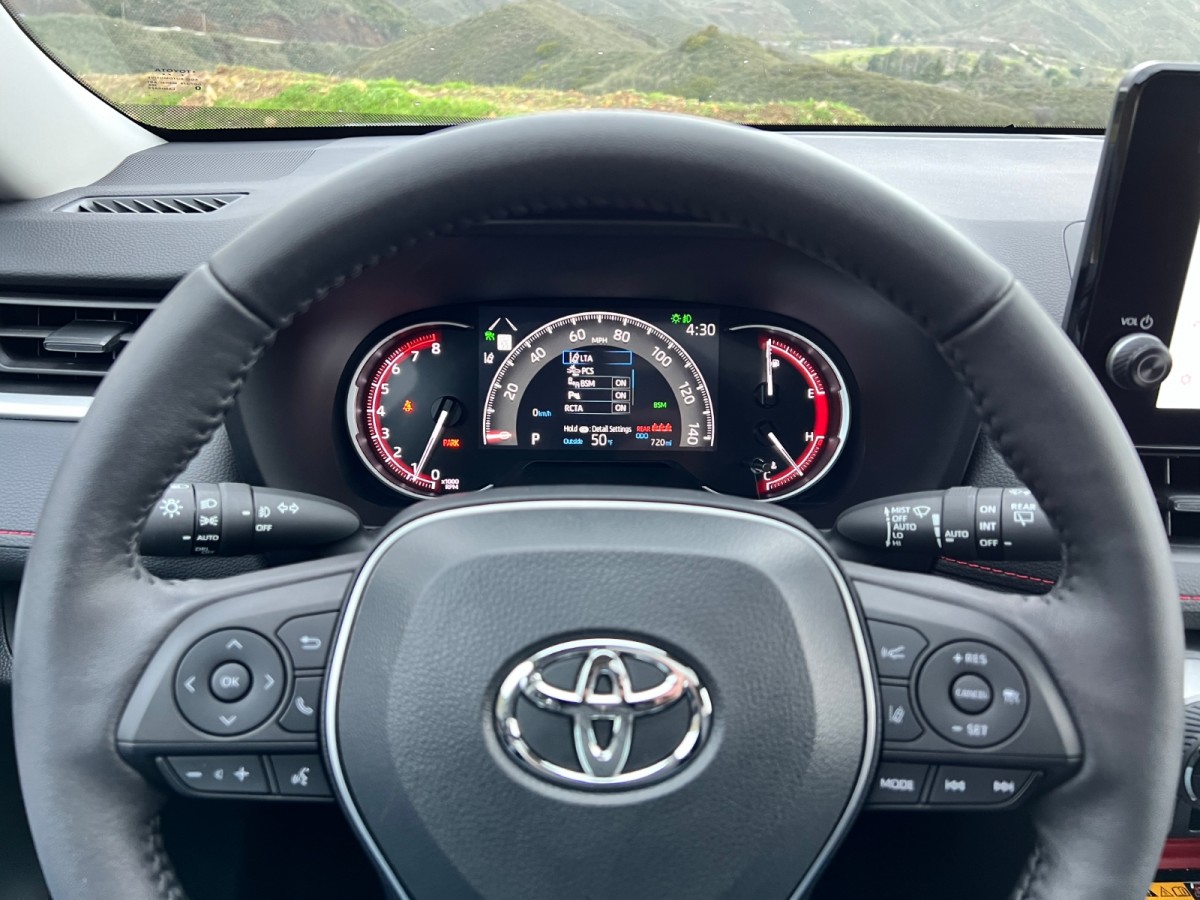
Where the RAV4 has a genuine edge over many rivals is in how early Toyota standardised active safety technology. Toyota Safety Sense (TSS) has been fitted to every RAV4 trim — not just the higher grades — since 2019. The 2023 model year brought an upgrade from TSS 2.0 to TSS 2.5, adding expanded pedestrian and cyclist detection, better low-light performance, and more refined lane assistance at highway speeds. If you're shopping used and that distinction matters to you, 2023 is the threshold to target.
| Feature | What It Does |
|---|---|
| Pre-Collision System (PCS) with AEB | Scans for vehicles, pedestrians, and cyclists ahead. In IIHS testing, the RAV4 avoided collisions at 25 mph in both vehicle and pedestrian scenarios. |
| Lane Departure Alert with Steering Assist | Detects unintentional lane drift and applies corrective steering input before the vehicle crosses a lane marking. |
| Lane Tracing Assist (LTA) | Keeps the RAV4 centred within its lane when Dynamic Radar Cruise Control is active on the highway. |
| Dynamic Radar Cruise Control (DRCC) | Maintains a set following distance from the vehicle ahead, including slowing to a full stop and resuming in stop-start traffic. |
| Road Sign Assist (RSA) | Reads speed limit and stop signs via a forward camera and displays them on the instrument cluster. |
| Automatic High Beams (AHB) | Toggles between high and low beams automatically based on oncoming and preceding traffic. |
Headlight Performance: An Important Variable by Trim That Many Buyers Ignore
Headlight quality on the RAV4 varies significantly by trim — and it's a useful things to check on any used example. The IIHS rates headlights on the same Good–Acceptable–Marginal–Poor scale as crash tests, and on the RAV4, the gap between the best and worst configurations is significant. Poor or Marginal headlights struggle to illuminate bends and side roads at speed — the exact conditions where seeing further ahead has the most impact.
| Trim / Headlight Type | IIHS Rating |
|---|---|
| 2023–2025 XLE Premium, Limited, Hybrid XSE (LED Projector) | Good |
| 2023–2025 LE, XLE, Adventure (LED Reflector) | Acceptable |
| Pre-2023 LE/XLE (Non-Projector Halogen or LED) | Marginal/Poor |
Buyer Tip: A Marginal or Poor rating on a pre-2023 RAV4 doesn't have to be a sticking point. The RAV4's large ownership base means aftermarket headlight options are plentiful and well-priced. A full, legally compliant LED housing swap is a more meaningful upgrade than it might sound.
All-Wheel-Drive Safety Technology
The RAV4 is available in three AWD configurations depending on the powertrain: a mechanical AWD system on V6 and base 4-cylinder models, Electronic On-Demand AWD on standard 5th-gen petrol trims, and Dynamic Torque Vectoring AWD on select 5th-gen configurations—which can direct torque independently to the rear wheels for sharper handling in poor conditions.
In addition to knowing this, other useful safety systems to be aware of for the 5th-generation RAV4 include:
- Trailer Sway Control: Integrated into Toyota's Star Safety System. Detects trailer oscillation and applies selective braking to individual wheels to stabilise both the RAV4 and a towed load before the driver has to react.
- Blind Spot Monitor (BSM) with Rear Cross-Traffic Alert: Standard on most trims. Covers adjacent lanes during highway driving and warns of vehicles approaching from behind when reversing. Worth confirming on base LE examples—it's an optional add-on rather than standard equipment on that trim.
- Panoramic View Monitor: Available on higher trims. Stitches together camera feeds from around the vehicle into a bird's-eye view. This is particularly useful in tight spaces or when lining up a tow.
Toyota Safety Connect: Emergency Assistance
Every new RAV4 comes with a 10-year trial of Toyota Safety Connect, which works independently of the driver's phone or a Wi-Fi connection.
- Emergency Assistance Button (SOS): A dedicated overhead button connects to a 24/7 response centre that can send emergency services to the vehicle's GPS location.
- Automatic Collision Notification: Triggers automatically if an airbag deploys, alerting the response centre without the driver needing to act — relevant in any scenario where the driver is unable to make a call.
Safety Connect requires a paid subscription after the 10-year trial lapses. On any used RAV4 you're seriously considering, it's worth checking whether the account is still active.

Active Recalls: What Every RAV4 Buyer Needs to Verify
Every RAV4 purchase, regardless of model year, should include a VIN check at NHTSA.gov. The 2019–2020 model years in particular carry a cluster of significant open recalls that any used buyer should account for.
Major Safety Recalls (2019–2025)
| Recall / Issue | Affected Models | The Safety Risk |
|---|---|---|
| Steering Gear Box (20TA11) | 2019–2020 | Water intrusion into the steering gear can cause partial or complete loss of power steering assist. |
| Fuel Pump (20V012 / 25V012) | 2019–2020 | A faulty fuel pump can cause the engine to stall while driving, significantly increasing crash risk. |
| Front Suspension Arms (20V285) | 2020 | The front lower suspension arms may separate from the wheel hub, causing loss of vehicle control. |
All safety recall repairs are carried out by Toyota at no cost to the owner. Software-related issues can sometimes be resolved over-the-air on connected vehicles; hardware recalls, like the suspension arm and steering gear campaigns, require a dealership visit. Don't assume a previous owner got it done.
Related Reading: Want to know which RAV4 engines hold up best over time? See the Toyota RAV4 Engine Longevity Guide for a complete breakdown by powertrain.
How the Toyota RAV4's Safety Tech Has Changed Over the Years
As you'd expect, with each recent generation of RAV4, Toyota has offered more standard safety technology, a stiffer structure, and better crash test performance than the one before it.
| Generation | Active Safety Tech | Key Structural Changes | Safety Considerations |
|---|---|---|---|
| 3rd Gen (2006–2012) | Minimal — ABS, VSC, Traction Control | Side curtain airbags standard from 2007; conventional steel body | No forward collision warning or automatic braking available |
| 4th Gen (2013–2018) | Progressive — TSS-P standardised in 2017 | Improved small overlap structural reinforcements; 7 standard airbags | 2017 was the turning point — pre-2017 trims have no active safety tech |
| 5th Gen (2019–Present) | Full suite — TSS 2.0 standard; TSS 2.5 on 2023+ | High-strength TNGA platform; 8 standard airbags; lower centre of gravity | Rear occupant "Marginal" IIHS rating; verify open recalls on 2019–2020 models |
The 4th gen's 2017 model year was the pivot, because it was the first year TSS-P came fitted across all RAV4 trims. The 5th gen raised the bar again in 2023 with TSS 2.5, and the TNGA platform gave the whole generation a structural foundation the 4th gen couldn't match. The one gap that persists (rear occupant protection in the updated IIHS test) is a segment-wide problem that Toyota hasn't yet resolved.
Related Reading: For a detailed breakdown of the RAV4's mechanical reliability, common powertrain failure points, and which model years to prioritise on the used market, see the Toyota RAV4 Reliability Guide on CarGurus.
Is the Toyota RAV4 Safe?
The RAV4 is one of the stronger options in the compact SUV segment. Five stars from NHTSA, standard Toyota Safety Sense across every trim since 2019, and consistent IIHS Top Safety Pick eligibility on 2023+ models with the right headlights all point to solid foundations. The Marginal rear occupant rating is a genuine gap, but it's one the whole class shares.
For the strongest available configuration, our research shows that a 2023 or newer XLE Premium or higher delivers the best combination of crash test scores, Good-rated headlights, and the full TSS 2.5 feature set. If budget pushes you toward an earlier model, the 2019–2022 generation is still a sound choice, but we'd advise that you verify the VIN with NHTSA before you sign anything.
Ready to start shopping? Browse Toyota RAV4 listings on CarGurus to compare safety features and access free vehicle history through AutoCheck reports on most models.