2024 Hyundai IONIQ 6 Reviews, Pricing & Specs


Pros & cons
What we like
Impressive electric range
Fun to drive
Comfortable
What to consider
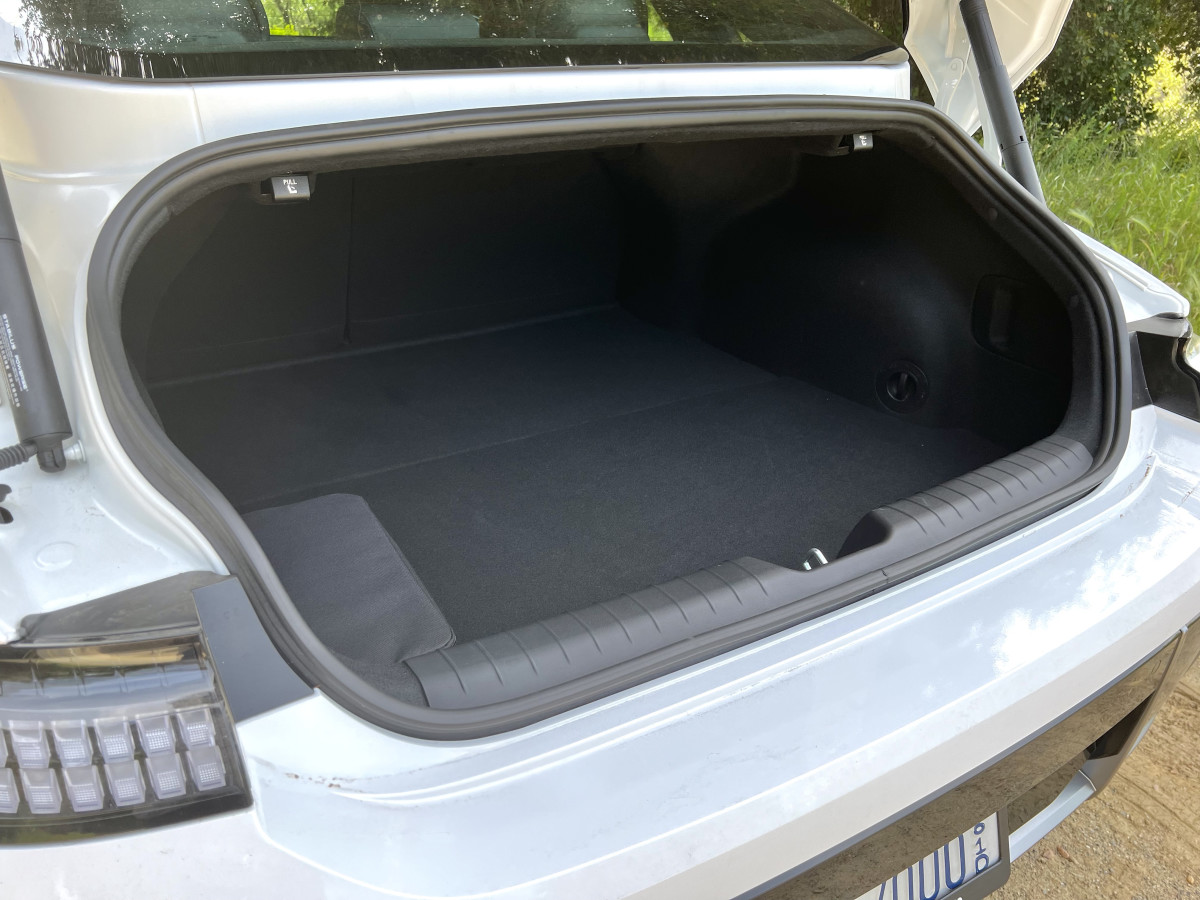
Not much cargo space
Potentially polarizing design
Expert review
The Hyundai Ioniq 6 is a smart choice among all-electric sedans.
Verdict: The 2024 Hyundai Ioniq 6 hits all of the high notes for an all-electric sedan, with plenty of range, surprisingly sporty performance, and high levels of comfort. It's also fairly affordable when you consider how much you'll be saving in operating costs. Its unusual exterior styling stands out as one of its potential drawbacks, but otherwise, it's very easy for us to recommend one.
out of 10 expert review
Look & feel
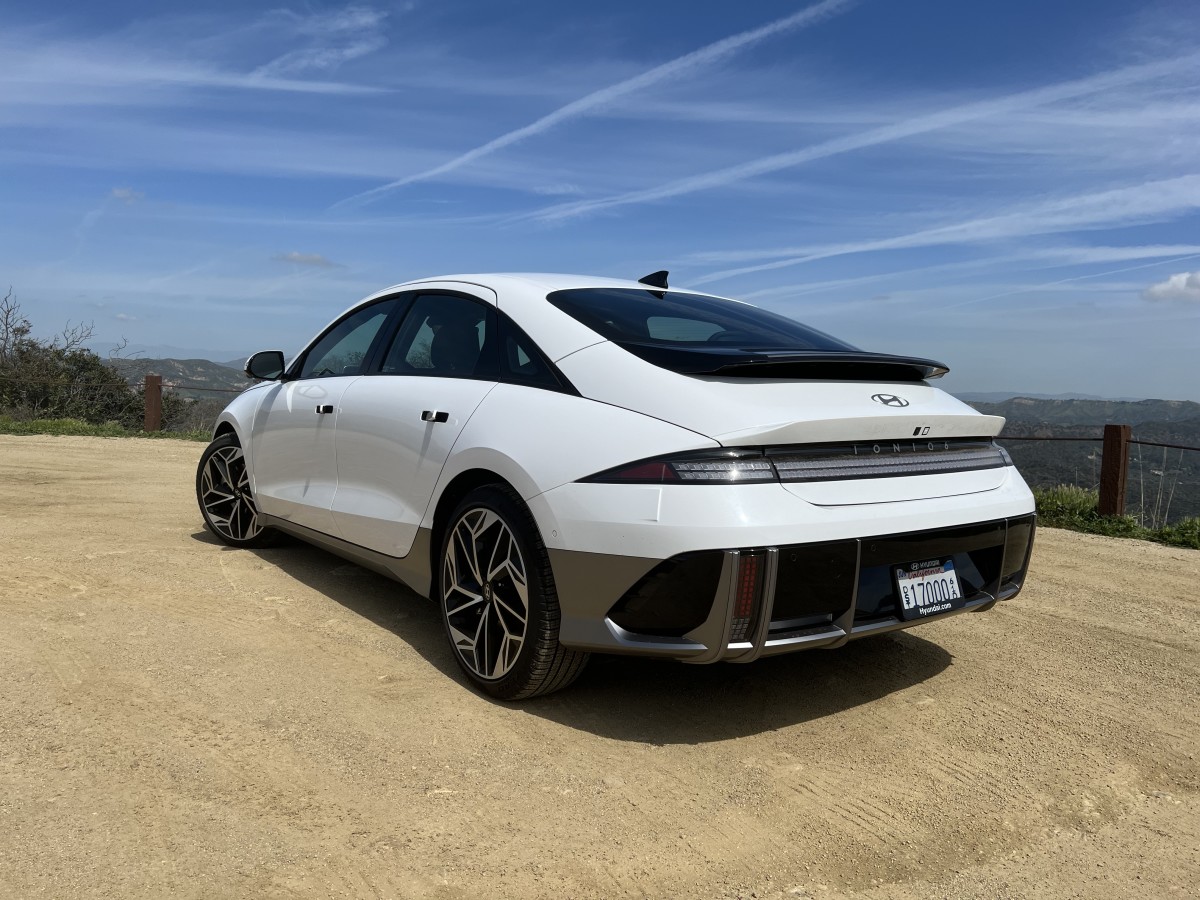
If we can say one thing about the 2024 Hyundai Ioniq 6, it certainly stands out from other four-door sedans. That may be good or bad, depending on your personal tastes as its styling tends to divide people into either the love it or hate it camps. The overall shape is comprised of two very distinctive arches—one for the roofline and another for the supporting body. The thick midsection tends to make it look rather bloated and heavy. The flush-mounted door handles help to streamline the sides and also help to make the Ioniq 6 more aerodynamic, which is critical for EV range.
The front fascia with its large air inlet and active shutters helps to break up some of the roundness while also giving it a strong visual anchor. The rear end tends to be one of the more polarizing styling exercises, which tapers to a somewhat weak tail that is interrupted by a pair of awkward spoilers. The top wing is the most jarring with a black plastic construction that seems as though it was inspired by a Porsche 911. The lower and smaller spoiler helps to reduce some of the body roundness and both also contribute to reducing aerodynamic drag. Underneath are two vertical marker lights/reflectors that seem out of place next to the pixelated horizontal taillights.
Whether you're attracted to the Ioniq 6's exterior styling or not, it is very effective when it comes to efficiency. It's rated to have only a 0.22 coefficient of drag, which is marginally better than a Tesla Model 3. Considering that wind resistance multiplies exponentially with speed, there's certainly some beauty in its function.
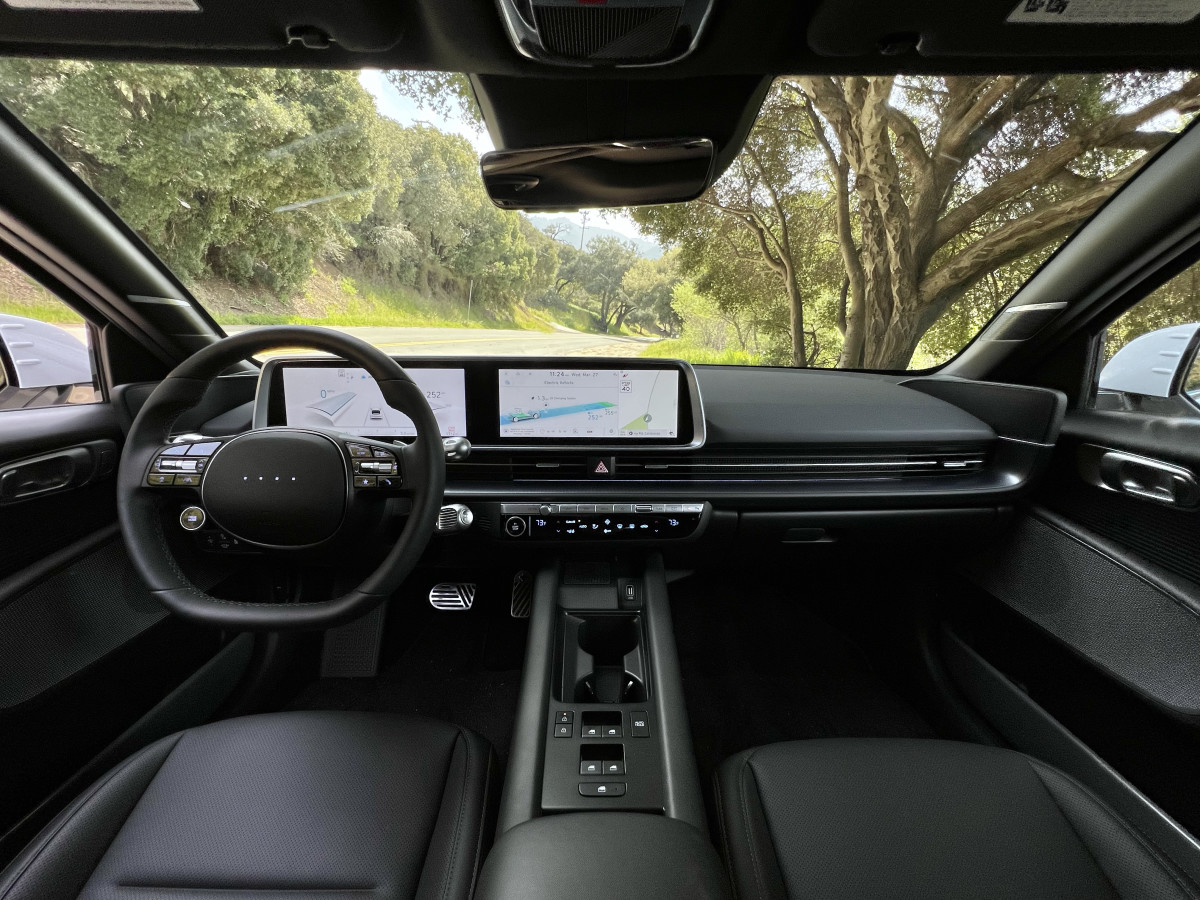
The interior is far less controversial, with an elegantly simple layout that emphasizes a modern feel. The wide dashboard enhances the sense of spaciousness and the integrated air vents keep the design nice and tidy. At the ends are some distinctive wing-like flip-ups that add just a bit of flair. The modernity is on full display with the large digital instrument panel and infotainment touchscreen that are housed in a well-integrated single housing atop the dash.
The center console contains the typical cupholders and storage bins in addition to centrally located window switches. It's an unusual spot for those controls, but they're easy to get used to in a very short amount of time. There's a fair amount of hard plastic, but the sides are minimally padded with a rubberized surface. The door panels also have a large panel of hard corrugated plastic, but the armrest is sufficiently cushioned. Seat upholstery is a synthetic leather substitute that Hyundai calls H-Tex and while it's not quite convincing, it is more substantial than some other leatherette materials found in other sedans.
Performance
There are three main trim levels of Ioniq 6, with the base Hyundai Ioniq 6 SE, midrange SEL, and the top-of-the-line Limited that we evaluated. The entry-level SE with rear-wheel drive (RWD) is the range leader in the lineup, with an EPA-estimated 361 miles of range on a full charge. A more affordable Standard Range model should be on its way and should return a still-strong 240 miles, but its 149-horsepower output from its single electric motor may be a bit weak for some.
The SEL and this Limited are rated at 305 miles with RWD and 270 miles with all-wheel drive (AWD). They make 225 horsepower in rear-drive while the second motor up front kicks the AWD output up to 320 horsepower. These are all strong figures, especially for the price. That amounts to a 0-60 time of only five seconds for the dual motor and a still quick 7.3 seconds for the single motor powertrain.
Even more impressive is how quickly you can recharge the 77.4-kWh battery. Hyundai made these DC-fast-charge capable at some of the highest charge rates possible today. If you're lucky enough to find a working fast charger that can operate at 350 kW, you should be able to replenish the battery pack from 10 to 80 percent in only 18 minutes. On the more common 50-kW rate, you can expect it to take an hour and a quarter or so.
On the road, our Ioniq 6 AWD test vehicle benefits from nearly instantaneous response to the accelerator pedal. It won't pin you to the seat in the way some other EVs will, but it's still quicker than most drivers will ever need or desire. The second motor driving the front wheels deliver more than adequate traction and should be a good option for those in weather-prone regions as well as for driver's seeking a bit more handling prowess.
Slowing the Ioniq 6 is nearly identical in feel to a traditional internal combustion vehicle. You won't feel the transition between energy recuperation (brake regeneration) and when the physical brake pads are actuated. One-pedal driving is activated by tapping on the left steering wheel paddle until the "i-pedal" icon appears in the instrument panel. It's preferred by many EV drivers as you can slow the vehicle to a stop without ever having to touch the brake pedal and can help to reduce fatigue on longer drives.
Handling is surprisingly confident and can even be considered sporty by some. Agility is helped by having its battery weight in the floor, giving the sedan a low center of gravity. Thankfully, this kind of cornering ability doesn't come at the expense of ride comfort. The suspension feels slightly firmer than typical sedans, but it's not at all harsh or stiff. Adding to overall comfort is a distinct lack of noise. With no gasoline engine humming under the hood and well-silenced wind and road noise, the cabin remains blissfully quiet. There's also none of the low-frequency "boominess" that some other EVs have to contend with.
Form & function
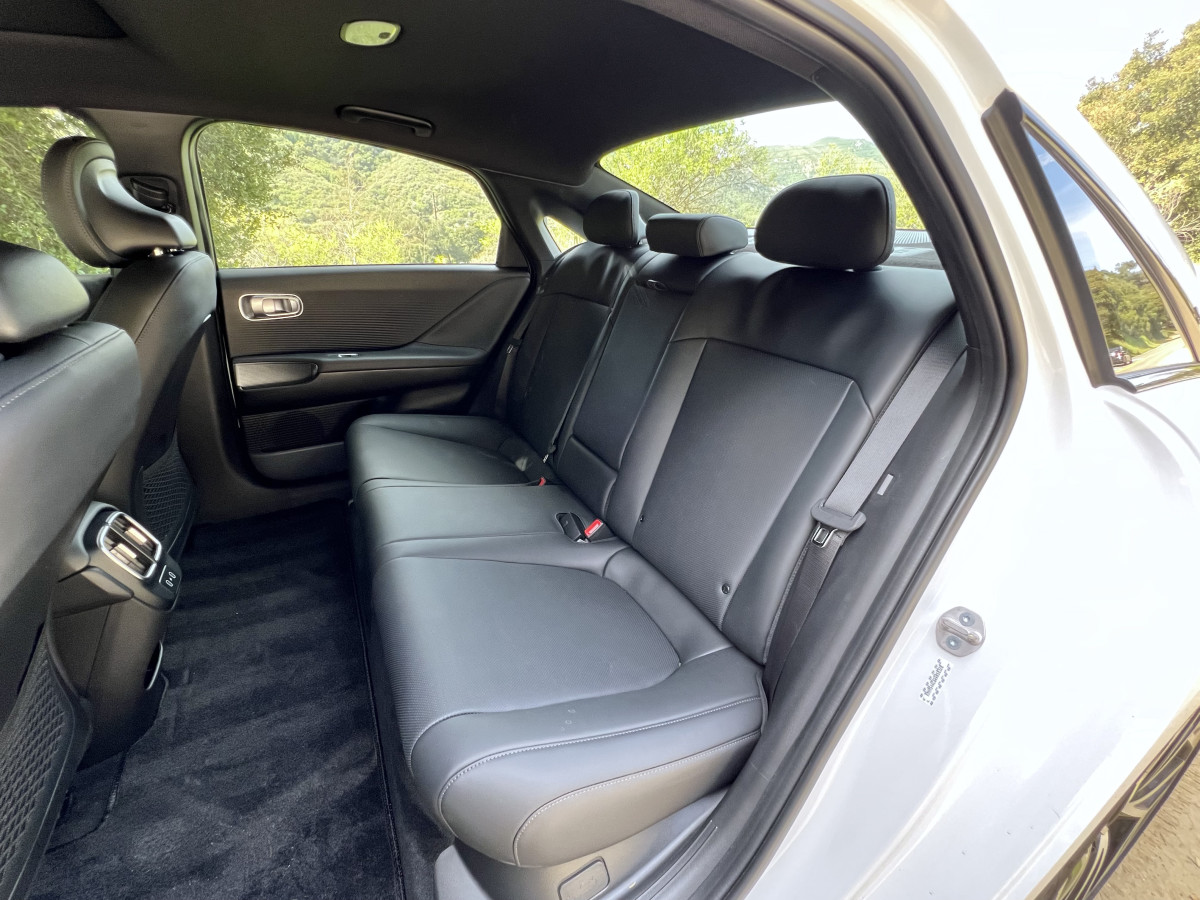
The front passenger space not only instills the sensation of roominess, it does indeed have plenty of room. The same can't be said for the back seats, though. Headroom is tight for an average-sized adult, which is a byproduct of the sloping roofline, but there is at least a wealth of legroom, even if you can't slide your feet under the front seats. You will have to duck when getting in or out in order to keep from bumping your head into the low roof, though. The thick rear roof pillars reduce the sense of airiness in the rear seats, but they don't obstruct the outward view enough to make things feel claustrophobic.
Outward visibility from the front seats is expansive, even when looking back through the rearview mirror, but the lack of visual cues leaves a lot of guesswork when parking in a tight spot. Thankfully, the surround-view camera system takes all the mystery out when you need to back into a space, but it's only offered on the top Limited trim.
As far as storage goes, you get well-sized cupholders, a deep center armrest bin, and a very generous bin underneath the console for larger items. The door pockets are moderately sized and can't hold larger drink bottles, but you still won't have any problem finding a place for your personal effects.
Trunk capacity is on the small side for sedans, measuring only 11.2 cubic feet. By comparison, the Tesla Model 3 can accommodate almost 20 cubic feet and most average midsize sedans can hold around 15 cubes. That said, the space is fairly usable and you should be able to get plenty of luggage and gear loaded. Helping matters is a hands-free power trunklid that is standard on all trim levels. There's also a frunk (front trunk) under the hood, but the tray is only suitable for holding the charge cable and not much else.
Technology
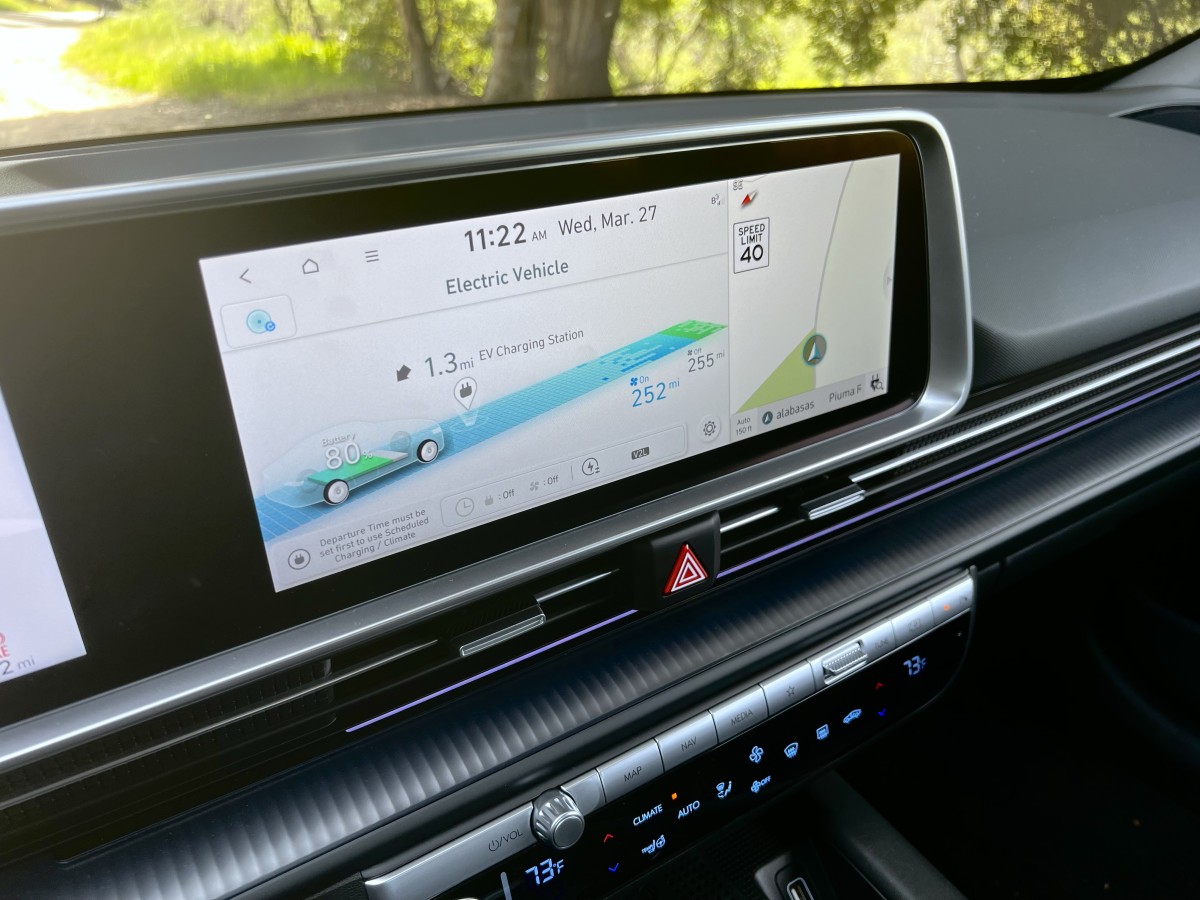
The large digital 12.3-inch instrument panel delivers crisp graphics and can be configured to provide a wealth of information related to efficiency. The adjacent infotainment touchscreen is the same size and is within easy reach of the driver. The system itself is easy to use, thanks to logical menus and reasonably quick responses. Route planning via the native navigation system could be improved though, as charge stations aren't well integrated. This is a problem since the battery can pre-condition itself to optimize DC fast-charging rates.
As with many other vehicles, remote vehicle monitoring and control is included and run through a smartphone app. You can also use your phone instead of a key fob, thanks to Hyundai's Digital Key feature. A wireless charging pad located just below the climate control is included on the midrange SEL trim and up and features a very grippy rubber surface that does an excellent job of keeping your phone from sliding around. It can easily accommodate a Plus-size iPhone and even has enough space for the big camera lenses on the back. Unfortunately, you'll still need to use a cable if you want to make use of Apple CarPlay or Android Auto connectivity, as they're not wireless.
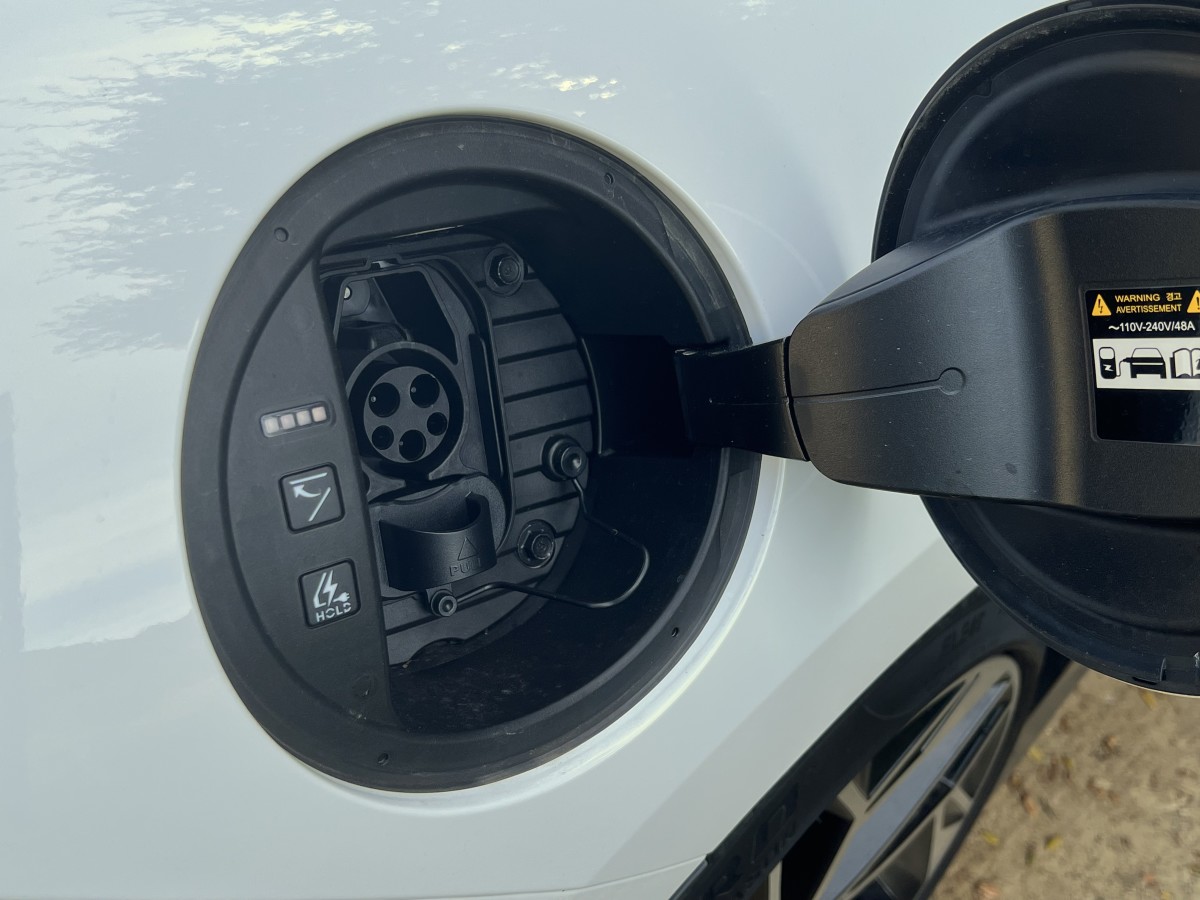
The Ioniq 6 gains an advantage for its vehicle-to-load capability, which allows you to power appliances from an adapter plugged into the exterior charge port. You can even come to the rescue of a fellow EV driver with the right adapter, though the charge rate will be noticeably slow.
Safety
Standard advanced safety features for all models include forward collision warning with automatic emergency braking, adaptive cruise control, a blind-spot monitor with rear cross-traffic alert, lane-keep assist, intersection collision mitigation, parking proximity sensors, safe exit alert, and a driver attention monitor. The SEL trim further benefits from blind-spot collision intervention, cross-traffic collision mitigation, and Hyundai's Highway Driving Assist 2 system that combines enhanced versions of adaptive cruise and lane-keep assist to reduce the burden on drivers. The top Limited trim rounds out the driver assistance features with a surround-view camera system, a blind-spot camera system, and low-speed collision mitigation.
All of these systems operate as advertised with no false alarms. The blind-spot camera system that projects a rear-looking side view is a polarizing feature. It can help ensure a vehicle or cyclist is not lurking when you signal for a lane change or turn, which many drivers appreciate. Some find it a bit too distracting, especially at night, and requires you to take your eyes off the road to use it.
Cost-effectiveness
The base Ioniq 6 in SE trim has a starting manufacturer’s suggested retail price (MSRP) of $43,565 (including $1,115 in destination fees). The midrange SEL starts at $46,365 and the top Limited stickers at $51,265. An SE Standard Range model is forthcoming for only $38,615 and has an estimated range of 240 miles, but its 149-horsepower rating may be a bit weak for some. For those seeking the ultimate in range, the base SE with RWD is estimated to return an impressive 361 miles of driving range. Rear-wheel drive is the way to go for any trim if you're looking to extend range, though AWD models still have plenty for most shoppers and the added traction is a definite plus for those in snowy or rainy climates.
Unfortunately, none of the Ioniq 6 models are eligible for the very attractive $7,500 tax credit, but a little-known loophole can get you some incentives if you lease instead of buy. The Tesla Model 3 is eligible, however, and prices can be slightly less expensive when you factor that in. It's been recently updated and is more desirable than before, but some comfort and usability issues have us favoring the Ioniq 6.
Many carmakers have focused on building electric SUVs to meet consumer demand, leaving very few other sedans to choose from. These include the BMW i4 and Polestar 2, but you'll have to spend quite a bit more for those electric cars.
Overall, the 2024 Hyundai Ioniq 6 represents a very compelling package, with excellent range estimates, very capable performance, and high levels of comfort. Really, the only knocks against it are the limited cargo capacity and its polarizing style, which we recognize is completely subjective. If you like the looks, we recommend you start your search with the Ioniq 6.

What owners say
Excellent car and features. A great value compared to other similar cars.
December 1, 2023Trims & specs
Base MSRP N/A | Seating N/A |
Engine N/A | Cargo Capacity N/A |
Combined MPG N/A | Drivetrain N/A |
Base MSRP $50,150 | Seating 5 |
Engine 225 hp Electric | Cargo Capacity 11.2 cu ft |
Combined MPG 118 | Drivetrain RWD |
Base MSRP $53,650 | Seating 5 |
Engine 320 hp Electric | Cargo Capacity 11.2 cu ft |
Combined MPG 103 | Drivetrain AWD |
Base MSRP $37,500 | Seating 5 |
Engine 149 hp Electric | Cargo Capacity 11.2 cu ft |
Combined MPG 137 | Drivetrain RWD |
Base MSRP $42,450 | Seating 5 |
Engine 225 hp Electric | Cargo Capacity 11.2 cu ft |
Combined MPG 141 | Drivetrain RWD |
Base MSRP N/A | Seating N/A |
Engine N/A | Cargo Capacity N/A |
Combined MPG N/A | Drivetrain N/A |
Base MSRP $45,950 | Seating 5 |
Engine 320 hp Electric | Cargo Capacity 11.2 cu ft |
Combined MPG 121 | Drivetrain AWD |
Base MSRP $45,250 | Seating 5 |
Engine 225 hp Electric | Cargo Capacity 11.2 cu ft |
Combined MPG 118 | Drivetrain RWD |
Base MSRP $48,750 | Seating 5 |
Engine 320 hp Electric | Cargo Capacity 11.2 cu ft |
Combined MPG 103 | Drivetrain AWD |
Base MSRP N/A | Seating N/A |
Engine N/A | Cargo Capacity N/A |
Combined MPG N/A | Drivetrain N/A |
Base MSRP N/A | Seating N/A |
Engine N/A | Cargo Capacity N/A |
Combined MPG N/A | Drivetrain N/A |


Pricing trends
MSRP range
$37,500 - $53,650
Current avg. market price
$26,496
Trending up by 0.8% this month
May 2026 - October 2026