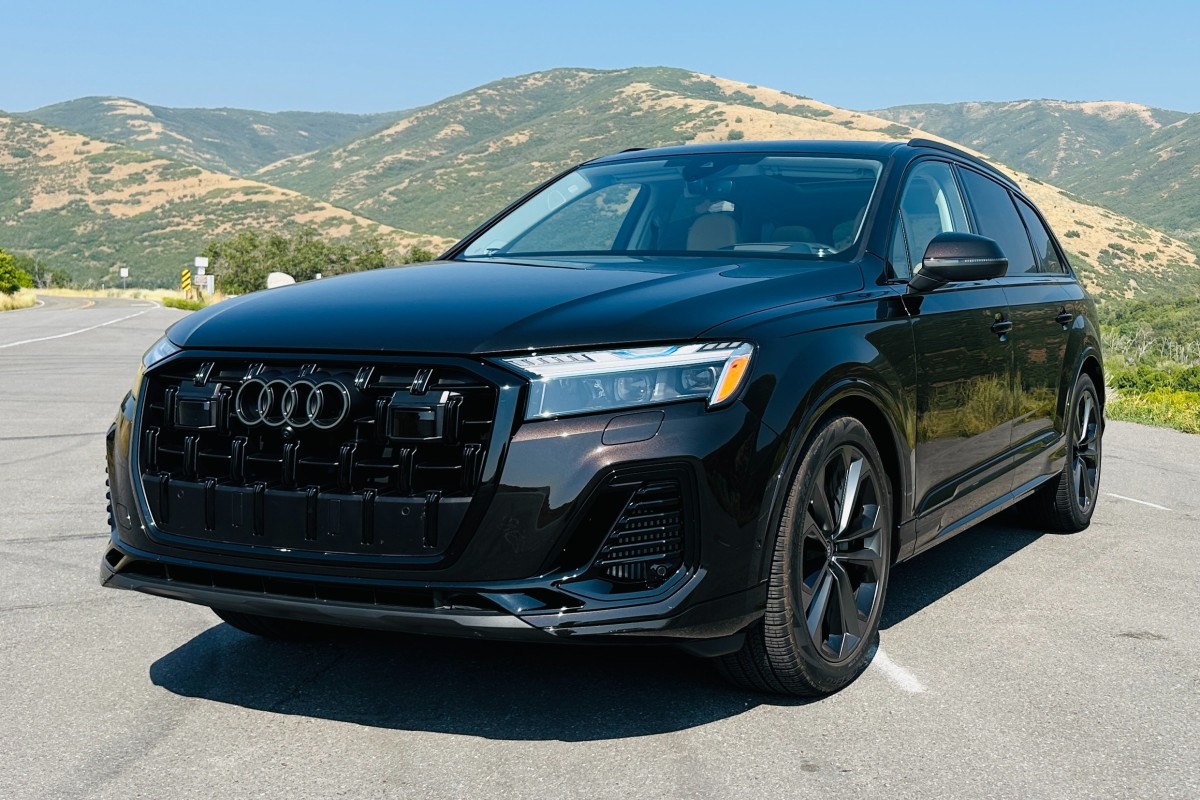
2025 Audi RS 3 Reviews, Pricing & Specs


Pros & cons
What we like
Powerful engine
Fun to drive
Great handling
What to consider
Not much cargo space
Poor value for money
Expert review
Chassis tweaks make Audi’s pocket rocket an even more capable performer.
The RS badge only accompanies the sportiest version of a given Audi model, as demonstrated for the 2025 Audi RS 3. It differentiates itself from the Audi A3 and S3 sedans with a unique engine, more sophisticated chassis tech, and bolder styling. The current-generation RS 3 was introduced for the 2022 model year, and for 2025 it gets updated chassis tuning that makes it even easier to drive fast, plus a subtle facelift.
Verdict: With its closest rival, the Mercedes-AMG CLA 45 S, on the way out, the RS 3 is in a class of its own. It combines four-door practicality, sports car-rivalling performance, and an interior worthy of the Audi name. But you’ll pay a lot for all of that.
out of 10 expert review
Look & feel
The RS 3 first reached the United States as a 2018 model, with an updated version arriving in 2022 as part of a redesign of the entire A3 sedan lineup. Throughout, the RS 3 has kept the ubiquitous MQB architecture used by several models from both Audi and Volkswagen, as well as its trim compact sedan proportions, but it’s accumulated add-on styling features like barnacles on a well-traveled ship’s hull.
There’s a lot to unpack on the front end, from the blacked-out grille, to the large side air intakes, to the apostrophe-shaped headlights with programmable LED signatures (including an RS 3-exclusive checkered flag pattern). None of it quite fits together, but it certainly conveys that this is a step above the Audi S3. The complexity continues in profile view, where the RS 3 sports box fender flares—a toned down-version of what you’ll see on Audi RS 3 LMS race cars—with an extra crown and air vent on the front fender. A rear diffuser juts out of the back, framed by vertical reflectors.
The grille and front air intakes are new for 2025, but you’d have to park a 2024 model alongside to spot the differences. The new 19-inch cross-spoke wheels, which have a pattern that recalls old-school wire wheels, make a bigger impression. An optional Carbon Optic Package adds a carbon fiber rear spoiler, mirror caps, and trim pieces for the side sills and front air intakes.
Like the exterior, the interior makes it immediately apparent that the RS 3 is a performance car. Heavily-bolstered front seats and a smattering of Alcantara ensure that, along with accent stitching and trim in Express Red or Micrommata Green with the optional Design Plus Package. An RS-specific steering wheel with a flat top and bottom is new for 2025, and blends with the angular air vents, screen housings, and door-panel trim that carry over from the base Audi A3. Another cool touch is backlighting for the door panels, which takes the interior ambient lighting to the next level.
Performance
Numerous upgrades differentiate the RS 3 from the already-sporty Audi S3, starting under the hood. The RS model features a unique turbocharged 2.5-liter five-cylinder engine, connected to a seven-speed dual-clutch transmission and all-wheel drive (AWD). The inline-five has been associated with the four-ring brand since its introduction in the 1976 Audi 100. With added turbocharging, it powered the legendary Audi Quattro to rally victories across the globe, transforming Audi from an anonymous maker of dowdy sedans to a motorsports and engineering powerhouse.
Today’s turbo-five produces 394 horsepower and 369 pound-feet of torque, increases of 66 hp and 74 lb-ft of torque over the turbocharged 2.0-liter inline-four that powers the Audi S3. Straight-line acceleration is predictably brutal, with an Audi-estimated zero to 60 mph time of 3.6 seconds. That’s 0.1 second over the two-door BMW M2 CS, and 0.4 second quicker than the 416-hp Mercedes-AMG CLA 45 S. Top speed is electronically limited to 155 mph, or 180 mph with the summer tires that come with the optional Dynamic Plus Package. A Nürburgring lap time of 7:33.123—a record for compact cars, Audi claims—provides further bragging rights.
Other RS-specific hardware includes adaptive damping, a brake-based torque-vectoring system, available carbon-ceramic front brakes (also part of the Dynamic Plus Package) and the RS Torque Splitter, which replaces a limited-slip differential with multidisc clutches for each rear axle, that sends extra power to the outside rear wheel to help reduce understeer. For 2025, Audi recalibrated the software controlling these features for better response when cornering, which helps make a new Audi RS 3 more than just a compelling collection of specs.
A powerful turbocharged engine, quick-shifting dual-clutch gearbox, and AWD grip is a familiar recipe for drama-free performance, but the 2025 RS 3’s chassis tuning makes all the difference. Even while the torque-splitting clutches are shunting twisting force in all directions, the RS 3 feels consistent and linear. And unlike so many cars that rely on technology to raise the limits of performance, it still feels engaging. This car’s small size helps with that, but Audi deserves credit for keeping the driver involved rather than just trying to spread a safety net around them.
Switch from the maximum-attack RS Performance and RS Individual modes (one is the factory setting, the other is customizable), and the RS 3 becomes a reasonably civilized daily driver. In Efficiency, Comfort, Auto, or Dynamic modes, the adaptive dampers and gearshifts soften up enough that your passengers won’t complain. Wind noise is also minimal, so the distinctive sound of the five-cylinder engine won’t be interrupted.
Form & function
As a four-door sedan, the RS 3 is more practical than traditional sports cars or two-door coupes like the similarly-priced BMW M2. And while there are plenty of sport compact sedans and hatchbacks, most don’t offer the RS 3’s power or sophisticated chassis tech. The one exception is the Mercedes-AMG CLA 45 S, but production of that pocket rocket is being wound down as the third-generation CLA arrives at dealerships.
The RS 3 is also a small sedan, however, with less front-seat headroom than a four-door BMW 2 Series Gran Coupe. However, equivalent rear-seat headroom and legroom to the Gran Coupe and the current-generation CLA means choosing the sportier Audi won’t detract from your ability to carry passengers in relative comfort. The RS 3’s 8.3 cubic-foot trunk is fairly small, however, even by compact sedan standards. Although, again, it’s pretty good if you’re cross-shopping the RS 3 with sports cars or sporty coupes.
Interior storage space is about what you’d expect for a compact sedan. That means an undersized glovebox and center-console storage bin, as there just isn’t that much room for them. The small toggle-like shifter also doesn’t pay dividends in usable space compared to a conventional lever, as it’s placed smack in the middle of a large piano-black plastic panel. Bucking decades of German-automaker convention, Audi does at least provide reasonably-sized cupholders.
Technology
A standard 12.3-inch digital instrument cluster and 10.1-inch touchscreen run Audi’s Multimedia Interface (MMI) infotainment system, with standard wireless Apple CarPlay and Android Auto. A 15-speaker Sonos audio system and wireless device charging are standard as well, while a standard head-up display is coming for the 2026 model year.
While it doesn’t have the latest, Android-based version of MMI rolling out in the 2025 Audi A5 and Q5, the RS 3 doesn’t present any technological bugs or hurdles. Its screen menus have logical layouts and impressive graphics. As in other Audi models, Google Maps satellite views are a highlight, but the RS-specific instrument cluster graphics are also noteworthy here. Unique designs like a hockey-stick tachometer and a “runway” design that renders the tachometer as parallel lines around the gear position and speedometer readouts are unique and easy to read at a glance. The new steering wheel also provides a perfect, unencumbered view of the cluster.
Drive modes are a little more fiddly. The new steering wheel includes buttons for the RS Individual and RS Performance modes (with a checkered-flag symbol and “RS” logo, respectively), but the other modes require pressing a button on the center console, which brings up a touchscreen menu, from which the mode must be selected. You can also select the two RS modes from there (as well as set up RS Individual mode), but a single drive-mode toggle on the steering wheel would be better.
Safety
The RS 3 comes standard with expected driver-assist features like adaptive cruise control, forward collision warning, automatic emergency braking, blind-spot monitoring, and rear cross-traffic alert. Also standard are Park Assist Plus automated parking assistance, and a 360-degree camera system that provides overhead, front, rear, and side views. Automatic lane-centering is included as well, but there is not a hands-free option.
At press time, the Insurance Institute for Highway Safety (IIHS) and National Highway Traffic Safety Administration (NHTSA) hadn’t released safety ratings for the current-generation Audi RS 3, nor had they recently crash tested the Audi A3 on which it’s based.
Cost-effectiveness
The RS 3 is fairly efficient for a performance car—if you take it easy. It’s EPA-rated at 23 mpg combined (20 mpg city, 29 mpg highway) and our overall observed fuel economy was 22.8 mpg. However, sustained spirited driving will empty the RS 3’s fuel tank quite quickly.
It may be a special performance model, but the RS 3 is covered by the same four-year/50,000-mile new car warranty and four-year/50,000-mile powertrain warranty as other Audi models.
Pricing starts at $67,395 (including a $1,295 destination charge), and with all option boxes checked you’re looking at a $78,140 car. That’s a lot for what is still a derivative of Audi’s entry-level model, but the RS 3 certainly distinguishes itself with its unique engine, fun-enhancing RS Torque Splitter, and high-quality interior. It’s also in line with the BMW M2 and Mercedes-AMG CLA 45 S, the sportiest compact offerings from Audi’s traditional rivals.
The RS 3 is a very competent car, combining thrills with everyday refinement. But if you just want a small four-door driver’s car, the Audi S3 is about $14,000 cheaper, although it doesn’t feel as special as the full-send RS model. The Acura Integra Type S and its Honda Civic Type R sibling lack the RS 3’s absolute power and AWD, but do have manual transmissions and more practical hatchback body styles. The Volkswagen Golf R shares the RS 3’s MQB architecture and drives like a much more expensive car, but its interior gives away its working-class station. This Audi is for driving enthusiasts who want the most of everything—and are willing to pay for it.

What owners say
Trims & specs
Base MSRP $63,400 | Seating 5 |
Engine 2.5L 394 hp I5 | Cargo Capacity 8.3 cu ft |
Combined MPG 24 | Drivetrain AWD |